Showing posts with label metal. Show all posts

Sunday, May 15, 2022

Reed interpretation: Matt's double bass method - 03

More of an expansive double bass method using the book Syncopation, that I've been developing with a student. Here we'll get into 16th triplets on the bass drums. The method is a little obscure to read, but it's still the best way to get realistic playing vocabulary.

You can do this with all the usual major sections of the book: quarter notes (pp. 4-5), 8th notes (pp. 9-10), 8th rests (pp. 30-31), syncopation (pp. 34-45). 


Do that with as many of the variations from the last system as you see fit— the won't all work equally well with the triplets.

Note that triplets on an & will start with the left foot, so the downbeats always fall on the right foot— I imagine some people will be more comfortable starting every run of triplets with the right foot, which is fine, you'll just have to work some things out when you integrate the triplets with the rest of the system.

For example, if you A-B the 16th triplet and 16th note versions of the following rhythm, starting that last 16th triplet with the left foot foot, that puts the 16th note measure lead normally with the right foot:
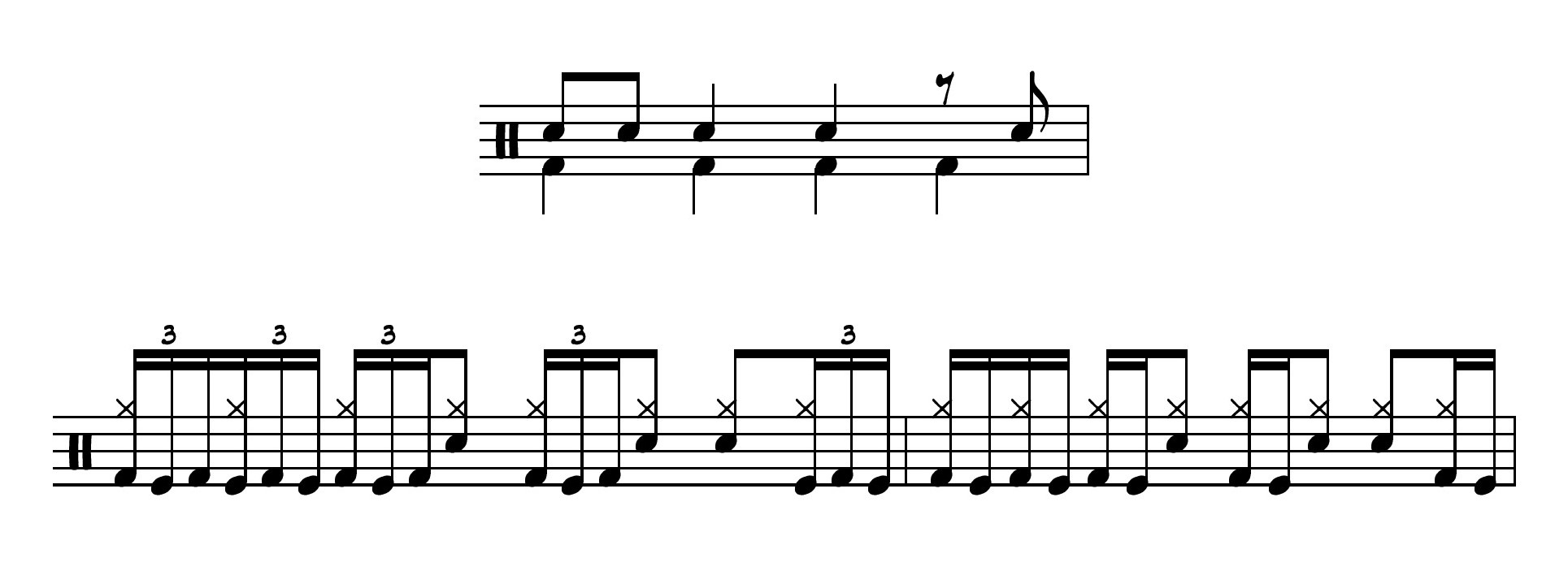

If you started that last triplet with the right foot, the 16th note measure would lead with the left. Maybe that's fine with you, you'll just have to make a decision about how you want to handle it. 

Another way of doing this system that would be easier to read, would be to invert the above thing— play the book rhythm on the snare drum, fill each 8th note worth of spaces with a 16th triplet:


That generally creates a different kind of vocabulary than the first way— it more suggests ensemble figures with the bass drum filling. If you want to emphasize that, you could play the cymbal as accents only (on a crash or China), along with the snare drum, and play the bass drum filler by itself, with no cymbal. 

Get the pdf

Sunday, May 01, 2022

Reed interpretation: Matt's double bass method - 02

Continuing a double bass drum method I'm developing with a student. I don't play double bass, and have very little to teach on the subject, but we're building a pretty substantial drill out of it. That's been my focus lately, putting together a set of stuff you can work on for about an hour at a time, that covers most of the fundamentals of a style— see my recent jazz drill and rock drill. 

As always, use Syncopation pp. 30-45, interpreting the top line part only, ignoring the stems-down “bass drum” part.


Step one is to play two 16th notes for every note sounding in the book rhythm— it doesn't matter what the note value is, just play two 16ths instead of the one note. Play that rhythm on the bass drums, add quarter notes, 8th notes, or offbeat 8th notes on the cymbal. Add snare drum on the 8th note gaps in the bass drum rhythm, or on beats 2 and 4, or on all of the &s, to make a double time feel. Play all combinations of the above. 

Combine this with the previous post, and play all parts of it in one continuous drill— no breaks, focusing on polishing each individual thing, and on being able to switch from one to the other without stopping.  

Get the pdf

Wednesday, October 26, 2016

Double bass drum: 5 and 7 stroke singles

A student request. This is the first thing I've ever written for double bass in my life— I don't play it, it's not my thing. It doesn't matter. This page of exercises will work for getting together your 32nd note single stroke short rolls— which seems to be a large part of what people do with this area of drumming. Lots of short rolls and ruffs.


The 16th note patterns are the skeleton of the accompanying 32nd note lick, so as a warm-up, you should be able to play the patterns in 2/4 solidly with either foot. Play the entire page as written, with the right foot leading, and also play it reversed— left foot lead.

Get the pdf

Sunday, January 31, 2016

Practice loop: Black Sabbath - The Wizard

I've been making and using a lot of sampled loops lately— it's a fun way to practice. And this is a fun one: the main riff from The Wizard, from Black Sabbath's first record. It's doom-y in kind of a hilarious way. Actually playing the riff is fine, but you can run anything you want with it.

I suggest getting one of those allegedly-legal YouTube audio ripping browser extensions/add-ons/plug-ins and ripping the mp3, and setting it to loop on your mp3 player. It loops cleanly, so you can play all day without resetting it.

Friday, October 17, 2014

This / not this: what's a bass drum for?

First, an eerily-passionless video demonstrating the manipulation of a piece of machinery: a pedal mechanism, which is attached to a product called “a bass drum.” We are left to speculate about what purpose these space aliens have for this activity.


Next, an example of this so-called bass drum being used in its former role, as a musical instrument:

Sunday, February 16, 2014

This/not this: death metal

By popular request (well, one guy), here's another one of these— we'll take this in reverse order:

Not this:


This:


[h/t to Bo]

Bonus Melvins after the break:

Wednesday, March 13, 2013

Clive Burr 1957-2013

Sorry to hear that original Iron Maiden drummer (he played on the first records, anyway) Clive Burr died yesterday, of multiple sclerosis, at age 56. Heavy metal drummers tend to be pretty anonymous sounding to me, but I always thought he managed to project a personal voice, and I was sorry when he didn't appear on Piece of Mind, the last Maiden record I ever bought, in 1983.

Here's one of my old favorite tracks of his, from the band's early, punkish days. Listening back to this stuff, there is so obviously a tight band chemistry; no doubt they were playing together a lot, doing a ton of gigs, and made this record in a few days: