Happy 2018. To soothe your possibly-aching head, here are 90 minutes of recording engineer Steve Albini talking about recording drums for pop music, and about production in general. Let the endless technical detail wash over you like a balm. Do pay attention to the explanation of the difference between the recording engineer and the producer. Sorry the guy drumming in the first video is so painful to look at.
(h/t to Kamak at Drummerworld)
Jump to 5:00 to get past the annoying host:

A drumming blog written by Todd Bishop.
Showing posts with label studio. Show all posts
Showing posts with label studio. Show all posts
Monday, January 01, 2018


Wednesday, December 24, 2014
An Internet thing I like
OK, this is actually useful: I like this new YouTube thing of isolating drum tracks from famous pop/rock recordings. Recording can be a horrible exercise in self-scrutiny, and is often a question of how much inaccuracy you can stand to let remain on the track vs. the amount of time/budget you have available to you. It's a little less that way now that, with sophisticated editing technology, much more can be fixed in the mix. But these videos give you a very clear picture of the tolerances for executing a classic, great drum track.
They also help me be clear on what I really like and don't like about some famous performances— in general I don't approaching music like a critic, but playing pop music is a very craft-intensive thing, you have to approach doing it more like a composer or designer, and know critically what works and doesn't work for you. For understanding what's being played, the videos are, for me, better than seeing a written transcription. I've never been a huge Neil Peart follower, but listening to his isolated drum track from Tom Sawyer, I now understand that I like the way he handles the tom toms, but am not real excited about the way he plays time— you feel there's a total lack of R&B exposure with him:
Dave Grohl is another one who is that way, though he's coming from a different place. Rock needs R&B as a direct influence, or it just becomes a march, played loud. Smells Like Teen Spirit is a great song, but this is not groove music:
Compare those performances with John Bonham on Ramble On— here a switch has gone off, and we're actually grooving:
More after the break:
They also help me be clear on what I really like and don't like about some famous performances— in general I don't approaching music like a critic, but playing pop music is a very craft-intensive thing, you have to approach doing it more like a composer or designer, and know critically what works and doesn't work for you. For understanding what's being played, the videos are, for me, better than seeing a written transcription. I've never been a huge Neil Peart follower, but listening to his isolated drum track from Tom Sawyer, I now understand that I like the way he handles the tom toms, but am not real excited about the way he plays time— you feel there's a total lack of R&B exposure with him:
Dave Grohl is another one who is that way, though he's coming from a different place. Rock needs R&B as a direct influence, or it just becomes a march, played loud. Smells Like Teen Spirit is a great song, but this is not groove music:
Compare those performances with John Bonham on Ramble On— here a switch has gone off, and we're actually grooving:
More after the break:
Monday, April 14, 2014
Groove o' the day: Dougie Wright — En Melody
I spent a lot of time listening to French songwriter Serge Gainsbourg as I was working on my album of his music a few years ago, and came to appreciate a very British, very 70's, session drummer named Dougie Wright, who frequently recorded with him. This is the drum groove from En Melody, from Gainsbourg's famous concept album Histoire de Melody Nelson. You get the feeling here that Serge told the band to do something très extrême, they did this in a couple of takes, and then went off to do whatever musicians did in their off time in those days. It was kind of Gainsbourg's style to do these things almost as if he couldn't be bothered, and the entire album is under 28 minutes long.

As it says, the circled bass drum notes are optional— his most frequent variations in the groove are to play or omit those notes, especially the first one. The 16th notes are slightly swung. There are a lot of sixtuplet fills throughout the song, which no doubt use that same RRL sticking used here.
As it says, the circled bass drum notes are optional— his most frequent variations in the groove are to play or omit those notes, especially the first one. The 16th notes are slightly swung. There are a lot of sixtuplet fills throughout the song, which no doubt use that same RRL sticking used here.
Sunday, July 24, 2011
Transcription: Andy Newmark - Anticipation
This is kind of a remarkable track by Andy Newmark, Anticipation by Carly Simon, one of the first and biggest hits he played on. It's an easy thing to dismiss— if you're over about 40 years old you've heard it on way too many gas station AM radios, and then, ad nauseum, on a Heinz ketchup commercial— but it's a serious piece of drumming, and music.

What's interesting about it- and what I'm noticing across the board as I get in and really study some of these 70's things— is the amount of shape and variety there is in the part. In fact “part” isn't the right word; it's a performance— it is obviously played very much in the moment, rather than crafted for the perfect choice of notes. [Update: that's contradicted by the interview below— he actually spent a lot of time thinking about the fills]. The drums track the dynamics of the tune very sensitively, not only in volume but in content— every single measure is different. Very different from the totally regular, completely worked-out thing expected now.
Get the pdf
The transcription presented some problems— the frequency of his cymbal is very close to the guitar's range, so it's sometimes difficult to tell which is which, and again, there is so much shape to his playing that at the lower end of the dynamic range things get lost. During the very soft second verse I had to just render the time as slash marks, and write in the fills- what is audible is too sketchy to make a usable transcription.
Much of the riding is done on the crash cymbal (it sounds like a 16")- during those sections he tends to play 8th notes on the hi-hat with his foot; I've mostly left that out except where it's integral to the part. Accents are for shape, rather than absolute volume— accents are just louder than the surrounding notes. The 2 and 4 on the snare are always pretty strong.

What's interesting about it- and what I'm noticing across the board as I get in and really study some of these 70's things— is the amount of shape and variety there is in the part. In fact “part” isn't the right word; it's a performance— it is obviously played very much in the moment, rather than crafted for the perfect choice of notes. [Update: that's contradicted by the interview below— he actually spent a lot of time thinking about the fills]. The drums track the dynamics of the tune very sensitively, not only in volume but in content— every single measure is different. Very different from the totally regular, completely worked-out thing expected now.
Get the pdf
The transcription presented some problems— the frequency of his cymbal is very close to the guitar's range, so it's sometimes difficult to tell which is which, and again, there is so much shape to his playing that at the lower end of the dynamic range things get lost. During the very soft second verse I had to just render the time as slash marks, and write in the fills- what is audible is too sketchy to make a usable transcription.
Much of the riding is done on the crash cymbal (it sounds like a 16")- during those sections he tends to play 8th notes on the hi-hat with his foot; I've mostly left that out except where it's integral to the part. Accents are for shape, rather than absolute volume— accents are just louder than the surrounding notes. The 2 and 4 on the snare are always pretty strong.
2023 update: John DeChristopher interviewed Andy Newmark about recording this song:
Wednesday, July 06, 2011
1984 Modern Drummer interview: Andy Newmark
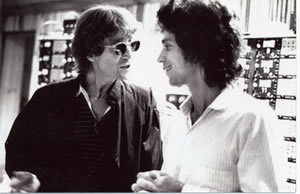
 , John Lennon's Double Fantasy
 , David Bowie's Young Americans
 , and much more. Here he discusses studio greats Jim Keltner and Jim Gordon- who he has worked with closely, his time with George Harrison and John Lennon, and the craft of drumming on records:
THE GOODNESS of KELTNER and GORDON:
It's a feeling that makes other musicians, and producers, feel musically comfortable. They're able to play that real simple stuff with a conviction that makes it work. If you don't see the beauty in playing simple and get off on it, then when you do it, it won't come off like the person who loves to do it. When Russ Kunkel, Gordon or Keltner would just play those real simple beats, they got off on it. They liked that; they were into it, so it gave the notes validity.
Also, I noticed on the playback that all of the takes- not just the final one- sounded like real records. Whereas often, when I'd hear a playback of something I was doing, a lot of little things would make it feel, to me, like a demo. When I heard them play on something, it always seemed to be so smooth. They had a way of making everything settle and be relaxed. The hardest thing to get a studio drummer to do is make the record feel it's in the right place. Tempo has a lot to do with good records. Being slightly too fast or too slow might cause the whole song to miss the point. And I think producers rely on drummers to find that magical place, within a very small range of tempo. It's something that most people might not hear. There isn't a large difference in those tempos, but it's that one magical place that makes it feel like everything's breathing properly. I started picking up on an inner instinct from these guys that they knew where to put the tempo, and believed in it themselves. They weren't looking for direction- they were the direction; they were the core.
Extended excerpts plus a couple more of Newmark's tracks after the break:
Saturday, April 30, 2011
Airto: 1983 Modern Drummer interview

Here is a teaser anecdote about Miles Davis- all the best stuff is after the break:
Q: What was wrong on that session where Miles walked out and said, "This is shit"?
AIRTO: The music just didn’t come out. Today I can analyze it a little better. I think there were too many musicians there playing where there wasn’t that much music to be played. The parts weren’t really fitting together and it was a very experimental kind of thing. Everybody was going, "Yeah, yeah, yeah," and then Teo Macero asked, "Hey Miles, how is it?" And Miles said, "It sounds like shit. I’m going home," and he left.
I got very hurt because I thought I didn’t make it. I put everything on me, of course, but about three days later, they called me again. On that first session, there had been another percussionist playing tablas, sitar and some other things, but when they called me again, I was the only one. There was just one bass and less people, and then it was nice. I didn’t even know how to think about those sessions because I didn’t understand the music at all.
Q: How do you play on something where you don’t understand the music?
AIRTO: You listen and you play. You just have to be careful that you don’t play too much. If you don’t feel, you don’t play. It is better not to play than play too much.
Q: When you were young, did you find that you were anxious and overplayed?
AIRTO: Many times bandleaders told me, "Hey, shut up," or something like that. So I had learned that, but not to the extent that I learned that with Miles Davis. Miles is the best for learning to play the right time, the right note, the right space and everything.
Definitely keep reading:..
Saturday, April 07, 2007
New shoot: Tera Zarra of Fist Of Dishonor!
 AKA Missy Jitsu of Ninja band Fist Of Dishonor. We'd been meaning to do a shoot for weeks, finally got around to it, and a bunch of great stuff happened. Wow. Next time we add a bad guy for simulated combat!
.jpg)
.jpg)


Monday, February 05, 2007
Willie Matheis!
 I got my group The Notables together to do some promo shots, and got a few interesting ones of Willie.


Tuesday, January 02, 2007


Monday, January 01, 2007

Saturday, December 09, 2006
Slapping together a portfolio.
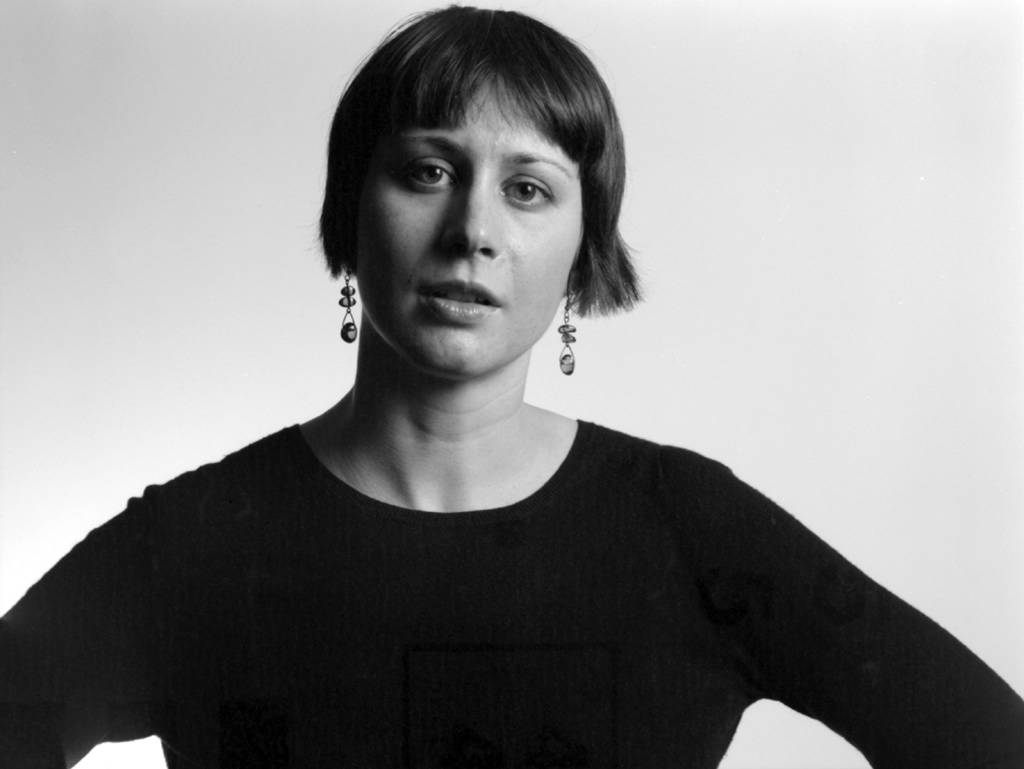
These are the finalists. I should probably cut 10-13 of these. Here's a shot of Andrea Niemic. I think this is T400CN- that's what I use for more critical stuff because it's really easy to handle.


We're doing a series of shots with each member of Red Venus Love Army in beret and some goggles we found on the ground. This is from one of the test rolls. I think I used Arista 400, which if repackaged Fomapan. I usually push my 400 speed BW to 1600.
While we're on the subject, here are my impressions of some of the different BW films pushed 2 stops:
Ilford HP5: looks lovely, nice grain and contrast. I use HP5 for all my serious stuff.
Kodak TMY: looks crappy, pulpy-looking grain, contrast out of control- highlights blown massively, shadows blocked up.
Fortepan: Not great- seemed to get a weird sooty look and the highlights tended to blow.
Fomapan: pretty good, maybe not as pretty as the HP5. I get this repackaged as Arista for practice/experimental stuff, because it's cheap.
Neopan 400: I like it a lot- maybe more contrasty and grainy than the HP5, but not out of control. I would use a lot more of this, except I like the HP5 more, and I want to limit the number of films I use.
Take all this with a grain of salt- in the darkroom I don't have the strictest tolerances in the world, so maybe the bad results are due to sloppiness.
Subscribe to:
Posts (Atom)