Showing posts with label Airto. Show all posts

Saturday, December 24, 2022

Page o' coordination: Airto's afro

Page o' coordination based on Airto's unique afro 12/8 groove played on the intro of Casa Forte, from Flora Purim's album Stories To Tell.

It's a good introductory groove for this style— the hands are mostly in unison, and the rhythm is easy to follow. The bell rhythm is only different from the normal short bell rhythm by one note, but it seems like a whole different thing, and it should be much easier to work out the coordination.


As always, work out the patterns, then drill them by doing some moves with the left hand. 

Get the pdf

Thursday, September 08, 2022

Groove o' the day: Airto Afro 6

An Afro 6* groove played by Airto, on the intro of Casa Forte, on Flora Purim's 1974 record Stories To Tell. It has some big shot LA musicians on it, including saxophonist Hadley Caliman, who was a Seattle fixture for years, and trombonist George Bohannon, who was a grad student at USC when I went there.  

It's a rather simplified groove, with the hands largely in unison. The percussion, also played by Airto, multitracked, fills out more of the rhythm. 

* - Right, I notated it in 12/8, but Afro 6 is the generic name I've chosen to use for this kind of groove. 


We like thinking in terms of stickings, and filling in spaces, and playing linear, but unisons are powerful. It's worth thinking about.

There are some open sounds with the hihat played with the foot, that I didn't indicate. 

Monday, November 04, 2019

Groove o' the day: Airto - Street Vendors D'Jmbo

A baiao-type drum set groove from Airto— actually I don't know what to call this. I'm not hearing obvious markers of a particular style. Maybe Airto's just playing. Someone who really knows their berimbau rhythms could probably tell us. It's from the track Street Vendors D'Jmbo, on Airto's album Homeless. It's a sort of impressionistic percussion and vocal piece, backed with some synth.

From the intro:


This is the groove for most of the track, with subtle variations— there's a lot of overdubbed percussion and I can't tell what's happening with the left foot, if anything.


It's actually not difficult to hear that second groove backwards, starting on the fourth beat, so the bass drum rhythm is on 2, and the snare drum accent with the buzz is on 3. 

You can hear that he's swinging the 16th notes in an interesting way, that is different from the “tripteenth” interpretation we've discussed before. Some of the effect is due to the interaction of the percussion parts, but it sounds like occasional 16ths on the a are played late. Or perhaps the a is in the normal place and the 1e& is slightly compressed. Something to explore in another post.


Saturday, October 13, 2018

Groove o' the day: Tombo in 7/4

More from Airto's great record Fingers. I got burned last time crediting the drumming to Airto when it was really another great drummer da América do Sul, Osvaldo Fattoruso; this time I think it really is Airto on this track, but I was pretty sure last time, too, so... I guess I have to seek out a lot more of Fattoruso's playing and learn to recognize him.

These are the grooves for the major sections from Tombo in 7/4. It's a samba in 7, which in principle sounds like an insane and wrong concept, but it's not— Brazilian musicians have only been playing them for 50-60 years. Once you get the hang of it it's just a slightly different flavor of samba. The tune is in one of the major fake books, so odds are fairly good you'll have to play it some day.


The grooves are played pretty repetitively; variations are usually pretty subtle, and it's obvious when the player breaks from that to fill or improvise briefly. Pay attention to the timbres of the snare drum— the major rimshot accents sound almost like repique. On the first groove the tenuto/staccato markings indicate half-open and closed hihat notes.

Get the pdf

Monday, October 01, 2018

Groove o' the day PLUS : Airto - Fingers

UPDATE: Correction from the comments, it is Fattoruso on drums! I'll put the correct credit in the 2018 Book of the Blog. Until then, you'll have to pencil it in onto your printout. 

Here is a SUPER-ENHANCED groove o' the day— it includes not only the groove for this tune, but the intro, and a couple of brief shout choruses with a lot of fills happening. It's from the album Fingers by Airto, and it's an early fusion samba played either by Airto, or by the Uruguayan drummer Osvaldo Fattoruso, who passed away a few years ago. They both have drum credits on the album, and since I don't have the LP, I don't know if there is a personnel listing for each track. It sounds like Airto; it could be Fatturuso.

...no excuse for not having the LP, by the way; Airto's stuff is massively available used. I've heard this record my whole life, but just never owned it. CTI must have really papered the radio stations with promo copies...


The ensemble figure from the intro happens a few times throughout the tune, and the drummer always plays the same set part behind it, with very minor variations. He cuts loose more on the drum breaks on the shout choruses at the bottom of the page. The main groove for the tune is in the fourth line. You can see that the right hand is very busy with the running 16th notes, in typical Brazilian style. There's also a fast left hand move required— a small tom hit right before a rim click. I can do that move pretty fast, but I haven't tried it with this groove at this tempo. It may be that there's something else happening there— just get the sounds right. The small tom is the main left hand voice through out this tune.

Something has happened with music in the last 30 years— people have gotten really fascinated with subdivisions. You shouldn't sound like you're fascinated by subdivisions. If you listen to a lot of music from the early to mid 70s, there's an overwhelming energy and enthusiasm. I think people should try to sound like that.

Get the pdf

Tuesday, January 16, 2018

Practice loop: Airto - Hot Sand

This is another loop I use a lot: Hot Sand, a bright samba by Airto, from his album Virgin Land. Great for use with my recent drumset batucada drill, and with my book Playing Samba and Bossa Nova (see the sidebar for e-book version). Somehow they always make you do the fast sambas on the quietest gigs, and it's not supposed to be a heavy feel to begin with, so it would be an excellent idea to play with this until you can do it very softly, with a relaxed right foot. Tempo is half note = 122 bpm.


Friday, July 22, 2016

Transcription: Airto - Black Narcissus

From Flora Purim's album Encounter, here's more Airto— this time playing a jazz waltz: Black Narcissus. I've transcribed the head of the tune, and the first couple of choruses of his playing behind Joe Henderson's tenor solo, after which there's some out-of-time blowing. There's a long free intro, and the transcription starts at 0:56. His playing here is modern, but quite simple, with some interesting triplet runs. Always interesting to hear someone playing jazz on a 70s studio-sounding drum set— not that it's some big novelty.


Swing the 8th notes. The cymbal pattern is largely a shuffle rhythm, with running swing 8th notes— though it doesn't sound like a shuffle the way he plays it. Not a lot of action on the snare drum, you'll notice; a lot of single notes, a lot of &s of 2. The rolls are generally played closed, as multiple-bounce rolls; I've indicated where one of them should be played as unmetered singles.

Get the pdf

Sunday, July 10, 2016

Transcription: Airto — Hot Sand

Why am I not always talking about Airto? I've spent fewer hours listening to him than most other drummers at the top of my personal influences list; I never had a period of chasing down everything he ever played on. But he's really, really great, and very influential, and I love his playing a lot. Jazz would not be what it is today without Fusion, Fusion wouldn't have been the same without Brazilian music, and Airto is the most influential Brazilian drummer in the USA. Bada bing, he's a big deal.

That's a little glib. Here's a transcription of his drumming on the head of Hot Sand, from his 1974 album Virgin Land. It's pretty straightforward: samba over a vamp, baiao-type groove on the B section, with breaks at the end of each section, plus a few fills:


The A section has the hands doing some minor variations on a basic two-measure samba groove in 2/4. Listen for the accents— lots of 'a' of 2s of the first measure (matching the rhythm of the bass line) and 'e' of 1s of the second measure. The B section (most of page 2) is pretty repetitive, with a quasi-Baiao groove happening with the bass drum and cymbal. The fills are largely played by the right hand, with the left hand filling in softly. As with all good Brazilian drummers, there's a lot to be learned about touch here.

Get the pdf

Monday, May 25, 2015

Partido Alto practice loop and basic grooves

Another practice loop, sampled from the tune Partido Alto, from the Azymuth album Light As A Feather. Ivan Conti is on drums. As I mentioned before, Partido Alto is the name of a Brazilian rhythm, a songstyle or genre of samba using standard instruments, a tune title (more than one, I'm sure), and a fusion-like drum groove. It probably refers to some other things, too— my factual knowledge of Brazilian music is not that deep. In this case, we're dealing with the 70s fusion tune, the drum groove, and the rhythm.

I'll say it is one of the great rhythms in music, which doesn't get the same attention from north American drummers as does clave, its Caribbean relative. Clave has a built-in resolution, so it's almost like a repeating “shave-and-haircut” ending— I was embarrassed to relate clave to something so hokey, but apparently the similarity has not gone unnoticed by actual serious Cuban music people. That's where its power comes from. But Brazilian music is nothing if not about forward motion, and, especially, continuation, and the Partido Alto rhythm does not have that built-in stop, and keeps skipping ahead, forever. Come to think of it, despite its similarity to clave, the Bossa rhythm (so-called “Brazilian clave” or “Bossa clave”) is the same way.

Anyway, here's the loop:


Here's the basic rhythm as it occurs in this tune; it's easy to get lost at first, so it may help to note that (in this case) there are 4 notes on the downbeats, and three on the upbeats. The half notes are just for reference, but you can play them along with the rhythm to help keep track of the downbeats.


Also try this variation, with a couple of notes added:


Also see this page for some insight on the construction of the rhythm generally.

After the break are some basic things you can play on the drums:


Saturday, February 14, 2015

Transcription: Airto — Partido Alto

If you've been reading the blog regularly, you probably know that partido alto is the name of a rhythm used in Brazilian music. It's also a style of samba, a funk samba groove, and the title of a famous tune by Chico Buarque, and also a fusion-era tune... which uses that funk samba groove. There is some overlap between those things— an actual Brazilian music expert might be able to explain the distinctions between them precisely. We're transcribing the fusion tune, as recorded by Airto in 1979, on his album Touching Me Touching You. I've written it out just up to the beginning of the solos:  


The phrasing is ambiguous, and at first it may be difficult for some people to even find the 1— the “downbeat” of the groove lands on the & of 1, with the snare drum (do watch the rhythm video above for help with that). Each four measure phrase could begin at the start of each line, or it could begin on the third measure of each line— the melody does land strongly on the third measure, and the solos begin on the third measure. But the keyboards enter at the beginning of a line, and putting the phrase on the third bar puts a phrase break in the middle of the unison ensemble figure (@ bars 41-44, and several other places). And that puts the bulk of the melody in the second half of the phrase, which I just don't like. The way I've written it, it's a little bit of a fractal; the shape of the larger structure is similar to the shape of the (two-measure) groove. They each start weakly, and are strong in the middle; the groove has the solid down beat on the bass drum in the second measure, and the phrase has the melody of the tune landing on bar 3. Try feeling it either way, and see what works for you.

To master the basic groove, you could just play the second and fourth lines many times. Airto appears to be using five tom toms here— if you don't have them, it doesn't matter; just play the written rhythm on whatever drums you want. The break at measures 45, 53, and a few other places, feels a little weird; make sure you take a moment to actually count it out— you may be able to listen and guess at it and be close, but you want to know exactly what's going on. Airto is not guessing at it. The starting tempo is half note = 78, but by the end of the solos it has picked up to HN=88, and settles a bit to HN=85 when the tune comes back in.

Get the pdf

Monday, February 09, 2015

Transcription: Airto — Earache My Eye

Cheech & Chong's Earache My Eye is just an eternal piece of American teenage rock & roll culture, along with Smoke On The Water, Iron Man, Sunshine Of Your Love... like that. On hearing it for the first time in a long time, I think this is what I've been really been trying to play like all these years— with rock & roll, anyway— like this, and like Jim Gordon on Zappa's Apostrophe.

It turns out the drummer on the recording is Airto, which surprised me, but I can dig it. To understand how great he is, just check out a few of the many covers of the song; the tom fills really make the whole track, but nobody else does them especially well. And none of the guys beating the f__ out of their drums plays as effectively as Airto does here— they rock less.


I went ahead and put in everything I could hear, including the hihat played sporadically with the foot. If you actually want to work this up, you can safely ignore the left foot, for the most part. What's significant about it is that he will sometimes play it on the &s, Brazilian/jazz style, and other times he'll play it in unison with the bass drum, emphasizing the rhythm section line.

Get the pdf

Saturday, February 15, 2014

Another page of Brazilian rhythms

Here is another page of Brazilian rhythms, written in 4/4. The last set was written as 8th and 16th notes in 2/4, the native meter of much of Brazilian music, but when playing lead sheets made by Americans (like out of The Real Book), they will usually be written in 4/4. These are transcribed mainly from tunes by Airto and Dom Um Romao. Some are left hand parts played on drumset, others are percussion parts— tamborim or agogo— a few are horn parts or rhythm section parts. That's why you want to listen to, and play along with, the actual music from Brazil: all the players know the percussion rhythms, and play them.


You also need to listen to develop an ear for how they are inflected; most of them are played with varying accents, long or short notes, and multiple pitches. Where there is a circled note, play the rhythm with that note and without it. Here are a couple of (well, pretty obvious) ways of putting these into context, using this rhythm, for example:


Play the rhythm as rim clicks on the snare drum, with 8th notes on the cymbal, and the usual Samba/Bossa Nova feet parts:


Or play both hands in unison on the snare and cymbal:


Get the pdf

A couple of the tunes these came from are after the break:

Monday, March 04, 2013

Got my Chick cymbal

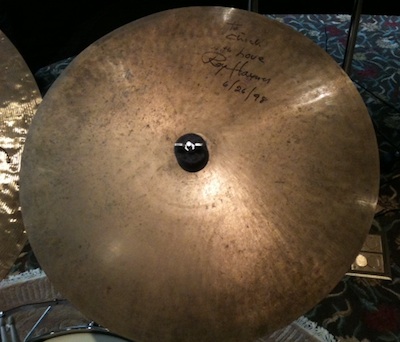
The original, signed by Roy Haynes.
The nice thing about Paiste cymbals— most of them— is that when you hear a sound you like, you can duplicate it almost exactly by just buying the same type and model of cymbal. They're very consistent, even across decades; my circa mid-60's 20" 602 medium ride, though a little played-out, is obviously the same basic cymbal as the current reissued 602s.

So after many years of listening to Chick Corea's Now He Sings, Now He Sobs and Return To Forever I was very excited the other day when the type of cymbal used on those records, an 18" Paiste 602 Flat Ride— in this case a 1975 Medium Flat— arrived in the mail. There seem to be some differences of opinion as to what the cymbal was, exactly— whether it was a medium or a thin. I always thought it was a 22", based on a random comment by my brother, but the consensus is that it was an 18", and comparing my cymbal with the recordings that makes sense.  My medium is definitely on the lighter side of that category, and crashes better than you would expect, and is still a very light-sounding instrument. Chick's cymbal is a “pre-serial” model, meaning it was manufactured before Paiste started stamping serial numbers on them.

Continued after the break:


Thursday, November 22, 2012

Groove o' the day: Airto — Stanley's Tune

Here's a baião-based funk groove from Airto:


That is, Airto's feet are doing baião, everything else about the tune is just early 70's funk jamitude. The accents on the floor tom are pretty subtle; he just plays the right hand a little stronger than the left.

Get Airto's Virgin Land at Amazon.com. You should really be able to get this one at your local used vinyl store, though. I don't link to iTunes, but you could try them, too.

Audio after the break:


Wednesday, February 22, 2012

A crash course in the ECM feel

Look for the photos with water
and the Helvetica font.
The "ECM feel", as it's now being called, is a style that evolved in the late 1960's and 70's, and has since become one of the major time feels of modern jazz. It's associated with the ECM record label because that's where you find most of its major early practitioners and first/best recorded examples. Before you do anything, I suggest hitting the read more link at the bottom of the page and listen to the audio examples.

Some of its features: Even 8th notes, non-repetitive, linear, broken-up (pick your adjective), possible suggestion of a backbeat, Brazilian influenced. Light, airy, ride cymbal based feel (get yourself a Paiste 602 Flat Ride to complete the period effect). Had it's beginnings in the 1960's work of Tony Williams, Roy Haynes, Paul Motian and Barry Altschul. The drummers it is most generally associated with include Jon Christensen, Jack Dejohnette, Bob Moses, and Airto.

There is no standard method that I'm aware of for developing this feel, but if you work through one or more of these suggestions and do a lot of listening and playing you should begin to find it

UPDATE: In the comments Clint lets us know that Berklee professor Skip Hadden has a method book and mini-series of videos at the Vic Firth site dealing more broadly with this style. Onward:


Practice methods:

Basic coordination using the 8th/2-16th cym pattern. You can also think of it in cut time:


Use regular jazz vocabulary with even 8th notes (converting them 8th note patterns to 16ths if you're thinking of it that way). Working out the same materials with two or three more complex cymbal patterns- and with plain 8th notes- would also be helpful; you could pick a pattern from Syncopation pp. 34-37 (new edition) and put it in double time, for example.

Stick Control- the first section, and maybe the flam section- and the same part of Syncopation as above, plus the long syncopation exercises. Play this (and all the following) with the right hand on the cymbal and the left on the snare. Also play the first section with the hands together on the cymbal and snare on the Rs, and the bass drum and/or hihat (w/foot) on the Ls.

Paradiddles and paradiddle-diddles and their inversions, plus plain old doubles- RRLL and RLLR RLLR- with/without a flam at the beginning of the R or L hand double:


And Swiss triplets in a 16th note rhythm. They make a 4:3 polyrhythm, so find a place to stop to fit them within one or two measures of 4/4:


Using the feet:

Again, with the right hand on the cymbal and the left on the snare, play all of the above over an ostinato with the feet; either samba or baiao, or double some/all of the right hand part with the bass drum. Also play an ostinato with one foot let the other play sporadically to fit with the hand part.

Note: It would seem to be an obvious choice for developing this style, but I don't like to recomend Dahlgren & Fine's Four Way Coordination to anyone seeking immediate results; as I've written before, I've seen it turn into a bit of a tar pit for more than one young drummer. But if you keep your eye on the practical result you want to achieve, and don't get bogged down with the need to learn it "completely", it should also be useful here. Vol. 2 of Dahlgren & Fine's Accent On Accents would be a good substitute/supplement for Stick Control for the exercises above, though.

Audio examples and discography after the break:


Wednesday, February 15, 2012

Groove o' the day: Airto's samba in 3

Here's a favorite piece of drumming by Airto, from Chick Corea's Return to Forever album on ECM. I'd like to transcribe this entire track, but today I just have the primary grooves for you. The tune is a samba in 3; I've written it in 3/2, but it could also be counted in 6/4 or as 16th notes in 3/4. The intro, and various other points in the tune keeps a simpler bass drum part, buzzing the snare drum accent on 2:


As it develops, he also uses the standard samba pattern on the bass drum, and plays the snare accent as a stronger rim shot:


Get Return to Forever by Chick Corea

YouTube audio after the break:

Wednesday, August 24, 2011

Day of the Podcasts! Airto on Jake Feinberg's show

They just keep coming. Here Jake Feinberg (of the great interviews with the likes of Mickey Roker, Richard Davis, Dick Berk, and much more) talks to Airto, who I've been listening to and thinking about a lot lately.

This would also be a good time to go back and read my excerpts of Airto's great 1983 Modern Drummer interview- I think I'll do that myself...

Saturday, April 30, 2011

Airto: 1983 Modern Drummer interview

Here's part of another great Modern Drummer interview, from 1983, with Airto, the famous Brazilian drummer and percussionist. As always, I've excerpted the parts that are most important to me, and the headings are mine. Dig out your old issue, or get the MD Digital Archive to read the entire thing.

Here is a teaser anecdote about Miles Davis- all the best stuff is after the break:

Q: What was wrong on that session where Miles walked out and said, "This is shit"?
AIRTO: The music just didn’t come out. Today I can analyze it a little better. I think there were too many musicians there playing where there wasn’t that much music to be played. The parts weren’t really fitting together and it was a very experimental kind of thing. Everybody was going, "Yeah, yeah, yeah," and then Teo Macero asked, "Hey Miles, how is it?" And Miles said, "It sounds like shit. I’m going home," and he left.
I got very hurt because I thought I didn’t make it. I put everything on me, of course, but about three days later, they called me again. On that first session, there had been another percussionist playing tablas, sitar and some other things, but when they called me again, I was the only one. There was just one bass and less people, and then it was nice. I didn’t even know how to think about those sessions because I didn’t understand the music at all.
Q: How do you play on something where you don’t understand the music?
AIRTO: You listen and you play. You just have to be careful that you don’t play too much. If you don’t feel, you don’t play. It is better not to play than play too much.
Q: When you were young, did you find that you were anxious and overplayed?
AIRTO: Many times bandleaders told me, "Hey, shut up," or something like that. So I had learned that, but not to the extent that I learned that with Miles Davis. Miles is the best for learning to play the right time, the right note, the right space and everything.

Definitely keep reading:..