Busy getting ready for Christmas, trying to figure out what to say about this, working out of Dahlgren & Fine (which I've never been fond of- more on that later) and playing through some of the sundry new-old books that have come in recently. So enjoy this tune that's been stuck in my head for several days, by now-obscure Bay Area jazz/rock group Smoke:

A drumming blog written by Todd Bishop.
Tuesday, December 20, 2011


Monday, December 19, 2011
Todd's methods: Reed triplets in steps - BD
One of the common interpretations applied to Ted Reed's Syncopation is to fill out the written rhythm with triplets, which can be pretty technically challenging due to all the doubles and multiples that come up. So, at some point you have to fill out the triplets more selectively; I've written about this before, using parts of the triplet. Here we have a slightly different approach, which I've broken down into steps, partly to make it more accessible to different levels of skill, but mainly to introduce some space, and to arrive at something practicable and playable at different tempos:
 This is meant to be applied to Syncopation, pp. 37-44 (old edition), but will work with any written music with 8th note or longer rhythmic values.
Get the pdf

Get the pdf
Sunday, December 18, 2011
Vinnie Colaiuta Q & A
Here's 37 minutes of audio from the question and answer portion of a Vinnie Colaiuta clinic. He opens with some discussion of playing in 19/16 on Keep It Greasey, from Joe's Garage by Frank Zappa (which reminds me, I think maybe Santa might have a transcription for you coming up). At a certain point in my life I would've worn out the cassette hanging on every word of this, despite the quality being a little rough:
As I'm listening through: He discusses getting an authentic feel in samba and baiao, which is something else we've talked about here, and also the non-alternating flam drag, which is similar to one of my licks.
h/t to Stitch Kaboodle @ Drummerworld
As I'm listening through: He discusses getting an authentic feel in samba and baiao, which is something else we've talked about here, and also the non-alternating flam drag, which is similar to one of my licks.
h/t to Stitch Kaboodle @ Drummerworld
Saturday, December 17, 2011
Bob Brookmeyer 1929-2011
Trombonist, arranger, and educator Bob Brookmeyer has passed away; visit Jazz Wax has a nice obituary and retrospective of his career.
Here he is playing with one of my favorite groups of the 50's, the Jimmy Giuffre 3, with Jim Hall:
More after the break:
Here he is playing with one of my favorite groups of the 50's, the Jimmy Giuffre 3, with Jim Hall:
More after the break:
All the grooves from Still Bill
Today we've got all of the grooves from the Bill Withers album Still Bill, with drumming by soul master James Gadson:
 Notes:
- Swing the 16th notes on "Lonely Town, Lonely Street".
- Bass drum notes in parenthesis are optional or occasional embellishments; snare drum notes in parentheses are ghost notes- play them very lightly.
- Also see my transcription of the drum breaks from "Use Me".
Get the pdf

- Swing the 16th notes on "Lonely Town, Lonely Street".
- Bass drum notes in parenthesis are optional or occasional embellishments; snare drum notes in parentheses are ghost notes- play them very lightly.
- Also see my transcription of the drum breaks from "Use Me".
Get the pdf
Friday, December 16, 2011
Wednesday, December 14, 2011
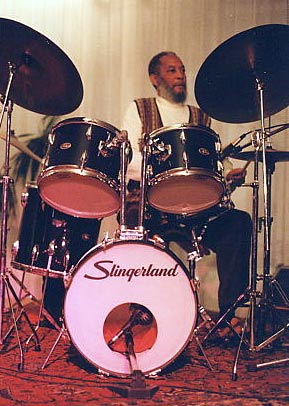
MD interview: Ben Riley on Monk, more
Time, feel
[Monk] had a great sense of time and rhythmic construction. I played two or three different ways in that band until I felt comfortable. Certain tunes dictated that I find another way to interpret the beat. I got more into a Shadow Wilson style of playing later on, because it left a lot of space for the other musicians to do what they
wanted, and it didn't dictate what was happening.
Thelonious would always drop one-liners on you. Instead of telling you what to do directly, he would give you a little hint, such as, "Because you're the drummer, it doesn't mean you have the best beat." He said, "You can't always like every song. Another player might like the song better than you; his beat might be better than your beat." What he was saying was that you should listen first before you take control and find who has the swing in the beat. And whoever has the best beat—that's the one you join.
One of the things I enjoyed about playing with Monk as well as Sphere was that we didn't always play the same tunes in the same tempo. When this happens, you can't come in and develop "cheats." Since each tune could be in a different tempo each time you play it, the things you played before won't fit the next time, so you always have to approach it differently. That's one of the great lessons that I learned from Thelonious. He played what we used to call "in between tempos." He used to say, "Most people can only play in three tempos: slow, medium, and fast." So, he played in between all of those, and we had to learn how to feel that beat. In certain tempos, you would be in big trouble trying to count, so you would have to feel the structure.
Monk's ballad test
In my first experience with him, in Amsterdam, we played "Embraceable You'' as a very slow ballad. Then he went into "Don't Blame Me." He stood up, looked over to me, and said, "Drum solo!" Fortunately for me, I had been working at the Upper East Side supper clubs playing a lot of brushes, and I like brushes. So when I played it, I didn't have to double the tempo, because I was used to playing slow brush tempos. I played it right at the tempo he gave me. When we were going back to the dressing room, he just walked by me and said, "How many people you know could have done that?" and he kept on going. You see, I had asked him for a rehearsal and he said, "What do you want to do—learn how to cheat?"
Tuesday, December 13, 2011
Transcription: Ndugu - Watch Out, Baby!
Here's one of my favorite funk drumming performances ever, which I originally transcribed years ago off of my brother's bootleg cassette- Ndugu Leon Chancler playing on Watch Out, Baby! from George Duke's 1977 Reach For It album. Stanley Clarke plays bass on this track, in case you're wondering. Between this and my recent Good Old Funky Music and Use Me transcriptions we've got a veritable school of funk going here. It's got to be a school of funk if they use the word "veritable."
As I mentioned when this piece was a DBMITW, this is is pretty NSFW, so don't play the track loud during tea with the Reverend... save yourself some embarrassment...
 Notes:
- There are a couple of tempo changes, the first at the edit at measure 19, the second when the time pulls back a little at measures 72-73, for a new slower tempo at 74.
- Chancler uses a pretty large set here- at least five toms and two bass drums, but you can easily play through this without them.
Get the pdf
YouTube clip after the break:
As I mentioned when this piece was a DBMITW, this is is pretty NSFW, so don't play the track loud during tea with the Reverend... save yourself some embarrassment...

- There are a couple of tempo changes, the first at the edit at measure 19, the second when the time pulls back a little at measures 72-73, for a new slower tempo at 74.
- Chancler uses a pretty large set here- at least five toms and two bass drums, but you can easily play through this without them.
Get the pdf
YouTube clip after the break:
Monday, December 12, 2011
Two more Paul Motian memorials

"Who was Paul Motian? A bald white guy without proper technique? One look at his trademark grip, choked way up on unusually thick sticks, and many dismissed him as a charlatan. His off-and-on ride cymbal, although accurate as a metronome, had a bizarre spacing in the skip beat. For those who believe jazz drumming is bound by certain parameters, Motian was the ultimate enigma, perhaps even an insult.
Yet Motian had a deep relationship to tradition. Those baseball bats were Oscar Pettiford’s idea. In 1955, at Small’s Paradise in Harlem, the legendary bassist looked over at Motian’s small sticks and said, “What are you playing with? Are you a drummer or aren’t you?” The next day Motian went out and got the biggest drum sticks he could find.
Thelonious Monk was another mentor. Both Monk and Motian have something of earlier jazz in their rhythmic feel (as he got older, Motian’s phrasing on the hi-hat sounded more and more like a drummer from the 1940’s), and when Motian was about thirty, Monk gave him invaluable advice on his ride beat. At that age, most professional drummers would be unwilling to take instruction on their right arm, but Motian was still learning.
Indeed, he was arguably the most profound late bloomer in jazz history. It’s been said that Motian on the first Bill Evans album from 1956 was “Max Roach without any chops,” an unfair characterization that holds a kernel of truth."
Go read the enire piece.
I also came across a brief notice from Chick Corea:
"Paul set a very high standard of integrity as a human being. He kept his own counsel, communicated only when he chose to, played only the way he heard it and felt it, lived the way he chose in a society whose norm was quite different. He managed to accomplish the difficult feat of being completely himself."
Subscribe to:
Posts (Atom)