Showing posts with label rudimental drumming. Show all posts

Friday, December 31, 2021

10 and 11 stroke rolls in Wilcoxon's Rolling In Rhythm

Let's ring in the new year drummer-style, by complaining about a Charley Wilcoxon book maybe two or three of you own, Rolling In Rhythm! Even without the book, there's something to be learned about archaic drum notation, and rudimental-form rolls, and drum notation generally. It's funny, remembering that much of George L. Stone's Technique of Percussion, written 70-90 years ago, is dedicated to this same problem of interpreting drumming notation. Apparently it's an eternal thing.   

See my 2018 post All About Rolls if there's any confusion about the terminology in this post.

Rolling In Rhythm should be the ultimate book on rudimental rolls, especially in that swing-era type of phrasing, best known to us now through Philly Joe Jones's playing, and a lot of other bop drummers. It's a 30s thing that was a dominant form of soloing and filling in jazz for another 30-40 years. Unfortunately, the book a mess. There is a lot of bad, archaic notation in it, which is not aided in the typo-riddled edition by Richard Sakal, which seems to be the only version available now

The pages covering 10-stroke rolls and 11-stroke rolls are especially egregious— pp.24-26. 

We commonly encounter both of those roll types in triplet form in the piece Three Camps, either as two beats of triplets* with an accent at the beginning, rolling on the remainder:  


* - Since the example is in 3/8 time— a compound meter— these are not actual triplets— they are played with a triplet feel, however. I say triplets here for convenience, because that's what the same rhythm is in 4/4, and 4/4 is a familiar point of reference, and triplet is the familiar term for notes played with that feel. When the time signature has an 8 in the bottom, if I say triplet, I mean 8th notes played in a triplet feel. Compound meter 8th notes. 

Or as two beats of triplets with accents on the beginning and end, rolling in the middle: 


Starting with an accented single, the 11-stroke roll above would be called a “tap 11.” Another form begins with the roll on the downbeat:


So far so good. Things begin going off the rails in the next line, with this oddly-displaced 11-stroke roll:  


First, the editor put the time signature as 6/8, but put the actual barlines in 3/8. I scratched out the extra barlines and added a beat of rest at the end to make it actually 6/8. No big deal. He also put the wrong sticking on beat 2 of the third measure. OK. 

Further on we get into a bit of archaic rudimental drummer notation hell. I believe the intention is that the first two measures, and the second two measures, are each intended to be played the same: 


In measure 2, we get some ruff-type notation that is intended to be played as a metered rhythm, at the same speed as the rest of the body of the roll, like in the first measure. That's weird for me; in my training, ruff notation always indicates an unmetered embellishment, usually played as a buzz. 

The fourth measure is cursed— that ending ruff. The main note visually lines up with the bass drum on beat 3, but is actually intended to be played as 3e&, like the third measure. This happens fairly often in rudimental notation, and it's a major violation of space-time laws. I can deal with putting the ruff in rhythm, I cannot deal with distorting the plain rhythm on the page to accommodate the embellishment. Forget it, that is wrong. 

Moving along, the weirdness begins to compound on us: 


Again, the first four measures, and the last two measures, are each intended to be played the same. The last two measures are fine; it's a tap roll at 16th note rate— although 96 bpm is rather fast for that. 

The first four measures all have the roll starting on the beat, with the release written on the last 8th note in the measure. With the untied rolls in the third/fourth measures, there is an implied release. That is illustrated in the roll studies in Stick Control (see the heading Ties, Releases, Taps, and Accents here). 

PROBLEM: Making the above roll at a 16th note rate displaces that last 8th note to fall on the last 16th note of the measure: 


I think that's what we're intended to play. It's what they did to us in the previous example with the written ruff on 4. But I don't know what we're expected to do with that bass drum note in the third measure. Probably play it at the same time as the release of the roll. I'm beginning to sense that these old rudimental guys are playing fast and loose with rhythm.

We could play the 8th note release in its notated timing by playing the roll at a quintuplet rate, which you might actually do at times, but not at this tempo. There is some of that kind of thing in Stone, there is nothing like it elsewhere in Wilcoxon. 


The purpose of that is to produce a quality roll at tempos where it's difficult to do that at more normal pulsation rates. It's a good thing to practice, but it's not what's intended with the book, so you'll be creating inconsistencies within the book materials. If you follow the screwed up archaic interpretation, at the book materials will be consistent within themselves. 

That's enough of this for one day, we'll chronicle the 10-stroke roll atrocities another time. Happy New Year!  

Wednesday, September 08, 2021

Best books: Rudimental Primer by Mitchell Peters

Mitchell Peters is becoming the guy for snare drum literature, for me— his books form a thorough and complete vocabulary for the snare drum as it is played in the real world. They're adequately challenging for most players, but they never get into the technical/reading absurdity we get from some other authors. All together they're cleanest presentation of the core craft of snare drumming I've found. 

Peters is well known in conservatory percussion, but his books are somewhat low profile in the broader drumming world— they're published by the Professional Drum Shop in Los Angeles, which is not super aggressive about promoting them. 

Rudimental Primer seems like a rudimental book for the non-rudimental world— concert percussion and drumset musicians. It covers all 40 of the Percussive Arts Society's list of international drum rudiments. Each rudiment gets two dedicated, very dense pages, with some preparatory studies for learning the the basic movements, and a number of short exercises in different rhythms and meters, plus a few short solo etudes. This is the real format for learning rudiments— not simply playing the through the PAS list

The solos are quasi-traditional, not unlike those in Haskell Harr. But these don't have that general stink of tradition. Everything in them is there for a reason. It's a modern book, and he includes solos in non-traditional meters, like 3/4 and 5/8. Peters generally doesn't try to do the teacher's job in the text— this book, like his others, is virtually 100% music. There are no hand movements (upstrokes and downstrokes) or dynamics marked in, apart from the stickings and accents. It's a book for the practice room— you could practice for half an hour without turning a page. Nothing needs to be filtered. 

Haskell Harr's and Charley Wilcoxon's books are my other most frequently used rudimental books, but they each have their drawbacks. The Buddy Rich rudiment book, which I never use, is not terrible, but it's overloaded with extraneous stuff, short on studies preparing for and developing many rudiments. Corps people will want to use a book with drumline-type hand motions written in, like Matt Savage's Rudimental Workshop. 

Rudimental Primer is a serious practice book for mature players and teachers, who know how the fundamentals of do this stuff, and how to teach teach it; and for pretty serious students— teenagers and up— who need to learn the rudiments.  

71 pages. Distributed by Professional Drum Shop, Inc, published by Try Publishing. 

I also recommend: 

Elementary Snare Drum Studies

Intermediate Snare Drum Studies

Advanced Snare Drum Studies (though I don't use it much)

Odd Meter Calisthenics (thanks Ed!)

Odd Meter Rudimental Etudes

All are available from Steve Weiss Music, and from the Pro Drum Shop

Tuesday, April 28, 2020

40 international drum rudiments— a frank appraisal

Here at last is my opinionated commentary on each of the 40 PAS international drum rudiments— the good are praised, the questionable are denigrated and hounded from the public sphere. The abstruse are eschewed.

I'll put my bias up front: I'm most interested in what helps me play creatively on the drum set, and on that instrument I'm not a very snare-drum centric player. I don't do band, orchestra, or rudimental percussion professionally/seriously, though I did get a serious education in them.

We should also be clear on the basic terms the way I use them, the way they were used in the community in which I was educated:

Roll is reserved for running doubles, singles, or multiple-bounce strokes that are rapid enough to sound like a long tone.
Ruff = an unmetered multi-stroke embellishment.
Open = double strokes, closed = multiple bounce strokes. Traditionally in rudimental drumming, those are often taken to mean slow and fast.
Drag = one multiple-bounce or double stroke, played as an embellishment, or as part of an ongoing rhythm. This is not a universally correct definition, but it's how the word was used in the field by people I was around.

Download the Percussive Arts Society's pdf of their 40 standard snare drum drum rudiments and proceed:

Single stroke roll rudiments

Single stroke roll
Rapid single strokes are used for making a long tone on most percussion instruments— cymbals, mallet instruments, timpani, concert bass drum, almost all other concert percussion instruments except snare drum. It's usually a mundane thing, with discussion of it centered on what is correct for the particular instrument— mainly for sound. Speed is only a concern to the extent that instruments with long sustain call for a slower roll, and instruments with shorter sustain call for a faster roll. As technique enthusiasts have taken over, now the single stroke roll is thought to be just a high performance item, and the major concerns about it are speed, and training methods.

Standard 4-stroke ruff notation
Single stroke 4
Traditionally known as a 4-stroke ruff, written as you see on the left, and played with single strokes, with three grace notes embellishing a main note. PAS now writes it as a rhythm, with four even notes. Somebody just decided 4-stroke ruffs are not a thing any more, despite it being a common item in concert snare drum literature.

Single stroke 7
Since when was this a rudiment? Why is there a single stroke 7 and no single stroke 5? A 4 and no 3? If this is how we're going to do it, just give all of the standard roll rudiments a single stroke equivalent. Quit fooling around.


Multiple bounce roll rudiments

Multiple-bounce roll  
Or “buzz” roll, or closed roll. I use all three terms. This is the only type of roll used in band/concert snare drum— and only on snare drum. No buzz rolls on timpani or cymbals, please. It is a fundamental technique for anyone serious about the drums; still, many set players rarely need to play one.

Triple stroke roll
This is a way of playing sixtuplets in corps drumming, and serves no purpose at all outside of that activity. Really not in the same category as a multiple bounce roll; multi-strokes are not the same as multiple-bounce strokes. The triple stroke roll is a flash corps item, a multiple bounce roll is universal snare drum technique for making a long tone. I might conceivably use a variation of this as a chops developer, starting with a single note, so the last note of each triple stroke falls on the 8th notes.


Double stroke open roll rudiments

Double stroke open roll 
Just say double stroke roll or open roll, saying them both is unnecessary. I say open roll. Used in drum corps, and in soloing and embellishing on the drum set. It's an essential drumming technique, despite not being widely used in concert percussion.

5-stroke roll, 9-stroke roll
Two essential short rolls. These are played multiple-bounce as frequently as double-stroke, so it's misleading to put them in this category. Same with the 7 stroke roll and longer rolls.

6-stroke roll
One of the hippest of all rudiments for flashy, fusionoid soloing. Much used and abused by many, many “choppy” drummers. Typically played with double strokes, in two major forms: as a sixtuplet (which to me is not a “roll”), and as 16th note accents / 32nd note doubles.

7-stroke roll
Another essential short roll, and Exhibit A for why learning rudiments from a list sucks. This needs at least three examples to demonstrate its most common usages— 16th pulsation starting on the beat, 16th pulsation starting with a tap, 16th triplet pulsation starting on an &.

13-stroke roll
One-beat roll played with a sixtuplet pulsation. I never use this term, but like the 5, 7, and 9 stroke rolls, this is really one of the essential short rolls.

10-stroke roll, 11-stroke roll, 15-stroke roll, 17-stroke roll
I never use these terms, ever. With any roll longer than one beat, or more than 5 movements, I'm thinking overall duration and pulsation. To me these are relics from the days when drumming was just about stringing together named rudiments.


Much more after the break:

Sunday, March 31, 2019

Three Camps in paradiddle-diddles

For such a simple piece, Three Camps sure is a notation headache. There's next to nothing happening in it, but it takes a whole lot of ink to write it out, and it never looks very good.

Here it is with sixtuplet paradiddle-diddles as the main thing. There are three things in it: 1. accented paradiddle-diddles, 2. unaccented paradiddle-diddles, 3. a single paradiddle ending in a left hand accent. And 4. an ending— I've adapted the traditional ending, rather than the long fp roll I usually do.


Play it many times as written, and with the stickings reversed, starting with the left hand. Don't be confused by the abbreviated notation I've used— those are just more accented paradiddle-diddles in a sixtuplet rhythm.

Get the pdf

Friday, September 21, 2018

Three Camps video roundup

Just checking out various people's interpretations of the traditional rudimental snare drum piece Three Camps. A long time ago I did a round up sources of written versions; here we're looking at videos and audio recordings. We'll start with a version that has got to be definitive for early modern, circa mid-20th century rudimental drumming. After the break I'll comment on a number of interesting variations.

This is played by Frank Arsenault, a leading rudimental player when Wm. F. Ludwig, Sanford Moeller, et al were initially pushing their “26 Essential Rudiments” idea they made up. Three Camps begins at 2:20 in this video:


It's very interesting that on the repeat at the end he goes all the way back and does the third camp again— every other version I've seen and heard plays the four measures of the third camp and then the second camp twice. Arsenault follows a pretty strict triplet timing; in the more modern versions we'll hear later, that timing is somewhat exaggerated, emphasizing the space between the accents and the rolls. In the more traditional/amateur versions, the left hand doubles after accents are dropped in earlier, so the accent is effectively played at the same rate as the body of the roll.

There are a lot of other versions to listen to, so to avoid cluttering up my home page, I'll put them after a break. Read on...

Thursday, July 09, 2015

Rudiments and tempo

The basis of everything, or, like, not.
A question posed in an online drumming forum:

The problem I have with rudiments is that it seems they're only useful within a narrow range of tempo.  
Most rudiments have a minimum tempo, below which they're not very useful at all. They also have a maximum tempo, beyond which either a drummer can't play them, or they're so fast they sound like a blur, at least in most musical contexts. 
That leaves a narrow tempo range where rudiments have practical application. If your band doesn't happen to play in that range, rudiments are pretty much useless to you. 
I'm aware there are indirect benefits of studying rudiments, but that argument says rudiments should be thought of as calisthenics for drummers. That doesn't seem like a terribly strong argument when there are so many other things a drummer could be working on.


Here are a few thoughts on this— it would be easy to go deep into the weeds on any one of these points, but I'm going to try not to:


1. The traditional snare drum rudiments were designed to get semi-trained drummers to play military music uniformly, with a lot of volume, while sounding pretty good. In textbook form, they're intended to be played, and sound best at around quarter note = 100-120. There are slower military pieces, but they largely consist of single notes and long rolls— if you've ever played The Star-Spangled Banner, that's approximately the experience. They are not heavy on hand-to-hand rudiments. In modern playing, you don't typically see even very rudimentally-oriented players improvising with, say, very slow paradiddles.


2. Even though they were originally made for a narrow range of tempos, it's more complicated than that:

  • Flams and ruffs are embellishments that can be used at any tempo. 
  • All forms of rolls— single stroke, open, and closed/multiple-bounce— have a natural speed limit based on the instrument on which they're being played; the rate of the actual hits has to be fast enough to sound like a long tone— finely-textured, or coarsely-textured, depending on what's desired. At too slow a rate, it stops sounding like a long tone, and at too fast a rate (for the particular instrument) the quality suffers. So regardless of the tempo of the music, rolls have to be played at roughly the same real speed. 
  • Other rudiments— like paradiddles, flamacues, ratamacues, etc— can be played at any tempo, by varying the rhythm. It's true that, played ridiculously fast, they sound like static— that's a concern with anything you play. And with a lot of current drumming, which has hyperactivity issues.  

3. The questioner is right that textbook rudiments are not all necessarily extremely useful in everyday playing, and that there are a lot of other things to work on; so you're allowed to use your judgment about how much time you want to dedicate to them. The major reasons I see for working on them are:

  • You will use some of them directly in playing music. 
  • You will develop other things from some of them. 
  • They are good for developing general snare drum facility. 
  • Learning them connects you with the culture of the instrument. 


A student who is serious, but who doesn't want to over-commit to a real traditional rudimental approach, could just learn Book 2 of Haskell Harr's snare drum method, and leave it at that. I think most drummers would benefit from learning that book, along with Charley Wilcoxon's Rudimental Swing Solos— which is actually a very serious course of study. There are non-rudimental* snare drum technical studies in Buster Bailey's Wrist Twisters, Ron Fink's Chop Busters, and Jacques Delecluse's Methode de Caisse-Claire— I think those books (Fink especially) may be more directly useful in modern playing than Harr.


*- I'll have to explain what I mean by that at another time. Those books include singles, drags, rolls, flams, and ruffs, which are included in the traditional drumming rudiments. Suffice it to say that Bailey, Fink, and Delecluse are “non-rudimental” compared to Harr and Wilcoxon.

Sunday, August 19, 2012

I think this is what is referred to as a "chestnut"

Here's a book that has been part of the terrain forever, but which is much more valuable than you might expect: Haskell Harr's Drum Method. It's a two-volume item, and I've only used Book 2, which I've found to be excellent for general conditioning.

First published in 1938, and mostly derived from military drum and fife repertoire, it represents the most retrograde style of rudimental drumming, with scarcely a trace of any kind of modernity-- certainly none of the swing influence found in books by Wilcoxon or even the much earlier Edward B. Straight. The pieces included have names like Mildred Waltz, Cuckoo Quick-Step, Ancient And Honorable Artillery, and Bunker Hill. Included, of course, is the turgid old Downfall Of Paris. They are mostly two-part little pieces, which I suspect are meant to be played AABA, or AABBA-- I'm no expert in traditional military music. The book is actually usable because unlike many other older sources, it mostly uses modern notation.

There's nothing exceptionally challenging in it, and there's little in the way of equality between the hands, with no special attention given to strengthening the left. The left has certain little special things it does regularly-- the flamacue; seven stroke rolls, etc-- but mostly it follows the right. The only time the left has the lead is on rudiments that alternate, following the right handed version of the rudiment.

Here's a representative example:


And a nice performance of one of the pieces:


Now, despite my background in drum corps, I don't consider myself to be any kind of rudimental drummer, or to have a big rudimental influence in my regular playing. But I've found that as a jazz drummer, a few days of playing through a good chunk of the book-- 30-60 minutes worth-- is really good for my hands. It seems to "foreground" a variety of things I'm able to play, but that don't always come out when improvising. I haven't experienced quite the same effect with any other single book. So rather than using it as a primary method, I use it more as a "finish" book. I play it straight, without any kind of jazz-like interpretation, mf, and in the originally intended tempo range-- roughly quarter note = 92-126 in 2/4, and dotted quarter = 69-100 in 6/8.

Purchase Book 2 of Haskell Harr's Drum Method through my Amazon store.

Wednesday, May 02, 2012

Inversions of Three Camps

So I have basically a one-track mind. Maybe a two-track mind. Three closely-related tracks. Right now it's all  the Elvin waltz and Three Camps. What we have here is a little thing I improvised while playing the latter on the drums- it's an easy way to get a little more mileage out of it. What I've done is simply to offset it by one 8th note (or one triplet partial, if you're thinking of it that way) each time through; so the first time is the piece in its regular form, then it is displaced so the primary accents fall on the middle note, and then the last note of the triplet:


I've written it with the modern fp long roll at the end, rather than with the traditional ending. I think this is most effective played on the drumset, with the hihat on 2 and 4, and the bass drum either doubling the accented notes, or playing (lightly!) on 1 and 3, or on all four beats. You can also play the accented notes on the cymbals. This is easy enough that you should be able to toss the print out after two or three times through it.

Get the pdf

Monday, April 30, 2012

Three Camps round up

I recently picked up a stack of Mitchell Peters books, one of which contains several variations on this classic, and it seemed like a good time to round up the various sources and variations on it. In case anyone doesn't know, Three Camps is a military drumming piece over 200 years old, based on rolls and accents in a triplet rhythm. I've been playing it since drum corps legend Ghost (known to his mother as Bill Linen) taught me an unusual (possibly mis-remembered) version in 1982. Since at least Charles Wilcoxon's day, drummers have been using it as a template for working on other things- accented singles, paradiddles, ratamacues, etc. Here's what I could find online and in my own library: 


Books

The Moeller Book, and Haskell Harr Drum Method, book 2
Each of these has it written out in the archaic notation, with an unusual ending in Harr- two 5-stroke rolls plus release. Due to the notation they're pretty useless to modern users readers.

Rudimental Swing Studies for the Advanced Drummer by Charlie Wilcoxon
In traditional form, paradiddles, and ratamacues. Unfortunately both the original edition and the typo-riddled Sakal edition present it with the old-fashioned notation, though it's marginally more readable than the Moeller version. (To be fair to Mr. Sakal, I think there are many more typos in his edition of Rolling in Rhythm than in RSS. Still looking for an original edition of RIR to confirm that...)

Intermediate Snare Drum Studies by Mitchell Peters
Includes the usual triplet roll form (in modern notation), and in rolls with a 16th note, quintuplet, and sixtuplet pulsation.

Variations on Three Camps by Marvin Dahlgren
This was an unexpected find. I was continuing my so-far-in-vain search for a copy of Dahlgren's Drum Set Control, and came across Really Good Music, which publishes his books- including DSC. According to the site: "The first half of the book is designed primarily for Snare Drum. The second half is designed for use with Drum Set. As usual with Marv Dahlgren books, one can easily spend the rest of your life perfecting these patterns. This 61 page book is in easy to read manuscript with sticking patterns indicated." Naturally I ordered a copy- along with DSC and a book I had never heard of, Complete Text for the Rock & Roll Drummer. I'll let you know when I get them.

Variazioni in Three Camps by Daniele Sabatini
Never seen this before. Ten different variations. No information on what they are, but the preview has it written in flamacues. Available through a German site.

Online versions after the break:

Saturday, December 10, 2011

A stack of books

I got a nice deal on a pile of old books, and I thought I'd just give a quick overview of them, along with representative excerpts. Here, in no particular order:

Rolls, Rolls, Rolls by Joel Rothman

A book about rolls. Looks like a useful teaching aid; also good for self-teachers trying to figure out how to make a roll. The main point seems to be to work on reading and performing rolls in actual music by isolating the connection between a roll and its underlying rhythm. My old edition primarily deals with 16th note and sixtuplet pulsations in 4/4, and their cut-time equivalents. The current edition has about 20 more pages, and includes a section dealing with rolls in 6/8. I think most or all of this book of this is included in my Compleat Drum Reader by Rothman and Garwood Whaley.

Purchase Rolls, Rolls, Rolls (revised edition)


The Solo Snare Drummer by Vic Firth

A very challenging, college-level (junior and up, I reckon) book of etudes and duets for snare and multi-drums. There's some heavy reading in here, approximately the level of Tony Cirone's Portraits in Rhythm- most pieces have changing meters and rhythms that are very tough to negotiate. You don't use this book for sight-reading practice. It's an orchestral-style book, so the generally the only rudiments dealt with are closed rolls, flams, ruffs, and four stroke ruffs.

Purchase The Solo Snare Drummer


A bunch more after the break:

Wednesday, August 17, 2011

How we used to learn the open roll

I just got a very nice note from Jim Buckley about the following comment of mine from the Drummerworld.com. Jim is a major figure in corps- he marched snare with Ghost in one of the greatest drum lines in history- the early 60's Boston Crusaders, was an instructor for the 27th Lancers in the later 60's and 70's, and a DCI judge, among other things. I can't speak for him, but he was enthusiastic ("Ghost would be proud of your literary treatment of experiencing the long roll, the intro to percussion trauma.")- so I guess the way I describe it- as a pretty miserable but effective process- is the way it's really supposed to go, more or less. So here we are:

The way I learned the open roll- from 70's Santa Clara Vanguard guys and the corps legend Bill "Ghost" Linen- was pretty brute-force and unscientific, but definitely worked. We used to do doubles single-handed, slow to fast, in a triplet rhythm (leaving out the middle note), taking about 10-15 minutes per hand.

...and repeat.

You start out doing full strokes from the wrist; your back fingers are relaxed but always on the stick. As you get a little faster, you follow through on the second note of the double with a little arm lift from the elbow- your forearm raises with the rebound after the second note and drops on the first note of the next double. As you increase the speed, you play lower and shift from primarily two wrist moves to a single forearm move with a little wrist assist; if you started out with very open back fingers, you also close that up somewhat (again, at no point in the process do your back fingers leave the stick).

At some point, you will encounter the "break" where it's too fast to play the notes individually, but you can't quite make a good sounding double happen yet. You'll start feeling out of control, and that will generate tension at first. By the end (at well over 200bpm) you'll definitely feel like you're just hacking away at the drum with your forearm. Even though it feels like you're just punishing yourself, it's important to go through this part of the process- you need to put your hands in that zone so they can learn to adapt. The precise means of navigating the break was never explained- that's wilderness you need to pass through on your own.

Once you can make it over the break without losing it, and your doubles at the fast end sound clean and solid, you can practice shifting some of the forearm move back to the wrist, if you want.

Friday, May 20, 2011

Rudimental drumming as conceptual art

Here's a rudimental snare drum piece which I've been trying to get my head around for a couple of days now. Written by Ken Mazur, a champion drum corps soloist of the 70's who went on to be an instructor, clinician, and judge, as well as author of The Technique and Mechanics of Competitive Rudimental Snare Drumming, an epic ~350-page rudimental drumming manual (sorry, no link for that- the book does not seem to be commercially available- if you're interested, you should try to contact Mazur directly). He's a good writer and highly knowledgeable, with some interesting scholarly pieces which I'll be taking a look at in the near future.

He also seems to be a fairly controversial, Bobby Fischer-esque character in the drum corps community- brilliant, but personally difficult- perhaps even a little bit[?] of a crank. Maybe that's a totally unfair characterization; my drum corps world revolves around people associated with the Santa Clara Vanguard from the early 70's through the late 80's, and until this week he was unknown to me personally.

So this piece, Lazer Beam, was played by Mazur when he won the solo snare drum competition at DCI nationals in Philadelphia in 1976:


I'll give you a few moments to stare gape-jawed at that, then after the break I'll share whatever coherent thoughts I can muster about it.

Tuesday, March 29, 2011

The DNA of swing drumming

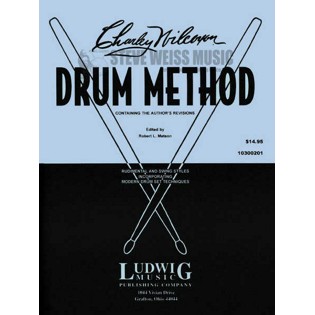
I picked up this interesting book- Charley Wilcoxon's Drum Method- as one of my local sheet music stores was going out of business. I'd been working with Wilcoxon's more advanced Rudimental Swing Solos, but this seems to be the true key book (as far as a book can take you) for understanding pre-modern jazz drumming.

The emphasis here is on rudiments and syncopated phrases, in the the 30's swing drumming mode, before before four-way coordination, and before use of the ride cymbal and hi-hat were universal. The approach to rudiments is different than in traditional military-style drumming, as in Haskell Harr. Even the march-like etudes have a distinctly swinging feel absent from the other style.

Most of the book deals with quarter and 8th notes in 4/4 and cut time, plus 3/4 and 6/8. Syncopated and even meter-within-meter rhythms and accent patterns are introduced early, in the quarter note section, and exercises generally have a swing lilt. Remarkably, 16th notes in #/4 meters are not fully explored until page 91. Notably absent are the mathematical/logical sequences of exercises that became a primary feature of many drum books after George L. Stone's Stick Control. Often sequences of exercises will be related by embellishments, or sticking variations as in the single page of 16th note exercises, which shows the unadorned rhythm, then several sticking, accent, embellishment options. Usually they just follow a musically-related progression.

It's somewhat easy to miss the fact that this is a drum set method book. The bass drum is used simply throughout, playing either quarter notes or half notes, and occasionally filling in breaks or supporting an accent pattern in the hands. Aside from a few dedicated hihat exercises, most of the book uses only the bass drum and hands. Jazz ride cymbal and hi-hat patterns are presented as stand-alone time feels, with no comping in the modern Kenny Clarke/Max Roach/Chapin mode. Brushes are mentioned, to introduce the left hand sweep, and to mention that "brush technique is usually developed individually by each drummer." There are a number of multi-voice exercises and etudes using tom toms and cowbell.

I've found it to be very useful in my own practice- I'm very fond of the pages of two bar breaks, "rhumba studies", 3/8 studies, 16th notes, and triplet/8th note combinations. Along with several of the later etudes, which are less dense and more focused on a single idea than those from Wilcoxon's other books. And it's nice to see earlier versions of the the type of phrases used in more modern books, like Ted Reed's Syncopation. The history lesson plus the dozen or so pages I actually use make it well worth the purchase price.

Purchase the Wilcoxon Drum Method.