Wednesday, December 30, 2020

Page o' coordination: feet in the gap

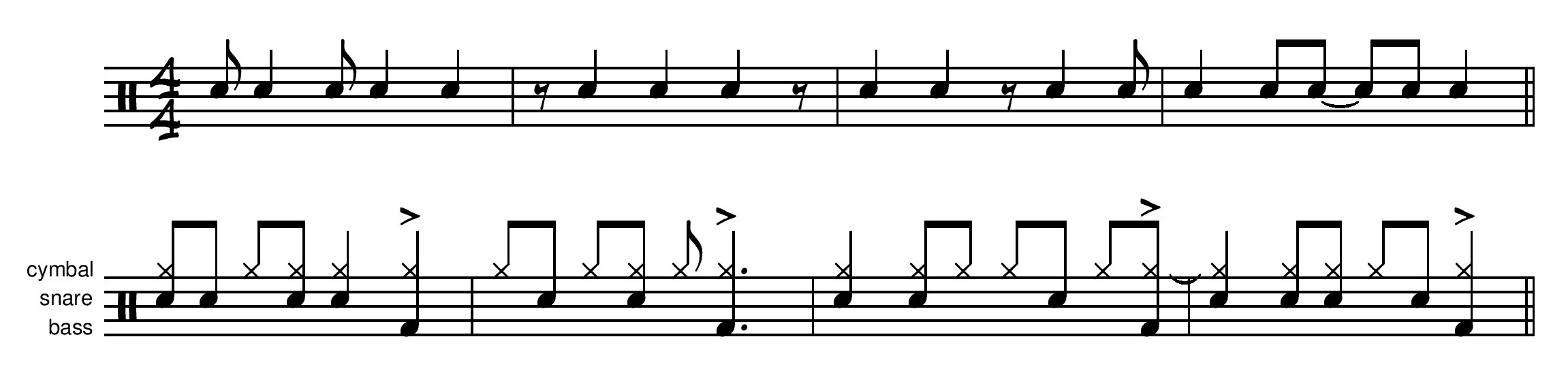
Another little item inspired by the ongoing Chasin' the Trane transcription— in which Elvin Jones does this a lot. Here we've got both feet in unison, played on the &s of 1 and 3, in the space in the cymbal rhythm. I've never practiced that exact move, so it's a little awkward. What's cool about dumb easy things you never practiced that are a little awkward is that you can work on them briefly and your body actually learns something new.   


The whole idea is to refine the timing of the feet unison on the & of 1/3— don't crowd the cymbal hits on 2/4. Don't play this page if you're not going to be really careful about that. It's probably a good idea to alternate one or two measures of exercise with one or two measures of regular ad lib jazz time. 

Do this together with the other recent page o' coordination with the repeating RLRR sticking, and add the left foot in unison with the L. 

Get the pdf

Tuesday, December 29, 2020

Transcription: Elvin Jones - Chasin' the Trane - 03

Third minute of Elvin Jones playing Chasin' the Trane, from John Coltrane Live at The Village Vanguard. The 13th-18th 12-bar choruses. I just noticed that the tempo— around quarter note = 235— is about the same as another famous Elvin track, Passion Dance, from McCoy Tyner's The Real McCoy. So this is now officially Elvin's tempo around here— like 286 belongs to Roy Haynes


This time I'm noticing he plays the snare drum on all of the &s in a lot of measures.  

Also look at the triplet in measure 177— throughout the transcription there are a number of SD/BD unisons on &s that are almost that— they flam slightly, with the bass drum landing a little early. At this tempo there's only the slightest difference between a flammy unison on a swing &, vs. just playing a complete triplet.   

Get the pdf

Monday, December 28, 2020

Bass drum rhythms for feathering

I wrote this up after listening to Mel Lewis's history of jazz drumming tapes, where he was raving about the importance of playing time on the bass drum (he really gets into it after 43:30). He basically describes this exactly, for making a syncopated accent with the bass drum, and then going back to feathering. This, together with some other things I've suggested, should make you functional enough to work out your timekeeping voice with the bass drum through playing with people.  

Loren Schoenberg, who did the radio interviews with Lewis, has posted the tapes on YouTube— and a lot of other interesting stuff. He's a good person to follow.  


Play the rhythms on the bass drum along with the normal jazz rhythms on the cymbal and hihat. Play the unaccented notes softly, but get the timing and coordination before sweating any extreme dynamics. My whole objection to this type of thing is that I don't want to work out vestigial bass drum— I'm not going to work out perfect 1" bass drum strokes in the practice room. It has to be an organic process. 

Get the pdf

Saturday, December 26, 2020

From the zone: two-note coordination patterns

From Manuel in Augsburg, Germany. We've met a couple of times in my travels— in Berlin and in Augsburg, and I got to help him put together a really nice set of Cymbal & Gong cymbalsa 22" ride and some other things. He's sent in a little Chaffee-esque library of all possible combinations of two-note patterns for four limbs:


Manuel says “I practice it on the set as a warm-up to 'remove friction' (as some authors put it) and to work on balance between the different volume levels of Ride, Snare, Bass and Hi Hat.” 


I may try it— I always had a problem with things like this (see Chaffee's Time Functioning book, Dahlgren & Fine), because I wouldn't know when it was OK to stop. Now I'm more able to just play through something once. Get through it in however long is reasonable. 

Friday, December 25, 2020

Transcription: Elvin Jones - Chasin' the Trane - 02

Happy Saturnalia everyone— although it seems a shame to call it that, with everyone celebrating in isolation. Nevertheless, here is the second minute of Elvin Jones playing Chasin' the Trane— 1:13 to 2:13— from John Coltrane Live at the Village Vanguard. Only fourteen more of these to go if I'm going to complete it. 


The hihat is a little bit looser through this section— seemingly a fair amount of loose, semi-controlled activity. Also noting a repeating SBBS pattern reminiscent of a thing inspired last year by John Riley— “that, with interruptions.” Also take a look at measures 95-96 for a repeating 3/8 pattern, BSS, with some unexpected accents. 

On some of the phrases where there is no bass drum written, it almost sounds as if he is feathering time on it, but I wasn't sure. I can't recall ever seeing or hearing him do that, although he seems to play a lot of semi-audible stuff on it. Let us know in the comments if you've ever seen Elvin feather quarter notes on the bass drum at bright tempos.

Get the pdf

Thursday, December 24, 2020

Three Camps for drum set - inverted quarter note triplet fill - 07

 I'm telling you this is a good system. It gives you the thing, some basic variations on it, starting on 1 or 2, straight and syncopated, and it makes you do it for as long as you should do it. Basically that's what you should do with every single identifiable idea you play on the drum set. 

This is the inverse of what I posted last week— we're playing a jazz time feel, with the bass drum playing the major TC accents, filling in the remaining notes of an inverted quarter note triplet on the snare drum. And there is an accompanying Reed-type method to develop all of this further.  


It's fun doing the standard left hand moves with these pages, playing a rim click on the snare drum— gives a nice Elvin-like texture.  

Get the pdf

Tuesday, December 22, 2020

Page o' coordination: jazz / RLRR

Working on this Elvin project the last couple of days, I noticed that, similar to Max Roach on another recording, he plays the snare drum in the gap in the cymbal rhythm a lot, for a sticking of: RLRR RLRR. It's almost like a foundation pattern, a home base. This a page using that pattern, adding some basic things to it.  

I already wrote this page, more or less, last year, but this version is easier. I'll use this with a few of my novice jazz students. I really like teaching the same basic thing several different ways. Like if we just teach jazz comping rhythms with Chapin, people start thinking jazz = one-measure left hand independence patterns vs. a static cymbal rhythm. If we only do Syncopation, maybe they won't have all finer points of the coordination worked out. You never know what idea is going to click for what person, so they really understand what they're doing, and are able to use it creatively. 


Swing the 8th notes. Treat the complete exercise patterns as extensions of the base RLRR pattern— they're places to go from the base pattern. Add the hihat on beats 2 and 4, or— and this is another thing I notice Elvin doing a lot— on the & of 1 / & of 3, in unison with the snare drum. Actually Elvin does it most often in unison with the bass drum, but that'll have to wait for another page of stuff.

Also see my other pages of sticking patterns for jazz. Also check out a post from a long time ago, The Kenny Note, in which I noticed the Kenny Clarke sure does play that comping rhythm a lot.  

Monday, December 21, 2020

Transcription: Elvin Jones - Chasin' the Trane - 01

Ending a truly bleak, shameful year— and four years— in United States history, with an ambitious transcribing project. A little act of penance, devotion, purging, re-centering. I'm hoping to clean myself a little with this.  

Elvin Jones was one of the supreme artists on our instrument, and one of a handful of creators I basically regard as religious figures. The project is to transcribe his complete >16 minute performance on Chasin' the Trane, the modern epic from John Coltrane's album Live at the Village Vanguard. In the end it should be over 30 pages long. I don't know if anyone will do anything with that, it doesn't matter. Hopefully the only thing that will stop me from completing it is if I hit a lot of untrancribable things as I get deeper in.  

I have a lot of history with this record. When I was living in Los Angeles, working for a messenger service, for about four months I had four cassettes in the car. Two of them Coltrane Live at the Village Vanguard, and Coltrane Live at Birdland, and I would just cycle them for 6-8 hours a day. This tune especially I would rewind and play over and over.   

There was originally some critical controversy with this album— stunningly. Some critics famously called what Coltrane was doing at this time “anti-jazz.” This track was considered to be particularly offensive in that respect. Here's a sample of that from a Downbeat column from 1962, in which Coltrane and Eric Dolphy were interrogated on their creative direction. Hoping to learn something, I dug this out of the stacks at the University of Oregon library, now you can just read it online:
  

“At Hollywood’s Renaissance Club recently, I listened to a horrifying demonstration of what appears to be a growing anti-jazz trend exemplified by these foremost proponents [John Coltrane and Eric Dolphy] of what is termed avant-garde music.

“I heard a good rhythm section… go to waste behind the nihilistic exercises of the two horns.… Coltrane and Dolphy seem intent on deliberately destroying [swing].… They seem bent on pursuing an anarchistic course in their music that can but be termed anti-jazz.”


It turns out that what critics say about music is not very enlightening for people trying to learn how to play it. Or for anyone. 

With that, here are the first six choruses of Elvin Jones's playing on Chasin' the Trane— about one minute, 14 seconds. The tune is a 12-bar blues, and the tempo is about quarter note = 235. 


There are a lot of ghosted notes here that are really hard to pick out listening at normal speed— I think I was able to get a pretty complete picture of what he was doing on the snare drum. Not so much with the bass drum— I think he's probably doing more than what I've written, but I could only get shadows of it. All the parts resolve pretty well as intentionally played notes. A lot of times there will be accidental/automatic notes sounding that don't really make sense as anything you would play on purpose.  

Generally the timing is pretty accurate. There are quite a few bass drum accents on a downbeat, with a ghosted note on the & before it— that note is usually played very tight to the main note, closer than an ordinary swing 8th note. The only place where I had to compromise a little bit was in the very last measure; Elvin is flailing it in there, you probably should too.  

Get the pdf

Friday, December 18, 2020

Another Reed tweak

Another minor tweak on a normal Reed method, in a jazz feel. It's good to have some easy options to relieve the tedium, and to bring more of the texture of real playing into it. 

Do this with the ordinary Reed snare drum comping method— jazz rhythm on the cymbal, melody rhythm on snare, 2 and 4 on the hihat. But now let's hit the last note of the melody as an accent on the cymbal and bass drum— usually on 4, the & of 4, or the & of 3. 

Here are a couple of lines of Reed played this way: 


Catch the accent with the shoulder of the stick in the riding area— that's a technique you never hear discussed, that I do all the time. It's a normal part of playing the ride cymbal. 

While practicing you can hit that accent every measure, or every two measures. In real life you'll do it more sparsely of course. 

Making that accent disrupts the cymbal rhythm, so come back in with it on beat 1 of the next measure, except with an accent on the &of 4; then play the cymbal accent as a tied note, and come in on 2. But play the complete melody rhythm on the snare drum regardless. You might not ordinarily do that in real playing, but doing it in the practice room it will help you perfect the timing— it's easy to rush from the & of 4 to the 2. 

I didn't include a hihat part in the examples. You could keep it going on beats 2 and 4 throughout this, except maybe when the accent is on the & of 3, you could drop it out on the 4. Do what you want.