Showing posts with label From The Zone. Show all posts

Saturday, January 27, 2024

Chop busters: syncopated flammed 16ths

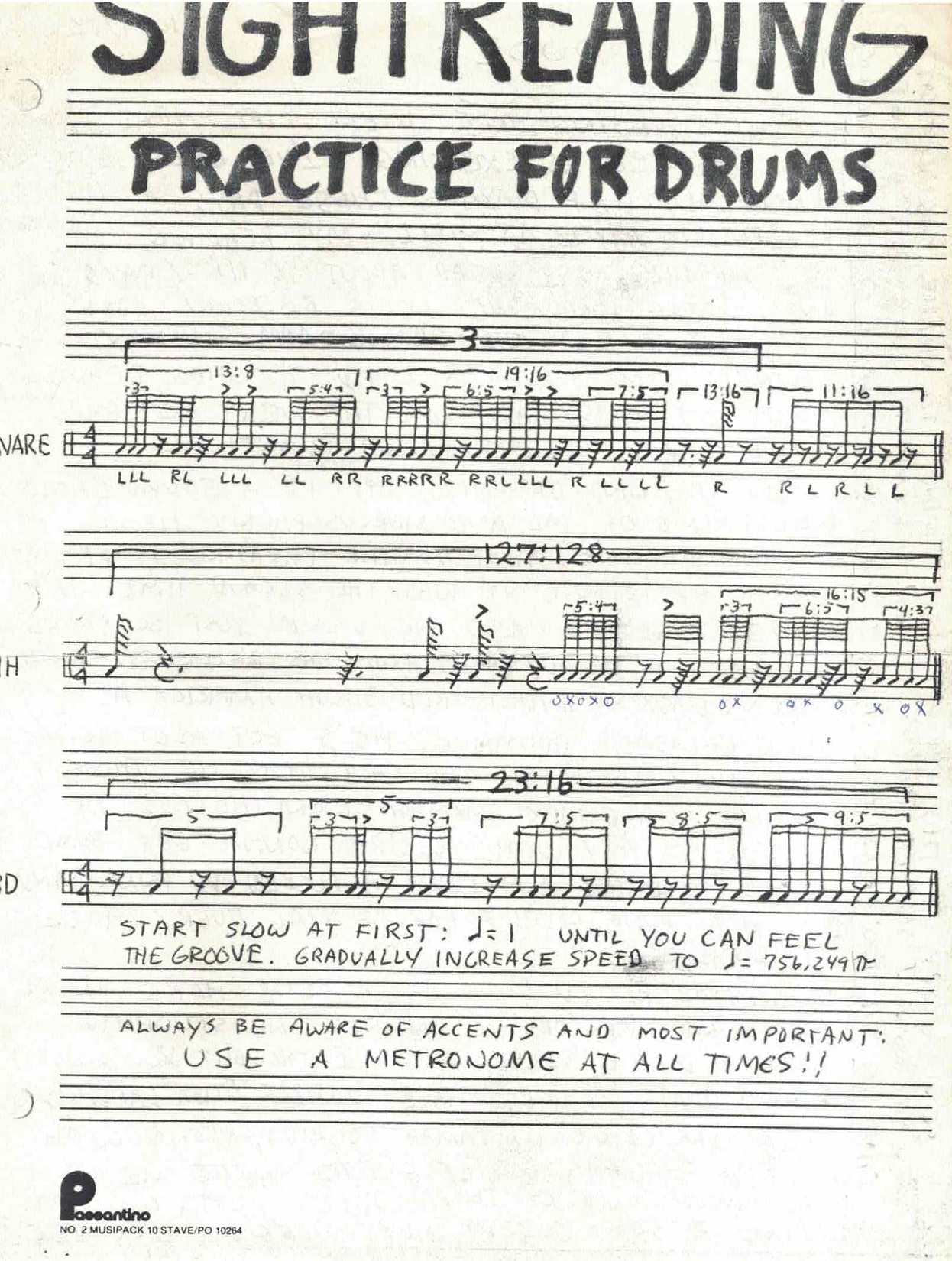
More rooting around in my archives, with a stealth from the zone item. I found this in one of my notebooks from high school, and it's worth playing, with some mixed 16th note rhythms with flams in funny places. So I wrote it up nicely so people can actually read it: 


There are accents on all the flams, and I believe the stickings alternate all the way through.   

...aaand as I look at it, it appears that this is just one pattern displaced by a 16th note from line to line. There are a couple of small variations, but those are probably mistakes. See my December page of flammed 16ths for something a little more challenging. 

Here's the original sheet scanned from my notebook: 


Get the pdf

Thursday, January 25, 2024

From the zone: Danny Gottlieb solo break

Another archive item— lots of action around here right now, and not a lot of time to write. And I just found some more of my old writing. I wrote a lot of drum stuff in school. 

Here I've bashed out a transcription of a four bar drum break by Danny Gottlieb, on the title track from his album Aquamarine. By the end of it I clearly lost patience with it. 


I haven't listened to a ton of Danny Gottlieb. This was released in 1987, when fusion was easing into what people started calling “fuzak”, and this record was a little light for me. It's difficult for me now. But I made an effort to listen to it. The break happens at 2:56 in the recording. 

Thursday, March 02, 2023

From the zone: SD chops

Another notebook item from the later 80s, as I get my act together following recent personal developments. Cleaning out my mom's basement, I found a bunch of my old notebooks and music materials.

Basically, I've been doing all this for a long time— here's a page summarizing my snare drum practice circa 1987:  


My instructions to myself: 

- Play from both Stone books [Stick Control and Accents & Rebounds] 
- Slow down the things that are causing tension— don't play faster than you can [play] relaxed— but push yourself— don't play the same d*mn speed for six months. 
- Cover as much material from the books as possible. [I'm not sure what books I meant, other than Stone— in my lessons I was working from Goldenberg, Cirone, Delecluse]


Identifying those rudiments by column, we have: 

Paradiddles
Flamadiddles
Windmills
Flam taps
Inverted flam taps
Dragadiddles
Flamadiddles again
Flam drag-adiddles

Flam Accent #1
Swiss Triplets
Flam Drags
Flam Drag #2 - I made that name up just now
Flammed 5 stroke rolls
Paradiddle diddles
Flam tap-adiddles - another name I made up right now
Inverted flam tap-adiddles - no sticking indicated, I assume it's connected to the thing above it

Ratamacues - my own form, inverted
Double ratamacues
Triple ratamacues
Double paradiddles
Flam double paradiddles
Pataflaflas

Flams
Ruffs
Four stroke ruffs
Tap 7 stroke rolls
Tap 5 stroke rolls - triplets
6 stroke roll - taps at the beginning
5 stroke roll - triplets
6 stroke roll - taps at end
6 stroke roll - usual format
Drag pataflaflas

Tuesday, February 14, 2023

Everything at once

Another archive item— these things are a very welcome brain cleansing for me.

This is a clinic handout by Russ Tincher, from when I was a student at the U. of Southern California. Tincher was a Bay Area drummer and teacher. I don't know much about him, and information online is sparse. I believe he passed away in the teens. He did some big band work, and played in a fusion band called Solar Plexus, and was Jeff Ballard's teacher. I'm sure somebody reading knows more about him, please share in the comments. 

The first paragraph is the most important. I don't know if I first heard it as an idea from him, or if I already knew it and he reinforced it, but everything at once in drumming practice was a philosophy I really ran with in the 90s— not just with what I played, but the way I played it, with an emphasis on exciting dynamics and sound. 


Typing out the text, so it gets insidiously woven into the fabric of the internet: 

COORDINATION & READING
GETTING THE MOST OUT OF YOUR PRACTICE TIME
by Russ Tincher

A common problem among beginning drummers is that they tend to split their practice time up. A typical practice session begins with the drummer just “whaling” for awhile and then working on some coordination, then maybe some technique exercises, and, if he or she is not completely bored, some reading. What we tend to forget is that in the real world of playing we do all of these things at the same time! It is necessary, then, to learn to practice several areas of importance at once. 

How does a drummer do this? One of the most useful exercises I have found lies in Louis Bellson's Reading Text in 4/4. Here is a basic program for the book. 

1. Learn and play the first 25 pages “hand-to-hand.” Be able to play it slowly and evenly without stopping. 

2. Starting at the beginning, play Jazz Ride Cymbal and Hi-hat while playing the written material on the snare drum. Swing the 8th notes. 

3. Starting at the beginning, play Bossa Nova Ride Cymbal, Hi-hat, and Bass Drum while playing the written material on the cross-stick snare. Play straight 8ths.

4. Starting at the beginning, play Samba Ride Cymbal, Hi-hat, and Bass Drum while playing the written material on the Snare Drum. 

In completing these four steps you'll find that your coordination will be challenged and your reading will improve dramatically. Using this technique as a launching place, try superimposing your own favorite grooves over the written material— it works for Funk, Latin, Swing, just about anything. Also be sure to play the written material with the bass drum, Ride Cymbal, and Hi-hat. Try the same method with other books; don't be afraid to develop your own practice routines! And finally, always use a metronome.

Friday, February 10, 2023

Time is money

Another funny item I dug out of my archives. I believe it's from the jazz festival at UC Berkeley in 1989— I was there playing with USC's guitar ensemble. A bassist and drummer gave a clinic that was mainly about time, and I think this was a handout. I forget their names, but they were Bay Area jazz professionals, not an 80s pop band from Indiana also called The Phonz

They've padded it out with some jokes, but there are some good points: 


The main thing I took from the clinic and never forgot was: 

Laying back or playing on top are confusing terms, they are a smokescreen. Time should be played in the middle of the beat by the rhythm section. 


It simplifies your thinking if you just decide to be the reference point stating the tempo, and let everyone else play ahead or behind. Which may put you seemingly ahead of / behind the beat, depending on the other players' ears / time concepts. The main thing is that you're being the reference point— you're not getting the time from them.  

Thursday, February 09, 2023

From the zone: feel the groove

Cleaning out my mom's house I found a box of all the siblings' music materials that she saved, including a bunch of my archive items, that are pretty interesting. 

The thing below was written and sent to me by my friend Kirk Ross, mainly a bassist then, now mainly a songwriter. Kind of an extreme personality. We played in a couple of bands at the University of Oregon, then we went off to different schools— me to U. of Southern California, him to Berklee. Later he got me on my first cruise ship gig, and he brought me to Los Angeles ~7 years ago to make a record with Geoff Keezer on piano, playing Kirk's songs and a Neil Sedaka cover. 

His first year at Berklee he was getting into some things from Gary Chaffee that I showed him, and he really ran with them. Following is a one-measure sight reading exercise— the left side got cut off, but top to bottom, I think each line was meant for snare drum, hihat, and bass drum:  


A joke, clearly. I'm sure it works out mathematically. After this Kirk moved to LA and sought out and befriended Vinnie Colaiuta, and jammed with him a few times. He had a big moment was when he was able to lose Vinnie playing the above kind of nonsense— I guess even he needed a foundation to play off of. We each had our course corrections shortly after this— Kirk going back to Berklee and getting really into James Brown, me at SC getting into Elvin Jones.  

Friday, December 23, 2022

From the zone: left hand developer

 Here's a cool little exercise from a great drummer from Los Angeles, Sinclair Lott:  


You can see what's happening there— a table of time with a RLL sticking, with accents on the downbeats. Which makes your left hand do some stuff. Very elegant. 

Check out Sinclair's YouTube channel, which has some lovely playing, and cymbal demos. And get his latest record here. Buy people's records. 

Send in your FROM THE ZONE items— any of your handwritten stuff. It doesn't have to be finished, or good, or anything. I just like seeing what people scribble out in the wood shed because it wasn't in any of the books, and they needed it. Take a picture with your phone and send it.  

Tuesday, October 18, 2022

16th note exercise for brushes - solo

Continuing this thing— playing the the 16th note pages from Reed with brushes, with accents and bass drum additions hastily scribbled in while practicing. Here's the 20 bar solo on p. 23.  

> = accent / circled note = add bass drum

Sunday, October 09, 2022

16th note exercise for brushes

Another cut and paste item. I don't practice brushes nearly enough, so yesterday I was hitting that a little bit. Poking around for things I needed to work on, I settled on these pages from Syncopation, with a few markings scribbled in: 


Like is says, the accent means hit an accent, the circled notes mean add bass drum. Half the time I was probably substituting bass drum for the brush hit— it doesn't matter. Nothing matters, we're just trying to play some singles with the brushes, with a little extra something to make a realistic thing out of it. You could try hitting a cymbal on those BD-added notes part of the time. Find your own way to play it. 

Do it at a bright medium tempo— I was playing it along with this McCoy Tyner loop

Monday, June 06, 2022

5/8 control, part 2

Hastily scribbled practice notes
It has been an interesting journey this week, preparing this challenging music— moderately challenging, I guess; there are a few grooves in time signatures I'm not used to, but I'm being ambitious about how I want to play them. When it's all over I'll give you a complete rundown of all the tunes, how I handled them, and how it worked out.

If you're in Oregon, you can come see us at the 1905 Club in Portland at 5:30 pm on Friday the 10th, or the Old World Deli in Corvallis at 7pm on the 11th. Antonio Sanchez is playing with Thana Alexa right after us at the 1905, so you can make a night of it.  

Yes, it is a little intimidating knowing King Kong may be in the house while I'm playing this stuff. But whatever, if I eat it somehow, and he's even around, I'll remember Frankie Dunlop

The 5/8 thing is coming along nicely. I needed to figure out a way to vamp on it, and learn a few key rhythms— claves, almost. Generally learning a lot of simple variations on basic things.  

Here's another page of 5/8 patterns based on the notes above, that I wrote while I was practicing, and some practice notes— to myself, they may make no sense to you.  


You can fudge it 
You don't need to play a perfect 5/8 subdivision all the time. This is not prog. In fact, if you're playing off the 1, a lot of almost-normal stuff can happen in the middle. 

And 5/8 rhythms can resemble normal things, pushed around a little bit, for example: 


But increasingly I've found I can just stay on the quintuplet groove— it just requires a focused and deliberate approach. Which is not my forte— as a musician I'm actually kind of a feral individual. Just playing the notes feels like cheating to me.   

Recovering from mistakes. 
I'm learning to bail out fast when something lands in a way I didn't intend— without immediately hitting something else, which will also be very wrong, to try to save the continuity. 

You also have to have the 5/8 in your ear well enough that you can drop in a note, and know where you are from hearing it. 


Playing free
It's also possible to just play free over the vamp— but there's a right way to do that. You have to listen, and you can't lapse into playing patterns that fight with the vamp. It's also nice to be able to play four measures totally free, and land on the 1 with the band, which I can do.    

The actual parameters
You look at a chart like that and you think oh my God I've got to learn to play 5/8, but really, it's one six minute tune, and one tempo. On the 5/8 portion of the head the drums are doing a light percussive background thing. The middle of the tune and the horn solo are in 6/4. The drum solo in 5/8 is really equivalent to an 8 measure break in 4. And the other players are used to holding it together with different drummers who don't know their music real well— or they better be. They won't be relying on me to be their foundation. 

Get the pdf

Saturday, February 20, 2021

From the zone: Zappa transcription project

 Daniel Bédard in Montréal did a really cool project: 

“I challenged myself in trying to transcribe one FZ song a week for a year. That year came to an end last September and due to covid, I've been slowed down big time but still managed to reach my goal of 52 songs in a year.” 


I love his copying style. Here's the whole pile:
 

Saturday, January 23, 2021

From the zone: Snare Conditioner

This was not a legitimate FTZ submission, but I am bequeathing it with that title because this is EXACTLY the kind of crap you're supposed to do when holed up in your studio because of a pandemic for 8 months.

London friend of the site Adam Osmianski transcribed a snare drum solo from someone's video “Broken air con that plays a jazz drum solo!!” Made by some random dork amused over a musical sounding appliance. 

The thing is, IT'S GREAT. Better than anything in found in psha books. I'm not joking, this should be your new flam exercise for snare drum starting tonight. I'm subtly pleading with him to write it out in 6/8. 


Hop over to Adam's site to download the transcription, and check out a lot of other excellent drumming-related content. 

Saturday, December 26, 2020

From the zone: two-note coordination patterns

From Manuel in Augsburg, Germany. We've met a couple of times in my travels— in Berlin and in Augsburg, and I got to help him put together a really nice set of Cymbal & Gong cymbalsa 22" ride and some other things. He's sent in a little Chaffee-esque library of all possible combinations of two-note patterns for four limbs:


Manuel says “I practice it on the set as a warm-up to 'remove friction' (as some authors put it) and to work on balance between the different volume levels of Ride, Snare, Bass and Hi Hat.” 


I may try it— I always had a problem with things like this (see Chaffee's Time Functioning book, Dahlgren & Fine), because I wouldn't know when it was OK to stop. Now I'm more able to just play through something once. Get through it in however long is reasonable. 

Wednesday, November 25, 2020

From the zone: ECM feel

Here's something sent in by Ed Stalling of Missoula, Montana. He mentioned being inspired by my ECM feel post from 2012— which definitely needs to be revisited and some links updated— but he's got his own thing happening here. 


I like the idea of notating flam rudiments for two voices this way. Normally on drumset I would write them with two complete rhythms on one set of stems. Here you can ignore some of the notes, and just play the basic sticking pattern, and add the flams to make the more challenging overlapping independent rhythms. It really suggests some interesting possibilities for ways of practicing Stick Control. You could do that with the flam pages from Stone, but I don't find it real inspiring with the flams/unisons in the same place every time.  

Get the pdf

I encourage you to send in your own writings for inclusion in a “FROM THE ZONE” post— seriously, anything scraped off the floor of your practice room, where you wrote something out to figure it out. I don't care how bad it looks. I want it to look bad. Take a picture with your phone and send it to my email link you see in the sidebar. 

Thursday, April 09, 2020

From the zone: Al Foster intro

Hey, it looks like everyone but me is getting a lot writing done right now. I have a couple more of these “from the zone” items to share— a series where people send in their personal stuff, scraped off their practice room floor. Feel free to email me (see the sidebar) any coffee-stained hand written stuff you want to share. It doesn't have to be particularly legible or even make sense to outsiders. Any old thing you needed to write out to practice.

This looked familiar when drummer Larry Nagel shared it on a forum; it's something I transcribed to include in my Book of Intros... a major project that is currently stalled. It's basically done, but I haven't released it yet because???

...anyway, it's a young Al Foster's intro from Chick's Tune, from Blue Mitchell's album The Thing To Do:


Here's my version of it for the book— most of the 8th rests are filled in with ghosted triplet doubles, and I included possible stickings and a few measures of the main groove from the tune:


Here's Nagel playing it, very professionally:


Monday, March 30, 2020

From the zone: cycling patterns

Since I am completely blocked for writing anything other than profane tweets right now, here are a couple of things from the practice room of our friend in Berlin, Michael Griener. It's a very elegant way of cycling inversions of three note patterns by alternating measures of triplets and 16th notes.

First as a solo idea, using the extremely useful RLB (B = bass drum) sticking in the first half, and LRB in the second half. No reason not to do these substituting the hihat played with the foot for the bass drum. Or both feet in unison— something I'm doing a lot lately. After learning the basic exercise, you should move your hands around the drums, of course. 


The same basic idea in context of a time feel, played along with a cymbal rhythm— first with snare drum and bass drum, then with snare drum and hihat: 


You could extend either of these to drill each individual inversion by repeating the triplet measures, or by extending one of the 16th note measures into 6/4:


You only have to do one of them— as independence practice, at least— because that includes all inversions of the pattern against the cymbal rhythm. 

Wednesday, March 13, 2019

From the zone: brush things

A little item from Ted Warren, author of the excellent Trap'd blog, who is clearly not suffering from any kind of OCD, having written this upside down on some kind of assignment sheet. I post so much stuff on this site that it's easy to forget that most of what you actually play centers around relatively few basic ideas (actually, what I write also centers around relatively few basic ideas, in different contexts)... so when you get one or two things from a source like this, you should actually spend proportionally more time playing them, and experimenting with them. They're going to be very useful and/or fertile.

Ted gives some explanation of this here.


Definitely also see his series of brush videos— those, plus a lot of playing with people are all you need to learn to play the brushes.

Please send me (see the sidebar) any practice room artifacts you would like to be featured in a FROM THE ZONE post. Don't worry about it looking good, making sense, or being finished.

Friday, February 15, 2019

From the zone: fill ideas from Tbilisi

Wrapping up a coo-coo week with some easy stuff. From the studio of Giorgi Lomidze, a drummer in Tbilisi, Georgia, who shares a lot of interesting practice materials on Facebook, here are some pages of ideas for orchestrating fills:


In this from the zone series, I share things artifacts from people's practice rooms— things they have written for their own practicing. Send me any handwritten things you want to share— the more illegible, unintelligible, coffee-stained, screwed up and stepped-on the better.

Sunday, November 27, 2016

From the zone: another Vinnie Colaiuta transcription

We haven't done a From The Zone post in a long time— handwritten scraps of stuff from peoples' practice room floors. This one is actually a nice, complete thing, from Toni Canelli in Sheffield, England: a transcription of Vinnie Colaiuta playing on the power ballad Put The Weight On My Shoulders, by Gino Vanelli. A fitting handmaiden(???) for our other recent Vinnie/Gino thing.


If you have any of your studio scribblings you want to share— and they don't have to look this good, or look good at all, actually— please email them to me via the Email Todd link in the sidebar. Just take a picture of it with your phone and send it in. I want it to look bad.

And email me if you know what a handmaiden actually is, and why anyone would use that figure of speech in 2016. I think I'm remembering it from the game System Shock 2.

After the break is the original track, and video of Canelli playing the transcription.

Friday, November 27, 2015

From the zone: Five in seven in six in four

A little Thanksgiving treat shared on Facebook by my friend Steve Pancerev:


Let's walk through this— it's difficult, but not impossible. I see a jazz rhythm there, and a crazy independent part with a double-beamed rhythm, which means the tempo is going to be slow/medium-slow. There are three sounds happening, and we can default to the standard drum set sounds for them:

  • top line = cymbal/right hand
  • black noteheads/middle line = snare drum/left hand
  • bottom line/black noteheads = bass drum. 

You can revoice those however you want, using whatever limbs you want. I always encourage you to move your left hand parts around the drums, either improvising the moves, or using our standard moves which you should have memorized by now.

Obviously the top line is a jazz cymbal rhythm, with quarter notes and 8th note triplets. The black noteheaded rhythm, which is split between the snare drum and bass drum, is sixtuplets— so every other note lines up with a note of a good old familiar 8th note triplet. Looking for familiar landmarks: the first accent in the sixtuplet part lines up with the last note of an 8th note triplet. The last snare drum double in the second beat, and then the doubles and single bass drum note in the third beat all line up with 8th note triplets. Going into the fourth beat, the second note of each double falls on the 8th note triplet. And the first two 8th note triplet partials in beat 2 fall on the second note of doubles. So the lick is mainly doubles with the first note landing on the triplet, and doubles with the second note landing on the triplet. If I had Finale handy while blogging from my mother's house, I could write you a little preparatory study of that. 

The bracketed 5 and 7 notations indicate the phrasing and voicing of the rhythm— we're accenting the sixtuplets every five notes (starting on the second note of the part), and voicing the rhythm between the drums in a seven note pattern— SSBBSSB. So the seven-note pattern (played three times) with the accents every five notes is SSBBSSB / SSBBSSB / SSBBSSB. You'll really want to get the basic coordination and rhythm together before you add that accents.

I've been meaning for years now to post more of Steve's stuff— maybe I'll actually follow through on that in 2016. In the mean time, you can follow him on Facebook. He's already posted one other crazy thing today. 

If you'd like to have your practice materials featured as a From The Zone item, hit the email link in the sidebar and send them in. Crappy photos of semi-legible manuscript is preferred. I just want things you had to write out because they weren't written anywhere else.