Showing posts with label Stone. Show all posts

Saturday, October 05, 2024

Stick Control with a backbeat

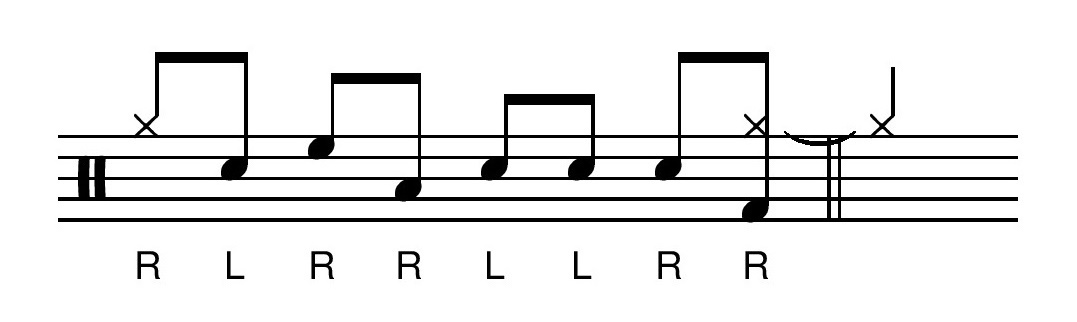
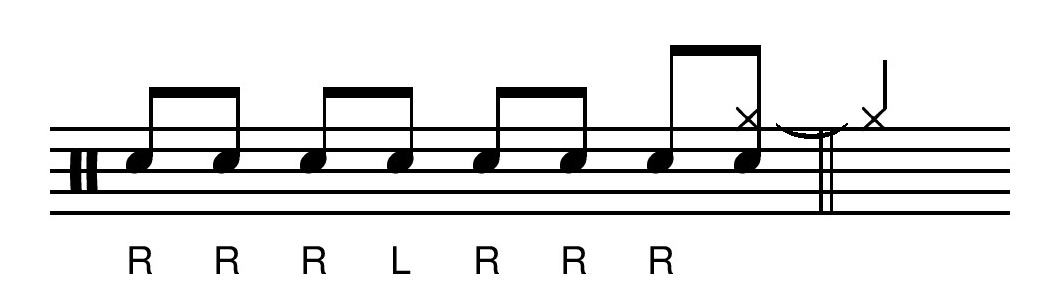
Another little oddball Stick Control related item, for drum set: some Stone-type sticking patterns with accented unisons added, on beats 2-4, and on beat 3. Introducing the idea— if you like it, you could obviously go a lot further working out of Stick Control itself. 


Play the right hand on the cymbal, left hand on the snare drum. Ghost the non-accented LH hand notes, play all the RH notes at an even volume. Add bass drum however you like— a particular kind of nut case could use the reading in New Breed for that.  

See also this other oddball item, and the right hand lead with a backbeat Syncopation system. Similar minor items. These things exist in the cracks between the actual major drumming vocabulary items, to create openings for other things to happen. 

Get the pdf

Monday, August 26, 2024

EZ 8th note groove with Stick Control

A simple 8th note groove sequence using the book Stick Control, played on the drum set. 

Use Stick Control pp. 5-7, or my page of sticking patterns, which I think is in a better order. This is a good thing to do along with music. 

1. Play the sticking pattern from the book with the right hand playing a cymbal, with the bass drum in unison, and the left hand on the snare drum: 


2.
As above, except the right hand plays running 8th notes on the cymbal. So reading from the book, the bass drum plays the Rs, the left hand plays the Ls, and the right hand plays along with everything: 


3.
As above, except the right hand plays quarter notes on the cymbal.


UPDATE: Oh, one other thing: cymbal in unison with Ls. L = both hands/SD-cym, R = bass drum: 


Play those in sequence without stopping, switching from one thing to the next every couple of measures, or every measure, and then as quickly as you can, not necessarily changing right on the 1. The end result hopefully keeps the SD/BD pattern mostly intact, with the cymbal rhythm varying in a loose way. You can probably tell that this connects with some other things we've been doing recently. 

Rock materials for drum set are usually limited to here are some one measure beats, here are some fills. Here's how some guys played some songs, which you should copy exactly. This idea is part of a larger project of mine, devising some methods for a more open approach, for students of all levels. It's about playing, not just learning to play “parts.”

Wednesday, November 16, 2022

Sticking patterns for drum set - basic

An item for one of my students— an adult student who is new to reading music: a page of sticking patterns, based on this 2018 post reorganizing the first pages of Stick Control. I could just circle the appropriate patterns in Stone, but I'm trying to be a nice guy and not make people flip around and go cross eyed looking at a page jammed with 500 sticking patterns when they're just starting to read.

These mostly start with the right hand, and are relatable to normal drum set stuff when played with one hand on a cymbal. See also my page of sticking patterns for jazz from a few days ago. 


Play with right hand on a cymbal, plus bass drum in unison / left hand on snare drum. Repeat many times.  Do it with music to stave off boredom. 

Get the pdf

Saturday, September 24, 2022

Subtractive method: an alternative approach

I just saw this from brother writer Jon McCaslin, over at the excellent and much hipper-named Four On The Floor blog: a Syncopated Stick Control method, which he's using to bring some rhythm interest to practicing Stone. It's sort of a parallel thing to my “subtractive” method. 

Both things are similar to the natural sticking idea, in which you stick mixed 16th note rhythms with the RH on all the #s and &s, and the LH on all the es and as. As if you were playing alternating 16th notes (an RLRL pattern), and dropping out notes to make the rhythm. We're just doing it with sticking patterns other than RLRL. 

It's hard to explain just in writing, much easier— and very worth it— to actually do it. 

Jon is basically eliminating the first note of any doubles, and the third note of any multiples, on either hand, or both hands— and some other things. Read his post, he illustrates it well. 

It's good to have slightly different angles on the same thing— it takes us to a total understanding of the basic materials and ideas we use in learning and teaching the drums, and the different ways might be better for doing some specific things. 

Monday, May 23, 2022

Dodge Drum Chart

An interesting item: the Dodge Drum Chart, by Frank Dodge, edited and published by George Lawrence Stone. It was advertised on the back cover of my first copy of Stick Control, so it's one of the first pieces of drumming literature I was ever aware of, but I never saw what's in it until recently. 

It's basically a key to interpreting rhythm notation, using technical charts converting a grid of equal-value notes and rests— the same format as most drum machines and sequencers use today—  into standard notation. 

It's also about one apparent common way of snare drumming, historically: it gives a sticking system based on natural sticking— so the right hand plays any #s and &s in the rhythm, the left hand plays any es and as— and flamming on the downbeats. The book describes the stickings as being based on the flamacue and the flam accent #1; it doesn't indicate the usual left hand accent we expect on the e of the beat with a flamacue. 

The key row at the top shows how the grid is counted in 2/4 time (today we generally say 1 e & a). Below that is the sequential count for each place in the grid— 1-8. Below that is the sticking— Right hand, Left hand, right hand Flam, left hand Flam, and below that is the full rhythm.

In the left hand column is the time signature, and the pattern numbers. To the right of that is the pattern grid, which has the rhythm in question in notes and rests. To the right of that is the sequential count (1-8) of the rests, and to the right of that is one common way of writing the rhythm. 


The idea is that you look up a rhythm that's troubling you in the right hand column, then look at the columns to the left to explain how to play it.  

The target audience appears to be professional and semi-professional drummers who nevertheless don't read very well. Possibly that was the norm when the book was published, and there wasn't a ton of practice literature available, so people needed a reference pamphlet like this in their trap case. Using it takes some knowledge— it's not a tutorial, and total non-readers would likely be lost using it.

The book could be occasionally useful today, in teaching, but we generally now just learn to read. We get a teacher, and get Podemski, Goldenberg, Reed, or whatever book, and do it. I was fluent with these kinds of rhythms in high school, without ever needing anything like this. 

It's somewhat interesting historically— it suggests some things about the playing of show/vaudeville drummers in the early 20th century. The major genres of “groove” it covers are the 2/4 march, the 6/8 march, and the foxtrot— there's a similar emphasis in the collection of Stone articles, Technique of Percussion. That 6/8 march was apparently a big part of people's lives then. Flamming on the downbeats was evidently standard enough practice that they don't mind baking it into the method. As well as using natural sticking (or “Straight” sticking, after Edward B. Straight.

All together it's a sort of quasi-rudimental performance language for snare drum, that is different from current common practice in band/orchestra playing. Today alternating sticking is the default, and we generally perform written parts literally— no ad lib embellishments. The march grooves are not a huge part of our playing lives, but the foxtrot category and type of notation survives in jazz.    

Most regular online stores are sold out of the book right now. You can also look at it on Scribd. Best to contact Stone publications directly if you want to buy it. 

Tuesday, April 12, 2022

Jazz fills with Stone

Another item from a drum lesson. A student and I were playing around with Stick Control, using it as a launch pad for jazz fills. The starting place was my post on rubadub using Stick Control— we went someplace else with it. We can use some rubadub type moves, but it's not the main thing. 

First, play one measure of any line from Stick Control, pp. 5-7, on the snare drum, swing interpretation. Let's start with line 4: 


No problem. The nature of a fill is that it happens in the context of a time feel, so we need to get away from the cymbal, and back to it. Put the last note of the pattern on a cymbal, on the & of 4— as always with a cymbal accent, add bass drum: 


Playing a fill in jazz time, it's most natural to end the time feel on 1, and then start the fill— whatever is written in the book, the 1 of the fill measure will be a RH on the cymbal: 


That's the basic framework. You can then try moving the right hand around the drums: 


To get a non-hokey swing interpretation, usually you'll emphasize the right hand, and don't habitually accent the down beats with either hand. 

With sticking patterns ending with a left hand, you have some options for how to end the fill. You could end with an accent on a drum on the & of 4, and come in with time on the cymbal on 1, normal volume— no accent:


You can add cymbal to that & of 4 accent: 


Or you can just end on the & of 4 with a cymbal and bass drum accent, played with hand indicated in the sticking, or just with the right hand, regardless of the written sticking: 


It's a starting point for trying some things. Play around with it for a few days, and you'll find some useful patterns, and some patterns that don't want to sound goo— so you play them a little longer trying to figure it out. A lot of things in drumming you don't need to work comprehensively— relentlessly drilling all 72 patterns at all tempos— to get something useful from them. Better to find a few easy things you'll do all the time, and improve at some ideas that are hard for you to make sound good. 

Thursday, February 10, 2022

Stick Control with short bell logic

Another one of my little photoshop gags— I edited a jpeg of the first page of exercises in Stick Control to follow the logic of the Afro “short bell” pattern*, which has beats 1 and 4 the same, and beats 2 and 3 the almost the same. The page is written in cut time, so each beat is four 8th notes long. Look closely and you'll see what's happening: 

* - That page is due for an update— maybe I'll do that soon. 


I got the idea when I was teaching a student that linked Afro 6 page above, and was curious to see how it would play out when written out. I haven't decided if this is actually worth practicing, but this logical orientation is a real world thing— notice that if you play pattern 1 with your right hand on a cymbal, you'll get something very close to a partido alto rhythm— and I won't be surprised if it develops into something creatively useful, with some different stickings.  

Thursday, April 29, 2021

Very occasional quote of the day: gabby pupils

An extended quote— extended is the only way to quote him— from George Lawrence Stone's Technique of Percussion, which has been on my mind a lot lately:

An instructor inquires what to do with a “gabby” pupil who insists on stopping whenever he makes a mistake in the lesson to tell the teacher all about it, thus consuming valuable time and slowing down the lesson. “I want to be a gentleman,” complains the instructor, “and I don't want to hurt anyone's feelings, but I sometimes feel that such a lesson is being taken right out of my hands.” 

The several remedies that first come to mind are against the law, but why not simply have a heart-to-heart with such a pupil and explain that he is supposed to come to his lessons not so much to talk as to listen. An instructor takes a defeatist attitude, not in keeping with his profession, when he hesitates to assume and retain control of the lesson period. 

It often happens that an eager pupil (not necessarily a gabby one) will stop at some minor error, fearing that his teacher may have been inattentive of disinclined to bother over trifles. Tell such a pupil that this shouldering of the teacher's burden is unnecessary, for the experienced teacher is trained to notice errors, however minor their nature. If he doesn't stop at each one and deliver a lecture upon it, there is generally some good reason why. It might surprise the eager beaver if he but knew that for every one error he himself detects, you, his teacher may have noticed several of them and stored them up in your mind for attention and correction at some future and more propitious time. 

Then, too, you might explain that an instructor often overlooks minor errors deliberately, especially when his efforts are centered on the development or correction of a major phase of the lesson. For a pupil to stop at a time like this— when the poor teacher is sweating blood to get him to comprehend, say, some rhythmic figure in its entirety— just to disclose the fact that he omitted a grace note of some flam, is to throw teacher completely off the track, distract his own attention from the matter in hand and delay progress. 

Fastened to the wall of a well known percussion studio, right where it can be seen by a pupil while taking a lesson, is the following card: 

Dear Pupil:

If, perchance, you should make a slight mistake while playing your lesson—

Don't waste the time you are paying for to tell me about it. 

I NOTICED IT!

Teacher. 


End quote. By the way, everyone with a serious is interest in the modern history of percussion is going to want to get this book: Technique of Percussion by George Lawrence Stone. I reviewed it a lifetime ago, in March 2020, and it is essential literature. 

Wednesday, January 27, 2021

Stone flam beats as independence patterns

I like doing this once in awhile: converting familiar materials into another format. Rhythm patterns (plus filler) can be converted to sticking patterns, accent patterns can be converted to rhythm patterns, sticking patterns can be converted to accent patterns... and vice versa. Any of them can be put into another rhythm or meter. We infer a lot of what we do on the drum set from those types of materials.  

Here I've written the eighteen basic flam beat patterns from Stick Control (p. 16) as coordination patterns for two voices, with the flams written as unisons. 


I'll be honest, I don't have a lot of use for this, but I often think about it when I'm practicing those pages. Like, what rhythm is each hand actually playing? It's good to know. For me it does illustrate how inane the Stone patterns are as real drum set vocabulary. It's rather dense nonsense, weighted on the 1. Good for developing an Ed Blackwell style of soloing on the tom toms, though. 

One possible place to take this, to make a Garibaldi-esque funk groove: eliminate the snare hit on every 1, or play that note on the bass drum. Accent the left hand on every beat 2, ghost the other LH notes. Add bass drum to any remaining RH-only notes you wish, or in gaps in the rhythm— es of the beat on patterns 1-7. You may find some connection with this and the funk stick control patterns I wrote back in November. 

Get the pdf

Tuesday, December 22, 2020

Page o' coordination: jazz / RLRR

Working on this Elvin project the last couple of days, I noticed that, similar to Max Roach on another recording, he plays the snare drum in the gap in the cymbal rhythm a lot, for a sticking of: RLRR RLRR. It's almost like a foundation pattern, a home base. This a page using that pattern, adding some basic things to it.  

I already wrote this page, more or less, last year, but this version is easier. I'll use this with a few of my novice jazz students. I really like teaching the same basic thing several different ways. Like if we just teach jazz comping rhythms with Chapin, people start thinking jazz = one-measure left hand independence patterns vs. a static cymbal rhythm. If we only do Syncopation, maybe they won't have all finer points of the coordination worked out. You never know what idea is going to click for what person, so they really understand what they're doing, and are able to use it creatively. 


Swing the 8th notes. Treat the complete exercise patterns as extensions of the base RLRR pattern— they're places to go from the base pattern. Add the hihat on beats 2 and 4, or— and this is another thing I notice Elvin doing a lot— on the & of 1 / & of 3, in unison with the snare drum. Actually Elvin does it most often in unison with the bass drum, but that'll have to wait for another page of stuff.

Also see my other pages of sticking patterns for jazz. Also check out a post from a long time ago, The Kenny Note, in which I noticed the Kenny Clarke sure does play that comping rhythm a lot.  

Wednesday, November 25, 2020

From the zone: ECM feel

Here's something sent in by Ed Stalling of Missoula, Montana. He mentioned being inspired by my ECM feel post from 2012— which definitely needs to be revisited and some links updated— but he's got his own thing happening here. 


I like the idea of notating flam rudiments for two voices this way. Normally on drumset I would write them with two complete rhythms on one set of stems. Here you can ignore some of the notes, and just play the basic sticking pattern, and add the flams to make the more challenging overlapping independent rhythms. It really suggests some interesting possibilities for ways of practicing Stick Control. You could do that with the flam pages from Stone, but I don't find it real inspiring with the flams/unisons in the same place every time.  

Get the pdf

I encourage you to send in your own writings for inclusion in a “FROM THE ZONE” post— seriously, anything scraped off the floor of your practice room, where you wrote something out to figure it out. I don't care how bad it looks. I want it to look bad. Take a picture with your phone and send it to my email link you see in the sidebar. 

Wednesday, November 04, 2020

Stick Control patterns for a certain type of funk

 A thing we do here is to rewrite/re-organize existing materials to make them better for practicing certain things. I hate hunting around the page while I practice, flipping pages, dodging things that are no good for what I'm practicing. 

Playing with a loop from a Meters song, I played some Stick Control combinations on the drumset to make a funk texture— I combined all the four-note patterns starting with an R with all of the four note patterns starting with an L. So beat 1 was an R, beat 3 was an L.  

You could just memorize the first thirteen patterns from Stone and figure out the combinations in your head while you play, as I did— or I can write them out so I have something to post on the blog, and maybe a few people will actually do it. Some of these combinations are already in the book, others are not. There are two pages, the first is most useful. 


Play this in 2/2, with the Rs as cymbal + bass drum, Ls as snare drum— with the appropriate hand. I put an accent on the cut time beat 2; or beat 3 if you're counting in 4/4... look, do this: 


I played quarter notes on the hihat with my foot, and played the unaccented snare drum notes pretty strongly— I wasn't ghosting them. It's an ordinary orchestration we do with Syncopation all the time, but it's hard to do this exact thing without using Stick Control-type patterns. 

It's similar to what Zigaboo Modeliste does at times, de-emphasizing the cymbal rhythm. And it's a lesson in a certain un-intricate concept of funk. I like unintricacy in funk. We're playing an 8th note grid, but it's a grid of interlocking parts, which creates a strong groove. To me, groove-wise, plain 8th notes played on a single sound is a weak structure; interlocking parts is a strong structure. You may not play this way all the time, but it sets you up to move some different directions— especially if you're used to playing funk with a repeating cymbal rhythm, or a linear cymbal rhythm. 

Get the pdf

Thursday, October 08, 2020

Jazz fundamentals: more stick control for jazz

Another jazz fundamentals item, that pairs nicely with Monday's thing. These are some stick control patterns designed to be played on the drumset, for a specific jazz vocabulary lesson. That's a lot of what we do here. I wrote something like this back in March, with a slightly different purpose— a nice thing about having software like Finale is that it's easy to focus our materials.

This page is meant to help with adding the left hand to some basic cymbal rhythms, and also to help get the timing of some common figures— “additive rhythm” style. We'll be seeing that term again in coming days.


Swing the 8th notes. Play the right hand on the cymbal, left hand on the snare drum. Add bass drum to some or all of the RH notes. Add hihat on beats 2 and 4.

Some of the patterns have the option of playing the left hand on beat 1— those are to get the timing of a cymbal accent on the & of 4. 

Get the pdf

Wednesday, July 15, 2020

Stick control exercises, mixed rhythm in 2/4

A page I'm using with some of my students, to learn to fill, and develop basic facility on the drum set. We've been doing a lot with parts of my harmonic coordination method— which is proving to be a lot more of a universal thing than a mere advanced coordination system. You could do these on snare drum as in Stone, but I think that would be a little dull. They're written to be played on drum set, en masse.


Play the exercises a few times on the snare drum, then move the accent(s) to a cymbal, with the bass drum in unison, then improvise moving the non-accented notes around the drums. Speed is not important; timing, sound, and movement around the drums is.

Get the pdf

Saturday, May 23, 2020

Three voice / four note patterns

Continuing in the vein of the recent three voice/three note patterns item. Let's call this series “things I have always been against writing that I am now writing.” I've been playing around with an online combination generator, making some Stick Control-type patterns for the drum set, including combinations of limbs. I'm trying to do it in a rational way; it would be easy to produce an insane collection of patterns that would be totally unusable.

This is a practice-able collection of four-note patterns, written for three drum set voices, including single notes and RH-LH and RH-RF unisons. It adheres to my usual rules for what makes something very playable: no more than two SD or BD hits in a row, and no more than three cymbal hits. It's similar to things found in Dahlgren & Fine, and Chaffee, but different.


So: what is this good for, and how do we practice it?

1. There are 120 patterns, so you have to move as quickly as possible. Try to cover all of the patterns in 15-30 minutes.

2. Use to develop an ECM-type texture, or as conditioning for breaking up a normal funk texture. Could also be played with a swing feel, addressing some possible coordination/timing gaps.

3. The patterns are written as 8th notes in 2/4, but you can play them on a four note or three note subdivision, as 16th notes or triplets. Doing them as triplets, it helps to know how the cymbal portion of the pattern lies in 4/4— a separate cheat sheet for that is coming soon...

4. Try these moves:
• Play the written cymbal/snare unisons as snare/tom unisons, or as flams on any drum— I suggest doing them left-handed, meaning the right hand lands first.
• Play cymbal/bass drum unisons on a different cymbal than the plain RH cymbal notes.
Doing those moves makes this very similar to what I do with my harmonic coordination improved system, except with more potential for speed.

5. Add hihat in unison with the left hand only notes, or the right hand only notes, or the bass drum only notes. Or add hihat in any basic rhythm suitable for the style you're playing.

5. Combine patterns from different sections to make linear funk grooves. Play patterns starting with a bass drum first, and patterns starting with a snare drum second. I arranged them on the page to make that fairly easy— sections A and B combine well, and C and D combine well. You can also do A/D and C/B. Section E could come first or second. That creates a vast number of combinations, which... there may be better ways of working on that sort of thing. I'm not a proponent of endless systems. But it's a possibility.

Get the pdf

Tuesday, May 05, 2020

Four on the floor: Stone meets Ghana

Here's something very rare, an idea to base your whole life on: Stone-type patterns based on Ghanaian bell patterns. This is from Jon McCaslin over at Four on the Floor, given to him by the percussionist Russell Hartenberger. Just go over there and get them, and print them, and keep them in your notebook forever.


Friday, April 03, 2020

Best books: 143 Binary Algorhythms Applied to Paradiddles

This book has been out for a couple of years, but fellow Portland drummer Ed Pierce just brought it to my attention: 143 Binary Algorhythms Applied to Paradiddles.

...possibly the worst book title ever, but who am I to cast that stone. It's a collection of practice methods to use with the first pages of the book Stick Control, mostly for snare drum, some for drum set. Steve Forster, the author, was a student of Joe Morello's, and you'll notice a definite continuity with materials found in Morello's books Master Studies I and II. 143 BAATP is definitely a worthy addition to that canon— Stick Control, Accents & Rebounds, Master Studies, as well as the other two new recent Stone titles.

This has got to be the final, authoritative volume on the subject of what to do with Stick Control on the snare drum... the first pages, at least. The method it details is infinitely expandable, and someone could keep writing if they wanted to, but what would be the point.

The concept is to make new exercises out of Stone patterns by substituting things for the Rs and Ls, basically:

R = play X / L = play Y


Those are the binary “algorhythms” (that's the way they spell it) referenced in the title, and we are given many ways of doing that, as well as some verbal explanation and background on Morello's methods— well-edited and concisely presented, which I like a lot. The book also includes 43 exercises based on Ravel's Bolero, an idea I approve of completely. The design and layout are not exactly elegant, but they are functional... and surprisingly appealing in such a serious book.

My reservation about Stick Control has long been that patterns of Rs and Ls are not music. For many years I didn't use the book at all. I've changed my mind on that— Rs/Ls may not be music, but they are drumming language, and it's useful to be fluent in those terms. It's a creative tool you want to use sometimes.

I do want the Rs/Ls to have some connection to physical reality, however— in physically playing the drums, right side and left side are things. I want my Stone-based methods to reflect that, somehow. I'm resistant to reading Rs/Ls as a pure abstract variables— like X/Y, containers for anything at all. Some of the more distant advanced methods here approach that level of abstraction.

Most often, I want my interpreted practice methods to have some basis in music-reading reality, and I think many of the drills in this book could be done to better effect by reading out of Syncopation— which Forster himself notes in the introduction. Much of Syncopation uses “binary” patterns, written as rhythms, and it would be easy to find pages in Reed that imply the rhythms used in a particular “algorhythm.”

So I think we're reaching the limit of what can/should be done on the drums while reading Stone-type patterns. I don't believe endless snare drum training is the best way to learn to be a good drummer, and this body of materials is far larger than I think anyone can or should reasonably practice. Every drummer will choose to focus on different things, and it's up to us to determine how far to go with any particular thing.

And to be useful, a book doesn't have to be the final word on everything; the main attraction of this one is that it outlines an essential creative attitude towards our materials, one that is widely used by professionals. Anyone playing or teaching the drums seriously will want to get it.

Monday, March 16, 2020

Book reviews: Two new Stone books

Two new works by and about George Lawrence Stone have just been released:

Technique of Percussion is a compilation of articles Stone wrote for International Musician Magazine in the 1940s-60s. It's over 400 pages long, with hundreds of musical examples in the author's own handwriting. It's a fascinating look at the drumming world in the early to mid 20th century, and it's a major addition to the literature of percussion. If you teach, if you are in concert percussion, or if you have any interest in the history of the instrument, just buy it now. It's an essential library item.

The articles, plus W. Lee Vinson's extended introduction, give a much fuller picture of Stone himself than we have had so far. Most of us only know him through his technical books Stick Control and Accents & Rebounds— typically on the internet he is invoked as a kind of technique oracle, and author of page 5 of Stick Control, and that's it. But he was a complete musician and percussionist, who performed and toured as a vaudeville and classical musician, and ran a teaching studio, and was involved with drum corps and NARD.

The book really illustrates a music centered approach to percussion. There is relatively little about technique in the modern high-performance sense, and much more about execution and interpretation— which is much more interesting and valuable information, to me. This focus feels very familiar, like the basic approach I learned (painfully and incompletely) from Charles Dowd, which Dowd got from Saul Goodman, whose career was contemporaneous with these columns. It's a professional concert percussionist's approach, centered on how you execute a part musically; with technique mainly about sound, presentation, and making the part— less as a means for achieving ultimate virtuosity.

The book also gives a more complete picture of the world of early modern drumming— for me almost a prehistoric period. Early recording technology was not up to the task of recording drums; there were  fewer drum books, many of them hindered by archaic notation and terms; and the authors were largely not genius theorists or communicators. The columns in this book were written in mid-century, but they refer to the entire 20th century, and before— Stone's career in percussion spanned the whole century until his death in 1967, and his father was a professional drummer in the late 19th century. Technique of Percussion gives the first living, relatable picture of that period I have seen. There are mentions of correspondences with Sanford Moeller, Alan Abel, Edward B. Straight, Charley Wilcoxon, Fritz Berger, and many other venerable figures, discussing ordinary problems with students and points of music and technique.

In fact Technique of Percussion shows a remarkable continuity between then and now. Percussionists of that era were dealing with many of the same issues as we do now: discrepancies between “ancient” and modern practices, interpretation of drum notation, and problems with it; points of terminology; use of rebound; whether to play left-handed or right-handed; developing speed. Excuses given by students for not counting out loud. What's a flam. What's a ruff. When to alternate and when to use “side” (non-alternating) stickings. There's a lot about interpreting and executing rolls— still a very poorly understood area. He mentions things I do that I haven't seen others talk about much: “side” triplets (RLL/LRR/RRL/LLR sticking), use of the B (both hands) sticking, for example.

Stone's writing style in the columns is conversational, and quite dated— this is a personality formed in the 19-oughts. But it is readable, his terms are modern, or at least not opaquely old fashioned. The information that is not fully relevant to modern practice is at least very interesting history. This book is essential for anyone serious about percussion. Buy it now.

An index would be helpful for future editions.


The second book is Drum Lessons with George Lawrence Stone, 90 pages long. Written by Barry James in collaboration with Joe Morello— both students of Stone's— and completed after Morello's death. It is advertised as “a personal account on how to use Stick Control” and “based on actual drum lessons” taught by Stone. The beginning of the book reinforces the idea that this is at last the real story of how to practice Stick Control. Vic Firth, in his introduction, calls it “Stick Control 2.”

...now, I consider Accents & Rebounds and Joe Morello's Master Studies I and II to be Stick Controls 2, 3 and 4, but to continue...

Having one “right” answer on how to use Stick Control is a sort of holy grail for a lot of people, but this book is really not about that. I see it more as a practice room companion to Technique of Percussion. It consists mainly of written examples from that book, re-engraved, with re-edited text, and commentary by Morello and James, printed in a more convenient drum book format. I haven't checked to see how many lessons are pulled from TOP, but many are.

There is an effort towards making this a general method book, with an extended introduction about technique, explanation of the level system, and a list of rudiments, and some other fundamentals. It is presented in “lessons”, but the organization feels quite scattered. As a practice book, it's very text heavy, with most of the musical examples are illustrating something in the text. There are practicable materials, but they are scattered throughout the book, which I don't find to be conducive to practicing them in an orderly way.

For example, the subjects of lessons 20-25— from one to the next they couldn't be further afield:

20. Interpreting the single and double drags
21. Alla breve
22. The finger roll
23. Left hand velocity
24. Breaks and solos
25. Embellishments with grace notes

It also includes some things from TOP which are questionably relevant today: “the 6/8 band and 2/4 drummer”, for example— who knows what performance problem (circa 1920s? Teens?) that lesson was addressing. Interesting as a historical item, but not particularly relevant to present day drumming, certainly not something I need to think about in the practice room. The hihat lesson is another example; a major standalone issue for show drummers in the 1930s, today it's just one item in a larger jazz education.

So part of my problem is figuring out what to do with this. It could be thought of as a condensed teacher's guide for digesting materials in TOP. Or a collection of general pointers for serious students and enthusiasts.

This book is a little unsatisfying for my purposes, but it is still worth purchasing— for taking the things in TOP to the practice room, and for James's and Morello's additional insights into Stone's teaching methods. Get it here.

Monday, March 09, 2020

Stick control patterns for jazz

Because some novice jazz students get hung up on the idea of left hand “independence”, here is a little set of exercises for helping coordination between the hands when playing jazz time. We're using some sticking patterns to make some common cymbal and comping rhythms.


You can play the patterns in 4, or in 3, by just playing up to the dashed bar line. Play the Rs on the cymbal, Ls on the snare drum:


B means both hands in unison:


Focus on the rhythm— which is running swing 8th notes— and the sticking, and don't make the leap to “I'm playing this rhythm on the cymbal, and this rhythm on the snare drum.” Play with just the hands at first, then add the hihat:


You can add bass drum on 1 when you're playing in 3.


This isn't meant to be a comprehensive method— it's more a remedial method for people having trouble getting the coordination, and/or with making a solid rhythm between all the parts. After working through this page, continue with normal jazz materials.

Get the pdf

Saturday, February 08, 2020

Rubadub with Stone

Reversing a years-long boycott, I've been using the book Stick Control quite a bit for drum set applications lately. I guess it's unavoidable that sometimes in playing the drums, we think in terms of stickings. This is an easy drill for doing a rubadub-type move with the exercises on pp. 5-7.

In its basic form, rubadub, as described by Chris Smith, is a three-8th note pattern played in */4 meters. The sticking is LRR, with the L on the snare drum, the first R on a cymbal + bass drum, and the second right on a tom tom:


The sticking alone is:


After learning to play the basic lick in 4/4, you then improvise with it, mix it up, and move it around the drums in different ways. If you can't do that by just winging it, this Stone-based method will help in opening up some possibilities.

It's quite simple. Start by playing the patterns with this basic drumset orchestration— I've started calling this “natural” orchestration: 

R = right hand on cymbal + bass drum
L = left hand on snare drum

Play with a swing feel. 

Then, wherever there are two Rs in a row, play the first R on the cymbal/ BD, second R on a tom tom:


Do that with patterns 3-4, 5-8, 14-18, 24-26, 33, 35-36, 41, 44-46, 65, and 68. 

You could do the same move where there are more than two Rs in a row. Just hit the first one on the cym/BD, and the rest on the toms:


I suppose you could default playing the Rs on the toms, only moving to the cymbal when there's more than one R. So pattern 5, a paradiddle sticking, would be played:


Here's that same sticking with my regular orchestration:


With anything to do with rubadub I would be thinking about moving both hands around the drums, and playing ideas as part of a regular jazz texture. Since it is used as a way of playing setups and kicks, and filling in between them, I would be aware of the rhythm of the cymbal/bass drum notes— those are the kicks that the rest of the pattern is setting up. A subject for another post, probably.