I sincerely believe that’s one of the main purposes for rhythm, if not for music period, to cause that kind of healing effect.”
- Billy Hart, Billy Higgins memorial roundtable, by Ted Panken
[h/t to @thenuge at DFO for the link]

A drumming blog written by Todd Bishop.
I sincerely believe that’s one of the main purposes for rhythm, if not for music period, to cause that kind of healing effect.”
- Billy Hart, Billy Higgins memorial roundtable, by Ted Panken
[h/t to @thenuge at DFO for the link]
I've been listening to this record a lot in the last several months— Enjoy The View, by Bobby Hutcherson, with Billy Hart on drums, plus Joey de Francesco and David Sanborn. The tune is Don Is, and it's a blues, 12 bars long, played twice on the head in, which is what the transcription covers:

This will be useful mostly as a listening guide, so you can check out how Billy Hart handles this rhythmic tune. It's very interesting, I want to write more about it when I understand it. In the mean time we can just listen. See what's going on with those triplet fills.
This is an interesting record from 2014, by Bobby Hutcherson, with David Sanborn, Joey DeFrancesco, and Billy Hart on drums. The whole thing is real loose, and basically the opposite of everything happening in music lately— like a titanic expression of the performer's great abilities. Not that.
Billy Hart is 74 years old here, and has played and recorded as much music as anyone alive, and is working from a level of familiarity with act of playing— and through levels of burnout— it's hard to conceive, and hard for me to write about— what I'm hearing with his playing here.
They're playing familiar music, but there's nothing routine here— everything sounds present and in the moment and there to serve a purpose. More like music behavior than a performance for an audience, or even necessarily for musical effect. All very unforced. When he plays assertively, it's not coming from a personality intruding, he's more riding an energy.
It's easy to hear the vocabulary items he's using, and basically why. He'll do one thing for awhile, and you can hear how he uses it, where it goes. You can pick stuff out and use it yourself.
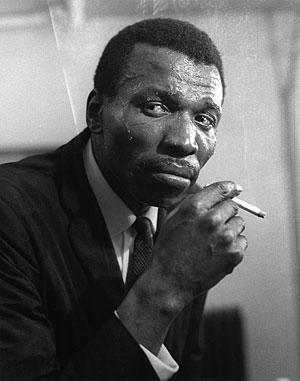
Hill began playing professionally in 1943 but held a day job as a mailman in his birthplace of Washington, D.C. for over thirty years. He played with Charlie Byrd in 1958-59, but was only occasionally active during the 1960s.
 |
| Photo by Anthony Porcar Cano |
Anybody can be a great instrumentalist. It's simply a matter of technique. The difference is in musicianship. You can be a great instrumentalist, but there are very few musicians.
Coltrane once told me about Elvin, “No matter how tense the situation gets, Elvin never tightens up.” I learned what that means. You don't mind taking chances in certain situations because you have confidence that it will come out. Or you enjoy reaching for it even if it doesn't come out.
[Milford Graves and Sunny Murray] were like magic; they conjured up spirits and ghosts and rainbow. You could actually believe that these guys could make it rain and give you visions. It was psychedelic. Now the high comes from precision and technique
The point is that what makes a rhythm you play groove is not that you're approximating a record, but that the groove is correct from what was played centuries ago in Africa. It's a rhythmic significance that's built on this heavy intelligence. Over centuries of playing they've come up with something that is so correct that when you play it accurately, based on the history, people are going to respond euphorically.
...the rhythmic reason for this is to make people feel good. On the highest level you actually heal people, both physically and psychologically. It makes people happy and it makes them move. That's the purpose of drumming in the first place. The dance. That's the point of anyone playing the drums.
Q: Where do those soaring buzz rolls that you play come from?
A: Art Blakey, but he would always conclude it with a cymbal crash. Tony would do it with single strokes, but not conclude it, he'd leave it empty.
Girls are always slightly behind the beat, but in the pocket. Watch them snap their fingers to the beat. They're sitting on it. It's what Gadd and Chambers are masters at. How come that shit never slows down?
Joao Gilberto used to tell me: “Play like the wind, play like rain.” Miles said the same thing. “Start everything on 4 and don't finish nothin'.”
How you resolve something is the key. You resolve it, but don't conclude it in a logical way. Find something else hip to play. You're concluding it, but in a more abstract way. That's what all the geniuses did.

On Stan Getz: He was performing his whole life, and never really got a chance to grow up. So if he did things that were selfish— little kids do that, and nobody hates them for it.
Q: Does he feel like a master?: No.
Response from a bandleader when Hart requested charts and a rehearsal: You don't use charts on this band. Play the dance.
On an anonymous phone call: They said, “Love is the highest form of intelligence in the universe.” I'm still trying to figure that one out.
• Seemingly mystified by what motivates some drummers (“I guess they like hitting drums.”)
• Saxophonists asking why he chose the least technical of three masterful takes of a track with Chris Potter.
• I was amused that nobody in the room, which included some great players, could name the drummer on Hub-Tones when it came up. “It's on Blue Note!” said Hart— he finally remembered that it was Clifford Jarvis.
• Said that focus on what is current or hip right now is really a corporate, consumer mentality.
• Remarking that he must have looked very stunned when Miles came up and enthused about his playing, and told Hart he would call him when he needed a drummer— Miles finished by leaning in close and saying “OK?!”