Tempo is about 256, solo begins at 2:36.

All the notes are played strongly, except the ones in parentheses. You'll notice not all the left hand stuff lines up perfectly with the cymbal.

A drumming blog written by Todd Bishop.
A selection of grooves played by Max Roach on the Miles Davis album At Last!— a live recording made at The Lighthouse in LA in 1953, and released thirty years later. Max here has been playing the tune every night for years, and the way he handles the whole thing is loose and interesting. Comparing how he handles the tune on the different recordings of it would be a good term paper project for somebody.

That rhumba beat is kind of an underrated item. I think most people how to figure out how to play it on the gig— there's no reason to practice it, there's nothing to practice. People get locked into it as a rather stiff/corny repeating beat, but you can handle it very loosely and have some fun with it, make your own personal thing out of it.
Here's a composed drum duo played by Max Roach and Stan Levey, on their album Drummin' The Blues. They trade off on some parts, and play in unison on others. I believe the whole thing is pre-written— by Roach, from the sound of it— maybe the trading portions are improvised.
Begins at 3:03 in the track, tempo is 127 bpm.

They didn't just breeze in and do the session, they took some trouble to tune their drums the same, and select cymbals that sounded similar, and their execution is very tight— no flamming between players on the unison parts.
If you're able to loop the first four bars, you can hear that bars 1-2 are one player, bars 3-4 are the other, mainly from the pitch of the cymbal. As best I can tell, they're trading twos— soloing two measures each— in the first 8 bars, then playing together. This would be a good recital or jury piece for somebody. If I were going to perform it, I'd look into some creative ways of splitting it up between players, fill it out with some actual improvised trading.
Get the pdf
Duo begins at 7:51 in the video below:
I am not screwing around people, this is now an ALL Max Roach site. Here he is trading fours on Minor Meeting, from the record Sonny Clark Trio, from 1960— there's another record by that title from 1957 with Paul Chambers and Philly Joe Jones. This would be a good jury or recital project for somebody— it's very clean look at some classic solo stuff.
The chorus of trading begins at 2:07, the tempo is a bright quarter note = 262— compare that with some other well known up tempo tracks.

Apparently there's no tom tom present, as Max plays the whole thing on snare drum, bass drum, and cymbals. I've offered some likely stickings. There seem to be a lot of six stroke rolls happening.
The beginning of most of these breaks is phrased in 3/4 time within 4/4— lines 1-2, 4-5, and 7. On line 3 he plays a 4/4 idea twice, then displaces it. On line 6 he also plays a 4/4 idea twice, then does the meter within meter thing in the third-fourth measures, with a simple running 3/8 pattern.
On this second of two days of major acts of white supremacist violence here in this paradise we call “the USA”, let's retreat into art, with part 2 of the thing from the other day: Max Roach's drum solo on A Little Sweet, from his record The Many Sides of Max.
That's what music is for. It's our job to do it with dedication in the face of a world gone totally insane.
Max's drum solo begins at 1:49 in the track.

Much of this consists of something I called “Max's rubadub”, because of its similarity to Mel Lewis's thing. The bass drum, cymbal, and snare drum are doing a kind of rolling, integrated, New Orleans type of thing. It's worth your time to learn some two and four bar excerpts from this, and some single measures.
That's the theme of the week now: jazz comping. Here's Max Roach playing on the horn solos on A Little Sweet, from his record The Many Sides of Max. Each solo is 24 bars long, and the soloists are George Coleman, Booker Little, and Julian Priester. The transcription begins at 0:36, tempo is about 230.
There's an element of sounding composed with Max— everything sounds like a deliberate statement. I noticed when transcribing Freedom Suite by Sonny Rollins that he often repeats whole phrases. It's very unusual— all drummers repeat stuff, with Max there's something non-organic about it. Like measures 19-20 and 31-32— there's no reason to for that specific sequence of things to repeat. I don't know how he arrived at that. It could be unconscious, or totally deliberate.

The cymbal rhythm is mostly consistent, and he plays the bass drum all the way through, pretty loudly. There are some accents on it, probably more than I've indicated— I feel like I'm hearing him leaning on beat 4 often. I really didn't pay attention to the hihat— it's not loud on the recording. Maybe he dropped it out occasionally and I missed it, it's not consequential.
There are a number of phrases that are worth practicing on their own— probably any two or four measures. A few that stood out are bars 11-12, 43-44, 49-52, 65-66, and 71-72.
Also bars 1-4, or 2-3, or 3-4. He's doing a New Orleans kind of thing between the snare drum and bass drum, that I associate with Billy Higgins later on.
And bars 21-28, or 21-23, or 25-28, eliminating the SD on 1 of bar 25.
Also noting that some of his longer ideas, where he's phrasing in 3/4 within the 4/4 of the tune, he begins them at the end of one soloist, through the beginning of the next soloist. That happens in measures 21-28— the double bar in the middle of that passage is where the soloists change. Also in bars 44-52. To me that's very unusual.
Finally, analyzing it from the perspective of that comping formula we learned about the other day: you're not going to see anything like that— &s of 1/3 on the body of the phrase / & of 4 at the end of a phrase. What we see is that they will alternate: & of 3 will be followed by an & of 2, and vice versa. See measures 17-18, 33-34, 53-54. More often his ideas will be phrased in 3/4 time outright— see several of the suggested phrase above.
A Max Roach epic here, a chorus of fours and two solo choruses on I'll Remember April— not a short tune. This will probably go in an e-book sometime, so get it free while you can. Chuck a few $$$ in where it says DONATE in the sidebar if you feel like it.
It's from Charles Mingus's live recording The Charles Mingus Quintet & Max Roach— Max is sitting in on this tune, the drummer on the rest of the record is Willie Jones. I'll Remember April is a 48 bar tune— ABA, each section is 16 bars. Often the A sections are played 8 bars Latin / 8 bars swing, swing on the bridge. The transcription ends 8 bars before the end of the second chorus— on the last 8 they play a rhythm vamp, and then vamp for 16 more bars before the horn comes in with the head out.
The fours start at 7:24. Tempo is about 180— it picks up some during the solo, and settles back to 180 on the head out. FYI the tune starts around 180, and settles to around 175 through the horn and piano solos.
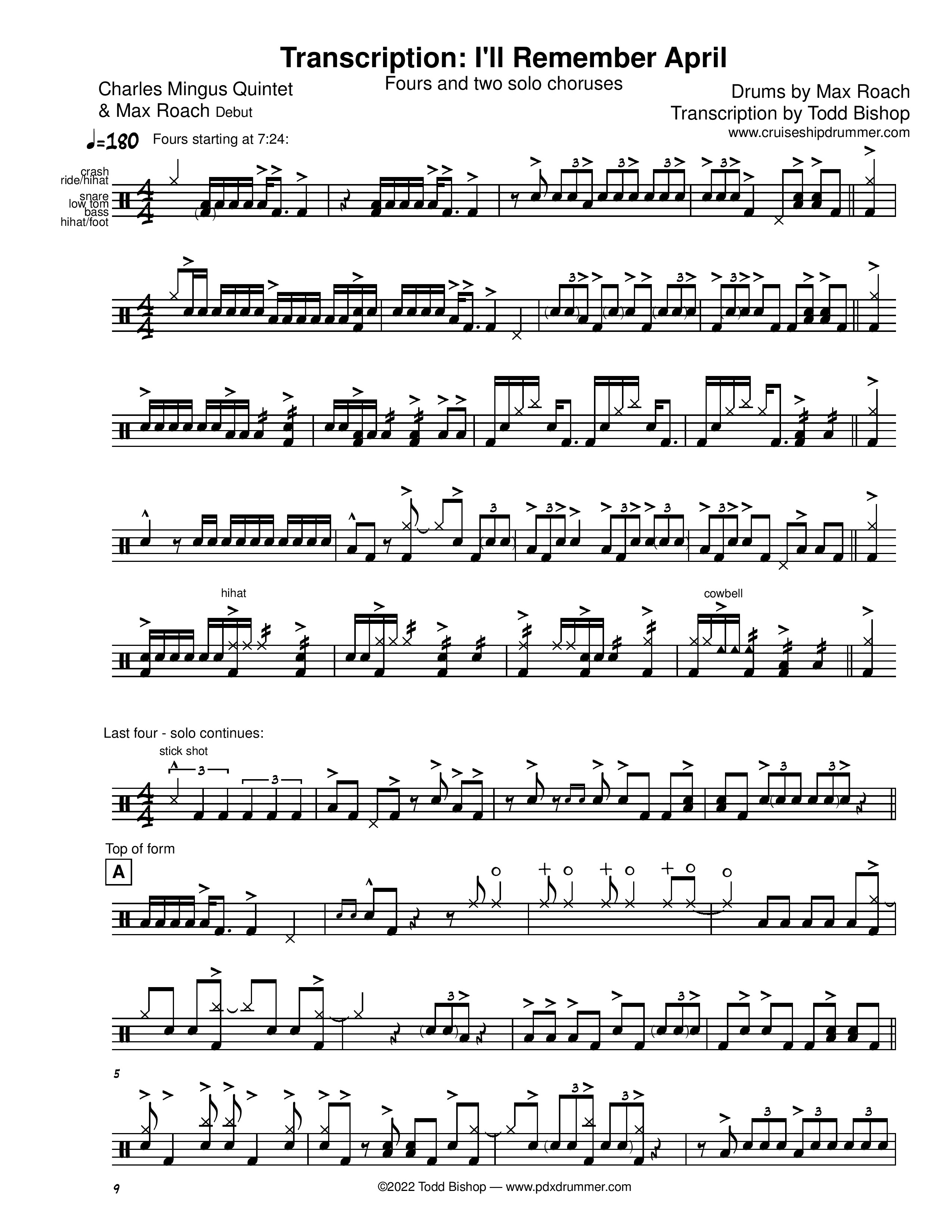
He plays a lot of 16th note singles, so mind the abbreviation— a quarter note with two slashes on it isn't a roll, it's 16ths. Jones's drum set evidently has just one tom tom, a floor tom. There's also a cowbell. He plays a triplet figure repeatedly— you see it in bar 49— the unaccented notes are probably a double.
There are some quintuplets in bar 69-70— I don't know if he's playing them deliberately. I would look for some kind of doubles to be involved on that whole passage, bars 65-71. And rudimental stickings generally— there are a couple of spots where he's obviously playing paradiddles. I think all of the 16th notes on one drum are singles.

BR: There are theatrical players, and there are melodic players. I think I play the melodic style, because I worked with a lot of trios and singers. Also, in the era I came from, there were more "melody" songs.
In order for a drummer to be really involved, he had to learn the melodies and verses to really be in tune with what everybody else was doing.
JP: Even your soloing shows this melodic structure.
BR: I think listening to Max Roach caused me to start doing that. If you really listen to Max, you'll notice that he plays the melody all the time. Many drummers who have experience with melody play "melodic" even if the tunes are more abstract. For instance, in Elvin's playing with 'Trane, there was a melodic structure set up. Even in Ornette Coleman's music—which a lot of people say is just "out"—it's all melodic if you listen to the rhythmic structure of the horns and rhythm section. I have always been conscious of playing with structure. Some people just go "out there" with no way of getting back. Sonny Rollins used to say, "When you play, it's like driving on a highway you've never been on before, but there are always landmarks. You have to make those marks."
When you first start playing, you idolize certain players. So, at one time, I tried to play like Max Roach, and then I heard Art Blakey and incorporated that into my playing. Then I heard Philly Joe Jones, and that impressed me. But the biggest impression came the night I heard Kenny Clarke. From then on, I tried to be everywhere he was working. I loved the way that he was not over the top of anyone, no matter who he played with. He was always right underneath and would always build.
He uplifted the music without overpowering anyone, and that is what impressed me about him. I decided that was the way that I wanted to play. But most important, I wanted to be a well-rounded player.
In the era I came up in, there was always someone around to inspire you or say something to you that would help you to think about what you were doing. They would make suggestions without making suggestions. The first time I met Kenny Clarke was at Minton's. I was playing, and I looked out in the audience and saw him. I tried to play as best as I could and as much stuff as I could think of. When I got off the bandstand, I went over to meet him and he said, "Yeah! That was wonderful. Let's go downtown and hear so-and-so." I said, "I can't. I have to stay here and work." He said, "Work? You mean to tell me you're going to play something after that?" [laughs] It made me stop and think. He was telling me that I had to take my time and use my space—put it in order. You can overplay without realizing it. You have to learn what not to play.

SF: Back in the '50s and '60s jazz drummers were primarily using the smaller size drums: 18" bass, 12" mounted tom and 14" floor tom. I've heard that one of the main reasons drummers used that size drum was because they were easier to transport than larger drums.
MR: Exactly. It made it easier to get from town to town. Pack up your gear, put it in your car, and off you go. That was one of the main reasons I think.
Plus, the bass drum had begun to become less and less an integral part of the whole musical set-up. It's different now. The bass drum, at that time, would stamp out what was happening with the acoustic bass. Even the pianists would leave that part. They would voice their chords so the bottom of the piano would be in thirds and sevenths instead of tonics and fifths. They left that part for the acoustic bass. So, your bass drum would only be used for accents and supports.
So the small drum was great, plus, you didn't have all the electronics around you, so you didn't need that power there. There were many reasons for it. But, today you do need that power with the electronic scene.
The italics are mine, and it's maybe a revealing part of the comment. Max typically played the bass drum in the way we now call feathering, but he doesn't bring it up as a role of the bass drum in modern jazz. It's important to note that at the time of the interview, larger bass drums were generally in favor— usually 20-22". And at that time bebop was not the only thing happening in jazz— many big players of the 60s had moved in a more fusion direction.
But imagine Mel Lewis addressing this topic— well, we don't have to. He's rather strident on it. Art Blakey said something similar in his '80s MD interview:
Like playing the bass drum: A lot of drummers today have no bottom. They talk about punctuating, but they don't keep that feeling in there, and that bass drum is the basis of the whole thing. And if you let that go it sounds like s*t to me.
I don't know what Max would say if he was asked specifically about it— he absolutely might agree with Lewis and Blakey. Maybe somebody reading has talked to him or studied with him, or been to a clinic. But feathering the bass drum in a bop setting has become such a dogmatic thing, especially with jazz hobbyists on the internet, and I thought it was an interesting omission.
I originally wrote about this in 2012, and my thinking has changed a little bit— maybe it's time to revisit that.

- Max Roach, Modern Drummer interview

Another snippet from Scott K. Fish's interview with Max Roach. This is how it's done, using your ears.
It's also interesting that Max, who moved to New York when he was very young, and was around to see all of the biggest developments in drumming happening in person— the ones he didn't make happen on his own— is talking about learning about drumming from records. Most of the story of the next generation of drumming is of other people listening to Max Roach records and doing what he's talking about.

- Max Roach
Quoted from Roach's Percussive Arts Society Hall of Fame entry.


