h/t to Hank Shteamer, uploaded by Bay Area drummer Jay Korber.

A drumming blog written by Todd Bishop.
Showing posts with label Ornette Coleman. Show all posts
Showing posts with label Ornette Coleman. Show all posts
Monday, August 05, 2024
Daily best music in the world: Ornette Coleman in Berlin - 1971
Newly uploaded video of Ornette Coleman playing Berliner Jazztage in 1971, with Dewey Redman, Charlie Haden, and Ed Blackwell:


Friday, March 25, 2022
Very occasional quote of the day: Blackwell and Ornette

- Ed Blackwell
Thursday, June 11, 2015

Thursday, May 28, 2015
DBMITW: Ornette Coleman live, 1968

So, while I work on some other things— two new books, a Europe tour, planting some hops, and dealing with a troublesome possum— check out this rare 1968 live cassette recording of one of my favorite Ornette Coleman bands, with Ed Blackwell on drums, and Charlie Haden and David Izenson on bass— I wish there were more recordings available of this group. One of these days I'm going to make a drums-sax-and-two-bassists album. Embedding is disabled, so click through to give it a listen:
part 1 | part 2 | part 3 | part 4
Wednesday, May 20, 2015
Ed Blackwell on playing the Five Spot with Ornette

So when you got to New York, you found yourself in the midst of the scene that was shaking New York’s art community to the core.
EB: Right. Well, I’ll tell you. The day I got a taxi to the front of the Five Spot. We went into the Five Spot, and Ornette pulled out his horn, and Don Cherry, we ran over our tunes, and he said, “Fine.” We went home and changed clothes and came back to work that night. And we worked there steadily for seven months, six nights a week straight.
Six nights a week will sure make a band tight.
EB: That’s right! We were doing quite a lot of recordings, you know. And he was writing quite frequently; he was writing a lot of the tunes.
Describe the way sets went down at the Five Spot. Were the pieces similar length to the records? Did you stretch out more?
EB: During this time most of the clubs were featuring two bands a night. There would be four sets. Ornette would play two sets and the visiting band would play two sets. This was going on for like six nights a week. We had a chance really to stretch out during our sets. Sometimes Ornette would stretch out our set, and sometimes he would just cut them a little shorter, depending on what mood he was in. But it was always intense. A lot of times we would rehearse all day and then come to work that night, and everybody was always geared up to play. The energy that flowed through that band was phenomenal.
Did people ever sit in?
EB: No. No, not too many people were sitting in with the band. [LAUGHS]
EB: Right. Well, I’ll tell you. The day I got a taxi to the front of the Five Spot. We went into the Five Spot, and Ornette pulled out his horn, and Don Cherry, we ran over our tunes, and he said, “Fine.” We went home and changed clothes and came back to work that night. And we worked there steadily for seven months, six nights a week straight.
Six nights a week will sure make a band tight.
EB: That’s right! We were doing quite a lot of recordings, you know. And he was writing quite frequently; he was writing a lot of the tunes.
Describe the way sets went down at the Five Spot. Were the pieces similar length to the records? Did you stretch out more?
EB: During this time most of the clubs were featuring two bands a night. There would be four sets. Ornette would play two sets and the visiting band would play two sets. This was going on for like six nights a week. We had a chance really to stretch out during our sets. Sometimes Ornette would stretch out our set, and sometimes he would just cut them a little shorter, depending on what mood he was in. But it was always intense. A lot of times we would rehearse all day and then come to work that night, and everybody was always geared up to play. The energy that flowed through that band was phenomenal.
Did people ever sit in?
EB: No. No, not too many people were sitting in with the band. [LAUGHS]
Tuesday, May 05, 2015
Ornette live in '58
Here's something remarkable: Ornette Coleman recorded live in LA in 1958, just before his big national exposure in New York. The band includes the musicians in his famous quartet: Don Cherry, Charlie Haden, and Billy Higgins, plus Paul Bley on piano. They had all been playing together a lot at this point, but like the album from '58, Something Else!, it does sound on-the-cusp; after the famous, long-running gig at the Five Spot in 1960, the band just sounds bigger and more confident in their thing. Or, hell, maybe they sounded amazing in '55 and just started getting recorded better. Don Cherry sounds great here.
Tunes are:
1. Klactoveedsestene
2. I Remember Harlem
Tunes are:
1. Klactoveedsestene
2. I Remember Harlem
3. The Blessing
4. Free
5. Ramblin' (possibly my favorite Ornette Track ever, from Change of the Century)
6. How Deep Is The Ocean?
7. When Will The Blues Leave?
8. Crossroads
4. Free
5. Ramblin' (possibly my favorite Ornette Track ever, from Change of the Century)
6. How Deep Is The Ocean?
7. When Will The Blues Leave?
8. Crossroads
Saturday, April 25, 2015
Daily best music in the world: Ornette live — 1973
I'll be out for a couple of days here— playing at the Jazz Station in Eugene tonight with flugelhornist Dmitri Matheny, attending a memorial service for my partner/wife's mother, and having my own birthday with family in Eugene— that's Monday the 27th, an excellent day to do something nice to support the blog, if you're so inclined...
...so here's a little listening for you: a bootleg recording of Ornette Coleman, from 1973. The band includes Ed Blackwell on drums, Dewey Redman on tenor, and Charlie Haden on bass. Ornette often had a second bassist, David Izenson, with him during this period, but I can't hear him here.
Part 1
Part 2
...so here's a little listening for you: a bootleg recording of Ornette Coleman, from 1973. The band includes Ed Blackwell on drums, Dewey Redman on tenor, and Charlie Haden on bass. Ornette often had a second bassist, David Izenson, with him during this period, but I can't hear him here.
Part 1
Part 2
Tuesday, February 17, 2015
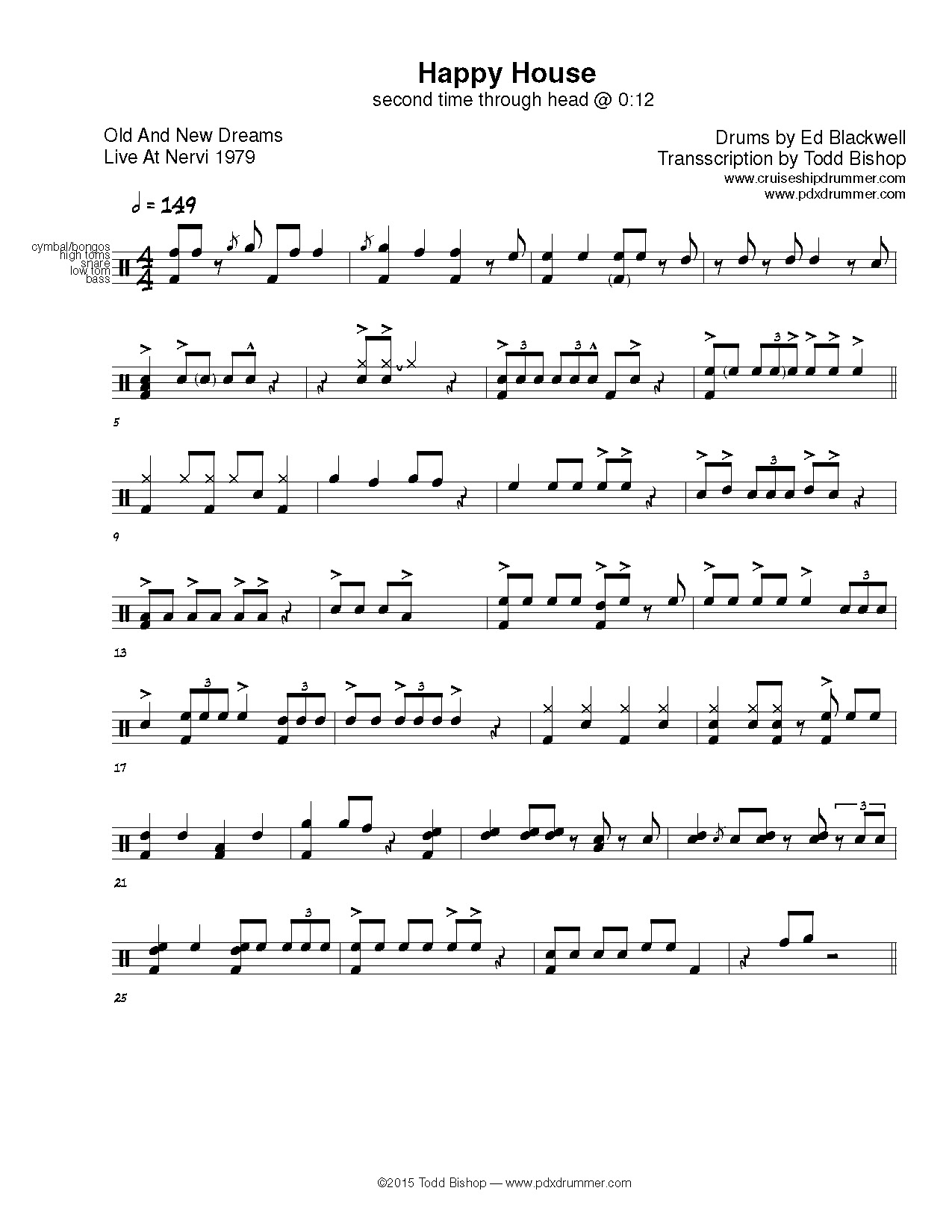
Transcription: Ed Blackwell — Happy House
UPDATE: Download link is now working!
Here is Ed Blackwell playing the head of a fairly well known Ornette Colman tune, Happy House, with the band Old and New Dreams. The beginning of the tune is cut off on the recording, so I've only transcribed the second time through the head. The album is Live At Nervi, 1979— I'm not sure if it's a real record, or a bootleg, or what. It doesn't seem to be commercially available, and I got it through one of those bootleg/vinyl rip blogs, which seem to be much of a thing anymore, what with the authorities cracking down on Rapidshare, et al.

The tempo is ~half note = 149. Blackwell is playing three regular tom toms and a couple of bongos here. You could just play the bongo parts on the two high toms on a five piece set, or adapt them however you see fit if you're playing a normal four piece set. Look for some type of mixed sticking on most of the triplets; in measures 16 and 17 they may be played as singles, starting with the left hand.
Get the pdf
Here is Ed Blackwell playing the head of a fairly well known Ornette Colman tune, Happy House, with the band Old and New Dreams. The beginning of the tune is cut off on the recording, so I've only transcribed the second time through the head. The album is Live At Nervi, 1979— I'm not sure if it's a real record, or a bootleg, or what. It doesn't seem to be commercially available, and I got it through one of those bootleg/vinyl rip blogs, which seem to be much of a thing anymore, what with the authorities cracking down on Rapidshare, et al.
The tempo is ~half note = 149. Blackwell is playing three regular tom toms and a couple of bongos here. You could just play the bongo parts on the two high toms on a five piece set, or adapt them however you see fit if you're playing a normal four piece set. Look for some type of mixed sticking on most of the triplets; in measures 16 and 17 they may be played as singles, starting with the left hand.
Get the pdf
Wednesday, September 10, 2014
What's going on: my recording of Ornette Coleman's Mothers of the Veil
While I was traveling recently, I got a note from a reader who had very kindly purchased my CD Little Played Little Bird, the music of Ornette Coleman, asking for some analysis and explanation of my drumming on the opening track, “Mothers Of The Veil”:
First, listen to the original Ornette Coleman recording, from the album In All Languages:
You can hear that Billy Higgins does a sort-of Latin feel on the head, seemingly at a faster pace than that of melody; the rhythmic connection between the drums and horns is somewhat obscure. It sounds like he's playing a shuffle rhythm on his cymbal, but it's really a quasi-Latin feel in a fast 3; what his left hand is doing really coordinates with that, and where the time goes during the solos is based on it:

Here's my chart, which is basically just a transcription of the melody as played by Coleman and Don Cherry— I don't know what the original music, if any, looked like, but you could play this chart with a steady pulse all the way through, and arrive at something fairly close to what's on the original record— putting it in 5/4 I think gives it a similar pacing to the original, which might have just been phrased with a breath every measure. Listen through the head of each of the recordings while following the chart:

Continued after the break:
First, listen to the original Ornette Coleman recording, from the album In All Languages:
You can hear that Billy Higgins does a sort-of Latin feel on the head, seemingly at a faster pace than that of melody; the rhythmic connection between the drums and horns is somewhat obscure. It sounds like he's playing a shuffle rhythm on his cymbal, but it's really a quasi-Latin feel in a fast 3; what his left hand is doing really coordinates with that, and where the time goes during the solos is based on it:
Here's my chart, which is basically just a transcription of the melody as played by Coleman and Don Cherry— I don't know what the original music, if any, looked like, but you could play this chart with a steady pulse all the way through, and arrive at something fairly close to what's on the original record— putting it in 5/4 I think gives it a similar pacing to the original, which might have just been phrased with a breath every measure. Listen through the head of each of the recordings while following the chart:
Continued after the break:
Thursday, November 07, 2013
Everybody digs the same stuff, part eleventy
I've decided that one of the immutable laws of the universe is that everybody digs the same stuff— well, I've felt that way for some time, and it keeps getting confirmed. In this latest case: if you're listening to any Ornette Coleman and, oh, Paul Bley, maybe looking for tunes to play, you're going to end up with the same selections, partly because only some of them are transcribable and playable by normal musicians, but partly because everybody digs the same stuff and everybody knows the same stuff.
Call it the Have-You-Met-Miss-Jones? effect. Everybody loves Roy Haynes's opening rim shot on that tune, including Roy. If you've heard this record, it's instantly your favorite thing on Earth:
Interviewed by Alan Jones in Portland recently, Haynes is still bringing it up, 50 years and many millions of notes later:
So anyway, in today's reletively minor case, I was slapping together some new things for next week's tour, I stumbled across a site, a blog called Jazz Transcript Authority, sharing a bunch of the same damn things I was working on: Mr. Joy by Annette Peacock, Street Woman and Macho Woman by Ornette Coleman, plus some other things I had written up in the past— not exactly well-known stuff, from little-heard albums. We'll see how usable his charts are, but there's a bunch of other interesting stuff in the same ballpark: late 60's Miles, Collin Walcott, some Don Ellis. Worth checking out if you have any interest along these lines.
Call it the Have-You-Met-Miss-Jones? effect. Everybody loves Roy Haynes's opening rim shot on that tune, including Roy. If you've heard this record, it's instantly your favorite thing on Earth:
Interviewed by Alan Jones in Portland recently, Haynes is still bringing it up, 50 years and many millions of notes later:
So anyway, in today's reletively minor case, I was slapping together some new things for next week's tour, I stumbled across a site, a blog called Jazz Transcript Authority, sharing a bunch of the same damn things I was working on: Mr. Joy by Annette Peacock, Street Woman and Macho Woman by Ornette Coleman, plus some other things I had written up in the past— not exactly well-known stuff, from little-heard albums. We'll see how usable his charts are, but there's a bunch of other interesting stuff in the same ballpark: late 60's Miles, Collin Walcott, some Don Ellis. Worth checking out if you have any interest along these lines.
Thursday, August 30, 2012
With Ornette at the Five Spot
 |
| Ornette Coleman |
SF: Was The Five Spot a good scene?
EB: It was a very happy scene. We were there about three or four months and every night it was packed. A lot of people really began to hear Ornette.
SF: Would horn players sit in with the band?
EB: No. The only person that sat in while I was doing the gig was Lionel Hampton. He came in one night and wanted to play the piano. So he sat in and played the piano!
SF: How about John Coltrane? Did he ever come down to check out the band?
EB: Coltrane would come down but he wouldn't sit in. He'd sit down and listen. During the break he and Ornette would talk quite a bit, but he never sat in. He just wanted to listen and he did a lot of listening. The scene was phenomenal. The same people that owned The Five Spot owned The Jazz Gallery. That club was about two blocks away, around the corner. When Ornette was at The Five Spot, Thelonious Monk was at The Jazz Gallery. He had a very good group: Charlie Rouse on tenor, John Ore on bass, and Frankie Dunlop on drums. They stayed there for quite awhile. After Monk left, John Coltrane went into The Gallery and he had a lot of different people playing with him. We used to go around and listen to him. We were off on Monday nights, so on Monday nights I always made it a point to come down and listen to John. Billy Higgins was drumming with John then. He was the drummer before Elvin joined the group.
Here's a little more historical detail about Ornette Coleman's career during this period.
Tuesday, July 03, 2012
Groove o' the day: T & T, too
While you're feverishly working on yesterday's GOTD by Ed Blackwell, allow me to throw at you a similar version of the same groove from later in the tune, which again is T & T by Ornette Coleman, from the record Ornette. Here the busier part is played on the high tom instead of the snare, and the SD has the snares turned off. Instead of playing half notes on the bass drum, he plays a funkier New Orleans/Baião type of pattern on the 1, 4, and 3 of the second measure:

Here it is again with the hands separated, without the bass drum:

Then with the bass added back in:

You know, I remember hearing a radio feature years ago about a French cat who had been studying with Blackwell for years, and who apparently knows his method as well as anyone living. I've been hoping he would come out with a book at some point. If I could remember his name I would hit him up to do that.
See the last post for the audio.

Here it is again with the hands separated, without the bass drum:

Then with the bass added back in:

You know, I remember hearing a radio feature years ago about a French cat who had been studying with Blackwell for years, and who apparently knows his method as well as anyone living. I've been hoping he would come out with a book at some point. If I could remember his name I would hit him up to do that.
See the last post for the audio.
Monday, July 02, 2012
Groove o' the Day: Ed Blackwell - T & T
Here's another Ed Blackwell groove, from the intro to Ornette Coleman's T & T, off the album Ornette:

For clarity, here is the same groove written as separate rhythms, without the bass drum:

We'll be seeing a lot more of these in the near future as I finally after all these years try to get inside these famous drum grooves of Blackwell's.
YouTube audio after the break:

For clarity, here is the same groove written as separate rhythms, without the bass drum:

We'll be seeing a lot more of these in the near future as I finally after all these years try to get inside these famous drum grooves of Blackwell's.
YouTube audio after the break:
Sunday, April 01, 2012
DBMITW: Lonely Woman
Maybe I shouldn't be posting this so close to the release of my own CD with this tune, but it's too good let go. Would you have the nerve to do what Paul Motian does at the end of Dewey's solo?
I'm going to be in big time work mode getting stuff together for the imminent release of my CD of Ornette Coleman tunes, Little Played Little Bird, so posting may continue to be a little a light this week.
I'm going to be in big time work mode getting stuff together for the imminent release of my CD of Ornette Coleman tunes, Little Played Little Bird, so posting may continue to be a little a light this week.
Saturday, November 12, 2011
What I was doing yesterday
Here's one of the rough mixes from yesterday's session- Ornette Coleman's Lonely Woman. I hadn't planned on recording this tune, and we didn't rehearse it, but we had nine tunes in the can, and a few minutes before Weber and Bill had to leave for their gigs. I thought it turned out rather nicely:
The band is Tim Willcox on alto saxophone, Rich Cole on bass clarinet, Weber Iago on piano, and Bill Athens on bass. The CD will be coming out in 2012, about the time of our Europe tour in April- info on pre-ordering coming soon...
The band is Tim Willcox on alto saxophone, Rich Cole on bass clarinet, Weber Iago on piano, and Bill Athens on bass. The CD will be coming out in 2012, about the time of our Europe tour in April- info on pre-ordering coming soon...
Friday, November 11, 2011
Tuesday, June 21, 2011
Tuesday, February 15, 2011
Old & New Dreams - 1980 lecture/demonstration
From Warren Senders at Running Gamak, here is audio and a transcript of a clinic given at Harvard by Old and New Dreams (Don Cherry, Dewey Redman, Charlie Haden and Ed Blackwell) during their 1980 tour. They speak in depth about Ornette Coleman's "harmolidic" method, and about making music in general.
A fun aside: it was during this tour that, in one of the more inspired programming moves ever, my brother's fusion group, Glider (or was it Glyder? Including Portland bassist Kevin Deitz and LA guitarist Richard Smith), opened for OAND at Perry's in Eugene. I think that was set up by Portland bassist Andre St. James. I had just started taking drum lessons a few months before this, and was learning the nature of life as a drummer by shlepping my snare drum the mile and a half to school 3 times a week.
Questions and answers about Ed Blackwell, who was getting dialysis treatment and was not present:
A fun aside: it was during this tour that, in one of the more inspired programming moves ever, my brother's fusion group, Glider (or was it Glyder? Including Portland bassist Kevin Deitz and LA guitarist Richard Smith), opened for OAND at Perry's in Eugene. I think that was set up by Portland bassist Andre St. James. I had just started taking drum lessons a few months before this, and was learning the nature of life as a drummer by shlepping my snare drum the mile and a half to school 3 times a week.
Questions and answers about Ed Blackwell, who was getting dialysis treatment and was not present:
Dewey Redman: ...if the drummer, who is the lifeblood of the group, is not here…it would give it a different inflection with the drummer, because he is the lifeblood, sets up the rhythm, counter-rhythm, etcetera.
[...]
Audience Member: Question for Charlie: Eddie Blackwell is not here, and you are the rhythm section for the time being. What’s that like?
Charlie Haden: Hard!
Tuesday, February 08, 2011
Charlie Haden interview by Ethan Iverson of The Bad Plus

In it Haden talks in depth about working with Ornette, Keith Jarrett, Old & New Dreams, and more. I've excerpted a few bits about the early days with Ornette, and about working with Billy Higgins, Ed Blackwell and Paul Motian. Go read the entire thing at Do The Math. After that go to Four On The Floor to watch some great Ed Blackwell clips.
ORNETTE:
EI: Tell me about playing behind Ornette in 1958.
CH: I learned about the importance of listening playing with Ornette. We first played duo at his house, for days. I had never heard such beautiful melodies. He had his compositions written out with changes on them.
EI: There were changes on his charts?
CH: Yes, and he said to play on the changes until he left them, and then just follow him. At first I thought he meant he would play on the written changes for a little while, but then I realized he would be creating a new set of changes almost right away. So I discarded his changes and followed him.
Sometimes the changes he had for the written parts didn't always fit, so I would look for the right note, even if it wasn't the root of the tonal center.
EI: Dewey Redman told me once that he was looking at a piece of Ornette's music and thought he heard some changes in there. He asked Ornette what the structure was, and Ornette responded by putting a chord symbol on every eighth note! He made sure never to ask Ornette that question again.
CH: Yeah, NEVER ask Ornette about the changes!
Sunday, February 06, 2011
Projects
Light posting for a couple of days while I proof a transcription/analysis I'm submitting to Drum! magazine- they've expressed interest in my Vinnie Colaiuta/Keep It Greasey piece (from the guitar solo in 19/16)- here's hoping it makes it to press! That has dogged me for years, ever since I showed my college professor my transcription of the body of the song (which is itself no picnic), only to have him ask "why didn't you do the guitar solo?"
"Well, it's an extremely dense recording in a very strange meter, and the tempo is ~QN=144, and all I have to work with is a cassette deck and some crappy headphones with no possibility of slowing it down, and it's one of the most insane drumming performances ever recorded" is what I might have said if I wasn't dumbfounded by the comment.
I'm also busy transcribing and arranging a bunch of Ornette Coleman tunes for my new record, which is due to be released on Origin in the fall, in time for my Europe tour.
"Well, it's an extremely dense recording in a very strange meter, and the tempo is ~QN=144, and all I have to work with is a cassette deck and some crappy headphones with no possibility of slowing it down, and it's one of the most insane drumming performances ever recorded" is what I might have said if I wasn't dumbfounded by the comment.
I'm also busy transcribing and arranging a bunch of Ornette Coleman tunes for my new record, which is due to be released on Origin in the fall, in time for my Europe tour.
Subscribe to:
Posts (Atom)