h/t to Hank Shteamer, uploaded by Bay Area drummer Jay Korber.

A drumming blog written by Todd Bishop.
Showing posts with label Ed Blackwell. Show all posts
Showing posts with label Ed Blackwell. Show all posts
Monday, August 05, 2024
Daily best music in the world: Ornette Coleman in Berlin - 1971
Newly uploaded video of Ornette Coleman playing Berliner Jazztage in 1971, with Dewey Redman, Charlie Haden, and Ed Blackwell:


Thursday, August 24, 2023
P. 38 canon
This is purely a writing experiment, pay no attention. Like, run away to some other web site right now.
Actually this is a pretty good exercise for working up an Ed Blackwell kind of solo texture, if you played it on the tom toms. I just took good old p. 38 from Reed and transcribed it for two hands, with the second part displaced by an 8th note. This kind of coordination happens a lot in Latin drumming as well.

There are really just two major combinations at work here, which I've highlighted on the segments labeled “warm up pattern.” Practice those a little bit by themselves, and you should be good to go. To make an Ed Blackwell thing out of it, play your hands on two different tom toms, add BD on 1/3, HH on 2/4, or both feet in unison on 1/3.
Thursday, May 18, 2023
Groove o' the day: Ed Blackwell - Love
Here's a fast 6/4 Afro type of groove from Ed Blackwell, on the track Love, from a duo record with Wadada Leo Smith, The Blue Mountain's Sun Drummer. There's no tune, it's just free blowing over a groove. People should do that more. These are some variations from about the first 90 seconds of the track.
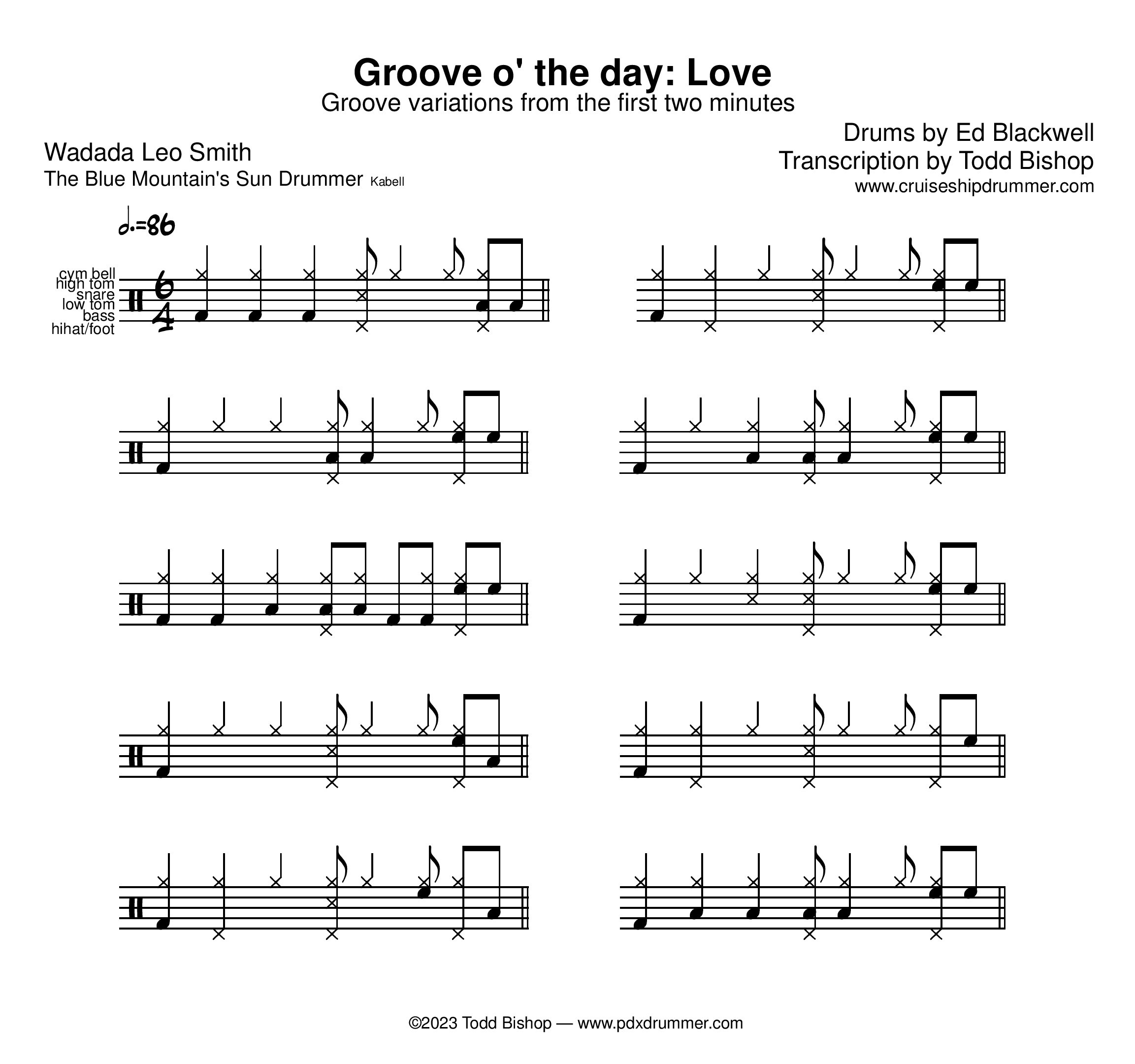
We're in kind of a compound 6/4 here— the dotted half note gets the beat, at about 86 bpm. Or if you're counting quarter notes, ~260.
Monday, June 20, 2022
Reassessing some free jazz drummers
There was a period of about five years where I was listening to a lot of early free jazz— Ornette Coleman, Cecil Taylor, Albert Ayler, Archie Shepp. Ornette (and his circle) is the only one I still listen to with any regularity. As an aesthetic and way of playing free music is still very much with me— a lot of it has been assimilated into mainstream modern jazz— but it's just one thing I do, and I don't listen to a lot of real out music.
Here I want to revisit some players I listened to in that period, and decide if there's anything there that's for me, now. I'm only making judgments for myself. I'm looking for people who do this kind of playing effectively, in the traditional sense, and who have some kind of musical personality that is appealing to me, and who have something special to say on the drums. I'm not an avant-gardist— I don't listen to music for the purpose of processing my negative feelings about it, I don't accept absolutely anything as legitimate art.
Ed Blackwell and Billy Higgins
The first players to do what was termed free jazz, with Ornette Coleman. Both solid mainstream bebop players doing real gigs outside the avant-garde— they're almost not even thought of as avant-garde. I don't think Blackwell ever really breaks away from being a groove player. Higgins may be the most humane voice in drumming— he always sounds like pure music. I talk about them both amply elsewhere on the site.
Ornette Coleman - Art of the Improvisors / This is Our Music / Change of the Century
Sunny Murray
Sunny is a strange case— I feel like there's some kind of personality disorder at work. He's the originator of that no-time white noise approach to free playing. There's some warmth there, I get a feeling of Baby Dodds around some of his later playing. See the record I posted yesterday.
Albert Ayler - Spiritual Unity
Cecil Taylor - Nefertiti, The Beautiful One Has Come
Andrew Cyrille
A great presence as an artist and creative percussionist. I've mainly listened to his old records with Cecil Taylor and a few newer things, and seen him play in person, but I don't have a real good idea of what he sounds like. It's strange. He's done a ton of creative music and I need to listen to him more. Cecil Taylor's Conquistador! is a free jazz classic.
Cecil Taylor - Unit Structures, Conquistador!
Milford Graves
Uses the tom toms a lot, with a strong African, polyrhythmic feeling— that's a feeling you can actually try to copy, and I do.
Paul Bley - Barrage
David Murray - Real Deal
Playing here with John Zorn in front of a painting by Jackson Pollock:
Friday, March 25, 2022
Very occasional quote of the day: Blackwell and Ornette

- Ed Blackwell
Thursday, December 30, 2021
Analysis: Ed Blackwell - Strength and Courage
Here's a boiled down version of the Christmas transcription, Strength and Courage, by Joe Lovano. It's a real crash course in Ed Blackwell— a lot of what he plays on many albums throughout his career is in here.
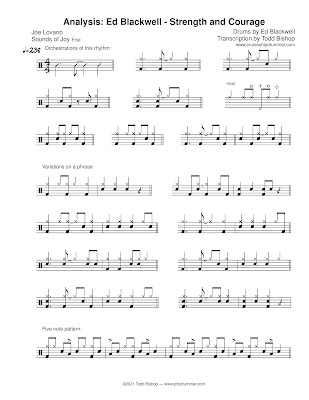
I've simplified the patterns as much as possible— taken out the bass drum, in a lot of cases. Often the bass is just feathered on beats 1 and 3, or is not necessarily integral to the pattern. You can see what he does with it on the transcription. He has a lot of integrated stuff worked up between his hands— conceptually it's not unlike the thing I called “Max's rubadub”. Inherently two-handed jazz rudiments, of a kind.
Once again, I'll leave this up for free for awhile, then sometime in the new year I'll ask for a donation to download the transcription and analysis together. Or you can just send a $3 donation when you download it now, if you want to.
Venmo: @todd-bishop-16
PayPal: toddbishop@[cruiseshipdrummer dot com]
Saturday, December 25, 2021
Transcription: Ed Blackwell - Strength and Courage
Merry Christmas, everyone. Ho ho hoooeeere's a LONG Ed Blackwell transcription for you, basically all of Strength And Courage, from Joe Lovano's trio album Sounds of Joy, along with Alex Cox on the bass. The drumming jumps around a lot, and, taken two measures at a time, this is a massive crash course in Ed Blackwell.
The tune is oddly structured— there's not much of a head to speak of. The first time through the form is 8-8-8-10-4-4-4 measures, and then 8-8-10-4-4-4 as the blowing gets going starting at 0:48. The 8 measure phrases are structured 6+2, and the 10 measure phrases is 6+4. So during that blowing form the changes could be outlined as:
||: 6-2 | 6-2 || 6-4 | 4-4-4 :||
It's noteworthy that the tempo is quarter note = 238— about the same tempo as Passion Dance, Chasin' The Trane, and some other big recordings. I've been thinking of it as Elvin's tempo, but it seems to be a sort of universal up heavy blowing tempo. Nobody should be asking about super fast tempos until you can really kill it in this range.
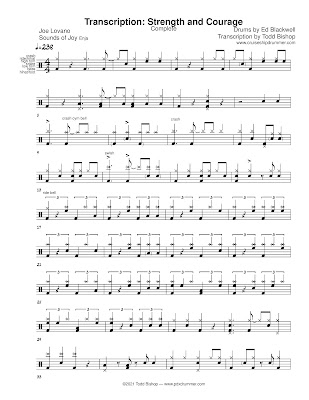
There's way too much going on here to summarize now, and I've got Christmas presents to wrap. There are a lot of different cymbals/bells happening— ride, crash, ride bell, crash bell, swish, hihat, cowbell. Snares off. Blackwell plays straight 8ths all the way through. A lot of the bass drum is quite soft, and there's very little left foot activity at all.
In the spirit of Christmas giving, I'll leave this up to download for free through New Years Day, and then, in the spirit of Christmas withholding, I'll change it to a $3 download, along with an analysis yet to be written.
Monday, September 23, 2019
Transcription: Ed Blackwell intro
A 16-bar drum intro played by Ed Blackwell on The Way You Look Tonight, from Mal Waldron's album You And The Night And The Music.
I like to post these things to shame myself for still not releasing the Book of Intros— a three year old barely-unfinished project. The thing is almost done, and I don't know when I'll actually release it. Next year? This is how it is. It's hard to open up a project again once you've gotten away from it.

This is a good candidate to actually learn to play— you'll want to figure out stickings for the more technical parts. Most of them here may be singles. Blackwell has a rather muscular sound on the drums that I attribute partly to that.
Get the pdf
I like to post these things to shame myself for still not releasing the Book of Intros— a three year old barely-unfinished project. The thing is almost done, and I don't know when I'll actually release it. Next year? This is how it is. It's hard to open up a project again once you've gotten away from it.

This is a good candidate to actually learn to play— you'll want to figure out stickings for the more technical parts. Most of them here may be singles. Blackwell has a rather muscular sound on the drums that I attribute partly to that.
Get the pdf
Thursday, May 28, 2015
DBMITW: Ornette Coleman live, 1968

So, while I work on some other things— two new books, a Europe tour, planting some hops, and dealing with a troublesome possum— check out this rare 1968 live cassette recording of one of my favorite Ornette Coleman bands, with Ed Blackwell on drums, and Charlie Haden and David Izenson on bass— I wish there were more recordings available of this group. One of these days I'm going to make a drums-sax-and-two-bassists album. Embedding is disabled, so click through to give it a listen:
part 1 | part 2 | part 3 | part 4
Monday, May 25, 2015
Ed Blackwell on playing with Monk

I’ll tell you what happened with Monk. During the course of the gig, after about a week… He used to give me a lot of solos. Then one night we were playing, and he gave me a solo, and I played, you know, and after he came off the stand he come over to me and he said, “You know, you ain’t no Max Roach.” [LAUGHS] And I don’t know why he told me that! He just danced away. Wilbur Ware was in that group also.
I remember a story Art Taylor told me about Monk. He was playing with Monk in Chicago, and Monk had stopped letting him solo. So during the course of intermission, he came over, and A.T. said, “You know, you cut off my solos, man. You used to give me little solos. Why don’t you let me play?” So he said when they went back up to the set, Monk went to the mike and said, “We will now hear a solo by our drummer.” And that was it!
Sunday, May 24, 2015
Happy birthday, Archie Shepp
While I regroup and get stuff together for next week, let's celebrate saxophonist, poet, and composer Archie Shepp's 78th birthday with Attica Blues. Play this loud:
And The Magic of Juju, with Ed Blackwell playing slit drum:
And The Magic of Juju, with Ed Blackwell playing slit drum:
Wednesday, May 20, 2015
Ed Blackwell on playing the Five Spot with Ornette

So when you got to New York, you found yourself in the midst of the scene that was shaking New York’s art community to the core.
EB: Right. Well, I’ll tell you. The day I got a taxi to the front of the Five Spot. We went into the Five Spot, and Ornette pulled out his horn, and Don Cherry, we ran over our tunes, and he said, “Fine.” We went home and changed clothes and came back to work that night. And we worked there steadily for seven months, six nights a week straight.
Six nights a week will sure make a band tight.
EB: That’s right! We were doing quite a lot of recordings, you know. And he was writing quite frequently; he was writing a lot of the tunes.
Describe the way sets went down at the Five Spot. Were the pieces similar length to the records? Did you stretch out more?
EB: During this time most of the clubs were featuring two bands a night. There would be four sets. Ornette would play two sets and the visiting band would play two sets. This was going on for like six nights a week. We had a chance really to stretch out during our sets. Sometimes Ornette would stretch out our set, and sometimes he would just cut them a little shorter, depending on what mood he was in. But it was always intense. A lot of times we would rehearse all day and then come to work that night, and everybody was always geared up to play. The energy that flowed through that band was phenomenal.
Did people ever sit in?
EB: No. No, not too many people were sitting in with the band. [LAUGHS]
EB: Right. Well, I’ll tell you. The day I got a taxi to the front of the Five Spot. We went into the Five Spot, and Ornette pulled out his horn, and Don Cherry, we ran over our tunes, and he said, “Fine.” We went home and changed clothes and came back to work that night. And we worked there steadily for seven months, six nights a week straight.
Six nights a week will sure make a band tight.
EB: That’s right! We were doing quite a lot of recordings, you know. And he was writing quite frequently; he was writing a lot of the tunes.
Describe the way sets went down at the Five Spot. Were the pieces similar length to the records? Did you stretch out more?
EB: During this time most of the clubs were featuring two bands a night. There would be four sets. Ornette would play two sets and the visiting band would play two sets. This was going on for like six nights a week. We had a chance really to stretch out during our sets. Sometimes Ornette would stretch out our set, and sometimes he would just cut them a little shorter, depending on what mood he was in. But it was always intense. A lot of times we would rehearse all day and then come to work that night, and everybody was always geared up to play. The energy that flowed through that band was phenomenal.
Did people ever sit in?
EB: No. No, not too many people were sitting in with the band. [LAUGHS]
Saturday, April 25, 2015
Daily best music in the world: Ornette live — 1973
I'll be out for a couple of days here— playing at the Jazz Station in Eugene tonight with flugelhornist Dmitri Matheny, attending a memorial service for my partner/wife's mother, and having my own birthday with family in Eugene— that's Monday the 27th, an excellent day to do something nice to support the blog, if you're so inclined...
...so here's a little listening for you: a bootleg recording of Ornette Coleman, from 1973. The band includes Ed Blackwell on drums, Dewey Redman on tenor, and Charlie Haden on bass. Ornette often had a second bassist, David Izenson, with him during this period, but I can't hear him here.
Part 1
Part 2
...so here's a little listening for you: a bootleg recording of Ornette Coleman, from 1973. The band includes Ed Blackwell on drums, Dewey Redman on tenor, and Charlie Haden on bass. Ornette often had a second bassist, David Izenson, with him during this period, but I can't hear him here.
Part 1
Part 2
Monday, April 13, 2015
DBMITW: Cherry / Blackwell / Gurtu / Wolcott / Shankar
From the same YouTube user who posted yesterday's Ed Blackwell videos, here's a totally amazing concert recording of Don Cherry playing in Neuwied, Germany, with Ed Blackwell, Lakshmi Shankar, Colin Wolcott, and Trilok Gurtu, probably from the 1979— Cherry references Margaret Thatcher's election in some improvised lyrics. You'll recognize things from El Corazon and Mu, Cherry's great duo albums with Blackwell, as well as a tune from Playing, by Old & New Dreams— Mopti, a 6/8 tune which I've been playing since this 90s.
Much more after the break— there are eight of these total:
Much more after the break— there are eight of these total:
Sunday, April 12, 2015
Lost Ed Blackwell
Jon McCaslin @ Four On The Floor has posted some obscure (I've never seen them,anyway) Ed Blackwell videos— that's all you should need to know to get over there and checkum out.
Tuesday, February 17, 2015
Transcription: Ed Blackwell — Happy House
UPDATE: Download link is now working!
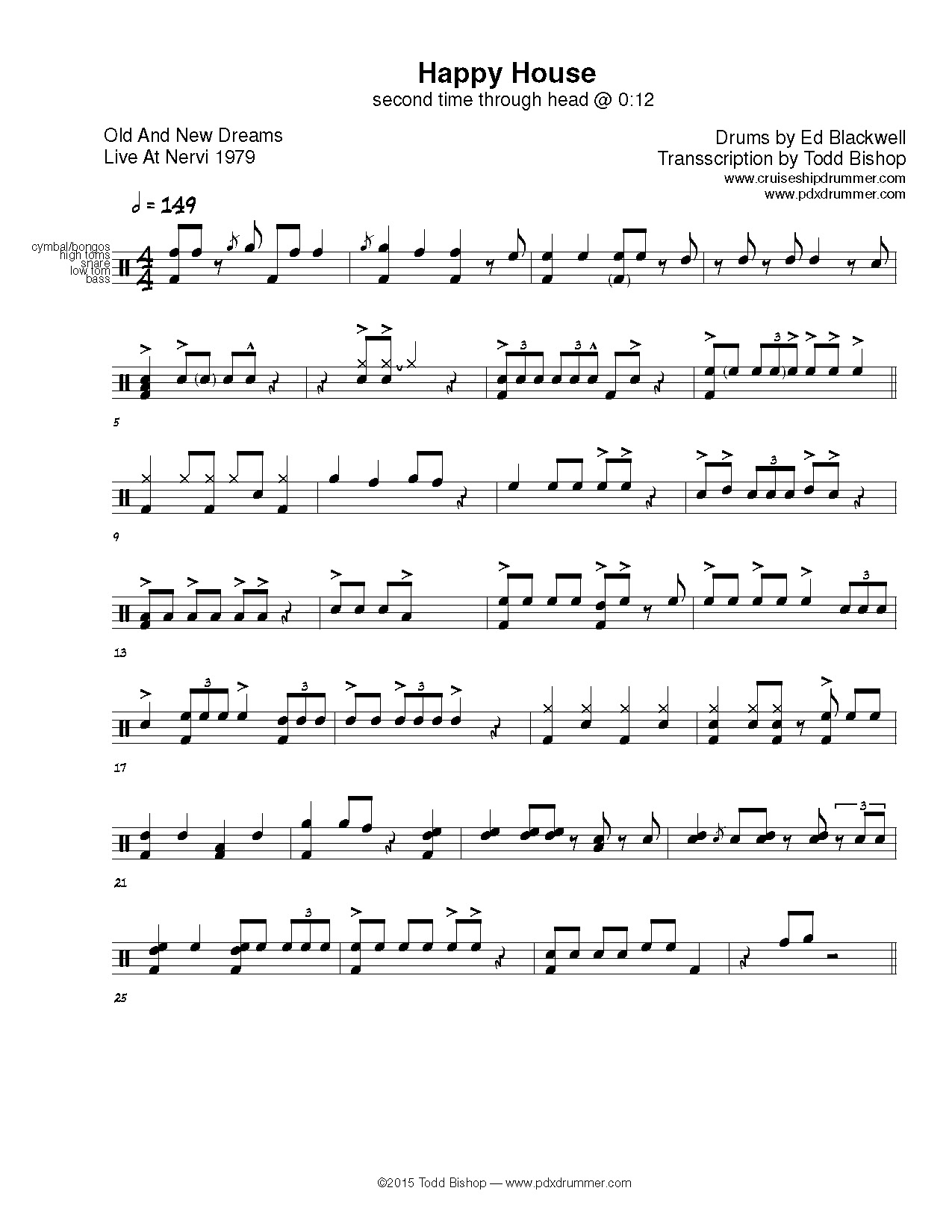
Here is Ed Blackwell playing the head of a fairly well known Ornette Colman tune, Happy House, with the band Old and New Dreams. The beginning of the tune is cut off on the recording, so I've only transcribed the second time through the head. The album is Live At Nervi, 1979— I'm not sure if it's a real record, or a bootleg, or what. It doesn't seem to be commercially available, and I got it through one of those bootleg/vinyl rip blogs, which seem to be much of a thing anymore, what with the authorities cracking down on Rapidshare, et al.

The tempo is ~half note = 149. Blackwell is playing three regular tom toms and a couple of bongos here. You could just play the bongo parts on the two high toms on a five piece set, or adapt them however you see fit if you're playing a normal four piece set. Look for some type of mixed sticking on most of the triplets; in measures 16 and 17 they may be played as singles, starting with the left hand.
Get the pdf
Here is Ed Blackwell playing the head of a fairly well known Ornette Colman tune, Happy House, with the band Old and New Dreams. The beginning of the tune is cut off on the recording, so I've only transcribed the second time through the head. The album is Live At Nervi, 1979— I'm not sure if it's a real record, or a bootleg, or what. It doesn't seem to be commercially available, and I got it through one of those bootleg/vinyl rip blogs, which seem to be much of a thing anymore, what with the authorities cracking down on Rapidshare, et al.
The tempo is ~half note = 149. Blackwell is playing three regular tom toms and a couple of bongos here. You could just play the bongo parts on the two high toms on a five piece set, or adapt them however you see fit if you're playing a normal four piece set. Look for some type of mixed sticking on most of the triplets; in measures 16 and 17 they may be played as singles, starting with the left hand.
Get the pdf
Tuesday, July 01, 2014
Transcription: Ed Blackwell — Guinea
OK, this one is definitely a labor of love— that took way too long to finish and proof. But I've been living with this piece for a good twenty years, and performing it for much of that time, so... whatever. This is Guinea, by the group Old And New Dreams, if you don't know them, a band of former Ornette Coleman sidemen: Don Cherry, Dewey Redman, and Charlie Haden, with Ed Blackwell on drums. The tune is Guinea, an African-flavored tune in 6/4, by Don Cherry.

The 8th notes are swung for much of the piece, except for a passage where straight 8ths are indicated, where he's making a double time feel. He's using three high tom toms, indicated by black noteheads on the top space, the top line, and the space above the staff. You can also safely ignore most of the hihat part. Rather than trying to play it exactly, I would just use it to get an idea of how he's approaching the feel for the tune overall. Sometimes he suggests a waltz, with the hihat on 2-3/5-6; other times he plays a "4" feel, with the hihat on 2/4/6. Often, though, the hihat is just moving sympathetically with what he's playing with his hands. Rarely is the hihat worked out as part of the coordination— his major ideas are flowing out of the hands, and bass drum.
The lick with the 5s, in measure 63, is simpler than it looks; the second lick starts on the & of 2, and ends on the & of 3. I might use a RLLRRL sticking.

In playing this, I would try not to get bogged down in the few little peculiar things, which, if I've transcibed them correctly, are obviously the product of Blackwell's very special, very practiced thing; like the 16th notes at the beginning of measure 14. Things like that are just the tip of a very large iceberg of stuff that he had been practicing and playing for decades before this. Rather than taking it as a lick to be copied, look at is as a clue about the sorts of things that are in his technical background— what he's been practicing.
Get the pdf
ECM has blocked most of their music from YouTube, and I've been spending way too much time on the computer doing technical BS to have the patience to make my own bootleg video of it, so you'll just have to buy the album, if you don't already have it. It's really essential listening, as important as any other record in my collection.
The 8th notes are swung for much of the piece, except for a passage where straight 8ths are indicated, where he's making a double time feel. He's using three high tom toms, indicated by black noteheads on the top space, the top line, and the space above the staff. You can also safely ignore most of the hihat part. Rather than trying to play it exactly, I would just use it to get an idea of how he's approaching the feel for the tune overall. Sometimes he suggests a waltz, with the hihat on 2-3/5-6; other times he plays a "4" feel, with the hihat on 2/4/6. Often, though, the hihat is just moving sympathetically with what he's playing with his hands. Rarely is the hihat worked out as part of the coordination— his major ideas are flowing out of the hands, and bass drum.
The lick with the 5s, in measure 63, is simpler than it looks; the second lick starts on the & of 2, and ends on the & of 3. I might use a RLLRRL sticking.
In playing this, I would try not to get bogged down in the few little peculiar things, which, if I've transcibed them correctly, are obviously the product of Blackwell's very special, very practiced thing; like the 16th notes at the beginning of measure 14. Things like that are just the tip of a very large iceberg of stuff that he had been practicing and playing for decades before this. Rather than taking it as a lick to be copied, look at is as a clue about the sorts of things that are in his technical background— what he's been practicing.
Get the pdf
ECM has blocked most of their music from YouTube, and I've been spending way too much time on the computer doing technical BS to have the patience to make my own bootleg video of it, so you'll just have to buy the album, if you don't already have it. It's really essential listening, as important as any other record in my collection.
Wednesday, December 25, 2013
Transcription: Ed Blackwell solo — Tarik
Oh, what the hell, happy Saturnalia— I went ahead and transcribed the solo from the GOTD of a few days ago, Tarik, by Ed Blackwell, from Dewey Redman's album of the same name. It's a real study of hand independence, and not very readable, but at least roughing it out measure by measure or phrase by phrase should give you some insight into Blackwell's way of playing. At least into this tom tom thing of his, which you should recognize right away if you've heard much of his playing. The tune is basically just a drum groove, with Redman improvising freely on the musette, along with Malachi Favors on bass. Possibly the opening phrase on musette was composed.

Throughout the piece, there are many times when the snare is played with both hands in unison, or nearly so, which I've indicated with a B. I included them based on the sound, and haven't worked through them on the drums prior to posting this, so if you hit anything really unplayable, probably one of those both-handed notes is in the wrong spot. Definitely write in your own additional stickings where needed. Blackwell basically plays quarter notes with both feet in unison all the way through, though often one or both may drop out for a few beats. It doesn't matter— the main thing is the hands. The repeated lick at measure 36 gets a little sloppy, and ends with an accidentally dropped beat, hence the single measure of 3/4.
Get the pdf
Audio after the break:

Throughout the piece, there are many times when the snare is played with both hands in unison, or nearly so, which I've indicated with a B. I included them based on the sound, and haven't worked through them on the drums prior to posting this, so if you hit anything really unplayable, probably one of those both-handed notes is in the wrong spot. Definitely write in your own additional stickings where needed. Blackwell basically plays quarter notes with both feet in unison all the way through, though often one or both may drop out for a few beats. It doesn't matter— the main thing is the hands. The repeated lick at measure 36 gets a little sloppy, and ends with an accidentally dropped beat, hence the single measure of 3/4.
Get the pdf
Audio after the break:
Monday, December 23, 2013
Groove o' the day: Ed Blackwell — Tarik
Here's something from I think the first record with Ed Blackwell I ever bought: Tarik, by Dewey Redman. It's sort of Blackwell's tom tom thing boiled down to it's smallest essence:

It will be up to you to find a sticking that works. Though it would be very difficult for most of us, I wouldn't be shocked if his right hand were playing all of the tom notes, plus the accent on the snare drum. Or there could be a LR on the low tom; probably that's the way you and I will have to play it. The flam is pretty “flat”, almost a unison, with the right hand louder than the left. As the piece develops, Blackwell begins playing the hihat with his foot in unison with the bass drum. One day I'll transcribe the solo.

It will be up to you to find a sticking that works. Though it would be very difficult for most of us, I wouldn't be shocked if his right hand were playing all of the tom notes, plus the accent on the snare drum. Or there could be a LR on the low tom; probably that's the way you and I will have to play it. The flam is pretty “flat”, almost a unison, with the right hand louder than the left. As the piece develops, Blackwell begins playing the hihat with his foot in unison with the bass drum. One day I'll transcribe the solo.
Friday, March 08, 2013
Groove o' the day: Ed Blackwell — Lop-o-lop
Another Ed Blackwell 6/8 today, from an album you may have some trouble finding, Dewey Redman's Tarik, on Aktuel. The drums play in two, and the bass (Malachi Favors, I think?) plays a fast 6.

He moves the left hand around quite a bit— either tom, snare, snare with snares off. This version includes some variations he does, usually not all at the same time:

That is a fast left hand double between the toms at the end there. He'll occasionally just play the left hand in unison with the bell part.
Audio after the break:

He moves the left hand around quite a bit— either tom, snare, snare with snares off. This version includes some variations he does, usually not all at the same time:

That is a fast left hand double between the toms at the end there. He'll occasionally just play the left hand in unison with the bell part.
Audio after the break:
Subscribe to:
Posts (Atom)