Showing posts with label Todd's music. Show all posts

Friday, August 26, 2022

The Wizard

More music in that 90s zone, from my personal archives. This really captures the spirit of my whole attitude towards playing the drums for that decade. Recorded in 2000, I think, when my group Flatland was recording our record Origin of Species. We played this tune twice in a studio in skinhead territory in southeast Portland. Using my 12/14/20 Gretsch set that was my only instrument for about 15 years. I like the performance, but the melody didn't come off the way I wanted, and it didn't really fit with the rest of the record, so we didn't release it.  

The tune is The Wizard by Albert Ayler. Here's the chart I transcribed for it:


And the recording. It's short. If it sounds like noise to you, listen to it a few times, there is direction, and order:  


That's a type of playing we don't talk about much on the site, because what can you really say about it? I think people need to do it some, whether or not they want to play that kind of music, because you can get to some things that you can't get from normal deliberate practicing and playing.   

Free playing now has gotten really preoccupied with sound— playing around with unusual timbres— but what this is about is pure energy, and listening. People hear this kind of thing as “emotional” or angry/angsty, or expressionistic, but it's really not. There is probably some kind of will to kick ass happening, but we're just playing music.  

Sunday, January 09, 2022

Jorge Rossy is stealing my stuff!

UPDATE: Oh, Crisis by Freddie Hubbard is also similar. 

Here's a funny one for you— check out the tune Post-Catholic Waltz from this 2021 recording by Jorge Rossy. 

Now compare with my tune Headlights from this 2000 recording by my group Lower Monumental. 

It's funny how people arrive at the exact same thing independently. I guess there aren't that many notes to choose from, it's unavoidable.

My tune, by the way, was inspired by Charlie Haden's tune Song For The Whales, which is distinctly different, and better.  

Friday, November 16, 2018

Hell of notes

I want to talk about my own playing a little bit. Here's an item from a little free-jazz show with Portland musicians Ryan Meagher and Noah Simpson a couple of nights ago:


What is going on here? How do you get from practicing notes on a page to that?

The short answer is: you just have to get the sound in your ear and go for it. It's in the same family of playing as Endangered Species on Ornette Coleman/Pat Metheny's Song X, something I've listened to a lot in my life.

It's not a display of chops— I'm going for an energy level and a texture and a certain feeling of time, and a certain interaction with the other players. When I'm playing the broken rock beat along with the guitar vamp, I'm not trying to be interesting or clever with the time. In my mind I'm not even looking to particularly feature the drums— I'm more setting up an energetic foundation the others can play over, and with.

People call this rubato, but it's really not rubato. That suggests a kind of variable, expressive tempo, which is not what's happening here— there is a pretty consistent feeling of velocity all the way through. A tempo area, I call it, and syncopations and variations in rhythm have the same effect they do in music where there's an actual stated tempo. When I play slowing-down accents on the cymbal, the feeling is not of the tempo slowing, but of tension vs. the continuing tempo area, which everyone is still feeling even though I'm not stating it at that moment.

I'm playing loud, but not harshly so. I'm not as loud as any given power-drumming funk guy. My cymbals are about at their limit. This was the loudest we played in our ~45 minute improvised set.

Everything I'm playing is easy. Maybe I'll do a post attempting to isolate some of the actual patterns I'm using. I'm really not aware when I'm doing it. Some of them are found in my e-book 13 Essential Stickings.

Friday, June 08, 2018

MY NAME IS PABLO PICASSO

Digging through my old cassettes I found this rather hilarious avant-garde thing I composed in 1991 on a then-fancy HR-16 drum machine, doing with it things entirely unintended by the technicians at Alesis. It's called MY NAME IS PABLO PICASSO, a suite in five movements.

This took me quite a few hours to make. At the time I was listening to a lot of John Zorn, so the movements are all extremely short; and to a lot of Ornette Coleman, especially the album Song X, so it is very dense. I performed it at a jazz combo concert at the University of Oregon, and I think half the people thought the sound system was malfunctioning, but a girl did approach me in the art library the next day to say she liked it. Turn it up loud to get the full effect...


Thursday, June 07, 2018

Figure and fills: Rover

Here's a page of drum orchestrations and fills based on a rhythmic figure from the tune Rover, on my album Travelogue, along with a practice loop sampled from it. The fills/orchestrations start very simply, building up to fairly complex. Learn to play them in your own way, and make your own variations on them.

We did a similar thing a few years ago with Herbie Hancock's Cantaloupe Island. I should write more of these!


Drum parts can and should be played on any drum, the cymbal part can be played on any cymbal. Vary the stickings as you see fit; the natural sticking for the drum set is to play the right hand on the cymbal, and the left hand on the drums, bringing your right hand to the drums as needed— in which case you can either play an alternating sticking, or doubles, or doubles mixed with singles, or a rudimental sticking. On items that don't have the hands in unison, you can also experiment with an alternating sticking— which will have your left hand moving to the cymbal sometimes. Whatever works for you.

Get the pdf

The tune was co-composed by me and Jasnam Daya Singh (née Weber Iago, née Weber Drummond), the pianist on the album. The loop is sampled from the intro, which was written by Jasnam:

Wednesday, May 30, 2018

The way I used to do things

I've been listening to some old rehearsal cassettes and demos and whatnot, and my God, I used to be an animal. This is an unreleased track, a cover of an Albert Ayler tune, from my Origin of Species record— play this loud:


To most people it sounds very aggressive, and it is, but that is a specific effect. It's not just mindless bam-bam— I was also listening hard, playing the tune, and trying to make music, just like every other time I play with people.

I worked through a lot of shit this way— it put some things in my playing I couldn't get any other way. Like if someone was going to be an abstract expressionist painter, you would expect him make a lot of big messes and waste a lot of paint on the way to being good at it. You learn by throwing it out there and doing a lot of things and seeing what works and what doesn't work. You can't work out your thing in advance in linear order, and you can't avoid people ever thinking you've made a mistake.

You also can't be worrying too much about what's correct— what your drum teacher would say, or your band director, or the people who always come after you if you play a loud sound, or even people who you might like to call you for gigs. With this group we decided to give ourselves the freedom to play whatever we wanted, and that ours would be the only opinion that counted. What made it sound like something (some of it) was that we did a lot of listening— 70s Miles, Keith Jarrett's American quartet, Don Cherry, Ornette Coleman, Bill Frisell, Sun Ra, delta blues, James Brown, all manner of African music— sub-Saharan and Moroccan. Anything with Charlie Haden on it. We were trying to do something good the way those things were good. I was certainly never thinking about anything to do with drum technique— except how it related to getting a sound— I was trying specifically to listen and not think about what I was playing on the drums.

I was pretty doctrinally committed to this way of playing for maybe 7-10 years; eventually I figured out that there were some limitations to it, and I decided to let some other things in and let my playing change, so I could be more deliberate when I wanted to. But there are a lot of things I can do that other good players can't do, because I did this.

Monday, August 22, 2016

Reed interpretation: triplets with breaks

I don't why it took me over 30 years to figure this out— I'm always looking for ways to simplify things, to make them more playable. This is an alternative to a very common, popular, and useful Reed method— the one where you play the melody rhythm with RH on ride cymbal together with BD (in a swing rhythm), and the LH fills out the triplets. One of the most useful things I ever learned for soloing .

One of its challenges is that on any note/rest values longer than a quarter note, you have to fill in multiple triplet notes— severely limiting your maximum tempo if you do them all with your left hand. You can do it much faster if you break up the multiples by bringing the right hand to the snare drum, to make only singles and doubles— I outlined the way I do this in this post from 2013. But I really don't like to think about execution at all when I'm playing, and even that very functional method is a little more technical than I like.

So the solution that finally dawned on me after three decades of playing this method: hey, let's just stop when we get to the multiples. Why not? There's no secret difficulty police that's going to walk onto the gig and escort us out for not doing something in the hardest way possible. As it turns out, by introducing some space, this method actually sounds more musical than the old one. It's a win all around.

So get out your copy of Syncopation, turn to the famous page 37 (or whatever page it is in the new edition— it's the first long syncopation exercise) and compare it with what I've written here. You can see that we stop on the melody note at the beginning of a longer space— any note+rest equaling a duration of a dotted quarter note or longer. If the next melody note is on the beat, come in normally with the melody-plus-triplets; if the next melody note is an &, play an accent on the snare drum on the 8th rest before it. Wherever there are one isolated note or two isolated notes an 8th note apart, just play the written notes and don't fill in the triplets. You should be able to figure this out by comparing the two pages:


Alternatively, you can play the snare drum on any 8th rest in the melody part. So the first two measures of the fifth line:


Would be played as follows:


Not a bad idea to stick those two-in-a-row snare hits RL, and move one or both of them to the tom toms. Of course the right hand part for this entire method can also be played on the snare and toms, without the bass drum. And as a general rule, we want to accent the RH part and play the LH filler notes quietly and legato (a lot of students try to over-articulate them), so the written melody line is emphasized.

I'll put a single snare hit on the beat after those hanging &s— melody hits on an & with a space after them. this will help get the timing, and keep a solid quarter note pulse throughout. I wouldn't do this on isolated hits on the &, like in the previous example. These two measures from the third line:


Would be played:


I don't accent that note. See what sounds good to you.

Also, where you come in on an & after a stop, instead of the single hit on the beat illustrated on the main page, I also like to play the first two notes of the triplet, with an accent on the first note. Sticking is usually LL, but it could also be RL. It makes it a little more Dejohnette and a little less big band. These two measures from the second line, then:


Would be played:


Figure out what sounds best to you and have at it. I think you'll find Exercise 4 on page 40 (old edition) to be the most challenging with this new interpretation.

Get the pdf

Saturday, March 07, 2015

2015 Europe tour

We're on light posting for a few days here, clearly, while I'm focused on some other stuff. LIKE MY 2015 EUROPE TOUR; it looks like we'll be on the road from approximately December 2-21, 2015. We'll definitely be playing in Belgium, Luxembourg, and western Germany; we'll see about the Netherlands and France... once I get to listing countries in a graphic, it's hard to stop... the Dutch especially have been notoriously reticent to book my groups.

We'll be back to regular programming soon enough...

Saturday, September 27, 2014

Transcription: Todd Bishop — Black Monk

This week I was working on something really narcissistic: a transcription of one of my own performances. I was just listening to some of my old rehearsal/gig recordings and thought, hey, I'd like to figure out what the hell I'm playing. When I had the thing finished, it seemed like it was a good opportunity to talk about some organic, seemingly-semi-metered Elvin- or Dejohnette-like playing. It's a thing that basically never gets discussed in any detail, and this is one instance in which I can definitely speak with authority about what was going on in the player's mind with it. Also, I was curious hear my own playing with the same frame around it as these other people. It's an interesting exercise, and, if you do any transcribing, I recommend it.

The recording was made from the stage during a 2009 gig with the Dan Duval Sextet, and isn't some special piece of genius playing on any of the performers' part; it was just a routine, rather sloppy, original-music gig at the Tugboat Brewery in Portland— a little dump which for a long time hosted live creative music. The tune is an easy, triplety, medium waltz, and a local favorite: The Black Monk, by Duval. I've transcribed the drums from Dan's guitar solo. The piece is really in 3/4, but the stuff I was playing is easier for me to notate in Finale in 9/8. It's the same thing; a predominantly-triplet feel in 3.


Here's the audio— the transcription begins at 0:27:


If you'd care to download and print the pdf, there's an extended analysis after the break:

Wednesday, September 10, 2014

What's going on: my recording of Ornette Coleman's Mothers of the Veil

While I was traveling recently, I got a note from a reader who had very kindly purchased my CD Little Played Little Bird, the music of Ornette Coleman, asking for some analysis and explanation of my drumming on the opening track, “Mothers Of The Veil”:


First, listen to the original Ornette Coleman recording, from the album In All Languages:


You can hear that Billy Higgins does a sort-of Latin feel on the head, seemingly at a faster pace than that of melody; the rhythmic connection between the drums and horns is somewhat obscure. It sounds like he's playing a shuffle rhythm on his cymbal, but it's really a quasi-Latin feel in a fast 3; what his left hand is doing really coordinates with that, and where the time goes during the solos is based on it:


Here's my chart, which is basically just a transcription of the melody as played by Coleman and Don Cherry— I don't know what the original music, if any, looked like, but you could play this chart with a steady pulse all the way through, and arrive at something fairly close to what's on the original record— putting it in 5/4 I think gives it a similar pacing to the original, which might have just been phrased with a breath every measure. Listen through the head of each of the recordings while following the chart:


Continued after the break:

Thursday, June 19, 2014

Groove o' the day: Todd Bishop — The Secret Agent

I've got a bunch of unfinished stuff on deck, so we'll just keep doing GOTDs until I can get it together and be a writer.

And what the hell, let's do one of me. The record is Origin of Species, something my old band Flatland recorded in about 2000, in a dump of a studio in the part of Portland called “felony flats.” We got a lot of time on the cheap, and got our rehearsed material out of the way pretty quickly, which freed us up do some free playing and experimenting. This piece, The Secret Agent, was just something we improvised with no forethought at all— I had our guitarist, Matt Wayne, overdub some psychedelic textural stuff, and that finished the piece.

We find a tempo in the first few seconds, and the groove develops within the first four measures that I'm actually playing time, and then hangs on that for the rest of the piece, with fills and variations. That, and the melody spontaneously composed by Matt Wayne, our guitarist, gives the piece some unity. This groove isn't anything I'd ever played before; clearly all the parts follow from the Reed-like cymbal pattern:


The main features of the groove are that cymbal pattern, the strong bass drum on beats 1 and 2 of the first measures, and the syncopated “backbeats” on the snare drum. Everything else is detail. The isolated filler notes on the snare drum on the 'a' of the beat are unusual for me.

Here's the audio:


Friday, April 18, 2014

Playing in Seattle tonight...

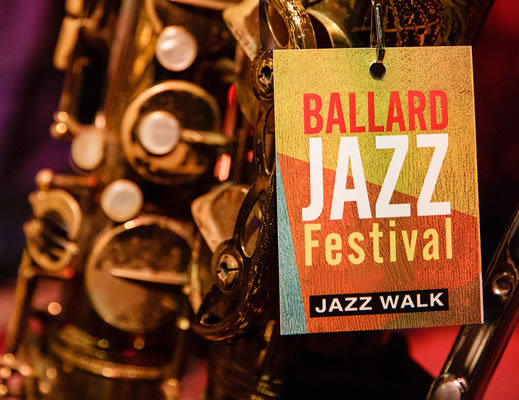
Hey, if you're in Seattle, come on down to Egan's in Ballard tonight— my group will be playing at 10:30, as part of the Ballard Jazz Festival. The band includes Richard Cole, Jasnam Daya Singh (née Weber Iago), and Chris Higgins. Before us at 8 is George Colligan's group, with Matt Jorgensen on drums. There's a whole lot of other music going on in the neighborhood, too.

Monday, December 02, 2013

Tour wrap-up

After our first gig, at Hot Club de Gand, in Ghent.
The tour went quite well, by the way— the shows were all well attended, audiences were very appreciative, we got some good press, and we are well situated to expand our reach next year. And we actually turned a profit this year; the gigs paid well, and I sold all of the CDs I took with me— 60 of them, I think. This was my fourth trip to Europe leading my own group; the first one lost a lot of money, another one made a little money, and another roughly broke even.


There's a gallery of photos from the tour here, and our updates from the road are here.


Earlier I posted the tunes I was including in our book— we ended up playing:
Mothers Of The Veil
Feet Music
Strange As It Seems
Enfant
Mob Job
Lonely Woman
Owl of Cranston
Guinea
Mopti
Empty Boat
Valse de Melody

And less frequently:
Comme Il Faut
Check Up
Las Vegas Tango
Olhos de Gato


Here's the group playing Mopti, by Don Cherry, at the Jazz Station in Brussels:


The musicians there are: Weber Iago — piano / Jean-Paul Estievenart — trumpet / Olivier Stalon — bass / Todd Bishop — drums

It's funny, this was the second gig of the tour, I was feeling pretty jetlagged, and felt that the group was under-rehearsed, and that we were kind of hacking out a performance; with a little distance from it, though, you forget what you were feeling, and what you were trying to do, and you can see the thing for the respectable performance it is. That's become one of my rules: the gig was always better than you think it was. I can't promise that holds for everyone at all times— it most certainly doesn't, in fact— but time and time again I have heard recordings from what I thought was a really off night, and they are inevitably totally fine, or even good.

So, now it falls on me to make a new record fast— which is how I like to do them— and get booking the November '14 tour in January/February... onward...


Thursday, November 14, 2013

Europe tour updates

Jazz Station, in Brussels
Things are going swimmingly so far, with two gigs down, but it's proving difficult to put tour updates on the blog, so if you're interested, please visit my personal Facebook page (and you're welcome to add me as a friend), or our Facebook event page. Otherwise, see you in December!

Sunday, November 10, 2013

On tour

As you may've heard, because I keep mentioning it, I'll be in Europe for the next 2+ weeks, starting now. Stay tuned for whatever updates I can make from the road— photos, video, and such. If you're in Belgium, Luxembourg, or northwest Germany, come on out and hear the band. Visit our Facebook event page for a list of gigs, with all details, but here are the essentials:

Personnel: 
Todd Bishop - drums
Jean-paul Estievenart - trumpet
Weber Iago - piano
Olivier Stalon Music - bass

Gigs: 
12/11/13 - 21:00 :: Hot Club de Gand — GENT
13/11/13 - 20:30 :: Jazz Station Asbl — BRUSSELS
15/11/13 - 19:00 :: Blues-Sphere — LIEGE
16/11/13 - 20:00 :: Appeltuin Jazz — LEUVEN
17/11/13 - 15:00 :: Centre Culturel Hannut — HANNUT
18/11/13 - 20:30 :: Dumont's — AACHEN
19/11/13 - 21:30 :: LiquID — LUXEMBOURG
20/11/13 - 21:00 :: Le Rideau Rouge — LASNE
23/11/13 - 21:00 :: Lokerse Jazzklub — LOKEREN
24/11/13 - 17:30 :: Flamingo Brussels — BRUSSELS

We'll be back to our regular content around December 1st. And, once again, if you would like to get a lesson from me, I will be based in Brussels from the 12th-24th, and then in Berlin on the 25th-27th. You can reach me through the regular site email.

Tuesday, November 05, 2013

2013 tour repertoire

Here's a list of the tunes we'll be working with on my group's Belgium trip next week. We won't end up playing all of this stuff, but it's in the books. A little over half of those are my own arrangements— I transcribed them off the record and made a playable lead sheet out of them, anyway.

Alice In Wonderland — Sammy Fain
Beatrice — Sam Rivers
The Blessing —  Ornette Coleman
*Blood — Paul Bley
Check Up — Ornette Coleman
Comme Il Faut  —  Ornette Coleman
Country Town Blues — Ornette Coleman
*The Empty Boat —  Caetano Veloso
Eighty-One — Ron Carter 
Enfant —  Ornette Coleman 
Feet Music — Ornette Coleman 
Guinea — Don Cherry
*Happy House — Ornette Coleman
Ida Lupino — Carla Bley
Las Vegas Tango — Gil Evans 
*Let's Play — Ornette Coleman
*Law Years — Ornette Coleman
Lonely Woman — Ornette Coleman
Mr. Joy — Annette Peacock
Mob Job —  Ornette Coleman 
Mopti — Don Cherry 
Mothers of the Veil — Ornette Coleman 

Never — Steve Swallow
Olhos de Gato —  Carla Bley
Owl of Cranston — Paul Motian
*Somnambulist — Rich Cole 
Strange As It Seems — Ornette Coleman
Syndrome — Carla Bley
Valse de Melody —  Serge Gainsbourg

Bold — likely players
 * —  new additions for 2013. We'll see if they work...

Wednesday, October 23, 2013

2013 tour posters

All right, the posters for my upcoming Europe (well, Belgium, plus the outer tip of Germany and Luxembourg) tour are done!

Here are the shows, once again, with times:
9:00, Tuesday, Nov. 12 Hot Club de Gand GHENT, Belgium
8:30, Wednesday, Nov. 13 Jazz Station BRUSSELS, Belgium
7:00, Friday, Nov. 15 Blues-Sphere LIEGE, Belgium
8:00, Saturday, Nov. 16 Appeltuin Jazz LEUVEN, Belgium
Event starts 5:00, Sunday, Nov. 17 Hannut Jazz Festival HANNUT, Belgium
8:30, Monday, Nov. 18 Dumont's AACHEN, Germany
9:30, Tuesday, Nov. 19 LiquID LUXEMBOURG
9:00, Wednesday, Nov. 20 Le Rideau Rouge LASNE, Belgium
9:00, Saturday, Nov. 23 Lokerse Jazzklub LOKEREN, Belgium
5:30, Sunday, Nov. 24 Flamingo BRUSSELS, Belgium

Friday, October 11, 2013

2013 Europe tour

Hey, my 2013 Europe tour, my fourth, is coming up in November— exactly four weeks from now. We'll be playing music from my record Little Played Little Bird, the music of Ornette Coleman, and some other things. The band will include the Brazilian pianist/composer Weber Iago, and Brussels musicians Jean-Paul Estievenart, and Olivier Stalon.

Here are the dates— if you're in the vicinity, come on down!

Tuesday, Nov. 12 Hot Club de Gand GHENT, Belgium
Wednesday, Nov. 13 Jazz Station BRUSSELS, Belgium
Friday, Nov. 15 Blues-Sphere LIEGE, Belgium
Saturday, Nov. 16 Appeltuin Jazz LEUVEN, Belgium
Sunday, Nov. 17 Hannut Jazz HANNUT, Belgium
Monday, Nov. 18 Dumont's AACHEN, Germany
Tuesday, Nov. 19 LiquID LUXEMBOURG
Wednesday, Nov. 20 Rideau Rouge LASNE, Belgium
Saturday, Nov. 23 Lokerse Jazzklub LOKEREN, Belgium
Sunday, Nov. 24 Flamingo BRUSSELS, Belgium

If anyone is interested in getting a lesson or two, I'll be based in Brussels from November 11-24, with a full day in Luxembourg on the 19th, and three days in Berlin from the 25th-27th. Hit the “email Todd” link in the sidebar to reach me about that.

Saturday, April 13, 2013

Ballard Jazz Walk next Friday

If you're in Seattle, hopefully you're out going to all of the Ballard Jazz Festival events anyway, but my group will be playing at the Salmon Bay Eagles on Friday, at 8pm, as part of the Jazz Walk. The band features, hey, me, along with three incredible players— Rich Cole (reeds), Jay Thomas (trumpet), and Paul Gabrielson (bass). It's going to be good.

More Jazz Walk info.

Get your tickets here.

Wednesday, March 06, 2013

2013 Europe tour taking shape

This way to Hot Club
Dates for my November, 2013 Europe tour are starting to firm up:

Tuesday, November 12
Hot Club de Gand — Ghent, Belgium

Sunday, November 17
Hannut Jazz Festival — Hannut, Belgium

Saturday, November 23
Lokerse Jazzklub — Lokeren, Belgium

Tour personnel will be:
Jean-Paul Estievenart — trumpet
Weber Iago — piano
Olivier Stalon — bass
Todd Bishop — drums