Showing posts with label Paiste. Show all posts

Sunday, November 16, 2014

Things I learned at a Billy Mintz concert and clinic, and hanging at Revival Drums

Get it here.
I already knew this, but I was reminded of how great is the distance between things we can talk about and write about with drumming, and the actual music itself. The actual music is a living, instant process, and practicing it, and studying it, is just sort of nipping around the edges of understanding it. It's like science is to the natural world; it doesn't claim to be able to tell the whole truth about everything, just about things it can say kind of for sure based on its own method. So we talk about the things we can, given the limitations of our media— language, the Internet, the software, and an imperfect user, me— and we don't talk about the things we can't. And what we can't talk about is a lot of stuff. It's almost the whole real thing.

So I won't try to say a lot about the concert, except that there was significant music happening. The players' patience was striking. They were not always in a hurry to get to the next note, and certainly not to get to some big, obvious, emotional payoff; but the music was never boring, or especially long-winded. The tunes, I think all by Mintz, were beautiful— something Monk-like about them, which was reinforced by the playing of Roberta Piket, the pianist, without anyone being overly referential or obvious about it.

It made me realize that some other music which I had been immersing myself in for another post, is total f__ing jive bullshit. Suddenly it's about as admirable to me as someone delivering a truly impressive time-share sales pitch. I can't have the music be just about the players' talent, and how much stuff they know.

Other thoughts:

Billy had a funny cymbal set up with two 70s-vintage Paiste 2002 20" sizzle cymbals— maybe one was a ride and the other a “medium”, a crash-ride. I thought he picked them out of Revival's stock, but they were his. They're not light cymbals, and the sound is a little different than you normally hear in a jazz context, but they had a nice tonal thing going on between them.

Everyone needs to buy more CDs. Can we all agree to make it a habit? Go to a show > buy a CD. Here, go order a Billy record.

I finally found a budget (well, mid-range) cymbal that not only doesn't suck, but that is actually really good: Istanbul's Xist line. The quality of the sound is somewhere between an A and a K. Jose at Revival informs me that they're actually consistently good— unlike the Dream brand, which is in the same approximate price range, and is sometimes great, but mostly not.

Revival Drums is another reason why Portland rocks. Going there really makes me feel like I need to add about $1500 per annum to my gear budget. Highlights: the cymbals below, a really perfect early-80s Yamaha Recording Custom set for $1800, a yellow-sparkle Rogers double-bass set from the 60s, a rare Yamaha floor tom with a tensioning pedal for doing talking drum-like effects. Really surprised no one has snapped that up...

Another reason Portland rocks is the company Cymbal & Gong— Revival was carrying several of their— or his, I think the company is one guy— hand-hammered, K-type cymbals. I believe the cymbals are manufactured in Turkey, and C&G hand selects the ones that get their brand, and patinas them. They also have seconds that don't get patina-ed, and are cheaper. It sounds almost like a miniature version of the old Gretsch warehouse in New York here. Jose says Matt Chamberlain, the guy from Tortoise, and a bunch of other big rock people are buying these. I smell a CSD! feature here...

Anyone in Portland who missed the show can see John Gross and Mintz play a duo concert at Revival on Wednesday night, the 19th.

Saturday, November 02, 2013

A few new vintage Paistes

I guess the 80's is vintage now. In the past few years I've been rebuilding my cymbal collection, after ruthlessly disposing of a lot of things during a lean patch, and have largely been focusing on older Paistes. After years of listening to Billy Higgins, Jon Christensen, Paul Motian, Al Foster, and ECM recordings in general, much of the sound in my head calls for them. And, as I've written before, I've also been on a clarity kick for several years, and the 602 and Sound Creation cymbals definitely fulfill that. The thin, warm, dark, lush, pretty-sounding, quiet cymbals jazz drummers have been favoring of late, while great for recording, I've felt have led to stage volume issues— mainly, a death-spiral of quietness— as well as being-heard-by-the-audience issues. I'm still generally playing these heavier cymbals quietly, but there is enough sound here to keep players from weirding out at their own finger noise competing volume-wise with the actual music. I believe a pianissimo on these cymbals gives you a true stage pp, which is louder than a practice room pp, where your ear is a couple of feet from the instrument.

That's the back story. These tend to be expensive cymbals, but through some very patient, unemotional shopping I've been able to get them very reasonably— for about half the expected price, actually. Here they are:


14" Sound Creation Dark Sound Edge Hihats — Black label, 1978

The sound here is dark and fairly complex, but these are very powerful cymbals, and high-pitched, the loudest hihats I've ever owned. The wavy sound edge bottom cymbal gives a very crisp, cutting foot sound. One of our local jazz guys, Ron Steen, has been using these exact cymbals and sounding great with them for years, in all settings— dinner music, vocalists, and everything. Players used to stomping on their hihat pedal would have trouble using these when any kind of delicacy is required; I've found it relaxes my whole physical set to just be able to step on the pedal and have the cymbals speak. They don't sound especially pretty by themselves from the playing position, but they blend nicely with the entire drumset, and with the rest of the ensemble.


20" 602 Heavy — Blue Label, 1985

I've been proceeding on the assumption that there are no bad 602s, and haven't been much disappointed so far. I saw Art Blakey playing what I guessed was a 22" heavy 602 back in 1985— his ride cymbal was extremely cutting. I don't feel this cymbal fits that profile at all; it's not overpowering or especially bright, despite its weight, which actually seems to have a dampening effect. It has that very refined 602 sound, and is not too bright. It is difficult to get a clean crash out of it, which I suppose you would normally expect, except that I can get that out of my 22" Dark Rides, which are not any thinner than this. Here the crash is long, without much of a peak, and you don't get much volume. It's obviously not a quiet cymbal, but it's not really a high-volume one, either; you could hurt yourself and the cymbal trying to play it really loudly. It would probably make a beautiful sizzle cymbal, but I'm going to take a break from drilling things for the moment.

I don't know the weight in grams— maybe around 2700-2800. Close to the weight of an A. Zildjian Ping Ride, but without that model's offensive qualities.


22" Sound Creation New Dimension Dark Ride — 1984, drilled for rivets, 3220 grams

 With the acquisition of a second one of these monsters— the other being a very early 22" 602 Dark Ride— I guess I'm officially an “SCDR” guy. Certainly Paul Motian's statement that “I’ve got a few of those…” has been working on my mind. I got a very good deal on this, mainly due to the fact that it has been played a lot; the top logo is worn away, there is a keyhole that appears to have been professionally drilled, and one minor nick in the edge. Plus cymbals drilled for rivets tend to sell a lot cheaper than “virgin” ones. People are silly that way. This is a creative tool to me, not a decoration or a vanity item, and I don't give a crap about any that stuff, so I was able to pick it up for about half of the normal low-end cost for this model.

This is the New Dimension model, and I don't know how those are distinct from the regular SCs— it's an addition to the line they introduced in the 80's. There are several iterations of 22" darks at cymbal smith Matt Bettis's site, and while he notes differences, he doesn't seem to particularly value one line (602, transitional, SC, SCND) over another. Compared to my 602 Dark, the ND is darker sounding, lower pitched, and more complex, with a fatter, gong-like overtone cushion. There's a fairly pronounced shoulder built in to the cymbals profile, which gives some distinctly different-sounding playing zones— you can draw a lot of sounds out of it. Like the 602, it is capable of producing a fast, explosive crash. It's rather an intimidating cymbal— when you first sit down with it, it feels like driving a large, 70's-vintage Cadillac. It handles like a boat at first, and you definitely have to find the right touch for it.

These Dark Rides were created by Paiste in partnership with Jack Dejohnette, and I wonder if the sound he was going for was not that of Jon Christensen's famous, heavy 22" K— it seems likely they crossed paths a fair amount in Europe in the early 70's— at least they were both being produced by Manfred Eicher a lot. It's remarkable how well the Sound Creations— heavy cymbals— handle in all sorts of situations. There's a lot of hype about them; maybe it's justified, and/or being what they are, maybe I give them a chance in settings where I would normally use something lighter.

By the way, if I've talked you into spending a lot of money on these types of cymbals— well, first think twice about it; they can be very challenging cymbals to work with— and then reread my tips on buying used cymbals online, then visit the following page by Zenstat, a moderator at the Cymbalholics forum who has compiled eBay sales statistics for Paiste 602 and Sound Creation cymbals from 2006-present. That should give you a ballpark idea of what you can expect to spend, keeping in mind that used prices are trending precipitously downward from the high points in his stats right now.

Monday, March 04, 2013

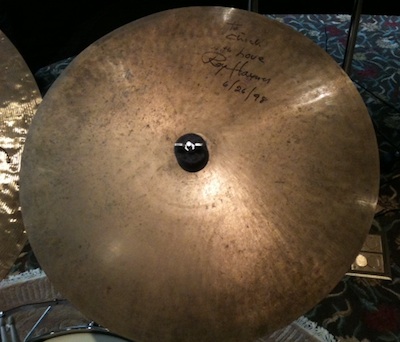
Got my Chick cymbal

The original, signed by Roy Haynes.
The nice thing about Paiste cymbals— most of them— is that when you hear a sound you like, you can duplicate it almost exactly by just buying the same type and model of cymbal. They're very consistent, even across decades; my circa mid-60's 20" 602 medium ride, though a little played-out, is obviously the same basic cymbal as the current reissued 602s.

So after many years of listening to Chick Corea's Now He Sings, Now He Sobs and Return To Forever I was very excited the other day when the type of cymbal used on those records, an 18" Paiste 602 Flat Ride— in this case a 1975 Medium Flat— arrived in the mail. There seem to be some differences of opinion as to what the cymbal was, exactly— whether it was a medium or a thin. I always thought it was a 22", based on a random comment by my brother, but the consensus is that it was an 18", and comparing my cymbal with the recordings that makes sense.  My medium is definitely on the lighter side of that category, and crashes better than you would expect, and is still a very light-sounding instrument. Chick's cymbal is a “pre-serial” model, meaning it was manufactured before Paiste started stamping serial numbers on them.

Continued after the break:


Sunday, November 18, 2012

Tour gear rated

C'est indispensable
I want to take a moment to mention some pieces of gear that distinguished themselves one way or another on this trip:

20" Paiste Sound Formula Full Ride with six rivets
This cymbal subs for my 22" 602 Dark Ride, and it turned out really nice. Since their sound from cymbal to cymbal is pretty consistent, and you can get them cheaply on eBay, I would not have been crushed if it had gotten stolen or lost, as I would've been with the 602. I highly recommend using a 20" when flying— my cymbal bag fit into the overhead bins on every leg of our trip. When I was schlepping a 22" I would have to sweet-talk a flight attendant into putting it in with the garment bags, risking them forcing me to check it if they didn't feel like helping me with it. Read my earlier semi-full review of this cymbal.

20" Sabian Jack Dejohnette Ride (original line)
Using two medium-weight 20" rides was a pretty unusual choice for me, but it worked well. This very dry cymbal is a nice contrast to the long and lush Paiste, and it has been working really well for me on the left side, especially when playing softer. It responds much like a drum, and has a nicely finished, clean sound when used with drums that are also pretty dry. One instance where it failed utterly was at CafĂ© Belga in Brussels— a large room that tends to have listeners close to the band and a lot of talkers in the back. There this cymbal just died.

Sonor drums - 70's, 9 or 10 ply mahogany Phonic line, I think. 12", 14", 18"
Loaned to me by a great Brussels drummer, Teun Verbruggen. These are some of the best drums I've ever played. Sounded great tuned low in the studio and on our one rock gig, and on all of the jazz gigs as well. I would love to get a set of these if I could find one for less than $3000. Hardware is typical Sonor overkill, with the plate for the tom mount weighing ~5 pounds by itself, otherwise they're not ridiculously heavy.

Sabian cymbal bag
Their heaviest-duty bag. Or their most expensive, anyway. This is the same one I had to sew up on my own because it was falling apart after a couple of years. It (and my sewing job) survived the trip, despite being jammed on flying days with two medium 20's, 16 and 18" crash cymbals, hihats, my stick bag, and my snare drum stand.

Chop Busters by Ron Fink
This is the one book I took along for grabbing a few minutes of pad practice here and there, a purpose for which it is extremely well suited. Read my original review for it here.

Some essential non-musical items after the break:

Saturday, February 11, 2012

Three Paiste cymbals

UPDATE: I think I've correctly ID'd one of the other cymbals.

I've been on a vintage Paiste cymbal-buying kick recently. Here are the findings on my finds:

22" Formula 602 Dark Ride - circa 1975-76 - approx. 3266 grams

The Dark Ride family of cymbals- which includes the later Sound Creation (and SC New Dimensions) Dark rides, and the "transitional" cymbals- has something of a cult following; on the aptly-named Cymbalholics forum they are discussed in terms bordering on mystical. Designed with input from Jack Dejohnette, other noted users include Paul Motian, Al Foster, and Jon Christiansen.

Here's what cymbalsmith Matt Bettis says about these cymbals, and how they compare to their successors:
The ultra-rare 22" Paiste Formula 602 Dark Ride is one of those cymbals that very few ever get to play much less actually own. The ideas behind them eventually became the Sound Creation Dark Ride, but they are definitely different beasties. The 602 has hammering that is more dense, and a markedly different sound. She has that killer, dark and complex wash, but her stick and bell are much more 602-ish than the Sound Creation Dark Rides.

So, this thing is, ah, quite prodigious. It even looks imposing sitting on the stand. It is actually about 1 cm larger than my other 22's, in fact. The sound is huge- an order of magnitude bigger than the light 22" Bosphorus Turk or Sabian Raw rides I've been playing. It's very imposing in the practice room, but when I played it on a session it snapped into a perfectly balanced Paul Motian sound. You can get a great range of sounds out of it lower volumes, and I'm really digging that the thing actually cuts- that's kind of a forgotten property for jazz cymbals. I noticed it influencing my touch on the rest of the instrument as well; it led me to pull a little fuller sound out of the drums. Yes, that means I played a little louder because of the louder cymbal, but it's more complicated than that. I actually think that trying to come in under the very delicate Bosphorus has led me to play excessively quiet; this cymbal balances with the natural volume of the instrument, which is a little bigger than I had been playing.

Using it in a combo situation definitely requires a refined touch- I don't think I would've been able to handle it as recently as five or six years ago. I play it with a Vic Firth SD-11 Slammer, a maple stick the size of a largish 5B. Cymbalholics devotees speak about "the haunt" of this cymbal- I see what they mean. It's not an overtly "pretty" cymbal like, say, a Bosphorus, but I can't get the sound out of my head, for reasons that are completely mysterious to me.


After the break are brief reviews of two other vintage Paistes, and some recorded examples of the 602 Dark:

Wednesday, February 08, 2012

HFS

Woof.
Whew, the 602 Dark Ride arrived, and it's really something. I knew it was going to be a giant slab of '70's; the cymbal equivalent of either a Maserati Ghibli (pictured), or a Buick Riviera (fun, but ultimately a heap;  picture after the break). It's certainly the most prodigious cymbal I've ever owned; the thing  has incredible presence just sitting on the stand- it looks bigger than its 22"- and the sound is huge. Review of this and two other vintage Paistes coming soon...


Saturday, February 04, 2012

Cymbal post coming up


We don't write much about gear around here- there's something of an epidemic of misplaced priorities surrounding the topic. But I've been on a cymbal-buying kick the past couple of weeks- a heavyish vintage Paiste ride cymbal buying-kick, specifically. I'll be reviewing them shortly, as soon as the last one-a very rare 22" 602 Dark Ride- arrives on Monday.

Until I get around to that, here are a few entries from T. Bruce Wittet's list of the best, most innovative cymbals ever made:

1. Avedis Zildjian 20” Medium Ride: the staple of the modern drummer irrespective of era. he weight and the wide variation were such that the cymbals caught on with players diverse as Buddy Rich and Ginger Baker. This was a desert island cymbal, still is. If on your island old Ks were hard to find, you might be able to find that darker tah in an A medium. [Note: This is also Joe Morello's "Take 5" cymbal. The newer ones are much heavier than the older ones. -tb]

5. Paiste Traditional Medium Ride 20” (or perhaps the Trad 22” light proto). Forget all your Paiste 602 Medium Rides in jazz context and go for the Trad medium, or the medium-thin, come to think of it. This is the money shot. At the time of its debut, it was arguably the closest ride closest to the old Turkish-made K Zildjian with its archetypical dry tang with a rich underbelly. Although the tip was a little more brittle than certain legendary Ks, it gained that its ping without sacrificing the caw of the stick laid parallel to the bow.

7. Paiste Formula 602 Dark Ride. [This is the one I've got coming- tb] At one point, around the time when the Paiste Profiles of International Drummers was published, the 602 Dark Ride was the Holy Grail of cymbals in my opinion. It was a thick, heavy, cratered like the lunar surface owing to extensive machine and hand hammering. I first saw one in the flesh when interviewing Jack DeJohnette circa 1978 for MD (my first MD feature). Jack told me that he’d collaborated in the development of the Paiste Dark Ride, which was a rare cymbal that succeeded in combining bright stick attack highs with exotic, dark undertones. There was no trash in this one nor was there a lot of build up. I wrote to Paiste, half hoping they’d loan me one for review purposes, and one of the brothers sent me a letter stating that to enjoy fully the Dark Ride, I’d need to play thicker sticks and with considerable force. His take on me was that I’d probably prefer the 602 22” Medium Ride! Ah well. The suckers were expensive and each time I’d see one I’d be penniless, so it was probably just as well.

More after the break:

Friday, September 30, 2011

Billy Higgins' instrument

Here's a nice follow up on my recent Billy Higgins solo analysis. I was just surfing around and getting discouraged at how little of value I was coming across, when I stumbled across this 2000 Jazz Times interview with Higgins, by Chip Stern. The focus is on his instrument, but it's hardly a standard gear discussion:

“I switch up between a K. Constantinople and an old Paiste 602 Medium Ride,” says Higgins. “That old Paiste was given to me by Ed Blackwell, so it has a special thing going for it besides its sound. There’s a vibe to it, and I’ve made a lot of very good recordings using that particular cymbal.”

JazzTimes: Do you always favor rivets in a ride cymbal?

Well, yeah, because it gives everybody a cushion. I remember working with Milt Jackson, and sometime if a cat didn’t have a sizzle cymbal, he wouldn’t hire him [laughter]. Because you’re always playing it, it gives a lot to the player and the ensemble, too—it’s like the maĂ®tre d’ of the drums set. You might never touch a tom-tom, but that cymbal is a big part of your sound.

Higgins' 602 in action:


After the break, discussion of miking, and tuning and playing the bass drum:

Wednesday, May 18, 2011

80" Gong

I have nothing to add. It's an 80" gong. Cost is $23,000, which has to make it one of the more expensive instruments in the world for the number of notes that are going to get played on it.