Showing posts with label ride cymbals. Show all posts

Monday, December 20, 2021

CYMBALISTIC: New Holy Grails and more!

CYMBALISTIC: New Holy Grails are in! My stock was getting pretty depleted after a wild couple of weeks of sales. I got some big thin jazz cymbals, if anybody needs a new main axe— though one (both?) of the 22s has already been claimed. 


That one reminds me of Max Roach's cymbal on this Charlie Parker track, which I shared awhile back. Max may be playing a 20, but it's a very similar sound: 


I also got video of the patinated Janovar crash-ride. The Janovar series are inspired by a 1960s European B8 line that was revived in recent years. We put a heavy patina on it, with green highlights, and it's kind of wild, a great contrasting sound to the Holy Grails: 


Hop over to my cymbal site, Cymbalistic, and check them out! 

Thursday, August 22, 2019

Cymbal of the minit: 18" Cymbal & Gong Turk “Toshiro”

I don't use Turk-type cymbals much any more, but this one is really special: 18" Cymbal & Gong custom Turk light ride. Weighs 1472 grams. C&G doesn't have a regular Turk line— the smiths in Istanbul call them “Krut”, Tim, the company owner, calls them “Midnight Lamp.” To me, this one has a Joey Baron kind of vibe.

As an 18" ride, this has a nice tight, controllable sound that will be great for practicing, for rehearsals, for recording, for piano trio, and for working with vocalists. Good Turks really shine when recording. Very pleasing darker sound, with no out of control trashy-noisy elements— it's a clean dark sound. It's not a loud cymbal, but it responds evenly through its full dynamic range, which makes it a real pleasure to play. Mainly, it crashes really nicely— which can't be said of many “dry” cymbals.

It's also a really cool looking cymbal. The automatic white balance on my camera makes the color look much lighter than it is in person— it actually has a rich chocolaty color.

$340.00. Shipping in the US is about $35.00. International shipping is available, should be around $60-80.

Hit the EMAIL TODD link in the sidebar to inquire or purchase. Visit Cymbalistic.com to listen to a whole lot of other great cymbals from Cymbal & Gong.

Saturday, November 02, 2013

A few new vintage Paistes

I guess the 80's is vintage now. In the past few years I've been rebuilding my cymbal collection, after ruthlessly disposing of a lot of things during a lean patch, and have largely been focusing on older Paistes. After years of listening to Billy Higgins, Jon Christensen, Paul Motian, Al Foster, and ECM recordings in general, much of the sound in my head calls for them. And, as I've written before, I've also been on a clarity kick for several years, and the 602 and Sound Creation cymbals definitely fulfill that. The thin, warm, dark, lush, pretty-sounding, quiet cymbals jazz drummers have been favoring of late, while great for recording, I've felt have led to stage volume issues— mainly, a death-spiral of quietness— as well as being-heard-by-the-audience issues. I'm still generally playing these heavier cymbals quietly, but there is enough sound here to keep players from weirding out at their own finger noise competing volume-wise with the actual music. I believe a pianissimo on these cymbals gives you a true stage pp, which is louder than a practice room pp, where your ear is a couple of feet from the instrument.

That's the back story. These tend to be expensive cymbals, but through some very patient, unemotional shopping I've been able to get them very reasonably— for about half the expected price, actually. Here they are:


14" Sound Creation Dark Sound Edge Hihats — Black label, 1978

The sound here is dark and fairly complex, but these are very powerful cymbals, and high-pitched, the loudest hihats I've ever owned. The wavy sound edge bottom cymbal gives a very crisp, cutting foot sound. One of our local jazz guys, Ron Steen, has been using these exact cymbals and sounding great with them for years, in all settings— dinner music, vocalists, and everything. Players used to stomping on their hihat pedal would have trouble using these when any kind of delicacy is required; I've found it relaxes my whole physical set to just be able to step on the pedal and have the cymbals speak. They don't sound especially pretty by themselves from the playing position, but they blend nicely with the entire drumset, and with the rest of the ensemble.


20" 602 Heavy — Blue Label, 1985

I've been proceeding on the assumption that there are no bad 602s, and haven't been much disappointed so far. I saw Art Blakey playing what I guessed was a 22" heavy 602 back in 1985— his ride cymbal was extremely cutting. I don't feel this cymbal fits that profile at all; it's not overpowering or especially bright, despite its weight, which actually seems to have a dampening effect. It has that very refined 602 sound, and is not too bright. It is difficult to get a clean crash out of it, which I suppose you would normally expect, except that I can get that out of my 22" Dark Rides, which are not any thinner than this. Here the crash is long, without much of a peak, and you don't get much volume. It's obviously not a quiet cymbal, but it's not really a high-volume one, either; you could hurt yourself and the cymbal trying to play it really loudly. It would probably make a beautiful sizzle cymbal, but I'm going to take a break from drilling things for the moment.

I don't know the weight in grams— maybe around 2700-2800. Close to the weight of an A. Zildjian Ping Ride, but without that model's offensive qualities.


22" Sound Creation New Dimension Dark Ride — 1984, drilled for rivets, 3220 grams

 With the acquisition of a second one of these monsters— the other being a very early 22" 602 Dark Ride— I guess I'm officially an “SCDR” guy. Certainly Paul Motian's statement that “I’ve got a few of those…” has been working on my mind. I got a very good deal on this, mainly due to the fact that it has been played a lot; the top logo is worn away, there is a keyhole that appears to have been professionally drilled, and one minor nick in the edge. Plus cymbals drilled for rivets tend to sell a lot cheaper than “virgin” ones. People are silly that way. This is a creative tool to me, not a decoration or a vanity item, and I don't give a crap about any that stuff, so I was able to pick it up for about half of the normal low-end cost for this model.

This is the New Dimension model, and I don't know how those are distinct from the regular SCs— it's an addition to the line they introduced in the 80's. There are several iterations of 22" darks at cymbal smith Matt Bettis's site, and while he notes differences, he doesn't seem to particularly value one line (602, transitional, SC, SCND) over another. Compared to my 602 Dark, the ND is darker sounding, lower pitched, and more complex, with a fatter, gong-like overtone cushion. There's a fairly pronounced shoulder built in to the cymbals profile, which gives some distinctly different-sounding playing zones— you can draw a lot of sounds out of it. Like the 602, it is capable of producing a fast, explosive crash. It's rather an intimidating cymbal— when you first sit down with it, it feels like driving a large, 70's-vintage Cadillac. It handles like a boat at first, and you definitely have to find the right touch for it.

These Dark Rides were created by Paiste in partnership with Jack Dejohnette, and I wonder if the sound he was going for was not that of Jon Christensen's famous, heavy 22" K— it seems likely they crossed paths a fair amount in Europe in the early 70's— at least they were both being produced by Manfred Eicher a lot. It's remarkable how well the Sound Creations— heavy cymbals— handle in all sorts of situations. There's a lot of hype about them; maybe it's justified, and/or being what they are, maybe I give them a chance in settings where I would normally use something lighter.

By the way, if I've talked you into spending a lot of money on these types of cymbals— well, first think twice about it; they can be very challenging cymbals to work with— and then reread my tips on buying used cymbals online, then visit the following page by Zenstat, a moderator at the Cymbalholics forum who has compiled eBay sales statistics for Paiste 602 and Sound Creation cymbals from 2006-present. That should give you a ballpark idea of what you can expect to spend, keeping in mind that used prices are trending precipitously downward from the high points in his stats right now.

Wednesday, May 22, 2013

Mel Lewis on cymbals

More on cymbals from Mel Lewis's 1985 Modern Drummer interview. This is pretty much the bible of the subject, as it relates to jazz:


Number and type
The average drummer usually uses two to four cymbals. To have any more than that is totally unnecessary, because where are you going to put them anyway, and how are you going to reach them? They shouldn't be there just for looks. I notice that most people have crash, crash, splash, ride, and hi-hat. Very few young drummers play on their hihats, except in the rock situation where they generally play them closed and they play their 8th-note beat on them. They should learn that the hihat is another ride cymbal to be played properly—"ta, da-ka, ta, da-ka, ta," changing rhythms and all that, open/closed, all open, half open, half closed. There are a lot of effects. To me, the hi-hat is another ride cymbal.
Every cymbal I use is a ride cymbal. Every one of my cymbals is also a crash cymbal. I only use three. Three is enough.
But every cymbal should be a ride cymbal and every cymbal should be a crash cymbal. I've been noticing that almost everyone has only one ride cymbal and a million crash cymbals. You don't need the crash cymbals. You need the ride cymbals, because that's where your whole thing is coming from. Crash cymbals are only for accents, so you can hit any cymbal for a crash.  

Dark
I find that all the cymbals should be dark. If you want a high-pitched splash cymbal or crash cymbal, fine. That's to your own taste. But darker cymbals are more complementary to horns than any other kind of cymbal. High-pitched cymbals have a tendency to obliterate high sounds. 
 The more high-pitched cymbals you have, the more trouble you're going to give the band. Also, for riding in a big band, I think that the pingier a cymbal is and the less overtone and spread it has, the more empty everything will be. It's important that you have a good, full, fat-sounding cymbal. Finding cymbals like that today seems to be a problem. They are all too heavy. Definition is one thing, but those pings do not cut through. There has to be a little more sound to a cymbal than they're creating right now. They've forgotten how to make ride cymbals with color. They don't know what dark sound is. That's why I still like the old K.'s. They're hard to find, but it seems like they are the only cymbal that was made for music. 


Orchestrating cymbals for big band
[W]hen you hit a high crash cymbal with the brass section while they're up in that high register, you will knock out half their sound. But if you hit a cymbal that will blend with that section—in other words, if there are four trumpets and the fourth is playing the lowest part, you should be the fifth trumpet, which is lower yet. Now of course, we can't go that low all the time, but that's the way I'm thinking musically. Trombones, of course, can go lower than my cymbals can, so I want to be somewhere in the middle register where I don't obliterate the lead and I don't destroy the bottom.
With the saxophones, you want a roaring sound to envelop, because reeds don't have the power that the brass has. That's why I believe that during a sax soli— where you have five saxophone players standing up playing together—nothing sounds better behind them than a Chinese ride cymbal, because there's a blend. Bass violin players love Chinese cymbals because the low sound and the Oriental type of roar make the bass sound spring forward. That's why, when we play big ensembles, I'll go to that cymbal, and you can hear the bass just singing through everything. When you've got a whole ensemble, you want a strong, enveloping, low sound with a lot of clarity as far as the beat is concerned. It's like a picture with a beautiful metal frame around it. It gives tremendous fullness to the sound of the band.

Continued after the break:

Saturday, February 11, 2012

Three Paiste cymbals

UPDATE: I think I've correctly ID'd one of the other cymbals.

I've been on a vintage Paiste cymbal-buying kick recently. Here are the findings on my finds:

22" Formula 602 Dark Ride - circa 1975-76 - approx. 3266 grams

The Dark Ride family of cymbals- which includes the later Sound Creation (and SC New Dimensions) Dark rides, and the "transitional" cymbals- has something of a cult following; on the aptly-named Cymbalholics forum they are discussed in terms bordering on mystical. Designed with input from Jack Dejohnette, other noted users include Paul Motian, Al Foster, and Jon Christiansen.

Here's what cymbalsmith Matt Bettis says about these cymbals, and how they compare to their successors:
The ultra-rare 22" Paiste Formula 602 Dark Ride is one of those cymbals that very few ever get to play much less actually own. The ideas behind them eventually became the Sound Creation Dark Ride, but they are definitely different beasties. The 602 has hammering that is more dense, and a markedly different sound. She has that killer, dark and complex wash, but her stick and bell are much more 602-ish than the Sound Creation Dark Rides.

So, this thing is, ah, quite prodigious. It even looks imposing sitting on the stand. It is actually about 1 cm larger than my other 22's, in fact. The sound is huge- an order of magnitude bigger than the light 22" Bosphorus Turk or Sabian Raw rides I've been playing. It's very imposing in the practice room, but when I played it on a session it snapped into a perfectly balanced Paul Motian sound. You can get a great range of sounds out of it lower volumes, and I'm really digging that the thing actually cuts- that's kind of a forgotten property for jazz cymbals. I noticed it influencing my touch on the rest of the instrument as well; it led me to pull a little fuller sound out of the drums. Yes, that means I played a little louder because of the louder cymbal, but it's more complicated than that. I actually think that trying to come in under the very delicate Bosphorus has led me to play excessively quiet; this cymbal balances with the natural volume of the instrument, which is a little bigger than I had been playing.

Using it in a combo situation definitely requires a refined touch- I don't think I would've been able to handle it as recently as five or six years ago. I play it with a Vic Firth SD-11 Slammer, a maple stick the size of a largish 5B. Cymbalholics devotees speak about "the haunt" of this cymbal- I see what they mean. It's not an overtly "pretty" cymbal like, say, a Bosphorus, but I can't get the sound out of my head, for reasons that are completely mysterious to me.


After the break are brief reviews of two other vintage Paistes, and some recorded examples of the 602 Dark:

Wednesday, November 30, 2011

Sabian Raw Ride in action

I finally got to record with the 22" Sabian Raw Ride I was so excited tell you about awhile back. I'd say it has an unmistakable "A" sound- neutral-seeming, but very pretty, with a lot of definition, though it's not a super dry cymbal; as I mentioned before, the wash seems to be in much lower frequency range than the stick sound. The rivets are nice, since it's not a real complex-sounding cymbal by itself. For comparison, the cymbal you hear during the fade in, and again at around 1:27 is my 22" Bosphorus Turk Original Ride, which is close to the same weight as the Sabian- maybe slightly heavier. The hihats are 13" Bosphorus Turk Regulars.


This is off of my new record of the music of Ornette Coleman, Little Played Little Bird, which will be coming out on Origin Records in 2012. You can pre-order is from the sidebar under the "help keep us operating" heading. Personnel is Tim Willcox on soprano saxophone, Weber Iago on piano, Bill Athens on bass, me on drums.

Sunday, September 11, 2011

Still loving Sabian AA's

I continue to be very impressed and excited by what Sabian is doing with their AA line. I've long felt the A. line of Zildjian cymbals- and by association, the AA's- to be in decline, with product development stagnating and the quality of the cymbals as musical instruments going a little bit to hell- I haven't made a systematic study of this, I've just come across many too-heavy, bright, and unrefined examples in the past 20+ years.

The addition of Zildjian's A Custom line did little to change that impression, though I have come across a few better cymbals. I had heard and played fewer Sabians, but since the manufacturing process is similar, I lumped them in with the A.'s.

No more- the first Sabian AA that got my attention a few years ago was the fast and very mellow El Sabor crash. More recently I picked up a Raw ride, after seeing them at Cymbalsonly.com, and I love it- thin, somewhat dry, and incredibly musical. Then just this week a student picked up one of the new Memphis rides, and I'm blown away even further. This is the perfect medium ride- an old fashioned medium- that is to say, lighter than has been standard since about the 80's. The pitch is high, with nice definition and a lovely harmonious cushion underneath- the sound made me think of the slamming bar bands of the 70's. I actually can't give you a detailed review because I was only able to play it for a few moments in a lesson, but it made a tremendous impression- I wanted to own one instantly.

All of these cymbals all have the classic A. sound- which I can't describe for you; you just have to have heard and played a lot of them- but much more refined than in the past, and much more controllable dynamically. These don't have the darkness or complexity of the hand-hammered K-types, but are fully their equal as musical instruments- using my Raw ride in a jazz setting is no compromise. Think Irish whiskey or a great British session beer compared to Scotch or a Trappist ale. I'm very eager to play another one of these, and to see what else Sabian is up to.

There are a number of YouTube clips of varying sound quality demonstrating this cymbal- one of the better ones is after the break. But I'd really recommend seeking one out and playing it.

Saturday, April 09, 2011

Sabian AA's are amazing

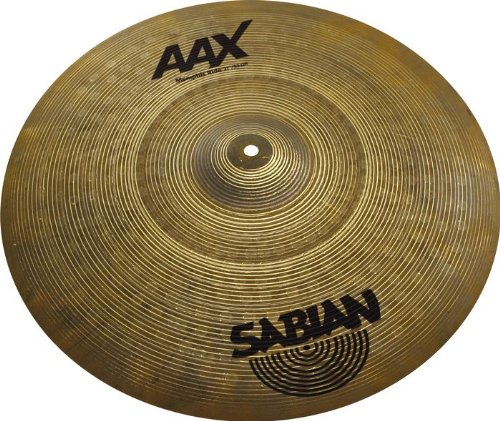
I just received my 22" Sabian AA Raw Ride (purchased blind on Ebay) in the mail the other day, and continue to be really impressed by the quality of  the AA's- these beautifully refined-sounding cymbals keep coming up.

Since they were introduced in the mid-80's, Sabian AA's have been roughly equivalent to A. Zildjians, which for anyone coming of age in the 70's and 80's were the classic cymbal sound- I lack the vocabulary to describe it, but the envelope is instantly recognizable to anyone of that era. While the Zildjians seem to have declined somewhat- I can't remember hearing a really nice one in a long time, and they seem to be making them heavier now- Sabian seems to be making real advances with the manufacture of this type of cymbal, taming their often-obnoxious brightness.

My unhammered and unlathed Raw ride looks a lot like the old Zildian Earth ride, but is a completely different thing. It's a jazz weight- a little lighter than my 2600+ gram Bosphorus Turk 22" Original (light) ride- and plays exactly like a jazz cymbal. The sound is very mellowed-out classic A, much like some of the thinner A's from the 1950's. You expect this type of cymbal to be very dry, but mine has a lovely, harmonious low cushion of sound under it, almost like an organ drone. I love the bell sound: clear, but not harsh- in fact, it's hard to get any kind of obnoxious sound out of this cymbal- even riding on it with the butt of my SD11's works. It gives a nice balanced, controlled, but explosive crash. It's well-suited to acoustic music, but would likely not work in situations requiring a cutting sound, or a sustained strong riding. Mine has six rivets installed, which livens up the sound, but I'm not sure this is the ideal sizzle cymbal- catching it with a brush does not give that nice long tone I want from that type.

The price is also nice, costing (on sites like Cymbalsonly.com) $75-100+ less than the K-type cymbals it is actually classed with.

Fulfilling the same role, the Sabian Raw ride is an excellent, lower-cost alternative to the generally darker and more idiosyncratic hand-hammered cymbals. Highly recommended, and I'm going to be keeping an eye on other AA's.

UPDATE: After using it on a couple of gigs (one very low volume), I'm more enthusiastic about this cymbal than ever- it's like a much kinder, mellower version of the circa 1970 A. Zildjian medium ride rivet cymbal I used for many years. In practice it actually works just fine as a sizzle cymbal, though not precisely ideal- I prefer a slightly heavier cymbal for that.