Showing posts with label product reviews. Show all posts

Thursday, March 28, 2019

Product review: Bopworks sticks

Related to my Jazz stick round up from January: I got to try out the product line of Bopworks Drumsticks, a small company in Austin, Texas, making sticks for jazz drummers:

Bopworks Drumsticks was formed to create genuine, faithful replications of the designs that produced a sound and feel not possible with those found in the modern market. Our sticks are custom made in the USA from American Hickory with vintage machinery similar to that used to make the original drumsticks in the 50's - 70's.


Making historically-accurate light hickory sticks for jazz is their stated mission, with designs either direct copies or close facsimiles of some well known players' signature models. Most of their sticks range in size from a small 7A to a large 5A... roughly the size of a Vic Firth SD-4 Combo or smaller.

From their FAQ:

WERE ALL THE OLD DRUMSTICKS THAT SMALL? 
Actually, yes, most of them were that small… although, the street/marching sticks were very similar to what’s out there today, both in thickness and length, going up to 17”or so. The orchestra or dance models, however, were generally less than 16” in length with a proportionate diameter. Models like the Krupa, Rich, and Belson models clocked in at 16” or close to it. 
Remember, sticks could be made in any size or length regardless of the decade, so it’s not like these guys had to use light sticks.  
Another interesting thing to consider is that Buddy, Gene, Chick Webb, Sonny Payne, Don Lamond, Jo Jones, Big Sid, Mel Lewis, Jake Hanna, Rufus Jones and a host of others were powering Big Bands with calfskin heads, “small” sticks and no mics.


Before getting into the reviews: Chris at Bopworks was nice enough to send some extra sticks, which I will send out to you all. If you want some free sticks, follow the site (in the sidebar, scroll down), and send me an email with your mailing address. I'll select names at random to receive sticks. US and Canada only, sorry.


The sticks: 

Birdland Model - 15 5/16" .500 - snap crackle
This is a signature stick from the 60s— Bopworks doesn't identify the artist by name, but let's just say it's the Snap Crackle stick. These are the smallest sticks I've ever played; a thin 7A, long taper, slender oval bead. It is not a stick for digging in— I find them to be unforgiving of any tension in my grip. You really have to dance with these sticks, and respect their limitation power-wise.

They are very interesting for their responsiveness to dynamics, especially subito changes in dynamics. They create so little vibration in the instrument that they are very limber in going from loud to soft. They are also interesting for the way they help you blend with the rest of the ensemble— normally drums tend to dominate the piano and bass, and the Birdlands really bring you down to their level, so you're much more co-equal with them volume-wise. They are also good sticks if you happen to have a lot of thin, live, difficult-to-control cymbals.


Mel Lewis 7D - 15 1/8" .540 - short / full
I associate Mel Lewis with good cymbal sounds and deep tom tom sounds, and that's what these give you: big sound out of the drums, and full, pleasing sound out of the cymbals. Very agreeable stick if you're playing a lot of drums.

Good if you like a tight set up, with everything close. They're relatively short, balanced toward the bead, so they feel rather stubby. The Birdlands are only slightly longer, but do not feel that way. My hands automatically seek a balance point, and I often find myself holding them very close to the ends. I like these sticks a lot, but would probably like them to be slightly longer.


West Coast Model - 15 13/16 .520 - general purpose runner up 
Excellent general purpose combo stick. Design is similar to the Birdland, scaled up— though it is still a light stick, roughly in the 7A category. Shorter taper, and balanced more toward the bead end, which I noticed more in testing the sticks than actually playing with them. Slightly mellower cymbal sound, and lighter sound overall compared to the Swing Classic.


40s Swing Classic - 16" .515 - general purpose winner
Signature model of a very famous drummer of the big band era— apparently Bopworks does not have legal clearance to identify him by name, but his initials may be GK. Small arrowhead bead, short taper. Great all-purpose stick, well-balanced, with a nice attack on the ride cymbal. After playing the Birdland and Mel Lewis sticks a lot, these feel quite long, and slender. This is may be my favorite stick of the lot, with the West Coast Model a close second.


Art Blakey 8D - 16" .530 - aggressive cymbal sound
Feels like a slim 5A, with a very robust acorn/arrowhead tip. Weighted to the bead end. Biggest cymbal sound of all the sticks. These are made for a big, aggressive Blakey-like sound. I don't want to overstate it; these are not extremely different from the Swing Classic, but they just seem to want to move long distances and make a lot of sound. I did not get to test these in a large ensemble setting, but they seem like they would be great sticks for big band.


Memphis R&B - 16" .570 - big stick / light sound
About the size of a 5A, with a surprisingly delicate, musical cymbal sound— a lot of highs and not a lot of body. It's a “refined” sound not unlike a Vic Firth AJ6, which is a normal stick that is extremely thin at the bead end. The Memphis is not as extreme as that, but it's a similar vibe. The pair I got seems to be made from very light wood, so although it's bigger than the Blakey model, it feels more limber, and gets a lighter sound. I don't know if the choice of lighter wood for these sticks is deliberate. These compared very well with the other sticks in a normal combo setting, despite being significantly larger— they got a bigger sound from the drums, and a nice controlled cymbal sound.


Rhythm & Groovz - 16 1/4" .590 - mellow heavy
Fat in the grip area, very long taper, smallish flattened acorn bead. About the size of a 5B at the butt. Not unlike the Vic Firth AJ12, but larger— the AJ12 also has an extreme taper. Rhythm & Groovz actually get a slightly mellower sound, with less highs in the attack. Very subtle stick on the cymbals, for having such a fat shaft. Seems a great stick for situations where some real power is called for, but also a nice cymbal sound.


Comments, comparisons, conclusion:

I have been using maple sticks for many years, but have become increasingly dissatisfied with them for drumset; they get a nice musical sound, but I feel I need something a little brighter on the cymbals. I tend to associate hickory with a hard, crude, “thuddy” sound— a feeling carried over my experience with Vic Firth American Classics, which I have used from time to time. That is not the case with these sticks; they are slimmer, and designed for a good cymbal sound— brighter than maple, with better projection, but still a musical sound. It is probably an ideal cymbal sound, since we are looking to be heard in an ensemble of players, in environments with varying degrees of background noise.

These are all excellent sticks, no actual dogs. Quality is excellent; sticks are well balanced, and made out of good wood— no detectable warpage or weird sounds/stick response that come from cheap, indiscriminately-selected wood. They do not appear to be matched for pitch, which is not a concern for me— I only need that in a concert snare drum stick. They are closely matched for weight, which is important to me. The closest thing to a design flaw I can find with any of them is the shortness of the Mel Lewis stick. But it's Mel's stick the way he wanted it, so...

For a general purpose combo stick, the most solid choices are West Coast and Swing Classic. Swing Classic has a stronger attack, with more highs. West Coast feels distinctly lighter (it isn't actually, so ???) with a mellower attack on the cymbal. The other models are all a little more particular, satisfying a more specialized need or taste. All the sticks work well in a combo setting, except Rhythm & Groovz, which are more suited to amplified music.

I definitely recommend trying out, and coming to terms with, the Birdland model, both for how they affect your blend with the ensemble, and to learn the touch required to use them effectively.

I compared these sticks with Vic Firth American Classic 7As and SD-4 Combos. The Combos are a very popular jazz stick, and the 7As are a conventional equivalent to the WC/SC/AB models. The 7As produced a very aggressive attack not unlike the Art Blakey model. The Blakey had a clearer attack, and the VF sounds relatively crude. The Combos produced a similar sound to the Swing Classic, but darker (Combos are made of maple), and with a mediocre attack.

See the jazz stick round up for more stick reviews and comments.

Tuesday, July 31, 2018

Product review: Backbeater app

A rare product review here; this organization contacted me and asked me to try out and review their upcoming release, so here we go:

Backbeater is a product in development, with a Kickstarter launch coming up on August 14, created by a non-profit organization called Makers4good. It's advertised as the “World's Most Advanced Drum Metronome”; what it is is a snare drum-mounted sensor linked with an iPhone/Android app, which allows you to monitor your tempo and accuracy:

The Backbeater app runs analysis on the signal input from the sensor, to register a strike when you hit the drum. It has been designed to find the moment of greatest attack amidst the broad-band snare noise and lock on to the backbeat tempo. Hence the name! It then does crazy mathematics to make sure it gives you output you can use.


What it does

So, the name Backbeater is significant; it only does what it's supposed to when you're playing the 2 and 4— or any other evenly-spaced rhythm— on the snare drum.

It has a simple built-in metronome, and you can enter and save tempos (along with song titles, or any other label you want to give them). For some reason it only works between 20-220 bpm. If you play faster than that (like if you play a fill while you're practicing with it, or if you just play a faster tempo), it will read MAX. There are settings for sensitivity, metronome sound, “window” (2-5; how many drum hits the app uses to calculate your tempo), and “beat” (1-4; corrects the rate of drum hits so the display reflects the musical tempo you're playing). The package includes the sensor, a mounting bracket, and a headphone splitter. The sensor plugs into your smart phone or other device running their app; it attaches to your snare drum by means of a bracket which slides under a lug. There is also a hihat mounted phone holder than I didn't get to try out.

playing sloppy time via
the phone's touch screen 
The app works with or without the metronome function running. The app display shows the metronome tempo, the tempo you are playing (as calculated from the spacing of your snare drum hits), and a circular display with a snare drum graphic at the 12 o'clock position, and little red dot moving counterclockwise(?) around it. You're supposed to hit the snare drum when the dot is inside the drum graphic. When the metronome is running, the dot moves at metronome speed; when the metronome is turned off, the dot moves at whatever tempo the device thinks you're playing based on the last 2-5 hits.


Using it

With the metronome running, the device is really an accuracy detector, not a tempo detector. Unless you're completely out to lunch, you're really always playing the metronome tempo; the number it gives you as “your tempo” is really an arbitrary (and misleading) indicator of the accuracy of your hits. Musical time doesn't work that way, with the tempo changing based on your note placement. The main value in metronome mode is in improving your consistency and accuracy by following the little red dot and trying to hit the drum when it tells you to. The app is actually trying to make you listen to the click a certain way, and place your backbeats a certain way, which I don't believe is strictly necessary for grooving, professional playing, but it could be a useful tool.

With the metronome turned off the device does actually measure your tempo, but using it is a little weird. Whether or not it's a useful for actually improving your time is unknown... at the very least it's a tool for testing yourself. The moving dot could be problematic in this mode: it moves at the tempo you established with your last 2-5 hits, and I can see minor fluctuations in tempo compounding as you follow the dot, leading to actual tempo fluctuation. Best to just ignore it, play your groove, and see how well you maintain the tempo through over time while playing fills and variations. This is made more difficult by a disorienting thing that happens in this mode: when you play a fill the app momentarily goes bananas— it will read MAX for a moment, then some other random tempos, while it tries to figure out what you did. If you keep playing your original tempo, after a few measures it calms down and shows the tempo you were originally playing— or something hopefully close to it if you sped up or slowed down.


Conclusion

In its present form, I think the app fulfills a few extremely narrow functions: aiding in accuracy of playing evenly-spaced rhythms played on the snare drum, and monitoring tempo based on evenly-spaced rhythms played on the snare drum. The non-metronome, tempo-monitoring function is more interesting to me, but the app spazzing out whenever I play anything other than 2 and 4 makes it somewhat less useful than it could be. I would need to this product to be a little more robust to give it a full recommendation, but it could be very useful to some teachers and players. Certainly Makers4good looks like a worthy organization, and if this product interests you at all, you should consider donating to their Kickstarter campaign, which once again is launching on August 14th.

They'll be sending me a production model of the sensor when it's available, and I'll continue using it, and post any changes in my feelings about it, and write about any updates to the app as they come out. It's potentially a useful tool, especially as (I assume) they continue to develop the app.


What would make it more useful to me

More robust metronome functionality, similar to any other modern metronome: expanded tempo range, give downbeats in different meters, give subdivisions, ability to silence measures, etc.

Calibrate the track for the little moving dot. At the very least add graphical markers so I can see where the 16th note or triplet subdivisions fall on that little visual timeline. Ideally, I would like it to monitor hits on 16th note and triplet subdivisions as it does downbeats.

Ability to program rhythms. Either that, or include preset rhythms, from which the device can detect a tempo.

Ability to mount the sensor on a bass drum (I tried), hihat or ride cymbal (good luck with those latter two).   

Saturday, February 04, 2017

Holy Grail

At a recent gig: on the left is
the 17", on the right is the 20"
UPDATE: Since this was posted I became a C&G dealer myself; visit Cymbalistic.com to see what I have in stock. There are videos of every individual cymbal for sale, and everything on the site was personally selected by me for sound and playability. 

I've been paying some visits to the Portland company Cymbal & Gong recently, and needing to write a full-fledged profile of the company. Until I get that done, here are brief reviews of a couple of cymbals I bought— it's very hard to be around C&G's products without buying them. The company is run by Portland drummer Tim Ennis; working with a Turkish cymbalsmith, he has K-type and A-type cymbals manufactured to his specifications, and he applies a variety of patinas to them. Full details on his products coming soon.

17" Holy Grail Crash - 1067 grams
Holy Grail is the name of this line, and aptly so. I never thought I could get so excited by a 17" crash. 1067 grams puts this in the thin category, with traditional, uneven lathing as you might see on an old A or K Zildjian. Patina is a very rich antique bronze— again, like an old K— with some green accents. And the cymbal plays like an old K. Have you ever played a 50-60 year old cymbal that has seen thousands of gigs? That's the way this cymbal feels; by itself it seems slightly dead, with a slight funny twang. Played on the drumset with a band it sounds incredible; it's a very responsive, fast crash, but it's also a shockingly good ride cymbal, with great definition and no riding up. And it has a great bell sound.

Jazz drummers today seem to feel anything smaller than 22" is a joke, but this is a true bebop cymbal— the sound from all those 50s albums. Best cymbal I've ever owned.

Cymbal & Gong seems to really excel at these crash cymbals, because we played a number of them at their headquarters (Tim's house), and a number of them sounded great.


20" Custom Ride - 2023 grams
Custom is not a line of product, it's a catch-all name for short runs or one-offs to a variety of specifications. I would categorize mine as a light medium ride, which is lathed like an Istanbul Sultan or Bosphorus Antique— unlathed bell, unlathed band in the playing area, fully-lathed bottom. And it has a similar sound to those cymbals, which is difficult for me to define. The upshot is that it is a great-sounding K-type cymbal, which plenty of definition, that crashes beautifully, and has a really nice bell sound. This one has a beautiful hand-oiled finish that gives it a very deep bronze color; he had another similar 20" with a matte green patina, which was rougher, more aggressive-sounding, and a beautiful honey-colored 19" that was a little higher-sounding, very tight, and slightly more refined.

Here's my friend Stephen Pancerev playing those cymbals. The 19" is on the left, and my cymbal is on the right:


Tantalizing tidbit: Ennis has just returned from a trip to Turkey, and I did show him one of my 22" Paiste Sound Creation Dark Rides before he went. We'll see if it captivated his (and his smith's) interest enough to order up a few copies...

Thursday, February 25, 2016

Two new linear drumming books by Joel Rothman


Received a few new books in the mail from author/publisher Joel Rothman, two of which I'll review today: Drummin' In The Rhythm Of Rock with Linear Patterns, and Linear Jazz Drumming. Rothman has been an extremely prolific drum author for over 50 years now, and he has a number of very valuable titles to his credit: Basic Drumming, most famously, as well as The Compleat Jazz Drummer, and the Mini-Monster Book of Rock Drumming— favorites of mine. I like that his books always keep a practical focus, are very masterable— they always include a lot of patterns, but you can devour them pretty quickly. Everything in them you will use in the field, or is immediate background for things you'll use in the field.

My biggest complaint is that he is sometimes too prolific. He may put in too much stuff, making a very long and shallow curve— you can wear out your user your running endless permutations. There are only so many practice hours in the day, and at a certain point, the extra pages of stuff can become a barrier to people getting to the best part of your book.

That's not a problem with the books we're looking at today; they're each focused on a single idea, which are treated fully without wandering, and without bogging down in endless variations. They each deal with linear drumming patterns for three voices— cymbal, snare, and bass. There are shorter sections using four way coordination. The patterns are derived from a single idea: starting with a cymbal rhythm, and filling in the gaps with the snare drum and bass drum. There are no unisons between limbs written, and there are rarely more than two notes in a row without a rest with any limb— both limitations I like. The jazz book deals with triplets, and the rock book deals with 16th notes. Many or most of the cymbal rhythms are not standard jazz or funk/rock ostinatos, so I don't see the particular value of organizing the books around them— except that it makes more sense than organizing them by one of the other voices.

The jazz book is good for developing a modern, abstract, and very triplety Jack Dejohnette-like way of playing jazz at slow-to-medium tempos. You could regard it as Stick Control for that type of playing. It's superficially similar to Elvin Jones's thing too, but most of the cymbal rhythms are so abstract that the total package of materials is really quite a different thing. Despite the cymbal-based format, we've really mostly abandoned the right hand dominated, ride-cymbal focused method, so central to jazz drumming in general and Elvin's thing in particular, in favor of a true three-limb approach. I'll say that if you've been doing my Afro 6/8 exercises, this book will be a good addition to that.

Continued after the break:

Tuesday, June 17, 2014

Tape for sale, cut up

Need to get rid of that horrible ring in yer snayer drum? Well, these guys are selling a product that may be said to be the answer:


As the man said, that drum sounds awesome. If using one of these patent-pending, ah, pieces of tape that has been “used several times”[???] sounds THAT GOOD, take a moment and imagine what one of these pristine new ones must sound like:


Mmm! Oh yes. Now, before you say “Hey, I know how to put tape on my drum, if I ever want to muffle it, which I don't. And that just doesn't look like much of a product to me, I'm sorry.”, let's look at the science. From the manufacturer's website:


Therefore, you should buy this product. You can't disprove science.

And this is NOT some skeevy, fly-by-night operation, cutting up pieces of industrial tape, probably pilfered from someone's day job, and selling them at an unconscionable markup, so stop thinking that. In the first place, there's no markup when you steal your raw materials, idiots. But one look at the awesome resources they have poured into packaging their product should put any such doubts to rest:


That's what you get for 90 bucks DID I MENTION THE FREE SHIPPING?! !!! !!! Look at this monkey:


Don't think about the $90. 

And to show you what kind of razor-thin profit margin they're operating on: if you are stupid enough to buy one set, they'll sell you a second set for only $50— surely sacrificing all of the profit they earned with the first set, several times over. Really, they should be considered to be a charity, rather than a profit-making business in the traditional sense. Almost a holy thing, if you think about it. Not buying this product is like crapping on a monk.

So, yeah... some product... that's how my brain works on my first cup of coffee...

[h/t to Bull @ Drummerworld]

Saturday, January 11, 2014

HFS III: the book reviewening

NOTE: This is something I started writing some months ago, never quite finished, and was unsure I even wanted to post it if I did. I'm putting it up now just to share some thoughts with a Drummerworld forum member. Please forgive its half-bakedness; maybe there's some entertaining reading here: 


A student loaned me his copies of both volumes of Mike Mangini's book Rhythm Knowledge, and they have rather blown my mind. Mostly not in a good way, I'm sorry to say. I hate to be critical of another drummer's work, but I also hate for drum students to get what I think is unhelpful information, so I'll go ahead and give these a frank review. I'm not trying to be negative, I'm really just trying to understand my reaction to this product, and the philosophy behind it.

I'll start by saying that, if you don't know who he is, Mangini is a rock drummer, and one of the leading guys in the current absolutely insane technical monster field of players, and likely has as much facility as any drummer who has ever lived. I am aware that he won the “World's Fastest Drummer” event at some point in the last few years. As a musician, he is probably best known as the current drummer for the prog-rock band Dream Theater. He also taught at Berklee for several years. Most of what I know about him as a musician I learned from watching this video, from the “WFD” event:


So: The books are unlike anything ever written for the drums, and are extremely ambitious in scope; he's basically attempting to rewrite the methodology of the instrument from scratch. Since there is a good amount of material dedicated to explaining fundamentals of rhythm and meter, including arguments in favor of things as basic as learning to read music, I assume that the books are geared towards novices, which is a good deal of my problem with them.

First: He is in dire need of an editor. There is a lot of text in these volumes, delivered in a frenetic style. He gets so far out into the weeds with parenthetical statements, explaining the meanings of ordinary words, and addressing his readers' presumed misconceptions, that points are completely lost. I'm all for people being exposed to far out concepts that seem incomprehensible on first exposure, but what is here is largely just incomprehensible, full stop. I know this subject well, and recognize most of the concepts he is attempting to communicate, but I have to work hard to grasp his explanations. One example:

To a Musician, especially a drummer, counting is the least intrusive method of connecting yourself to the otherwise intangible concept of time (something tangible is something we can physically feel). Since we use the muscles in our throats to count, we can feel, or be physically connected to, time. Counting also has the advantage of being a very accurate way to keep time. This is because of the relationship between effort and control. The more effort it takes to do something, the less control we have (try touching your nose with the tip of a pencil, then try touching your nose with the tip of a 100 bl. iron bar). Moving our throat muscles requires much less effort than moving our arm or leg muscles, so we can count more accurately than we can play. 

Communication issues aside, I don't know if agree with his premise, completely— most humans are well practiced in moving their arms and legs rhythmically, maybe not so much the voice. The voice connection is very important, not because the voice is better at rhythm, but because it is expressive; we want to make our playing more vocal, less mechanical. It's a small point, but the there are many more of these just-slightly-wrong-to-me things.

More after the break:


Monday, March 04, 2013

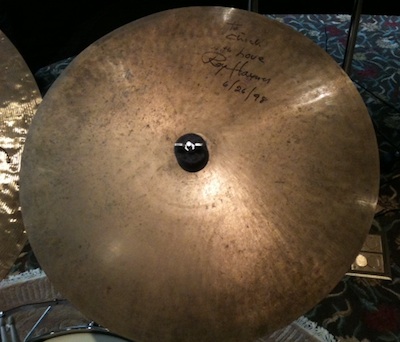
Got my Chick cymbal

The original, signed by Roy Haynes.
The nice thing about Paiste cymbals— most of them— is that when you hear a sound you like, you can duplicate it almost exactly by just buying the same type and model of cymbal. They're very consistent, even across decades; my circa mid-60's 20" 602 medium ride, though a little played-out, is obviously the same basic cymbal as the current reissued 602s.

So after many years of listening to Chick Corea's Now He Sings, Now He Sobs and Return To Forever I was very excited the other day when the type of cymbal used on those records, an 18" Paiste 602 Flat Ride— in this case a 1975 Medium Flat— arrived in the mail. There seem to be some differences of opinion as to what the cymbal was, exactly— whether it was a medium or a thin. I always thought it was a 22", based on a random comment by my brother, but the consensus is that it was an 18", and comparing my cymbal with the recordings that makes sense.  My medium is definitely on the lighter side of that category, and crashes better than you would expect, and is still a very light-sounding instrument. Chick's cymbal is a “pre-serial” model, meaning it was manufactured before Paiste started stamping serial numbers on them.

Continued after the break:


Sunday, February 17, 2013

Best books: the Dahlgren & Fine rock book

Complete Text for the Rock and Roll Drummer
by Marvin Dahlgren and Elliot Fine
Really Good Music Publishing
66 pages

When Really Good Music Publishing reissued a raft of Marvin Dahlgren titles last year, I was especially curious to see how Marv (along with Elliot Fine, in this case) would handle the question of how to play rock drums. I've gotten to do a little more work with this one since that original notice, and it's definitely a product of those two authors; the methodology is completely original, using their own special mathematical/logical, independence-oriented approach. Applied to rock and roll, that's very unusual.

After a fairly abstract introduction to using the four limbs on the drum set, there are sections on 8th note rock, triplet rock, shuffles, rock with 16th notes, and 8th note rock with right hand variations, plus a large section on fills. The authors' unique four-limb staff is used throughout; some of the fill pages using the toms are a little difficult to read, using different note heads for each tom.


tom notation

The major method used throughout the book involves playing snare drum variations (or fills) along with ostinatos played with the right hand, and/or the feet. The left hand parts either are generic, given names like “Latin”, “rock and roll”, or “bossa nova”, or are logically derived from the bass drum part (by adding snare notes before or after BD notes, for example), or are completely independent.


More, with examples, after the break:


Sunday, November 18, 2012

Tour gear rated

C'est indispensable
I want to take a moment to mention some pieces of gear that distinguished themselves one way or another on this trip:

20" Paiste Sound Formula Full Ride with six rivets
This cymbal subs for my 22" 602 Dark Ride, and it turned out really nice. Since their sound from cymbal to cymbal is pretty consistent, and you can get them cheaply on eBay, I would not have been crushed if it had gotten stolen or lost, as I would've been with the 602. I highly recommend using a 20" when flying— my cymbal bag fit into the overhead bins on every leg of our trip. When I was schlepping a 22" I would have to sweet-talk a flight attendant into putting it in with the garment bags, risking them forcing me to check it if they didn't feel like helping me with it. Read my earlier semi-full review of this cymbal.

20" Sabian Jack Dejohnette Ride (original line)
Using two medium-weight 20" rides was a pretty unusual choice for me, but it worked well. This very dry cymbal is a nice contrast to the long and lush Paiste, and it has been working really well for me on the left side, especially when playing softer. It responds much like a drum, and has a nicely finished, clean sound when used with drums that are also pretty dry. One instance where it failed utterly was at Café Belga in Brussels— a large room that tends to have listeners close to the band and a lot of talkers in the back. There this cymbal just died.

Sonor drums - 70's, 9 or 10 ply mahogany Phonic line, I think. 12", 14", 18"
Loaned to me by a great Brussels drummer, Teun Verbruggen. These are some of the best drums I've ever played. Sounded great tuned low in the studio and on our one rock gig, and on all of the jazz gigs as well. I would love to get a set of these if I could find one for less than $3000. Hardware is typical Sonor overkill, with the plate for the tom mount weighing ~5 pounds by itself, otherwise they're not ridiculously heavy.

Sabian cymbal bag
Their heaviest-duty bag. Or their most expensive, anyway. This is the same one I had to sew up on my own because it was falling apart after a couple of years. It (and my sewing job) survived the trip, despite being jammed on flying days with two medium 20's, 16 and 18" crash cymbals, hihats, my stick bag, and my snare drum stand.

Chop Busters by Ron Fink
This is the one book I took along for grabbing a few minutes of pad practice here and there, a purpose for which it is extremely well suited. Read my original review for it here.

Some essential non-musical items after the break:

Tuesday, October 23, 2012

Sewing day

Backstitch — makes a strong seam
[UPDATE: My sewing job survived the tour, despite being tested fairly extremely; I had to lighten my rolling duffle before checking it, and put my snare drum stand (a lightweight Pearl) in the pouch along with my stick bag when flying to and from Portland.]

Has anyone else noticed that the quality of drum bags of late has gone— how shall I put this— straight into the crapper, somewhat?  I have a Sabian cymbal bag, a Beato stick bag, and a Tuxedo bass drum bag which have all begun to fall apart way too fast— that bass drum bag actually arrived in the mail with the lining already undone, and I didn't feel like hassling with the returning it. The others have lasted a little longer— the Sabian bag survived the warranty period, just, only to have the fabric on the pocket begin to unravel at both corners:


I'm sorry to report that Sabian's customer service department was a lot more effective at enforcing their 1-year warranty than they were making me happy. I did manage to get a phone number, and possibly could have browbeat them into replacing it for me— usually it takes talking to someone in person, and being coolly persistent, even after they've given you several unequivocal noes— but again, I just didn't feel like hassling with it. 

So I got out ye olde needle and thread and sewed the damn thing up. If you have any bags in a similar condition, start by very carefully cauterizing the fraying edge of the nylon with a match, burning off the loose threads back to the good fabric without melting the whole bag. The stitch I used is a backstitch, which you can see illustrated above; apparently it's good for this application. I'll let you know how it holds up.

For the record, I've found Beato's products in general to be excellent; I've been using their mid-range drum bags and stand case for several years, and they've held up well— the stand case especially, as it has seen the hardest use. The stick bag just had the flap on the pocket come undone, which I've sown up— what's notable is that it's the second bag of that model I've owned which has done that.

Monday, November 07, 2011

Putting together a jazz drum set

The Gretsch Catalinas on my 2010 Europe tour.
A good point in the comments of the How to be a jazz drummer post- the sound of your instrument is very important. If you've been playing rock, have a lot of cymbals with "POWER" printed on them, or have one of those generic drum sets with the 22" bass drum and the big tom toms, this may mean buying some new gear. Fortunately, everything you need can be bought inexpensively used- here at Cruise Ship Drummer! we don't throw money at our problems, and we don't much give a crap about flashy new gear. The sound is what matters.

So here we go- my epic user's/buyer's guide for getting your jazz instrument together:

Cymbals
Cymbals, particularly the ride cymbal, are the most important part of the set for a jazz musician. Part of the philosophy- I'm paraphrasing Mel Lewis here- is that you treat every cymbal as both a ride and a crash; so you don't want your ride be too heavy or your crash to be too small/light. Your ride cymbal should be 20 or 22", light to medium weight; your left-side cymbal can either be a 17-18" thin to med. thin crash, or an 18-19" light to medium ride, or "crash-ride"; hihats 13-15", light to medium.

We're in a golden age of cymbals right now, with people like Bosphorus, Zildjian, Sabian, Paiste, Meinl, Istanbul, and many smaller companies making incredible hand hammered cymbals. One side effect of which is that the prices on regular old professional quality cymbals of the 70's-90's have come way down; and people have gotten pickier about appearance, so really dirty, funky-looking cymbals are even cheaper. People who only care about the sound can find some real bargains in A. Zildjians, Sabian AAs, Paiste 2002s and 3000s. Grungy-looking is good, tiny cracks (less than 1 cm) are acceptable (and will bring the price way down), "keyholing" is perfectly fine for you, but a good bargaining point for bringing the price down further.

Keep reading- it's a long post and there's much more information after the break:

Sunday, September 11, 2011

Still loving Sabian AA's

I continue to be very impressed and excited by what Sabian is doing with their AA line. I've long felt the A. line of Zildjian cymbals- and by association, the AA's- to be in decline, with product development stagnating and the quality of the cymbals as musical instruments going a little bit to hell- I haven't made a systematic study of this, I've just come across many too-heavy, bright, and unrefined examples in the past 20+ years.

The addition of Zildjian's A Custom line did little to change that impression, though I have come across a few better cymbals. I had heard and played fewer Sabians, but since the manufacturing process is similar, I lumped them in with the A.'s.

No more- the first Sabian AA that got my attention a few years ago was the fast and very mellow El Sabor crash. More recently I picked up a Raw ride, after seeing them at Cymbalsonly.com, and I love it- thin, somewhat dry, and incredibly musical. Then just this week a student picked up one of the new Memphis rides, and I'm blown away even further. This is the perfect medium ride- an old fashioned medium- that is to say, lighter than has been standard since about the 80's. The pitch is high, with nice definition and a lovely harmonious cushion underneath- the sound made me think of the slamming bar bands of the 70's. I actually can't give you a detailed review because I was only able to play it for a few moments in a lesson, but it made a tremendous impression- I wanted to own one instantly.

All of these cymbals all have the classic A. sound- which I can't describe for you; you just have to have heard and played a lot of them- but much more refined than in the past, and much more controllable dynamically. These don't have the darkness or complexity of the hand-hammered K-types, but are fully their equal as musical instruments- using my Raw ride in a jazz setting is no compromise. Think Irish whiskey or a great British session beer compared to Scotch or a Trappist ale. I'm very eager to play another one of these, and to see what else Sabian is up to.

There are a number of YouTube clips of varying sound quality demonstrating this cymbal- one of the better ones is after the break. But I'd really recommend seeking one out and playing it.

Saturday, April 09, 2011

Sabian AA's are amazing

I just received my 22" Sabian AA Raw Ride (purchased blind on Ebay) in the mail the other day, and continue to be really impressed by the quality of  the AA's- these beautifully refined-sounding cymbals keep coming up.

Since they were introduced in the mid-80's, Sabian AA's have been roughly equivalent to A. Zildjians, which for anyone coming of age in the 70's and 80's were the classic cymbal sound- I lack the vocabulary to describe it, but the envelope is instantly recognizable to anyone of that era. While the Zildjians seem to have declined somewhat- I can't remember hearing a really nice one in a long time, and they seem to be making them heavier now- Sabian seems to be making real advances with the manufacture of this type of cymbal, taming their often-obnoxious brightness.

My unhammered and unlathed Raw ride looks a lot like the old Zildian Earth ride, but is a completely different thing. It's a jazz weight- a little lighter than my 2600+ gram Bosphorus Turk 22" Original (light) ride- and plays exactly like a jazz cymbal. The sound is very mellowed-out classic A, much like some of the thinner A's from the 1950's. You expect this type of cymbal to be very dry, but mine has a lovely, harmonious low cushion of sound under it, almost like an organ drone. I love the bell sound: clear, but not harsh- in fact, it's hard to get any kind of obnoxious sound out of this cymbal- even riding on it with the butt of my SD11's works. It gives a nice balanced, controlled, but explosive crash. It's well-suited to acoustic music, but would likely not work in situations requiring a cutting sound, or a sustained strong riding. Mine has six rivets installed, which livens up the sound, but I'm not sure this is the ideal sizzle cymbal- catching it with a brush does not give that nice long tone I want from that type.

The price is also nice, costing (on sites like Cymbalsonly.com) $75-100+ less than the K-type cymbals it is actually classed with.

Fulfilling the same role, the Sabian Raw ride is an excellent, lower-cost alternative to the generally darker and more idiosyncratic hand-hammered cymbals. Highly recommended, and I'm going to be keeping an eye on other AA's.

UPDATE: After using it on a couple of gigs (one very low volume), I'm more enthusiastic about this cymbal than ever- it's like a much kinder, mellower version of the circa 1970 A. Zildjian medium ride rivet cymbal I used for many years. In practice it actually works just fine as a sizzle cymbal, though not precisely ideal- I prefer a slightly heavier cymbal for that.