

A drumming blog written by Todd Bishop.
Showing posts with label Al Foster. Show all posts
Showing posts with label Al Foster. Show all posts
Friday, August 23, 2024
Daily best music in the world: Al a la Roy
An interesting recording here, featuring Al Foster sounding for all the world like Roy Haynes— with the snappy, aggressive snare drum, occasional flamboyant tom tom moves, with a broken/open time feel the whole time. Much of this Foster is playing 3/4 time over 4/4.
IDEOLOGICAL INTERLUDE: This is the kind of record you find used for $5 on vinyl, $3 on CD. Those are the ones you grab. Buy them and listen to them. There's no excuse for not owning a CD player. It's still a major medium for music industry professionals. People serious about music have a permanent library, they do not leave their access to it to the whim of some high tech vampire squid.


Wednesday, February 15, 2023
Very occasional quote of the day: sound and touch

“I try to practice lightly. I played so loud and hard with Miles, and even on some of the gigs I did with Sonny. That’s what they wanted. But now I’m going back to the ’60s, approaching things in a much lighter way. I just don’t think you have to bash. You can get the same intensity without bashing. Billy Higgins proved that. You could feel the tune building with each chorus when he played. You could feel the fire getting hotter without the volume getting louder. That’s what I’m trying to get back to.”
- Al Foster, 2003 Modern Drummer interview by Ken Micallef
Friday, April 16, 2021
Transcription: Roy Haynes - It's Time
Roy Haynes playing behind Herbie Hancock's solo, on the title track of Jackie McLean's record It's Time. There's a lot of what people call “broken” time here, and meter-within-meter playing. The tune is in 4, but Haynes is playing with a strong broken up 3 feel all the way through. If you check out my “world's shortest Roy Haynes lesson”, and play those 3/4 patterns over 4/4, you'll have some similar stuff.
Tempo is 266— generally the range where a swing feel evens out into straight 8ths. Haynes is playing a very legato swing feel here— almost straight 8ths, not quite. It would be a good analysis project to print this out and add phrase markings indicating his two, three, and four beat phrases.

The transcription was a little tricky to make, and may be a little deceptive— there are lots of tied notes and ghosted notes— there's so much quiet stuff happening, it suggests a lot of physical activity where no notes are sounding, or barely sounding. The transcription could turn into a real nightmare of random looking stuff if I tried catching all of that, which is really not central to the main idea of what he's playing.
There are a lot of unisons happening— both hands together, both feet together, and everything together with the cymbal. Not much linearity, or “independent” lines against an ostinato. The hihat is quite sparse, and often in unison with accents on the bass or snare. A few times he'll play it on 2 after a couple of measures of floating meter-within-meter playing. The bass drum is less sparse, and there seems to be more activity than I was able to notate. For the most part the bass drum is not loud— his playing here seems centered mostly on the hands.
Thursday, April 09, 2020
From the zone: Al Foster intro
Hey, it looks like everyone but me is getting a lot writing done right now. I have a couple more of these “from the zone” items to share— a series where people send in their personal stuff, scraped off their practice room floor. Feel free to email me (see the sidebar) any coffee-stained hand written stuff you want to share. It doesn't have to be particularly legible or even make sense to outsiders. Any old thing you needed to write out to practice.
This looked familiar when drummer Larry Nagel shared it on a forum; it's something I transcribed to include in my Book of Intros... a major project that is currently stalled. It's basically done, but I haven't released it yet because???
...anyway, it's a young Al Foster's intro from Chick's Tune, from Blue Mitchell's album The Thing To Do:

Here's my version of it for the book— most of the 8th rests are filled in with ghosted triplet doubles, and I included possible stickings and a few measures of the main groove from the tune:

Here's Nagel playing it, very professionally:
This looked familiar when drummer Larry Nagel shared it on a forum; it's something I transcribed to include in my Book of Intros... a major project that is currently stalled. It's basically done, but I haven't released it yet because???
...anyway, it's a young Al Foster's intro from Chick's Tune, from Blue Mitchell's album The Thing To Do:

Here's my version of it for the book— most of the 8th rests are filled in with ghosted triplet doubles, and I included possible stickings and a few measures of the main groove from the tune:

Here's Nagel playing it, very professionally:
Tuesday, September 17, 2019
Transcription: Al Foster - Egg Head
A smoking short drum solo by Al Foster, playing with Cecil Payne and Duke Jordan on their album Brooklyn Brothers. The tune is Egg Head, a little three minute burner. It's a blues, and Foster plays two choruses— 24 bars. The tempo is about 275, so half note = 137. At the low end of what are considered up tempos.

Mark in your stickings if you're going to play this, using doubles wherever possible, especially on the fast triplets at the end. The rolls in bars 17-18 are played at 16th note speed, so play them as doubles on a straight 8th pulsation.
There's some hip modern stuff in here— I'll actually break it down a little bit in a follow up post, and give some suggested stickings. I like what I did with my Max Roach / Freedom Suite transcription, and will probably be doing more little study guides developing playing ideas found in the transcriptions.
Get the pdf
YouTube isn't giving me an embed code for this video, so you'll have to dig it out of your record library, or open it in a new tab to listen.

Mark in your stickings if you're going to play this, using doubles wherever possible, especially on the fast triplets at the end. The rolls in bars 17-18 are played at 16th note speed, so play them as doubles on a straight 8th pulsation.
There's some hip modern stuff in here— I'll actually break it down a little bit in a follow up post, and give some suggested stickings. I like what I did with my Max Roach / Freedom Suite transcription, and will probably be doing more little study guides developing playing ideas found in the transcriptions.
Get the pdf
YouTube isn't giving me an embed code for this video, so you'll have to dig it out of your record library, or open it in a new tab to listen.
Thursday, February 05, 2015
Transcription: Al Foster — Pannonica
Oh, what the hey, hot on the heels of our Frankie Dunlop transcription of Pannonica, here's Al Foster playing the same tune, the way I like to play it, in the original slow 4. It's from the McCoy Tyner album 4x4, and the transcription is from the piano solo, starting at 1:54 in the track. McCoy plays it a little slower here than Monk recorded it.

Foster is playing in a functional, modern mode here. He tends to accent the & of 2 and & of 4 pretty strongly, a la Elvin Jones, and maintains a triplet-based swing feel all the way through. McCoy and then Bobby Hutcherson do play some fast stuff over it, but almost all of it with a triplet foundation— little the soloing is actual double-time. During the more complex passages he will play straight triplets on the ride cymbal, which builds the intensity, and is a good way to keep from breaking the groove with that stuff.
Also noted that he likes to accent with the crash cymbal by itself— with no snare drum or bass drum to support it. And much of the comping— the things that are not obviously interactive, or marking a phrase— is for texture, and to keep the groove together.
Get the pdf
Foster is playing in a functional, modern mode here. He tends to accent the & of 2 and & of 4 pretty strongly, a la Elvin Jones, and maintains a triplet-based swing feel all the way through. McCoy and then Bobby Hutcherson do play some fast stuff over it, but almost all of it with a triplet foundation— little the soloing is actual double-time. During the more complex passages he will play straight triplets on the ride cymbal, which builds the intensity, and is a good way to keep from breaking the groove with that stuff.
Also noted that he likes to accent with the crash cymbal by itself— with no snare drum or bass drum to support it. And much of the comping— the things that are not obviously interactive, or marking a phrase— is for texture, and to keep the groove together.
Get the pdf
Friday, July 11, 2014
Groove o' the day: Al Foster — Billy Preston
Must play more music where I can just leave the hihats open all day. This is Al Foster's groove on the tune Billy Preston, on the Miles Davis album Get Up With It; kind of a sleeper album. I think a lot of people bought it for the cover photo, and never listened to it a second time. But it's great. Do check out Rated X, our other GOTD from this record.

Foster plays no fills, and the variations, mostly with the bass drum, should be easy to hear.
Foster plays no fills, and the variations, mostly with the bass drum, should be easy to hear.
Tuesday, September 03, 2013
Groove o' the day: Al Foster — Chick's Tune
I was working on our upcoming Book of Intros, and came across this cool Latin groove from a teenage Al Foster, playing on Blue Mitchell's album The Thing To Do. The tune is Chick's Tune, and he plays this during the brief Latin sections on the head:

This has a nice, relaxed Elvin-like feel, and should work at a variety of tempos— it reminds me of a previous GOTD by Jack Dejohnette. At faster tempos, you can break up the four 8th notes in the first measure, giving you a Mozambique-like bell pattern:
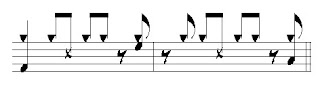
I can see adding a bass drum note on the & of 4 of the second measure, and hihat on beats 2 and 4. Experiment with the feet, and see what works for you.
The book, by the way, is going to be a collection of transcribed drum intros from jazz recordings from the 30's-present. Hopefully we'll have that ready to go before the end of the year.
Audio after the break:

This has a nice, relaxed Elvin-like feel, and should work at a variety of tempos— it reminds me of a previous GOTD by Jack Dejohnette. At faster tempos, you can break up the four 8th notes in the first measure, giving you a Mozambique-like bell pattern:

I can see adding a bass drum note on the & of 4 of the second measure, and hihat on beats 2 and 4. Experiment with the feet, and see what works for you.
The book, by the way, is going to be a collection of transcribed drum intros from jazz recordings from the 30's-present. Hopefully we'll have that ready to go before the end of the year.
Audio after the break:
Sunday, August 18, 2013
VOQOTD: Al Foster on taste

“Miles told me, 'If you don't hear it, don't play it.'”
— Al Foster, quoted in Modern Drummer
Sunday, May 19, 2013
VOQOTD: Al Foster's listening habits

“He’s in it all the time. He’s listening all the time. He’s got kind of a small range of stuff he listens to over and over again: Monk, Bird, earlier Miles Davis recordings, Sonny Rollins…he’s addicted to that music. He’s a real student of the music, and a student of the greats. He has no time for anything else. You might put something on that could be killing to you, but he’ll be like, “Eh…I don’t know…” He’s got very particular tastes. I guess as you get older, you develop that. You make your circle a little bit smaller…”
— Bassist Doug Weiss on Al Foster
A follow up question:
Do you think that intentionally narrowing his scope in that manner strengthens his artistic voice?
Yeah, I think so. He’s got a very strong identity, and very identifiable sound and approach to drumming, different than anyone else I’ve played with. Other people share that aesthetic of hearing the “big picture;” he’s hearing the entire piece of music as it’s happening, he’s not just hearing some hip shit on the drums (although he certainly plays a lot of very hip shit on the drums). I think that’s probably the biggest piece- his sense of radar, of being able to anticipate what’s going to happen, and help things go in a certain direction, without being pushy. He’s really not pushy as an accompanist. He’s very giving and selfless in that way, but still able to carry on this little dialogue with himself within the kit. That transfers out to the people that play with him, if they can pick up on it.
Monday, June 18, 2012
Groove o' the day: Al Foster - Rated X
As promised-- or hinted at, rather-- here is Al Foster's hip and unusual groove from Miles Davis's Rated X, from the record Get Up With It:

As you can hear, the 1 and the 4 of the first measure are accented slightly; he may also do a slight open hihat at the beginning.
Listen to Rated X at its Daily Best Music In The World entry from a few days ago.

As you can hear, the 1 and the 4 of the first measure are accented slightly; he may also do a slight open hihat at the beginning.
Listen to Rated X at its Daily Best Music In The World entry from a few days ago.
Friday, June 15, 2012
DBMITW: Rated X
From Miles Davis's Get Up With It:
That's the great Michael Henderson on bass. From Wikipedia:
And I sense another 70's Miles Groove o' the Day coming up...
A couple of other versions after the break:
That's the great Michael Henderson on bass. From Wikipedia:
Davis saw the young Henderson performing [with Stevie Wonder] at the Copacabana in New York City in early 1970 and reportedly said to Wonder simply "I'm takin' your bass player."
And I sense another 70's Miles Groove o' the Day coming up...
A couple of other versions after the break:
Monday, June 11, 2012
Groove o' the day: On the Corner
Today we've got Jack Dejohnette's James Brown-like groove on Helen Butte/Mr. Freedom X from Miles Davis' On The Corner:

There's an overdubbed part by Al Foster that's more forward in the mix, so it's a little difficult to hear once he comes in-- there's more of just Jack on the recording than you hear on the YouTube edit, so make sure you get the record if you don't already own it.
YouTube audio after the break:

There's an overdubbed part by Al Foster that's more forward in the mix, so it's a little difficult to hear once he comes in-- there's more of just Jack on the recording than you hear on the YouTube edit, so make sure you get the record if you don't already own it.
YouTube audio after the break:
Saturday, February 11, 2012
Three Paiste cymbals

I've been on a vintage Paiste cymbal-buying kick recently. Here are the findings on my finds:
22" Formula 602 Dark Ride - circa 1975-76 - approx. 3266 grams
The Dark Ride family of cymbals- which includes the later Sound Creation (and SC New Dimensions) Dark rides, and the "transitional" cymbals- has something of a cult following; on the aptly-named Cymbalholics forum they are discussed in terms bordering on mystical. Designed with input from Jack Dejohnette, other noted users include Paul Motian, Al Foster, and Jon Christiansen.
Here's what cymbalsmith Matt Bettis says about these cymbals, and how they compare to their successors:
The ultra-rare 22" Paiste Formula 602 Dark Ride is one of those cymbals that very few ever get to play much less actually own. The ideas behind them eventually became the Sound Creation Dark Ride, but they are definitely different beasties. The 602 has hammering that is more dense, and a markedly different sound. She has that killer, dark and complex wash, but her stick and bell are much more 602-ish than the Sound Creation Dark Rides.
So, this thing is, ah, quite prodigious. It even looks imposing sitting on the stand. It is actually about 1 cm larger than my other 22's, in fact. The sound is huge- an order of magnitude bigger than the light 22" Bosphorus Turk or Sabian Raw rides I've been playing. It's very imposing in the practice room, but when I played it on a session it snapped into a perfectly balanced Paul Motian sound. You can get a great range of sounds out of it lower volumes, and I'm really digging that the thing actually cuts- that's kind of a forgotten property for jazz cymbals. I noticed it influencing my touch on the rest of the instrument as well; it led me to pull a little fuller sound out of the drums. Yes, that means I played a little louder because of the louder cymbal, but it's more complicated than that. I actually think that trying to come in under the very delicate Bosphorus has led me to play excessively quiet; this cymbal balances with the natural volume of the instrument, which is a little bigger than I had been playing.
Using it in a combo situation definitely requires a refined touch- I don't think I would've been able to handle it as recently as five or six years ago. I play it with a Vic Firth SD-11 Slammer, a maple stick the size of a largish 5B. Cymbalholics devotees speak about "the haunt" of this cymbal- I see what they mean. It's not an overtly "pretty" cymbal like, say, a Bosphorus, but I can't get the sound out of my head, for reasons that are completely mysterious to me.
After the break are brief reviews of two other vintage Paistes, and some recorded examples of the 602 Dark:
Tuesday, January 31, 2012
Subscribe to:
Posts (Atom)