Showing posts with label double paradiddles. Show all posts

Thursday, August 31, 2023

Bishopdiddles - 02: double paradiddles to swing 8ths

Listen: do not show these to somebody and call them “BISHOPDIDDLES.” You're going to get both of us beaten up.  

One thing I like about this double paradiddle inversion is that it's possible to accent the first and last notes of a triplet (or beat of compound 8th notes) with it, so it fits nicer in a slower tempo swing 8ths environment, and we can make a Reed system for practicing it. 

Regular double paradiddles accent naturally on the first two triplet or compound 8th partials: 


This inversion puts the natural accents on the first and last partials, which of course coincides with a common swing 8th note interpretation: 


This, then, is a collection of drills for developing it fully:
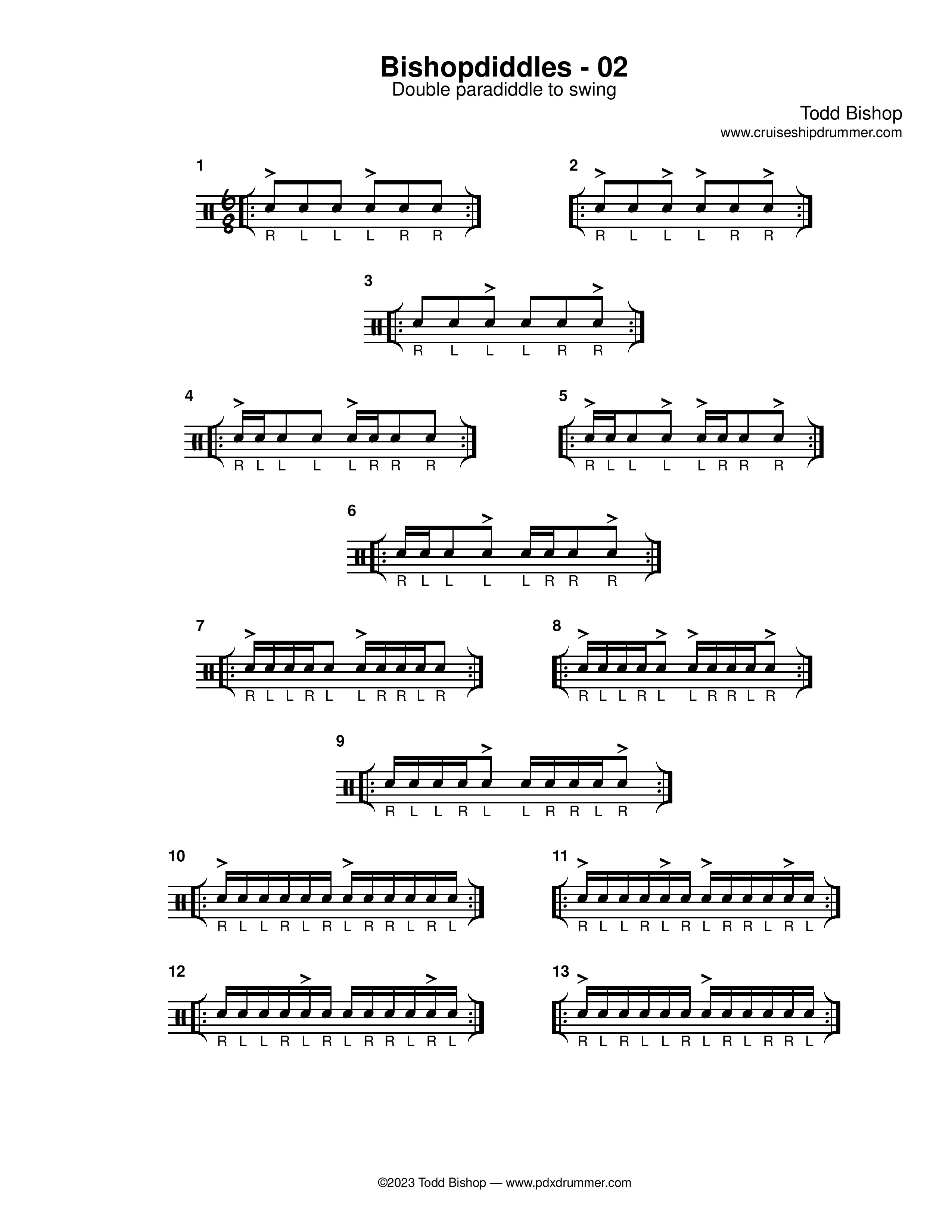


You can use patterns 1-3, 4-6, 7-9, and 10-12 (I don't know why 13 is there) as foundation patterns for practicing this out of Syncopation. Play p.38 all those ways. 

I mostly only use these patterns once at a time, not hand to hand like this, so this may not be much more than a technical drill, but I think it's a good technical drill. 

Get the pdf

Saturday, August 26, 2023

Bishopdiddles

Minor item, corralling some similar sticking ideas that have been floating around the site. I noticed that with paradiddle-like stickings, I like inverting them so the double is up front, right after the first accent. These all follow that pattern:   


DISCLAIMER: I don't want to mislead anyone with that BISHOPDIDDLES™© headline— I obviously didn't invent the RLLR-LRRL paradiddle inversion. The George Lawrence Stone estate would be working me over in court right now if I made that claim. My God. Or that RLLRRL sticking. The other two probably exist in some book somewhere*, but I got them from my own usage. 

* - I see now they're in Rudimental Swing Solos, with accents on the double, for some reason. 

 
So there they are as a single group of patterns. You can see them applied in this cool Reed system

Why do do this? When improvising with them on the drum set, you can hear the natural accents of the sticking, and they affect the way you can move around the drums. That's fine with me, it's natural texture, it's what I want. 

The double and triple paradiddles start with these strong singles, and end weakly with a double. They die at the end. However strongly you play the double, that's the structure of those patterns. 

With my wonderful stickings, the double slipstreams behind the starting accent— naturally a long sound— and the pattern finishes strongly, with singles: diga-diga-POW. If we accent all the leading singles, you can see how the natural momentum goes with each one:


I generally only use the double/triple paradiddle inversions once at a time, but they have some very interesting possibilities, I'll be writing some ways of doing them continuously. 

Get the pdf

Wednesday, September 23, 2020

Double-paradiddle / paradiddle-diddle inversions - linear, all on one page

I wrote this up for myself, maybe you'll use it, too. These are the 6/8 linear versions of the double paradiddle and paradiddle-diddle inversions page, written for snare drum and bass drum— that's easier for me to read for what I'm doing with them. Doing lots of triplets lately.


I've written the accents just to show where the inverted rudiment begins. You don't need to play the accent. I'm using these as independence patterns along with a jazz cymbal rhythm. Also playing them with the hands in unison— snare and cymbal, two drums, or flams on one drum. And playing with cymbal added on the bass drum notes. If you play these with the measures reversed, and play each measure of 6/8 individually, that adds up to a pretty complete unit of triplet patterns for jazz.

Get the pdf

Thursday, April 30, 2020

Double paradiddle inversions for drumset

Following up on my big rudimental tantrum post, here's a little exploration of double paradiddles— I mentioned that a good friend, and one of the most creative drummers I know, Steve Pancerev, is a fan of these. I've put the rudiment through its inversions, starting on each note of the pattern, and converted it to a linear pattern, then converted the right hand portion into a syncopation rhythm in 3/4.

Those are the first, most obvious things I would want to look at when practicing these creatively on the drum set. The syncopation rhythm may seem remote from the original rudiment, but when you practice them many of the ways we normally do, you'll end up with some form of double paradiddle.


I've retained the accent on the linear version just to illustrate the first note of the double paradiddle— that doesn't mean you have to play it.

A few things you notice right away looking at the patterns, especially in linear form:
• Versions 1 (normal double paradiddles) and 2 are very similar to the standard Afro-Cuban “short” bell rhythm.
• Version 3, with the measures reversed, is similar to the “long” bell rhythm.
• Version 6 is very similar to 6/8 rumba clave.

At the end I've given a few possibilities for orchestrating the linear version— note that the pattern is not always played just with the hands. You can interpret the linear patterns as representing any two voices, or combinations of voices.

It's beyond the scope of this post, but as with anything in 6/8— any six-note pattern— there are a lot of metric/rhythmic possibilities regardless of what time signature you're playing/practicing in.

Get the pdf

Thursday, February 09, 2017

Double paradiddle-adiddle

Look, it's not my fault. I never told you I was going to have cool names for the things I make up. Direct your derision at the founding fathers of drumming who put us on this path. To this day I honestly still feel like a jackass telling some little kid there's a thing called a paradiddle— all thanks to them.

...

NEVERTHELESS: this modification of a double paradiddle plays easily as a three-beat triplet pattern, and gets quite weird when you play it as 16th notes in 4. Here are some exercises for learning how to play it, and also some derivative phrases that are interesting in their own right:


You know what to do. These translate easily into bebop solo ideas. The space at the end of some of the patterns would be an excellent place to add some bass drum. See also my page on a Philly Joe Jones three-beat triplet lick— it's kind of related.

Get the pdf

Thursday, July 23, 2015

Paradiddle exercises in 7/8

UPDATE: Man, I am getting sloppy. There were a bunch of typos and duplicate exercises in the original pdf— I've updated it, and included some accent variations in the triple paradiddle exercises. 

Hey, breaking our little dry spell, here's something to go with our last set of stuff in 7/8— some paradiddle exercises, using a variety of inversions and variations:


On the RLLR/LRRL inversions you can lose either of the accents for each beat— practice them with both accents, without the second accent, and without the first accent. Moving these to the drumset, you can play every 1 on the cymbal together with the bass drum; or play all the accents on a cymbal with the bass drum; or play the RH on the cymbal or hihat and the LH on the snare, with the bass drum in unison with some or all of the RH notes.

Get the pdf

Friday, September 21, 2012

Rudimental Reed: paradiddles

Another entry in our “Rudimental Reed” series, in which we outline some methods for apply rudiments to the long exercises in Ted Reed's Syncopation, this time using paradiddles. Here's that well-known opening line from the first long syncopation exercise in Reed, p. 37 in the old editions, as written:


First, play the quarter notes (or the equivalent) as 16th note paradiddles. On the longer values/rests, play a paradiddle with an unaccented ending note, as on beat three of the second and last measures:


Next, apply an appropriate paradiddle-type sticking to the longer values/spaces— double paradiddles / paradiddle-diddles, or triple paradiddles / paradiddle-diddle, diddles as I'll call them (there aren't enough commas in rudiment names for my taste) since that rudiment doesn't exist to my knowledge. I chose the latter rudiments:


With that last, we arrive at something pretty similar to an interpretation in Ramsay's Alan Dawson book; the one additional step there is to play the 8th notes as two alternating 16th notes, with an accent on the first.

Another example after the break:

Thursday, December 08, 2011

You knew this was coming...

Here's the latest stupidly-named iteration of my basic paradiddle exercise, this time using 16th note 7s, septuplets, or whatever you want to call them. As always, play through the entire page, then play combinations of exercises in 1, 2, or 4 measure repetitions. The sequence I use for combinations is 1-2, 1-3, 1-4, etc... 2-3, 2-4, 2-5, etc... 3-4, 3-5, 3-6, etc... and so on.


Get the pdf.

Wednesday, June 22, 2011

Double paradiddle thing

Matt's Paradiddle Thing has been so useful to me, that I decided to apply the same methodology to double paradiddles. Don't be put off by the amount of ink on the page- the system is straightforward enough once you're familiar with it. Apply the same sequences as with MPT.

Get the pdf.