Showing posts with label Afro 6. Show all posts

Monday, September 23, 2024

Afro 6 - new basics

For one of my students, a new page of warmups introducing an Afro 6 groove— or various forms of it. It's as deep a thing as there is in drumming, and to begin understanding it we want to approach it from a few different angles. This is mostly for the hands, see also this page which works out the coordination with the feet


Play those, be able to count in 3 or in 4, depending on the time signature, as in ex. 1 and 2. It may help to count the combined rhythm of all the parts before playing a pattern, and/or to work it out as a sticking— including R hand, L hand, and Both hands. 

Get the pdf

Sunday, July 14, 2024

Transcription: Steve Gadd Afro 12/8

Here's Steve Gadd playing the whole first part of Full Compass, from George Benson's record Bad Benson— it's a fully arranged thing, with some drum breaks. It's an Afro-feel 12/8, modulating to 4/4 at the end. I could do a lot more with this track, but this is all I have time for today. 

As always we're struck by his incredibly deep time concept and execution— people should be thinking how do I sound that solid


The meter change happens in the middle of the last drum break, with the 8th notes in 12/8 becoming 16th notes in 4/4. The arranged four-8th note rhythm in bars 21-22 sets it up— the accent in that pattern, which is a cross rhythm in 12/8, is the new tempo in 4/4. The real tempo change is 12/8 = ~131 to 4/4 = ~103.   

In measure 18 there is a very Steve Gadd lick, I think I've written the rhythm correctly. Use a LRLR sticking, or go into the videos of him playing and see if he does this anywhere. There's something similar in the video at that link, but the bass drum is placed differently. Also visit the following link, where I've described how to work it up.  

 Get the pdf


Monday, May 20, 2024

One note / two notes

A little rhythm project, building rhythms based on sequences of one and two notes, spaced in a natural way for one hand— bell rhythms, essentially. It's a good approach for teaching people who are new to Latin rhythms, and not very skilled at reading complex rhythms. And good for anyone to grasp those kinds of rhythms more directly, without the interloping notation and counting.

Let's notate some simple combinations without time signatures, as single long notes, and short/long doubles.

⦿ = short note / 8th note, ⦾ = long note / quarter note

1-1:  ⦾  ⦾

2-2:  ⦿⦾  ⦿⦾

1-2:  ⦾  ⦿⦾  


1-1-2:  ⦾  ⦾  ⦿⦾

1-2-2:  ⦾  ⦿⦾  ⦿⦾ 

1-1-2-2:  ⦾  ⦾  ⦿⦾  ⦿⦾


If you count those out, you'll notice we found a natural entry to some odd meters; though a lot of people will round those rhythms out to fit in more conventional meters. The 1-2-2 group makes the familiar cinquillo rhythm.

The same rhythms notated normally: 


Longer combinations create a number of odd meters; I'm most interested in the rhythms that resolve to 4/4 or 12/8, like:
  

1-2-1-2-2:  ⦾  ⦿⦾  ⦾  ⦾  ⦿⦾


If you displace that so the second beat is the 1, you get the African “long” bell rhythm, with one of the doubles crossing the barline on the repeat, ending on the 1:


The same thing happens with a similar pattern metered in 4: 

1-2-1-2-2-2: ⦾  ⦿⦾  ⦾  ⦿⦾  ⦿⦾  ⦿⦾


If you displace that so the last note falls on 1, you get a Mozambique rhythm, again with one of the doubles bridging the barline on the repeat: 


And inverting the cinquillo rhythm— the 1-2-2 pattern— so each of the doubles end on 1, we get a couple easily recognizable Latin rhythms, or roots of Latin rhythms: 


So, some Afro/Latin bell rhythms are composed out of single notes and doubles, with the metered beginning of the pattern often falling on the second note of a double— a clue about how we should be feeling those rhythms. The idea of a “1” seems to clearly be an import from a European metering conception.

The 1 is important to us now, to the way music is understood, played, written, and arranged— it's just deceptive. It's the beginning of the the rhythm visually; musically the rhythm may start more naturally from the pickups, before the 1:


Or we could treat the 1 as the end of the rhythm, and the natural beginning is after the 1, which happens to be the same form as the original 1-2-1-2-2-2 rhythm above:  


So there's a little ambiguity there, having the start of the pattern being felt as a syncopation, different from the metered 1. Good to remember when learning these types of rhythms on the drums— don't always start on the 1.  

And just as a rhythm study we can sense its evolution as a multicultural thing— a complex intersection of natural and formalized rhythm; simple sequences of singles and doubles comfortably played with one hand, combined with a walking or dancing pulse, resolved into a European-style metered structure. 

Monday, April 29, 2024

Groove o' the day: two by Elvin Jones

I have a couple of larger transcriptions going right now, from a couple of Elvin Jones live albums, but don't have time to complete them, so here are the major grooves from them. 

The first one is an Afro 6/8, on Tin Tin Deo on the album Very R.A.R.E.: 


He is using three tom toms there, but it barely matters. 

Note on the word feel, here: you see it's written in 4/4 as 8th note triplets— because the tune is in 4/4, if you were looking at a lead sheet. The 6/8 or 12/8 groove is being played as a feel within the 4/4 time, with the beat in the same place, which makes the 6/8 rhythm into triplets. Calling it 6/8 or whatever refers to the normal meter of the groove, not the meter of this setting. 


The other is on A Love Supreme, from Elvin Jones Jazz Machine Live in Japan— a Latin groove with a Mozambique rhythm on the cymbal bell— very timely as we've been working on an “Elvinized” Mozambique lately. Here's the groove as he plays it with one note on the tom tom, and with two: 


Again, he's playing this in 16th notes as a double time feel— the feet are stating the underlying 4/4, and they're in half time compared to what we would normally expect with this groove. 

Here's the groove written out as a two measure, 8th note based rhythm, which is how I would normally write it. Obviously the feet are in half time there, with the bass drum on 1 and the hihat on 3: 


He plays the repeating rhythm without a lot of major variations or fills, but he does a lot with it dynamically. At times he'll lean into these accents in the bell part: 


The groove comes in after the opening rubato section— it takes a few bars before it develops into the grooves we see here: 


Sunday, April 07, 2024

Straight 8ths in funk Afro 12/8

Something I'm working out, that needed to be written out to do it: straight 8ths on the bass drum within a funk-style Afro 12/8 groove. I work a lot with this whole area of groove. This is worth working through even if you don't have an application for it, it makes you put a fine point on your accuracy with your bass drum. 


Play the accent like a backbeat and ghost the rest of the snare drum notes. At first omit the circled notes on the cymbal with patterns 3-4 and bass drum with patterns 5-16, if it helps you get them. 

Get the pdf

Saturday, April 06, 2024

Solo transcription: Billy Higgins - Third World

Here's a drum solo by Billy Higgins, from the tune Third World on Freddie Hubbard's album Bolivia. 

I've never played this tune and didn't count out the form. It starts with 8 bars of an ensemble figure with drum fills, which also occurs at the end of every solo chorus. The transcription begins with that section at the end of the piano solo, then Higgins's actual solo begins at bar 9. And you hear Higgins play the figure in the last 8 bars of his solo, then the band comes in with it on the head out. 


Snares off. 8th notes are swung, or half-swung. The bass drum is feathered through a good part of this; also there are some random hits I didn't notate. The hihat really isn't used at all, maybe one or two random notes I didn't notate. Look for places to add doubles when moving around the drums— like in measure 11, the first two triplet partials are played with the same hand. 

At measure 41 there's a little rhumba part that is difficult to notate There are a variety of sounds happening, and changes in pitch— which I didn't indicate. The regular Xs are rim clicks, the alternate Xs are played on the rim (possibly with the R instead of the L indicated), and the house top accents are rim shots. 


The sticking I've given should help you do something with it. Your left hand should be in rim click position with your palm resting on the drum, muffling it, and the right hand playing the head near the edge of the drum. I think the pitch changes result from moving the left hand across the drum— not from putting pressure on the head and changing its tension, but from changes in harmonics, from changing the position of his hand muffling the head. Experiment.  

Get the pdf

The solo starts at 5:18 in the track, or at - in the video of the full album below:

Monday, January 01, 2024

Groove o' the day: Dave Weckl Afro 6

Hey, happy new year— let's roll in 2024 with a snazzy Dave Weckl groove, which inspired some conversation. It's from 1994— hey, 30 years ago now— and Weckl is in his zone. He's been writing a lot, doing big gigs, he's fully world class: 


A lot happening there— so many syncopations that it's hard to get fully oriented. 

Having never heard it before, and me being a smart guy, I made a hasty, crappy guess about it being in an odd meter. On second listen it seemed more clearly to be in 6/8, or 12/8, seemingly based around 3-2 Rumba clave:  


With the first few bars of the track going: 


...incidentally, I believe the hihat part there is played on two sets of cymbals— the regular hihats, and some x-hats on the right. I'm pretty sure the right hand is doing a normal “long” or “short” bell rhythm there, and the left hand filling in the other notes.

David Crigger, an LA pro who has done a ton of stuff, decided that the tune was in 3/2 (the time signature*, not the clave rhythm), with the downbeat an 8th note later:

* - 3/2 time is a time signature with three beats per measure, each a half note long. 3-2 Rumba clave is a Latin rhythm, so called because it's comprised of groupings of three notes and two notes.


So the opening of the track would go: 


It may be hard to hear that, so he made an mp3 with a click giving the 3/2 pulse: 


It actually sits really easily that way— at least for that part of the tune— I just don't think that's what they're doing. I think they're doing an Afro 12/8, and getting cute with it rhythmically. It's part of the nature of this feel that there are cross rhythms other than that of the main “actual” time signature, that are strong enough to plausibly be an alternative time signature. There's a lot going on, a lot of major accents not happening on the 1.  


Those would seem to be totally opposed interpretations, following quite different major pulses, and putting the 1 of each measure an 8th note apart, but they're actually not. 


Notice that the beats in 3/2 time, when added to my transcribed groove in 12/8: 


Are quite similar to 3-2 Rumba clave: 


So if a player were orienting around the clave rhythm, rather than the dotted quarter note beat of the 12/8, they would actually be doing both things— putting the 1 where it obviously seems to be at the beginning of the track, and playing the rest of the major orienting rhythm agreeing with 3/2 time in Crigger's orientation.  

I think that's what's happening. Who knows whether they're observing clave throughout, or if that's just a rhythm he used in writing the main groove for the arrangement. 


Part of the deal here is, it's not difficult to confound even an educated listener— we're not privy to all the information they had making the recording. If you write some ambiguous/deceptive stuff and then don't show people the lead sheet, it's going to be hard for people to figure out what you're doing. Obviously they're all really sharp players, and don't have to put down a lot of auditory markers that are apparent as such without being able to see the chart

So, Weckl: 1, everybody else: 0, I guess...

Thursday, May 18, 2023

Groove o' the day: Ed Blackwell - Love

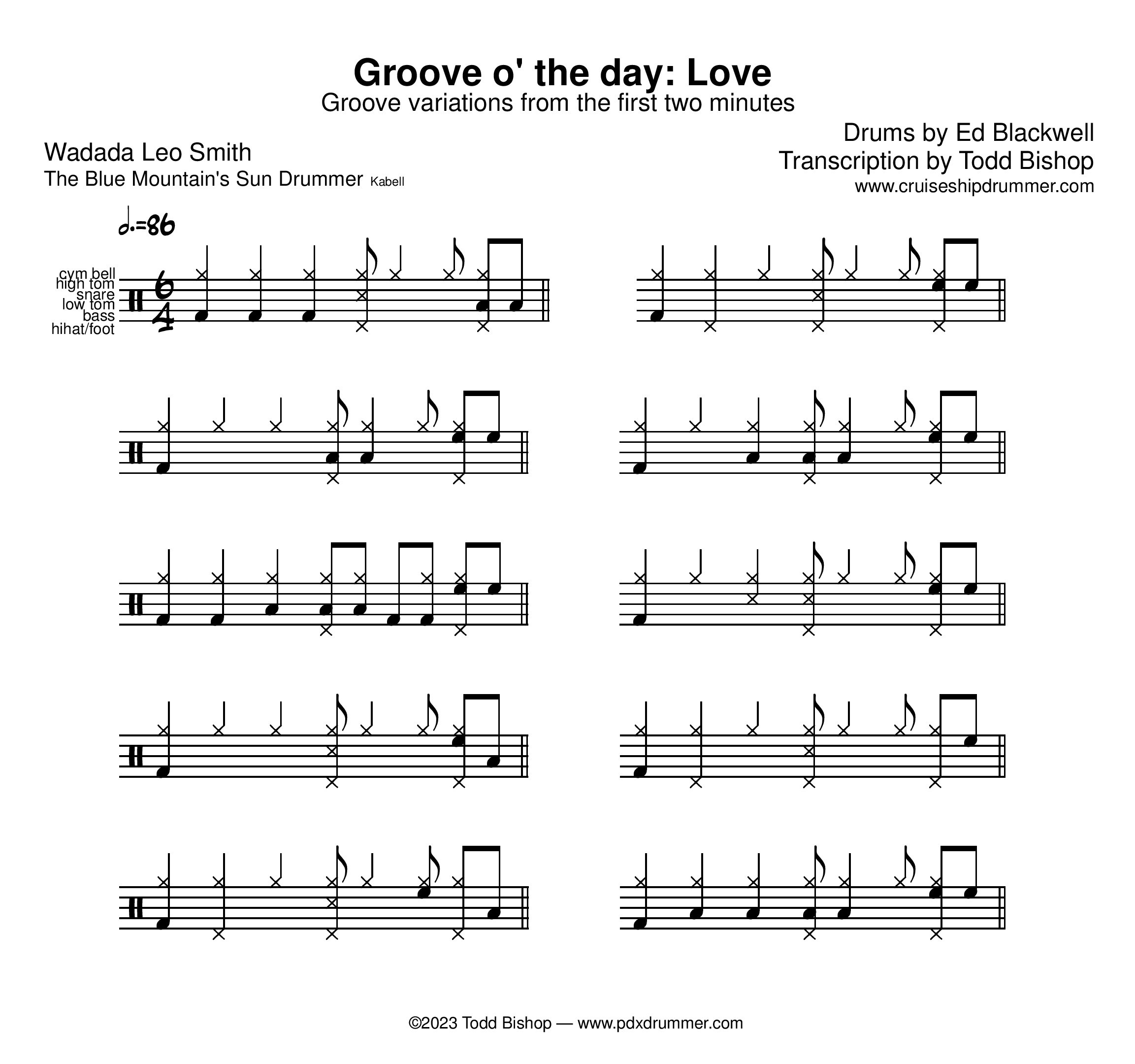
Here's a fast 6/4 Afro type of groove from Ed Blackwell, on the track Love, from a duo record with Wadada Leo Smith, The Blue Mountain's Sun Drummer. There's no tune, it's just free blowing over a groove. People should do that more. These are some variations from about the first 90 seconds of the track. 


We're in kind of a compound 6/4 here— the dotted half note gets the beat, at about 86 bpm. Or if you're counting quarter notes, ~260. 

Get the pdf

Tuesday, March 07, 2023

Groove o' the day: Grady Tate Afro

Grady Tate playing a heavy Afro-Cuban style groove, or Afro 6, as I've been calling it, on Grant Green's The Final Comedown movie soundtrack. The track is Soul Food African Shop, and the transcription is of the percussion break starting at 0:48. 


Bar 7 is probably the cleanest shot of his baseline groove here. He's hitting the bell of the cymbal, except in bar 6 where he moves his hand between a couple of cymbals. He hits the the drums strongly all the way, with a feeling of building into the next beat 1, a standard thing with this style.

Feet are in unison on the dotted quarters throughout— there is some dynamic variance in them, mainly occasional ghosted notes in the bass drum, which I wouldn't call accidental. I think he's very aware of the dynamic movement from beat to beat, and is sometimes getting the bass drum to help with that, mainly coming down with it in the middle of the measure, or on beat 3 as he builds into the next downbeat.  

Get the pdf

Saturday, December 24, 2022

Page o' coordination: Airto's afro

Page o' coordination based on Airto's unique afro 12/8 groove played on the intro of Casa Forte, from Flora Purim's album Stories To Tell.

It's a good introductory groove for this style— the hands are mostly in unison, and the rhythm is easy to follow. The bell rhythm is only different from the normal short bell rhythm by one note, but it seems like a whole different thing, and it should be much easier to work out the coordination.


As always, work out the patterns, then drill them by doing some moves with the left hand

Get the pdf

Tuesday, October 25, 2022

Afro 6 in 4

Purely exploring an idea that occurred to me during a lesson— this has nothing to do with anything. Except I'm writing a new book about developing the Afro 6 groove, so I'm thinking about the following ideas a lot. And I've noticed, in dealing with Latin rhythms and the 3:2 polyrhythm, that by doing some elementary things with them, even if they're purely mathematical, you often end up with an ordinary existing piece of drumming vocabulary. So I'll work through this and see what we get. 

Update: After having played through this, the results are nothing special playing-wise— we get a Latin-type rhythm in 4/4 with a dotted quarter rhythm happening. I found it difficult to perceive the Afro 6-ness of it. See just below for something interesting though. 

First, here's the Afro 6 bell pattern, written in its usual 6/8, and in 3/4:


Working on p. 38 in Syncopation with a student, I noticed there were two measures that were very similar to that 3/4 version, the second measure is just extended by two beats: 


Update:
 Apparently a common Brazilian rhythm, according to Ed Uribe. And notice that in the 6/8 rhythm the last beat is the same as the first beat— if we extended the 3/4 pattern that way, by adding the beginning notes at the end, we'd get this very familiar Latin rhythm: 


So what happens if play that over a dotted quarter note rhythm, like 6/8— to make it fit I have to write it in 16/8— two measures of 8/8. It's that 6/8 rhythm above exactly, plus some extra stuff at the end: 


Play this pattern to get a feel for that type of phrasing. Count it in 4, and also count it with the beats I've marked in— 1&a 2&a 3&a 4&a 5e&a:  


Here's that 16/8 rhythm written in 4/4, as a drum pattern:   


Adding hihat— on beats 2 and 4, and suggesting a waltz type phrasing— 3/4+3/4+2/4: 


Here we'll play the rhythm with the right on a cymbal, and fill in the remaining 8th notes with the left hand on the snare. Here's that, hands only, and with bass drum added, and with hihat added:


It's also instructive to look at the filled-in original Afro groove as 5/8+7/8— alternating sticking, with each part starting with the right hand: RLRLR-RLRLRLR


With our thing that would have to be 5/8+11/8— RLRLR-RLRLRLRLRLR. You could count it the way I've indicated: 


Adding bass drum on all the Rs except the last one, and on the first and last Rs only:  


Here are those written in 4/4, with hihat added on the second one:  


Back to the original 6/8 rhythm— adding a drum corresponding to all the Rs above but the last one gives us the Rumba clave rhythm: 


Here's the same thing in our 16/8 pattern— the left hand part is the “clave” of the made-up item we're looking at today: 


Absent the dotted quarter groove it's similar to a partido alto rhythm. I won't get into it here, but it's how these things work. Things tend to connect with each other. I won't be shocked if I stumble on, or if someone else informs me of, existing music similar to any of this stuff. 

Get the pdf if you want to play through all of this. There are a few page o' coordination style practice patterns there as well. 

A lot of learn about rhythm here, and meter, and about how things are orchestrated on the drum set. When you're operating essentially within a western music system, this is the level you have to get into with rhythm— consciously or not— to not just be boxed in by its structure. 


Thursday, September 08, 2022

Groove o' the day: Airto Afro 6

An Afro 6* groove played by Airto, on the intro of Casa Forte, on Flora Purim's 1974 record Stories To Tell. It has some big shot LA musicians on it, including saxophonist Hadley Caliman, who was a Seattle fixture for years, and trombonist George Bohannon, who was a grad student at USC when I went there.  

It's a rather simplified groove, with the hands largely in unison. The percussion, also played by Airto, multitracked, fills out more of the rhythm. 

* - Right, I notated it in 12/8, but Afro 6 is the generic name I've chosen to use for this kind of groove. 


We like thinking in terms of stickings, and filling in spaces, and playing linear, but unisons are powerful. It's worth thinking about.

There are some open sounds with the hihat played with the foot, that I didn't indicate. 

Monday, May 02, 2022

Afro 6 - advanced bass drum ideas/coordination

A page of patterns I'm playing around with, in an Afro 6 feel, that are difficult or unusual for varying reasons— either the bass drum is in unison with the left hand, or the actual rhythm is unusual. Use it as a companion to a similar page I wrote a couple of years ago, to develop some possibilities for soloing and blowing, with maybe more of an African vibe. 


Before even getting into this, you should develop line 1 as standalone groove. Vary the bass drum by playing it along with the cymbal, like on this page. The left hand part fills in the gaps in the cymbal rhythm— play it as rim clicks, or move it around the drums, varying the accents and articulations. Or do it funk style by accenting the snare on beat 3, and ghosting the rest. Add hihat however you like, on all four beats, or on beats 2/4. 

Get the pdf

Monday, March 21, 2022

More on that Latin system

Breaking down part of that short Latin method from the other day. I like it. It's easy, and gets us into some pretty fundamental things about rhythm, drumming, using the drum set. This is a page I'm handing out to my students.   

To review, the system is based on the cymbal/bell part, that we're getting from the book Syncopation, or from one of my rhythm pages. We're mostly limiting it to the cinquillo rhythm (and its inversions), which is built out of 3+3+2 eighth notes. 

This page has some warm-ups using just the 3+3 portion of the rhythm, in 3/4, in its inversions.  As before we fill in the the gaps in the rhythm with the left hand, and add bass drum to different parts of the original rhythm from the book— add it to the written quarter notes, the written 8th notes, and to the written notes sounding on an &. And add it on 1 sometimes, if it's not already there.

Just play the patterns as written on the page: 


I suggest playing the left hand as a rim click, then move it between the snare and the high tom, one note per drum. Play them along with one of my loops in 3/4, 6/8, 6/4, or 4/4. 

Get the pdf 

Thursday, March 03, 2022

Groove o' the day: Afro 10/8

An interesting groove by Billy Kilson, on A Seeking Spirit, from Dave Holland's Prime Directive album, one of the big records of the late 90s. If you're not familiar, he had a very high powered band that did a lot with odd meters. 


There's a strong quarter note pulse throughout, so this could easily be counted in 5, but there's something interesting happening with the bass drum rhythm, and in the percussion part, which suggests a kind of 10/8 Afro phrasing: 


Compare with the usual form of that rhythm in 12/8:


That 10/8 bell rhythm essentially shaves two 8th notes off the end of the traditional rhythm:


There are some other interesting things happening as the track progresses, which pull it some other directions, so it's worth some further analysis— maybe I'll get into that later. 

Having done this, I'm not finding a free way to listen to it online, so you'll have to buy the record, or sign up for Amazon music, or YouTube music, or something. 

Thursday, December 30, 2021

Analysis: Ed Blackwell - Strength and Courage

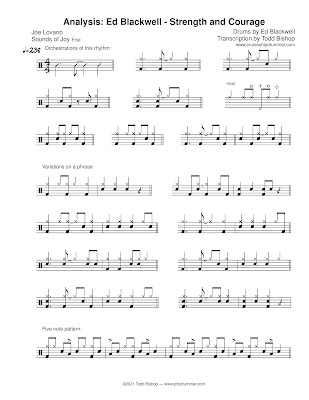
Here's a boiled down version of the Christmas transcription, Strength and Courage, by Joe Lovano. It's a real crash course in Ed Blackwell— a lot of what he plays on many albums throughout his career is in here. 


I've simplified the patterns as much as possible— taken out the bass drum, in a lot of cases. Often the bass is just feathered on beats 1 and 3, or is not necessarily integral to the pattern. You can see what he does with it on the transcription. He has a lot of integrated stuff worked up between his hands— conceptually it's not unlike the thing I called “Max's rubadub”. Inherently two-handed jazz rudiments, of a kind.  

Once again, I'll leave this up for free for awhile, then sometime in the new year I'll ask for a donation to download the transcription and analysis together. Or you can just send a $3 donation when you download it now, if you want to.  

Venmo: @todd-bishop-16
PayPal: toddbishop@[cruiseshipdrummer dot com]  

Get the pdf

Saturday, December 25, 2021

Transcription: Ed Blackwell - Strength and Courage

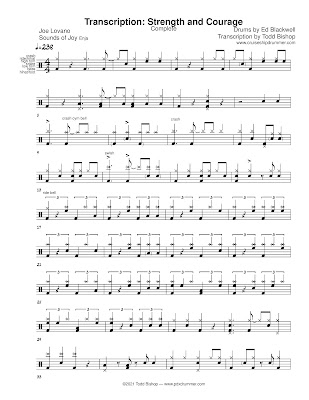
Merry Christmas, everyone. Ho ho hoooeeere's a LONG Ed Blackwell transcription for you, basically all of Strength And Courage, from Joe Lovano's trio album Sounds of Joy, along with Alex Cox on the bass. The drumming jumps around a lot, and, taken two measures at a time, this is a massive crash course in Ed Blackwell. 

The tune is oddly structured— there's not much of a head to speak of. The first time through the form is 8-8-8-10-4-4-4 measures, and then 8-8-10-4-4-4 as the blowing gets going starting at 0:48. The 8 measure phrases are structured 6+2, and the 10 measure phrases is 6+4. So during that blowing form the changes could be outlined as:
  

||: 6-2 | 6-2 || 6-4 | 4-4-4 :|| 


It's noteworthy that the tempo is quarter note = 238— about the same tempo as Passion Dance, Chasin' The Trane, and some other big recordings. I've been thinking of it as Elvin's tempo, but it seems to be a sort of universal up heavy blowing tempo. Nobody should be asking about super fast tempos until you can really kill it in this range. 


There's way too much going on here to summarize now, and I've got Christmas presents to wrap. There are a lot of different cymbals/bells happening— ride, crash, ride bell, crash bell, swish, hihat, cowbell. Snares off. Blackwell plays straight 8ths all the way through. A lot of the bass drum is quite soft, and there's very little left foot activity at all. 

In the spirit of Christmas giving, I'll leave this up to download for free through New Years Day, and then, in the spirit of Christmas withholding, I'll change it to a $3 download, along with an analysis yet to be written.  

Get the pdf

Listen to the tune on Spotify.