Showing posts with label humor. Show all posts

Sunday, February 04, 2024

Antonio Sanchez on drumming in movies

From Anzonio Sanchez's twitter feed, here's a video of him commenting on some drumming performances in movies, including School of Rock, Sound of Metal, Whiplash, and some other things. 

Most of the examples don't have much in them for actual drummers, but he's very businesslike about it. It's funny to bring in one of the top drummers on the planet to point out, OK, there's no bass drum there, here's how you hold the sticks. 

This is all just an excuse to share that screen shot, which I thought was hilarious. It is funny when they get to the movie Whiplash. 

Enjoy:

Friday, August 18, 2023

Time economics of drum videos

Taking a break from a whole lot of teaching, business related emails— there's a Seattle cymbal meet coming up, and a Germany trip in October— and whatnot. I get irritable when I don't get to practice and work on my own stuff, so I'm blowing off some steam* writing, with great hostility and in the most annoying style possible, a script for a 20 minute YouTube video, DECODING STICK CONTROL, that will be CRUCIAL to CHANGING YOUR LIFE, drumming and otherwise. 

...for the worse. Oh my God, greatly. I think what follows accurately conveys the average time:benefit ratio of >95% of drumming videos on YouTube. This is what it's like for me sitting through those things... if I have to suffer, so do you.  

* - UPDATE: Ehhhh I wrote this a little more EXPLICIT than I normally do on this site, I went back
and toned it down a bit. Sacrificing some primo comedy material to preserve the dignity(!) of the site. 

 
Scene: 

[user innocently types youtube.com into his web browser, searches “how to practice stick control”, list of videos comes up, the following is at the top of the list, with 6 million views]

[title card, we see the words DECODING STICK CONTROL at a crooked angle, photo of presenter brandishing book STICK CONTROL by George L. Stone, with look of inane, inappropriate surprise]

[30 second intro graphic for production company of long suffering video team]

[90 second intro montage of guy apparently wailing on the drums, with elaborate facial expressions] 

HEY [edit for blown take] EVERYBODY!!! it's JJ, Jim Jackerson comin' atcha again, and [90 seconds of blather, introducing himself, his dog, and his Pontiac, which he calls “The Squealer”, etc] and working the camera today we've got Stevo, known as The Hairball, say hi to everybody Hairball! [camera view vigorously nods hello] 
So in today's lesson we're going to CRACK THE CODE [makes Rubik's cube-like gesture] of one of the GREATEST DRUM [edit for blown take] BOOKS OF ALL TIME, STICK CONTROL by George Lawrence Stone, which [2 minutes of superlatives]. Now, George Lawrence Stone was [2 minutes of superlatives]. 


[2 minutes of superlative blather about what brands of drums/cymbals/heads/sticks he's using]

SO LET'S GOOO here's the WORLD FAMOUS EXERCISE 1. [goofy montage of guy at a practice pad experiencing various stages of perplexity / frustration / exultation] 


Now the kinda notes you see here are called [edit for blown take] AYT-TH NOTES which you count ONE. AND. TWO. AND. THREE. AND. FOUR... AND.

[looks significantly at camera]


Now you may be saying [begin funny voice] HURR HOLD UP JJ, WHAT DO ALL THOSE Rs AND [edit for blown take] Ls DOWN THERE MEAN, [affects southern accent] AH'M CONFEWSED [end southern accent, end funny voice]

WELL YOU KNOW I WONDERED ABOUT THAT FOR A LONG TIME MYSELF, AND THEN I GOT THE INSIDE SCOOP WHEN I TOOK A LESSON WITH
[well known drum teacher who spent the longest 50 minutes of his life with this guy] AND HE SAYS THE R MEANS RIGHT HAND [hits pad slowly with right hand] AND L MEANS— THAT'S RIGHT, YOU GOT IT, AHH, HAHAHAHAHA YOU'RE WAY AHEADA ME, I GOTTA WATCH YOU GUYS... LEFT HAND! 

[hits pad slowly with left hand]

SO TO PLAY THAT YOU GO: WWON [hits pad slowly with right hand] AND [edit for blown take] [hits pad slowly with left hand] TOOO [hits pad slowly with right hand] AND [hits pad slowly with left hand] THREEE [hits pad slowly with right hand] AND [hits pad slowly with left hand] FORRR [hits pad slowly with right hand] AND [hits pad slowly with left hand]. 


[90 seconds of superlatives about the myriad ways this is going to change your life, 2:1 ratio of words:edits for blown takes]

[two minutes of “critical” instructions on how to practice it in the wrongest / most mind-numbing way possible, emphasis on using “free stroke”]
 

ONCE YOU CAN DO THAT, IT'S TIME TO J**K IT [frenetic graphic text to that effect, with high speed background video of host jacking up his Pontiac, brandishing wrench at camera] and LEVEL UP TO JACKERSON LEVEL and do it... A LITTLE FASTER. [crazee montage of drumming mayhem, funny camera angles] SO YOU READY, HERE WE GO, JJJ-STYLE:

[plays exercise at a medium tempo]

NOW THE REST OF THE BOOK [riffles pages at camera] IS A LOT OF STUFF YOU PRAHHBLY DON'T NEED, I MEAN EVEN I HAVEN'T DONE IT. [flings book off-camera] 
BUT [90 seconds of earnest, near religious superlatives about how it has changed his life, opened the gates to a paradise of freedom of creativity going dooga-dooga on the drums.]


[3 minutes of entreaties to “like” video, ways to follow on social media, ways of contributing, etc etc] 


End scene
 

Sunday, March 12, 2023

Cymbal size vibe war!

Photo stolen from the cover of 
The Cymbal Book by Hugo Pinksterboer, 
which you should own.
At last, the definitive guide to the vibes we all get from the various sizes of cymbals. I don't know why most of them relate to cars for me. File this with my previous tom size vibe post. 

...mind you, what follows is rated 100% pure BS, so don't let it dissuade you from getting the cymbal you want or need. There are no “dumb” or “serious” cymbals, they're all instruments serving a musical purpose. But it's fun to let fly with these kinds of judgments.  

Let's do this from little to big: 

<6" - Finger cymbals, bells, crotales, Necco Wafers, other rejected Halloween candy.  

6" - Do you need something that goes ki? Looks ridiculous if not carefully placed, like putting a tiny hat on your drum set. 

8" - Normal splash, slightly suspect economy vibes, Honda Civic.  
 
10" - True normal splash.  Ford Bronco of splashes.

12" - Serious splash. BMW 5-series of splashes. Or, from another perspective, a big dumb splash. Hihats on a child's drum set, or for really trebly Dixieland, with a guy singing through a paper megaphone. 

13" - Sport hihats. Either Ferrari-like or Suzuki Samurai-like, depending on your perspective, abilities, and quality of the cymbals. Meinl = Suzuki. 

Tiny hat cymbal

14"
- Normal hihats— Volvo 240, Gap jeans. Small crash or splash for serious people.   

15" - Alternate normal hihats. The viola of hihats, slightly bigger, dumber. Enticing/intriguing crash size. 

16" - Normal crash, most people's first crash cymbal. Now looks slightly inadequate in its former spot on the left side of the set. Fiat Panda, Volkswagen Rabbit/Golf. Big hihats for when you want people to know you're serious about “pocket.”  

17" - Sporty, agreeable-looking, the optimal size for a crash cymbal. Stupid looking hihat size, trying too hard. Like somebody really late to the party with the 80s wide leg jeans phase. 

18" - Platonic normal universal all-purpose cymbal size, though currently out of favor as such. People want their crashes either smaller or huger, and want their rides— left side or otherwise— bigger. Smallest size for a ride cymbal without getting weird. 

19" - Compact ride, big crash. Subaru Forester of rides, Oldsmobile 98 of crashes.  

20" - Normal ride, junior ride. The Ford Taurus of ride sizes. People are unsettled by its universality, interpreting it as a mundane rather than classic vibe. A little out of hand as a crash cymbal— you'd better be playing a lot of Billy Squier covers in that case, with a Pinstripe on your snare drum.     

21" - Compact master cymbal, Ferrari-like vibe, when a 22" would just bog you down, hold you back.  

22" - Master cymbal. Big, substantial, serious cymbal for grown ups. Full size Mercedes. I refuse to acknowledge that people buy crash cymbals in this size. 

My '70 Buick Elektra,.en route to Las
Vegas from Los Angeles, 1989

23"
- There are a few of them around. Contrarian. You're not like those regular 22 and 24 inch cymbal using clods. 

24" - Big dumb cymbal— 1970 Buick Elektra, or DUKW aquatic military truck. I drove an Elektra when I went to USC. Driving it to LA with my brother, five minutes outside of Eugene, we passed a flaming hulk on the side of the road, then the Elektra's crumbling vinyl top peeled back and was flapping behind the car like a sad cape. We had to tear it off and keep driving. That's the 24" cymbal experience. 

>24" - The block long Hummer limo of cymbal dimensions. For the kind of person who's always looking for a hoppier beer. Looks like elephantiasis.

Friday, February 10, 2023

Time is money

Another funny item I dug out of my archives. I believe it's from the jazz festival at UC Berkeley in 1989— I was there playing with USC's guitar ensemble. A bassist and drummer gave a clinic that was mainly about time, and I think this was a handout. I forget their names, but they were Bay Area jazz professionals, not an 80s pop band from Indiana also called The Phonz. 

They've padded it out with some jokes, but there are some good points: 


The main thing I took from the clinic and never forgot was: 

Laying back or playing on top are confusing terms, they are a smokescreen. Time should be played in the middle of the beat by the rhythm section. 


It simplifies your thinking if you just decide to be the reference point stating the tempo, and let everyone else play ahead or behind. Which may put you seemingly ahead of / behind the beat, depending on the other players' ears / time concepts. The main thing is that you're being the reference point— you're not getting the time from them.  

Thursday, February 09, 2023

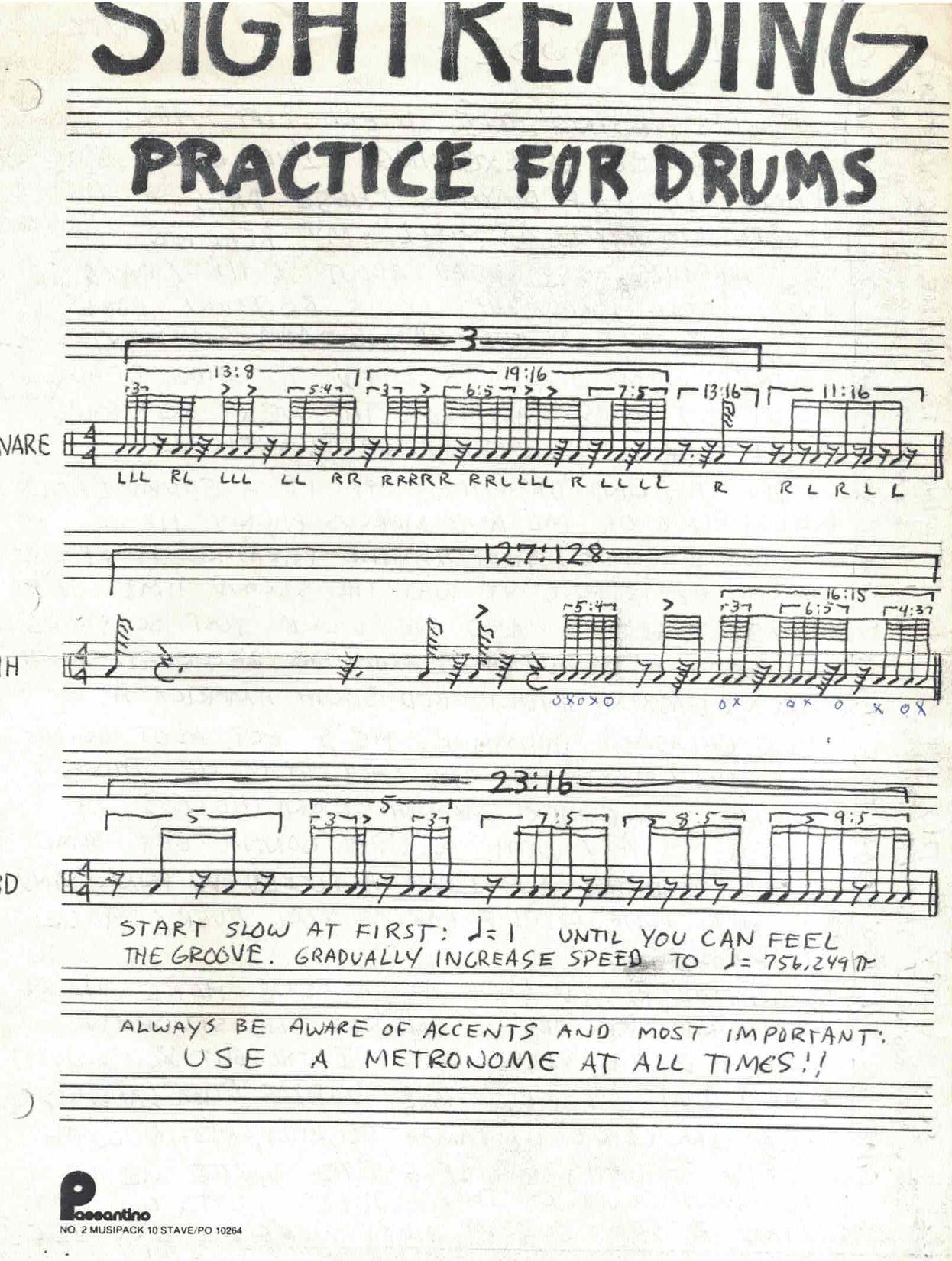
From the zone: feel the groove

Cleaning out my mom's house I found a box of all the siblings' music materials that she saved, including a bunch of my archive items, that are pretty interesting. 

The thing below was written and sent to me by my friend Kirk Ross, mainly a bassist then, now mainly a songwriter. Kind of an extreme personality. We played in a couple of bands at the University of Oregon, then we went off to different schools— me to U. of Southern California, him to Berklee. Later he got me on my first cruise ship gig, and he brought me to Los Angeles ~7 years ago to make a record with Geoff Keezer on piano, playing Kirk's songs and a Neil Sedaka cover. 

His first year at Berklee he was getting into some things from Gary Chaffee that I showed him, and he really ran with them. Following is a one-measure sight reading exercise— the left side got cut off, but top to bottom, I think each line was meant for snare drum, hihat, and bass drum:  


A joke, clearly. I'm sure it works out mathematically. After this Kirk moved to LA and sought out and befriended Vinnie Colaiuta, and jammed with him a few times. He had a big moment was when he was able to lose Vinnie playing the above kind of nonsense— I guess even he needed a foundation to play off of. We each had our course corrections shortly after this— Kirk going back to Berklee and getting really into James Brown, me at SC getting into Elvin Jones.  

Saturday, November 06, 2021

Izquierdadiddles

Tenue des baguettes
I've got 6 hours of driving to do a 90 minute gig today, gang, so I'm going to leave you with this:

I spend a good part of my life singing stickings in rhythm, for students. We're very lucky in the English-speaking world that we have nice one-syllable words for left and right, and for many of the other possible four-way stickings— bass, kick, hats, hands, feet, both. Others— Spanish-speaking people, for example— are not so lucky. To tell someone the sticking for a paradiddle, you have to say: 

derecha izquierda derecha derecha
izquierda derecha izquierda izquierda


It's only possible to do it at baby speed, with a giant space in between words. Derecha. [Whack]. 

Italian is almost as bad, they shaved off a syllable:
 

destra sinistra destra destra
sinistra destra sinistra sinistra


If you say it fast you have a Bulgarian rhythm.

German is acceptable, with rechts (or rechte?) and links. French droite and gauche are a mouthful, but sound cool, especially the word gauche has a good sound for percussion, like a Pinstripe on a snare drum. Goosh. Drummers speaking most other languages are burdened with extra syllables. I don't know what they do, call stickings by their letter name? Assuming the letters themselves are only one syllable?

Sidebar, step into my office: Where the hell did the Danish get venstre for left? It's similar to das Fenster in German, meaning window. We can only speculate on that etymology, remembering that usually words meaning left are derived from weird, dirty, evil, weak, clumsy, suspect. The left hand is out the window, like the rotten herring seems the likely word source.  

[...] 

Fellow drumming blogger Ted Warren suggested you could have a whole new rudiment if you played a note for all the syllables in that Spanish version. We have the choice of keeping the beat the same, or keeping the rate of notes the same: 


That first one will give you a little left hand workout. I imagine in a parallel Star Trek universe where I speak Spanish, I say izquierda in a lesson, and the student says so I hit it four times, IZ-QUI-ER-DA? [whack whack whack whack] and I say NO! It's quite simple! etc endlessly.

Lots to think about.   

Wednesday, October 27, 2021

Tom tom sizes rated!

The genesis of this post. 
Let's do something dumb: critically assess the full range of tom tom sizes for goodness and badness. Reward the good, denigrate the bad, punish the weak and strange:


6": A bongo, an effect drum. Cute. Use for circus-style roundhouse drum fills when you want to start absurdly high, like a musical joke. Virtually always appears as a concert tom, putting a bottom head on it is ridiculous. Sonor did that.  

Notable uses: Neil Peart, obviously. See 2112, the Working Man drum solo. Ralph Hardimon writing for the Santa Clara Vanguard would always write an exposed sixtuplet on the 6" tenor drum during the percussion feature.
  

8": Also a bongo, but sort of a drum. Use for non-ridiculous very high sound. Poor sustain consigns it to the effect category. 

Notable uses: For awhile Dave Weckl tried to make the 8" “the new” 10". It didn't sound good. Acceptable as a pair of add on 8"/10" concert toms, frequently used to great effect by 70s drummers like Ndugu Leon Chancler, and more lately by the Foo Fighters guy. Those guys put it off to the side, so you have to use it occasionally and deliberately.
 

10": Fun to play, but irritating. Remember the video game Asteroids? That's what you sound like to everyone. I would have given my front teeth to have one in the 80s, now they're just annoying. Usually placed right in front of the snare drum, so you're going to play it all the time. The only case where I would be tempted to reverse the tom toms, putting the 12 on the left and 10 on the right, but that looks stupid and I don't want a 10 around that badly.

Notable uses: Steve Gadd and everyone else in the world after him. See Night Sprite from the Chick Corea album Leprechaun. 


11": Rare oddball size that would probably be a good substitute for a 10" as a high drum, if they ever caught on as a thing. I've only ever seen one, and didn't actually play it, but it seems like it would be a fuller, less comical high sound paired with a 12. Now they exist only to create head-finding problems for their owners.  

Notable uses: Who the hell knows. I wouldn't be surprised if Tony Oxley used one, a metric 11". Gene Krupa probably had a few in his basement when he passed away. 


12": Normal drum, the main tom tom voice. Expressive, right tonal range for a high tom. Sounds good in high and low tunings.  

Notable uses: Every record ever made. 


13": The viola of the tom tom world, the dimwitted step sister of the 12". Substitutes for a 12 in heavy rock settings where the little drum gets overwhelmed. Good middle drum paired with a 12 and 14; pointless but I guess unavoidable paired with a 12 and 16.  

Notable uses: Jazz records where the toms sound tubby. 


14": The best, most versatile floor tom size. Sounds good in high and low tunings, adequately low and full for most settings. Agile, expressive low drum. Maybe an 80s Metal guy could get away with using one as a rack tom, despite being ridiculously low pitched for that role. Like the guy in the Melvins had a 14x14 rack tom when I saw them in Eugene. Anyone else attempting that, seek medical attention immediately. 

Notable uses: Everywhere. Elvin Jones playing Alabama on the Ralph Gleason TV thing. Tony Williams on Four & More. In my youth I played a whole solo on the 14 on a recording.


15": Alien drum size, strictly for weirdos. I would entertain the idea of a 15x15" floor tom, but I've never seen one, and it would instantly plummet the value of any drum set it was attached to. 

Notable uses: Steve Gadd has long used 14/15" floor toms mounted on a stand. 


16": Normal rock floor tom, only good for big, loud, low sounds. Too big and dumb for anything else. 

Notable uses: More jazz records where the toms sound tubby. Good paired with a 12" tom tom in funk/R&B settings, see Andy Newmark. 


17": Another very rare size. I have a 17" Ludwig marching tenor drum / thing I set my drink on, that I want to make into a bass drum someday.  

Notable uses: None. Marching drum for slow kids. 


18": Too low. Good if you want a big expensive pain in the butt nobody's going to be able to hear. Maybe use if you're a rock guy and want two floor toms, and a 14 is too small for you. Good for converting to a weird looking bebop bass drum. 

Notable uses: John Bonham I guess. His 18 never makes much of an impression on me. Tony Williams during the period when nobody likes his drum sound. 


20": Get the hell out of here. Now. 

Notable uses: What's wrong with you. 


20": OK, I've cooled off. Manufactured in small quantities in the 70s and 80s following the “add more of what we already did” logic favored by razor blade companies and IPA brewers, and Nigel Tufnel's famously halfwitted “these go to 11” line.  

Notable uses: Unknown. NAMM displays, magazine ads, a few chump purchasers. The Twisted Sister guy probably.  


Notes on depths: 

Standard: Always use standard depth mounted toms, square depth floor toms. 

Fusion: Very 80s/90s, but also sort of standard now. Do not want, but unavoidable with some lines— a lot of Yamaha  lines, for example. 

Power: Absurd 80s things, like a Flock of Seagulls hairdo. Sonor rendered a lot of their product totally worthless on the used market due to investing in this fad in a big way. 

Extreme: Sonor made some absurd deeper-than-the-diameter drums in the 80s. Everything wrong with power toms, made worse. As ridiculous as a drum can possibly look, this side of a North drum. 

Thursday, July 29, 2021

The demon-haunted world: jazz snobs

Here's a desperation special. When I can't write much, I pull something not-that-great out of the drafts folder, like this: a few snippets of people battering their insecurities into submission by attacking a mythical demon, The Jazz Snob. I forget where I got these. They're probably YouTube comments, possibly forum comments.

First you'll notice that these people are all very successful, while the jazz musicians who torment them are losers, forced to do very shameful work:
 

“I wanted to make a living. I found I had many hard jazz heads talking down to me as I was making a good full-time living doing tv shows, movies, and pop recordings. They play great and work at Walmart.”

 
One man was scarred by an event decades ago: 

“...about 25 years ago I was taking a long lunch in downtown Everett, Washington and I noticed some jazz people setting up. So I casually walked over and asked what they were playing... 'Jazz' he said very snobbishly... That much was obvious ..... I was planning to hang out and listen top them, but instead I cut my lunch short and went back to work... You can abuse me to a point, but you are going to pay me to do it...”


“I have nurtured a decades-long grievance over a single word spoken to me, that was directly responsive to my question, which I interpreted as intolerably abusive.”

“When I was in music school, the group of drummers asked me- a freshman - what music I was listening to and who my favorite drummers were. I said “Rush - and Neil Peart, Vinnie, Stewart Copeland, Manu Katche...” the collective disdainful gasp is nothing I’ll forget soon”


This happened. People do make exaggerated, easily-readable expressions of shock when a drummer lives up to their expectations.

“There's nothing more ironic than a term like "jazz police"

A Music genre, that was forbidden, whose interpreters were prosecuted by a society in where they dared to be outlaws... Has a "police"

Elitism kills music scenes...” 


Note: “Jazz police” are not actual police. It is not some enforcement body created and named by jazz musicians to root out heretics and unbelievers and too-creative neophytes. A made up thing fulfilling the disparaging name you made up for it is not an irony-type situation.  

“Jazz has become an orthodoxy and anyone who truly challenges that orthodoxy will get rejected. Too many years of jazz being 'taught' has created a glut of jazz musicians who don't know how to work in the modern music world but will be able to have an opinion on how you should play jazz. There is a huge difference to what Ornette and Monk were doing compared to what most modern jazz musicians are doing today. And this can be heard in how similar modern jazz musicians sound.  This video really seems blind to the real problems that exist in the current jazz ideology; It can't cope with true iconoclasts anymore....”


...oh, I remember, these are comments from the 80/20 guy's  “authenticity” video, which I wrote about, to which he responded in another video, without naming this site or linking to it...   

“Jazz” didn't necessarily cope that well Ornette and Monk at first, either. Iconoclasts are never welcomed by everyone, and having iconoclasty be an expected thing is not necessarily good. You get a situation like in the art world— a certain attitude in it— where every new thing has to wipe out what came before it, and nothing gets developed. It becomes a form of commercialism. It would be great if people were more accepting of individual voices, and were more original in their creative work— we'll have to take that up with the human race. 

As for jazz being an orthodoxy— I think somebody probably was told to do some homework and didn't like it, and couldn't respond to that person at the time. Or the authority figure didn't validate the commenter's objections. 

“Jazz cats are among the most insufferable jackasses on the planet. And this is coming from someone who’s worked in two different music stores and attended three different schools of music. I once asked an unruly jazzer 'why are you knocking yourself out to make elevator music?'”

 
Note: I shall not comment on a music store guy calling other people insufferable. Equating jazz to elevator music is evidence of a thorough and deep understanding of a world wide field of music spanning a >100 year period.  

“Jazz is that ugly place where all the toxic mistakes of history ferment.”


This I could not have said better. Finally someone gets it.


...so yeah. These are all basically the notes from a story-writing session for the movie Whiplash. 

My theory: I blame this type of thing on the South, and the southern diaspora. Sorry, South. There seems to be some kind tribal instinct to demonism and mob frenzy down there, where you identify an enemy, and then make things up about it, get good and mad about that, and everyone piles on more made up things, and everyone has a good homicidal wallow. There's also a particularly American kind of self-defeating belligerence towards moral, intellectual, scientific, professional and artistic authority— any non-violent authority— while being slavishly submissive/worshipful to the punishing kinds of authority. 

And there are a lot of very fragile egos. Many folks seem to be mostly concerned with building some kind of fraudulent appearance of status, and with cocooning themselves in self-delusion about their abilities, and they get very angry when someone doesn't help them with that project.  

Most jazz musicians I know, and I, are painfully aware of their/our real and imagined shortcomings, and spend many years learning to deal with that— not by BSing, but by working really hard at learning to play. So by the time we are done(?) being beaten up by our insecurities, we're pretty solid about what we know and do not know, and we don't concede points of music to just anyone who wants to disagree. This also makes some people very angry. 

The thing to do, instead of what these people did, is to get serious about learning. All that requires is to have some humility about the task ahead of you, to stop the BS, and to learn to listen and take in information— all the time, from any and all sources. And not get mad at people who outperform you, or that know more than you, or that don't stroke your ego and self-delusion. Those are all learning opportunities, and only the biggest losers in this game pass them up for the sake of their ego. 

Saturday, January 04, 2020

New gear rules

NO
I'm getting a little punchy from working on this new book, so I just started writing rules about gear.

Consider the following to be LEGALLY BINDING. Failure to comply may result in a SUBSTANTIAL PENALTY:

• No rubber practice pads. Everybody has to use the pieces of crap that Remo pads have become.

• No more 10" tom toms, unless it's an 8 and 10" concert tom, like Ndugu Leon Chancler. Mounted someplace difficult to reach, so you have to really have a purpose in using them.

• No deep bass drums. I'm tired of looking at them. And they all have to be 18" or 20". Quit screwing around.

• No snare drums that sound like static. Do you talk in a squeaky voice? Listen to some 70s records.

• No more punchy tom toms. Life is not a YouTube video. Get a different sound. Listen to Billy Cobham.

• I'm not going to ban every drum head in the world except Remo Ambassadors, but I would be fine if somebody did.

• No more mentions of Gretsch drums made after the 90s. If it's part of a “line” and not just Gretsch drums you don't get to talk about them.

• No more mentioning most brands. You can talk about Gretsch (real only), Yamaha, Sonor, Ludwig, Pearl, Slingerland, maybe Premier. I kind of don't want to hear about Tama any more. Whatever defunct brands you want, Fibes, Corder, Rogers, whatever.

• But no wistfully mentioning defunct brands that were crap in the first place. Maxwin. Royce. CB700. No more mentioning student/middle lines by any company, defunct or otherwise.

• I'm a nice guy for including Ludwig.

• Bass drums are sounding too nice. Put on a CS Black Dot until further notice.

• NO VISTALITES

• No more cymbals with really long creative names, no ultra thin cymbals, no dry cymbals, no putting the word “POWER” on cymbals. No more luxuriant cymbals. Play luxuriant.

• I don't ever want to see another Moon Gel. Flick that disgusting thing in the trash.

• From now on no more than 5% of your talk about drumming and music can refer to gear. Get into playing.

Tuesday, February 13, 2018

Idiots, you're doing it wrong. Fools!

This is you trying to play a normal drum set.
Ergonomics! The science of putting things where scientists tell you to and shutting up. Our sad devotion to this clearly absurd contraption, the drum set,  has given us nothing but crippling injuries and a lifetime of frustration, but we are psychologically and intellectually unequipped to evolve it into a rational musical instrument. We don't know what the hell we're doing and we need help.

Well, our torment is finally at an end. Some scientists from the Philippines (home of the hard boiled fetal duck egg) have recognized our cognitive disability and taken pity on us, and have conducted a study to help us set up our drums and be not as stupid.

Now, before you start in with a lot of “what are you talking about I know how to set up my drums wtf is this” nonsense, let me show you some actual scientific equations used in this study:


There.

Now let me back it up for those of you reading this and saying durm what is durm, and sadly pawing the computer screen, in some atavistic hope of making the words less incomprehensible to your inadequate drummer's brain. The scientists inform us:

A drum is simply any percussion instrument beaten by the hands or with some tool, as a stick or wire brush. However, the use of only a single drum may not be able to utilize the full capacity of a skilled drummer. This then leads to the development of the drum set.

Indeed it does.

The drum set or drum kit is a collection of percussion instruments to be struck by a single player seated at a drum throne/seat. It is, as often said, the backbone of every band, keeping the pace and driving the rhythm section of every performance. A standard set of drums consists of a snare drum, a bass drum, a hi-hat, two tom-tom drums and one or more cymbals. The hi-hat could be operated by the left foot; the bass drum is operated by the right foot, while the other drum components are struck with drum sticks. Drumsticks are normally held at their fulcrum points. 

Do not be deceived by the purposely vague language and general yada yada attitude towards this seemingly foundational part of the study. You only think that an actual understanding of the underlying issues is important because you don't think scientific. They are clearly attempting to lull us into a false sense of security— making it look like they haven't bothered to think about what actually happens in a drumming performance so they can trap us later on. That's what science is all about, man.

Though the drum kit arrangement is arbitrary, there is a common set-up widely used by drummers. The image shows the common arrangement of a drum kit (Fig. 2).

Totally arbitrary! Finally someone with a total lack of knowledge of how the drums are played has the balls to point this out.

Here is how the study team thinks you are setting up your drums. I had to invert the image from the study because they have disorientingly presented it the other way around, which makes no sense at all. This does not mean they don't know what they're doing so stop thinking that.


Fig. 2


I also want you to stop thinking what the f__ is this, who puts their floor tom off to the side of the bass drum, and the tom toms are apparently placed on snare drum stands in front of the bass drum, what the f__ is up with that, the hihats are also in a weird spot, and the crash cymbal a mile away on the far side of the small tom WHAT IS THIS— and so on. That's just what the scientists want you to think. The gross inaccuracy of the diagram will make the impact of the equations, which are truly rigorous, all the more seismic. Plus there's only so much rigor to go around. Here:


more science


Get off my back. The study looked at male drummers from the Philippines (home of revolting culinary traditions too numerous to mention) aged 14-30. I don't know why exclusively male— God knows what they thought was involved in including women in the study. They basically settled on a methodology of a) trying to figure out what drummers hit most, and b) putting those things closest. All the while ceding as little as possible to three-dimensional reality.


Part 3: GET READY TO FEEL STUPID

If you think I'm going to try to explain/understand the actual mathematical gibberish that went into this you're sadly mistaken. This is what they came up with:


Overwhelmed by your crippling hidebound conformism, you may find this confusing at first. For example:

— If we assume the player is facing north, the snare drum is positioned directly where the left knee would be on an intact human body, with the large tom tom positioned flush on its left. Assuming the player is allowed to keep that portion of his leg, the snare drum will have to be severely elevated and mounted on some kind of boom or bracket mount with enough leg clearance to allow heel-up playing on whatever pedal that foot operates. Playing the snare drum normally with both hands would require a weird asymmetrical posture by the drummer,

— The hihat is on the right, meaning either it will now be played with the right foot, or we all have to buy remote systems, the cost of which could feed an average Filipino family of five for six months. Most hihat stands also have a thin metal stick protruding 8-10" above the cymbals, which is also problematic for positioning tom 2.

— The ride cymbal is way off to the right, a bit of a reach if you jazz players ever want to ding on that thing here and there, but no big woop; going cshhh-chick-a-cshhhh on the hihat sounds way more “jazzy.” You'll get used to it. Just play different stuff.

— The placement of the second tom tom would seem to be problematic, but that may just be my relentless pig-ignorance talking. Since it overlaps the hihat, and tom toms are actual three dimensional objects in the real world, and not two dimensional circles you drag around the screen with your mouse, the drum will have to be positioned at considerable height over the hihat to be playable— just look at your drumset and imagine how a 13" tom tom would have to be positioned to match the diagram.

— The smallest tom tom is not too horrible, but if you play the toms as an ensemble, they are arranged high - middle - then low way off to the left with a crash cymbal directly in between. And if you read the description of this dream set up, the crash cymbal and smaller toms are to be positioned at the same “level 3” height. So any hand motion between the low and higher tom toms is hereby consigned to the dustbin of drumming history.

— Just put that big-ass 22" bass drum any old place. Ergonomics!


Part 4: SCIENCE HURTS

Now, I know what you're saying: “that won't work”, and “there's no f__in' way I'm f__in' doing this you f__, what's wrong with you. The f__ is wrong with you.” A torrent of f-bombs, basically.

After we've all calmed down, the general awkwardness sets in. I don't know what else to tell you. Visit the Philippines. Try the hard boiled fetal duck egg.

Thursday, February 18, 2016

Very occasional quote of the day: conversation

Glass: “Listen to me. Shut the f__ up and listen. I'm trying to compliment you.”

Kindler: “I won't be able to be doing a bit if I listen. If I stop talking, you might be funny. If you're funny, how does that help me? What am I, on a charity mission?”

—Comedian Andy Kindler in conversation with Todd Glass on a Nerdist podcast

Do download the podcast— that exchange happens after about 31:00, and the whole thing after the long opening monologue is hilarious. It's a two-parter, in fact.

Friday, July 31, 2015

More Dom

I'll say again, I strongly encourage you to check out comedian Dom Irrera's podcasts. There's a lot that reflects musicians' world— what these guys are, musicians used to be. They are very intimate with what's happening in their scene, and with the work of their contemporaries, and with their immediate influences, but are not necessarily all-encompassing scholars of the history of comedy. That's actually the way it's supposed to be, in an active, living scene— it seems that musicians have gotten more serious about history and scholarship as the scene has fallen apart.

Critical opinions are oriented around funny/not funny, and original vs. “stolen” material, rather than the type of judgments fans make, about who's currently hot and who “sucks.” For example, you'll hear neutral, non-snide references to Carrot Top and Larry The Cable Guy, each perennial figures of loathing among comedy fans. The interview with Rob Schneider, who is also the subject of a lot of antipathy, is really good:


Much of the conversation is NSFW in a big way, so best not to play these in front of your grandmother— these guys are pretty “low chakra” types, as Bob Moses said of most musicians in a recent clinic. There's also some racial stuff that's pretty marginal in my book. The comedians have a lot of verbal intelligence, but not necessarily a lot of education, and are generally not real sophisticated politically.

But these things are a great working class entertainment business hang, and very worth the time.

Tuesday, June 30, 2015

Dom Irrera talks

If you don't know who Dom Irrera, he's sort of the Godfather of road comedians— stand up is a punishing trade, and comedians try to get away from it when they can. It's also a very pure form of comedy, and Irrera is one who has stuck with it year after year, completely killing it since the 80s. I saw him on a Sunday night at the Comedy Store in Los Angeles back in 1989— Sunday is their traditional open mic night, when pros come out to try out new material, to keep their chops up, or because it's just what they do. It's not an amateur thing; there were several people on that evening who had been in movies recently, and the second person on was Richard Pryor. Here's Dom in about that period:


So, Irrera has been doing a podcast, on which he basically just hangs with other comedians, and talks shop— there's quite obviously no preparation, no real questions, not even much effort to be interesting to an audience— it's just a straight pro comedian hang. It's very cool. The Hang has kind of died off as a thing musicians do, but clearly it's still a major thing in professional comedy. Here's Irrera talking to another legend, Richard Lewis:


You can get part of the series on iTunes, or you can go here and get them all.

Sunday, June 21, 2015

Phil Austin 1941-2015

Very sorry to hear we lost another comedy legend last week: Phil Austin, from the Firesign Theater— an incredible surrealist satire troupe, if you don't know them; they're really the American Monty Python. Austin was best known for his character Nick Danger:


TFT's album Don't Crush That Dwarf, Hand Me The Pliers is really essential listening.

Saturday, June 06, 2015

Comedy break

While I'm embroiled in working on the new rock-and-funk book— which is in the wonderful snowballing-on-me-and-just-about-needing-a-total-reorganization phase— enjoy some classic turn-of-the-90s comedy: Get A Life, starring Chris Elliot. If you haven't seen it, it is the greatest thing in the world, EVAR. I've these memorized for about 25 years, and they're never too far from my mind.


Here, Larry, have a stick... it's an old Navajo snack-treat...
First, Camping 2000, in which Chris and his best friend go camping with Chris's dad (played by his real-life dad, and comedy legend in his own right, Bob Elliot), and end up getting lost and eating hallucinogenic berries, which give them homicidal delusions:


More after the break:

Wednesday, April 08, 2015

Stan Freberg 1926-2015

A few clips by comedian, satirist, and ad man Stan Freberg, who died yesterday. His heyday was before my time, but we had several of his albums in my dad's record collection, and I memorized all of these when I was a kid. I think my favorite is his Elvis parody:


Several more after the break:

Tuesday, April 07, 2015

A waste of time

Here's a good video in case you ever wonder “Am I wasting my time geeking out on this drumming nonsense? Does anyone really care if I get such-and-such particular little drum thing together?” The answer is: yes, you are, and no, they don't. But everybody who's any good at anything wastes vast quantities of time on things no one is really going to ever fully appreciate. It's just what you do. For example:


You'll also enjoy the movie Comedian, which follows Seinfeld through the process of developing a new stand-up act, after some years away from that medium. It's really about the professional ethic of comedians, which is not that different from that of musicians. The full movie is after the break:

Monday, February 09, 2015

Transcription: Airto — Earache My Eye

Cheech & Chong's Earache My Eye is just an eternal piece of American teenage rock & roll culture, along with Smoke On The Water, Iron Man, Sunshine Of Your Love... like that. On hearing it for the first time in a long time, I think this is what I've been really been trying to play like all these years— with rock & roll, anyway— like this, and like Jim Gordon on Zappa's Apostrophe.

It turns out the drummer on the recording is Airto, which surprised me, but I can dig it. To understand how great he is, just check out a few of the many covers of the song; the tom fills really make the whole track, but nobody else does them especially well. And none of the guys beating the f__ out of their drums plays as effectively as Airto does here— they rock less.


I went ahead and put in everything I could hear, including the hihat played sporadically with the foot. If you actually want to work this up, you can safely ignore the left foot, for the most part. What's significant about it is that he will sometimes play it on the &s, Brazilian/jazz style, and other times he'll play it in unison with the bass drum, emphasizing the rhythm section line.

Get the pdf

Thursday, November 13, 2014

NAKED CLICKBAIT: ten pieces of drumming equipment you should throw away TODAY!

I don't know, I just felt like writing an inane Buzzfeed-style listicle a few weeks ago, and I'm tired of looking at this in my drafts folder. Please don't be offended if one of your favorite things is listed here:

Don't do this.
Budget/student quality cymbals
I've pointed out many times that old, filthy, pro-quality A. Zildjians and early Sabian AAs are now dirt cheap. The only excuses for buying student cymbals are embarrassingly horrible: you like the metal to be shiny, you like for all the logos to be the same, or you are a disturbing virginity fetishist, and cannot use products that have been touched by human hands.

Double-bass pedal
Nobody wants to hear that noise, unless you're in a Metal band. Which you should quit if you're in. Go join a Buddhist monastery, find a shaman to lead you in an ayahuasca session, exorcise whatever demons are causing your pain, and learn to love. Especially, learn to love music the sole purpose of which is not to arouse feelings of intense negativity. It all starts with the pedal. Get rid of the pedal and you break the spell. And Cruise Ship Drummer! becomes a little more openly anti-Metal...

Third, fourth, fifth tom tom
Once the band is playing, people just hear a high sound and a low sound. This isn't the 70s— nobody is leaving spaces in their arrangements for big melodic tom fills. So let's end this charade. Special note: Wanted: 13" Sonor Phonic tom tom, or 16" floor tom, black wrap.

10" tom tom
Steve Gadd called, and he wants his personal thing back. Gadd is, of course, wonderful, and his distinctive, punchy little 10" tom tom won everyone's hearts back in the late 70s, but it really is a specialty sound. And the way you set up the drums, the 10 is always right there, so you're always playing this extra-high, bongo sound; and I am not adopting some weird-looking set up just to keep me from playing that drum too much. Just lose the thing. Special note: Wanted: 10" Sonor Phonic tom tom, black wrap.

See, yeah... no.
Second, third China-type
It's extremely rare that anyone remarks on the absence of a Chinese cymbal on a gig. So what are you doing with three of them? See the above thing about the double-bass pedal.

Vic Firth SD-4 Combo drum sticks
Every jazz drummer in the world uses these, but for my taste they deliver a thin tone, and they're too short—  playing above mf, they make you wave your arms around, and use more force than I would like. Try larger maple sticks— you can still play quietly with them. [2020 UPDATE: my views on smaller sticks have moderated somewhat since this post. I still don't like the Combos.]

Piccolo or “popcorn” snare drums
The sound of your snare drum should not send your recording engineer lunging to figure out which piece of outboard gear has just begun spewing random digital artifacts. Play a 14". Or a deep 13". And tune it normally. When in doubt, go to your record library, listen to your Police albums, and if your drum sounds significantly higher and lacking-in-substance than Stewart Copeland's, and you are not making a Reggae album, you are way out of line. Special note re: piccolos: the year 1990 called, and it wants etc etc... Special note re: popcorn snares: the year 2005 called, blah blah blah...

Drum rack
What are you still doing with that thing? Racks went out with mullets, wine coolers, and Winger. Call the dump and have them tow away that IROC Z-28 Camaro while you're at it.

Goofy, specialty hardware in general
If it's not covered by the cheapest end of the Yamaha line, you don't need it. With very few exceptions. They don't make a flat base cymbal stand, so, OK, if it's not also covered by the next-to-cheapest Gibraltar line (their dead-cheapest stuff is real swill), you don't need it. And no building clever things with multi-clamps! What matters is what you're going to play, and how.


Just get something
reasonably-priced
that looks like this.
That goes for extra-ridiculous bass drum pedals, too
Aside from a few new gimmicky things for playing Metal, which you should not own— or play— all pedals are the same today. Two posts, vertical spring on the side, little swinging cam, possibly chain drive? Sometime in the early 90s, everyone just said eff it, people, we're all going to sell slight variations on the Frank Ippolito/Al Duffy Gretsch Floating Action pedal from the 40s— that's the pedal that became the Camco, which became the DW 5000, and then everything else. For years all companies used a variation of that design for their crappiest pedal, until customers realized that their fancier, proprietary designs totally ate, and stopped buying them, which led to the great, late-80s fancy, proprietary bass drum pedal design die-off, after which the only thing left standing was the Floating Action design. Now everything from First Act to Axis uses the same mechanism. Pass on the Axis, or whatever is the boutique pedal du jour, and just buy the cheapest Yamaha pedal.

Bonus for drum corps people: Kevlar heads
They sound like garbage, and have stolen your balls. Break into the Ludwig warehouse and steal their remaining stock of Silver Dot heads. Tenors, get Remo Pinstripes. You will instantly have triple the power of every other drum line in the world.

Sunday, June 29, 2014

For Casey

My girlfriend/partner Casey Scott is in Ashland, Oregon, acting and playing bass in Family Album, the new Stew Stewart play, as a part of the Oregon Shakespeare Festival, and they're starting their final week of previews before the opening. So, to buck her up, I made this little gif from one of our favorite movies: