Showing posts with label odd groupings. Show all posts

Monday, January 15, 2024

Stick Control in 7 by Ralph Humphrey

A little item from an old issue of Percussioner International magazine, which I just found in my mom's basement— the Steve Smith issue, from November 1987. 

Here Ralph Humphrey shares some paradiddle-based stick control patterns in 7/8:


Humphrey says:

Practice each exercise with the written accents. But remember that when you begin to apply the patterns to the drum set, you might choose to keep the accents intact, or try a linear approach and set the hands off so that you hear the rhythm that each hand creates. This may change your accents and also change the way the rhythm sounds.


The main drum set application he suggests playing the patterns right hand lead style, with the R on the cymbal and the L on the snare drum (and moving to other drums), adding bass drum as follows: 

The choice of  bass drum placement depends on the style you wish to create, and/or helps to support one of the hands. Notice that not all of one hand's pattern is supported with the kick as this would create a heavy or over-active bass drum part. Learn to abbreviate the kick part so that it supports the hands and stands by itself. Experiment! 


Basically, he adds bass drum along with some, but not all of the RH notes. 

Also see my Stick Control in odd meters posts, and Dahlgren & Fine in 5/4, for some other possibilities for adapting those books into odd meters. And see my Stick Control related posts generally, there's a ton of stuff. 

Thursday, February 09, 2023

From the zone: feel the groove

Cleaning out my mom's house I found a box of all the siblings' music materials that she saved, including a bunch of my archive items, that are pretty interesting. 

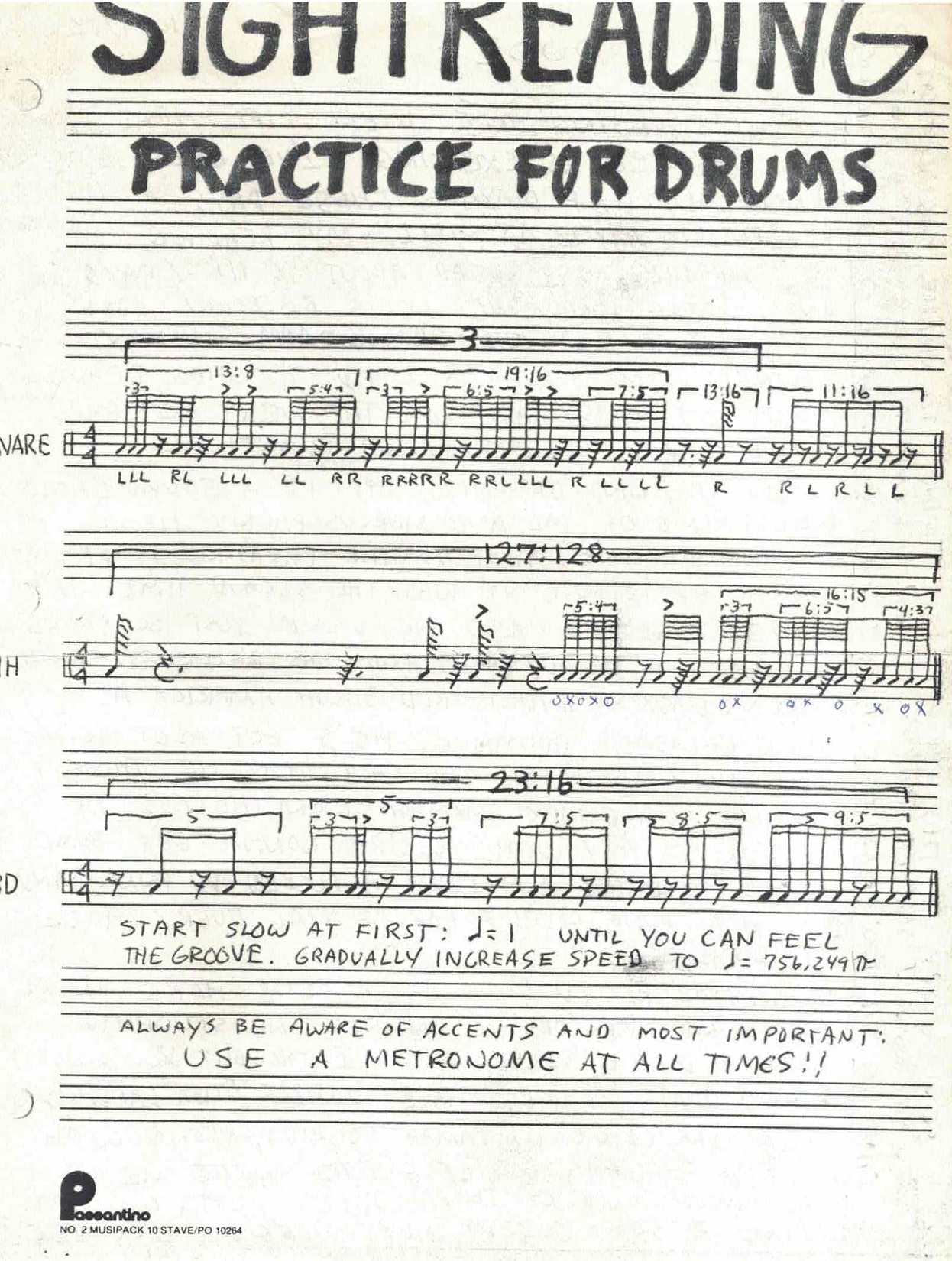
The thing below was written and sent to me by my friend Kirk Ross, mainly a bassist then, now mainly a songwriter. Kind of an extreme personality. We played in a couple of bands at the University of Oregon, then we went off to different schools— me to U. of Southern California, him to Berklee. Later he got me on my first cruise ship gig, and he brought me to Los Angeles ~7 years ago to make a record with Geoff Keezer on piano, playing Kirk's songs and a Neil Sedaka cover. 

His first year at Berklee he was getting into some things from Gary Chaffee that I showed him, and he really ran with them. Following is a one-measure sight reading exercise— the left side got cut off, but top to bottom, I think each line was meant for snare drum, hihat, and bass drum:  


A joke, clearly. I'm sure it works out mathematically. After this Kirk moved to LA and sought out and befriended Vinnie Colaiuta, and jammed with him a few times. He had a big moment was when he was able to lose Vinnie playing the above kind of nonsense— I guess even he needed a foundation to play off of. We each had our course corrections shortly after this— Kirk going back to Berklee and getting really into James Brown, me at SC getting into Elvin Jones.  

Saturday, January 07, 2023

Quintuplet jazz? - 02 - bass drum added

Continuing that suspect page of jazz rhythms in quintuplets, here are some more practice patterns with bass drum added: 


See that post view from the outside of a swing feel for some explanation of this lunacy. This, along with the 5/8 materials I posted last summer, may be more helpful in handling modern stuff with a quintuplet subdivision than it will be for playing jazz. Proceed with caution, most people need to work on things other than this.  

Get the pdf

Wednesday, November 09, 2022

Quintuplet jazz?

I wrote the following when I was still loopy from shooting and editing cymbal videos all day, I take no responsibility for anything I do.

There was another forum question, about using quintuplets in jazz comping. I basically think it's a bad idea, a recipe for sounding disconnected from reality. But I'm in favor of playing around with things, and seeing what happens, so here: 


Play it if you must, just don't over practice it. You've got bigger fish to fry. Use judiciously in real life if at all. 

However if you're getting your 5/8 stuff together, you might run it along with those pages I wrote back in June. 

Get the pdf

BONUS: Here's me playing down this page: 

Tuesday, May 31, 2022

5/8 control

Sid Catlett would always tell me, “Art, when you're in trouble, roll. Just relax, you know what I mean?”

Let's talk about something I'm preparing for, kind of a hairy gig coming up next week, playing with a trumpet player and guitarist from New York, who are touring and picking up local drummers. 

...which is a little nuts, of them, because some of the music is rather hard. The rhythm sensibility is generally rather abstract, there are some odd meters, with a couple of tunes in 5/8, or a 5/8 feel— possibly the unfriendliest odd meter. I wouldn't want to trust my luck with local musicians with that. [Or not— one of the other drummers is D'Vonne Lewis, a great veteran player in Seattle.] On the recordings there's that generally twitchy New York type of thing happening in the drums, with the recorded drummers playing a lot of stuff that I don't hear, and would never play.   

My thought process approaching this music is kind of involved— we're talking about taking a complicated organism— a mature player's performance vocabulary— and quickly mashing it into shape for a kind of alien environment. Maybe the atmosphere has less O2, gravity is 120% of Earth's, and the locals have started forming their own language.  

You can listen to the main tune I'm concerned with here, an arrangement of a Schumann piece— the body of the tune is in 5/8, the trumpet solo is in 6, and back into 5/8 for the drum solo:


The drummer on that record is Dan Weiss, and apparently that's his thing. Me, I've never soloed in 5/8 in my life. At this tempo, it has to be felt as a fast lopsided 2, or a slow 1— a quintuplet, and if you deviate from it, it sounds really wrong and you get really lost. If you let your hands go on their own for one second, you're dead. Counting in 1, the drum solo is basically eight measures of 4, in quintuplets. Long enough to embarrass yourself, too short to develop much... or to recover your dignity if you blow it, hahahahaha. 

So I wrote up a page of stuff to play through to get my hands better oriented, blocking out at least the outlines of some drumming content for this meter and feel. Maybe I'll also review this little etude in 5/8 I wrote a few years ago.


Like I say, an uncomfortable feel to play on the drumset. Playing alternating 8ths, you land on the opposite hand every measure. You can impose a lead on it by using a sticking that starts every measure with the same hand. Or you can try changing it into a mutant duple meter by playing RLRL and resting on the last 8th of the measure, and having that be your "grid." There are also some key rhythms you can hang things off of.   


If I don't feel great about making a continuous solo texture, I can take an attitude of backing off and jabbing— but you have to be able to hear it. Interestingly, as I prepare, I notice it's sort of possible to play loosely as long as you're playing off the 1. And why not— you can get to a quintuplet rhythm by massaging normal rhythms, why not the other way around? 

In the end, I won't go into a performance and be dominated by the music, or by another drummer's concept of how to play it. I can float a solo out of time, while still feeling the major pulse, and listening hard. The solo is so short I'll have to be aggressive, and hit that right away, to have time to establish that and bring it back around to the 5/8 feel. 

And hell, if it comes to that, painfully blowing it in public is a time-honored tradition in jazz, so I'll have that to fall back on if all else fails.  

Get the pdf

Saturday, July 31, 2021

Quintuplets from normal rhythms

The question of odd tuplets came up in conversation with a student recently, and again when I was working on a Jack Dejohnette transcription, where he was playing some 8th note quintuplets in cut time. In college I spent a lot of time working on this topic, via Frank Zappa's music, and Gary Chaffee's Patterns series of books— mainly volumes I and II. The whole area proved to be mostly* useless in real life— if you're not playing them fast, they just sound wrong. I'm talking about playing drumset, where you're usually interpreting a chart or improvising.  

* - Topic for another time. 

An area that is worth exploring is to make an odd tuplet by manipulating a more normal rhythm— usually by evening it out. I believe this is where a lot of naturally occurring tuplets come from— often just from sloppy or deliberately loose execution. See the Mark Beecher video here for one example of that. 

So here are some exercises for exploring that on the drum set— turning a normal rhythm into quintuplets: 


Play one line at a time, maybe either A B C, or A C B C. Set your metronome for half notes at your desired tempo. It's up to you how precise you want to get with the execution of your 5s. Unless you're playing a composed part, no one's going to come checking that your 5s for precise accuracy. We're just learning to push rhythm around a little bit while maintaining the overall groove. 

Try a few different stickings: 

  1. Alternating
  2. RH on cym / LH on snare
  3. Alternating, except with a double on the triplet— either RRL or RLL
  4. Alternating, except beats 1 and 2 will always be the RH— that's beats 1 and 3 if you count the measures in 4/4. 

Use all of the stickings you used on the A/B measures with the C measure.

At first play the regular 8th notes straight, but you could also swing them, for a fuller exploration of the interpretive possibilities. A logical progression would be to start out playing them swung, then straight, then as quintuplets.   

Get the pdf

Sunday, July 19, 2020

Alternating triplets displaced

Developing an independence idea that has been happening spontaneously in my practicing— triplets alternating between the snare drum and bass drum, with odd breaks.


Play the foot part with the bass drum or hihat. These are not necessarily intended to be played in the written time signature— that just indicates the length of the complete idea. You can play them in 4/4 or 3/4, running over the barline. You can also start them on any beat of the pattern. Add hihat and vary the cymbal rhythm however you like. 

Get the pdf

Monday, October 17, 2016

Three Camps in 5s

Another variation on the very famous old rudimental piece Three Camps, this time based on five-note groupings. We're in 10/8, counted in 2— 5+5/8:


All forms of this piece are excellent for working on endurance and speed. Play as written, with an alternating sticking, leading with the right and left hands— I've outlined the stickings for RH lead only. Also play with doubles or multiple bounce strokes on all of the unaccented notes.

Get the pdf

Wednesday, April 06, 2016

Best books: Odd Meter Calisthenics by Mitchell Peters

Odd Meter Calisthenics for the Snare Drummer 
by Mitchell Peters - 79 pages

I own several books by Mitchell Peters, and though they're mostly excellent, I approached this one with caution. I was not wild about his other straight technique book I own, Developing Dexterity— which isn't bad, I just do not find myself using it very productively. I blame the book when I don't practice it. But Odd Meter Calisthenics, it turns out, is excellent. I would say that (along with Gary Chaffee's Odd Time Stickings and Ralph Humphrey's Even In The Odds) it's an essential library item for anyone interested in odd meters generally— the odd */8 meters especially.

It's sort of a Stick Control for odd meters, but more performance oriented, and just better and more fun in general. It covers the major technical essentials, mainly accents, singles, doubles, mixed stickings , flams, and rolls in */8 meters— mostly in 5/8 and 7/8, with some 10/8, 11/8, and other meters. The exercises are well organized into one or two page workouts, and the learning curve for any one section is not steep; the emphasis is more on practical dexterity in these meters, rather than demanding technical combinations. Taken as a whole, the book is basically a complete practical language for the hands for improvising in these meters. Highly recommended.

As a companion to this book, I also recommend Peters's Odd Meter Rudimental Etudes, a book of fairly traditional rudimental etudes along the lines of Haskell Harr, mainly in 5/8 and 7/8.

Saturday, March 12, 2016

Snare drum etude in 5/8

This week I've been working out of Odd Meter Calisthenics, a very good book by Mitchell Peters, which covers a lot of stuff in */8 meters. Which led me to write out a little study in 5/8, based on some things I was improvising on the practice pad:


Use alternating sticking all the way through. I've indicated which hand the accents and flams fall on, to save you from having to pencil them in yourself. You can set your metronome to hit just the downbeats, or the 1 and the 3 to make a 2+3 phrasing, or the 1 and the 4 to make a 3+2 phrasing— try it all three ways. The ending hot lick is fairly challenging, a mix of flam drags and flamacues with drags. Enjoy.

Get the pdf

Thursday, October 22, 2015

Your own “glitch” beat

Having duly warned you of the perils of such dark, arcane knowledge, here's a page of exercises for developing your own “glitch”/Questlove/d'Angelo groove, which, like overly-groomed beards and twee interpretations of 1920s lumberjack clothing, is all the rage with the young people. Seriously, I don't play with people who would be impressed by this; for me this is just for demonstration purposes. If you're going to attempt this in actual music, be aware that the more rhythmic activity in the other players' parts, the more potential for the parts clashing, and you sucking.


Keep the focus on the right hand, and play the left hand softly. After you've learned the exercises, you can start playing all the basic rock beats with this type of swing interpretation— just grab any page of rock beats, like from A Funky Primer or Basic Drumming, if you need to.

Get the pdf

Saturday, July 25, 2015

Page o' coordination: blazing Zorn 7/8

More 7/8, this one specifically for very fast tempos, based on the riff from a tune called Solitaire, from John Zorn's album O'o. It's a short, simple, but very challenging vehicle for a drum solo, and Joey Baron absolutely kills it. I don't know if there's a real good reason to work this up if you're not playing a lot of modern music. I do get asked to play hard stuff, and the idea of having a piece like this put in front of me on a recording date, and me eating it as badly as I do practicing along with the recording, gives me hives. So I want to take a few minutes to learn to cover it.

The measures are phrased 3+2+2— unusual— but the tune is basically played “in 1”— one seven-note-subdivided-beat per measure. The format of the exercises is different than we usually do for the POCs— the left hand column  has the cymbal rhythm, with both feet on the downbeat, and a variety of left hand parts; the right hand column has the same patterns with additional bass drum notes.


Play it down in columns, go left to right down the page, whatever you want. I think if you're not able to whip through this up to speed in less than half an hour, you should probably be working on something else. Don't screw around.

Get the pdf

No YouTube for this one, which is just as well. Buy the track here, or the whole album. I wish I could give a link that forces you to go to your local record store and buy it there, instead of from Amazon. But it's good, buy it. 

Tuesday, May 19, 2015

Transcription: Vinnie Colaiuta — Beat It With Your Fist

It is law that I must do an ultra-hairy Vinnie Coliauta transcription every time I do a fund raiser [Have you contributed yet? Please do. -tb], so here's Beat It With Your Fist, from Frank Zappa's album Return Of The Son Of Shut Up And Play Yer Guitar. It's one of the harder 29 measures of music I've attempted in a while:


The really big sketchball lick is in measures 15 and 16— which I've chosen to write out as a single measure of 8/4— otherwise the barline is in a really messed-up place. The lick is septuplets— seven 16th notes in the place of four— against even 8th notes in the left foot... and the septuplets begin on the & of each beat. I would play that lick as running doubles— a few of the doubles will be split between two drums. You can learn that lick like this:


Play the repeated measure many times as written, then improvise moving your hands around the drums. When you can do that, trick yourself into thinking the downbeats are the &s: say “&” where it's written in the example, and then play the written ending with the 16th note triplet and crash on “1”.

If it's any consolation, with all of this crazy stuff happening, there is a little bit of variance in the length of the measures— the time does stretch a little bit, as low as 65 bpm, and as high as 72, averaged over one measure. Vinnie Colaiuta is, apparently, a human being.

This is another pdf that will only be available for the duration of the fund raiser.

Get the pdf

Friday, January 02, 2015

Survival chops: triplets in 5/4

Part of the idea of this “survival” series is to be very right hand (or leading hand, if you play lefty) oriented; we want to start every measure with the right hand— it just suits the needs of playing music on the drumset better. An awkward thing about playing alternating triplets in odd meters— including 3/4— is that every downbeat lands on the opposite hand from the last. So to make that right hand orientation happen here, so we can feel a little freer with this type of thing, we'll play a sticking of RRL on beat 5. We also could've used RLL, but RRL is a little hipper.

Many of these will sound rather far out your bandmates' ears, and you could lose them— not every single pattern is practical vocabulary— but having played through them you'll be much less likely to accidentally play something that gets you lost.


An easy modification of this would be to play doubles on all the unaccented notes, except for the two rights in row on beat 5. You could also pencil in whatever drags or flams you want. A reasonable workout with this page would be to play each exercise 2-8 times, going on to the next one without stopping; you could do that at two different tempos

Get the pdf

Saturday, November 12, 2011

It's a five-off

Following the lead of Four On The Floor's 5 Beat Groupings (including a hip way of using Stone on the drumset), and Trap'd's 5 beat figures in triplets, here's another variation of the paradiddle exercise we've been using a lot lately, this time using quintuplets- 16th-note fives. As always, play each measure individually many times, then combine measures one, two, or four times each, then reverse the sticking for the entire page.

And yes, I know my made up rudiment names are stupid, but at least I don't put the word "cheese" in there... that's just nasty... 

Get the pdf.