Showing posts with label natural sticking. Show all posts

Saturday, September 10, 2022

The natural sticking / fill lesson

These are some steps I was running through with an adult beginner, to get oriented with some normal things you do on the drums, and to practice counting 16th notes. There are a number of directions you could go with it, depending on the student and goal.  

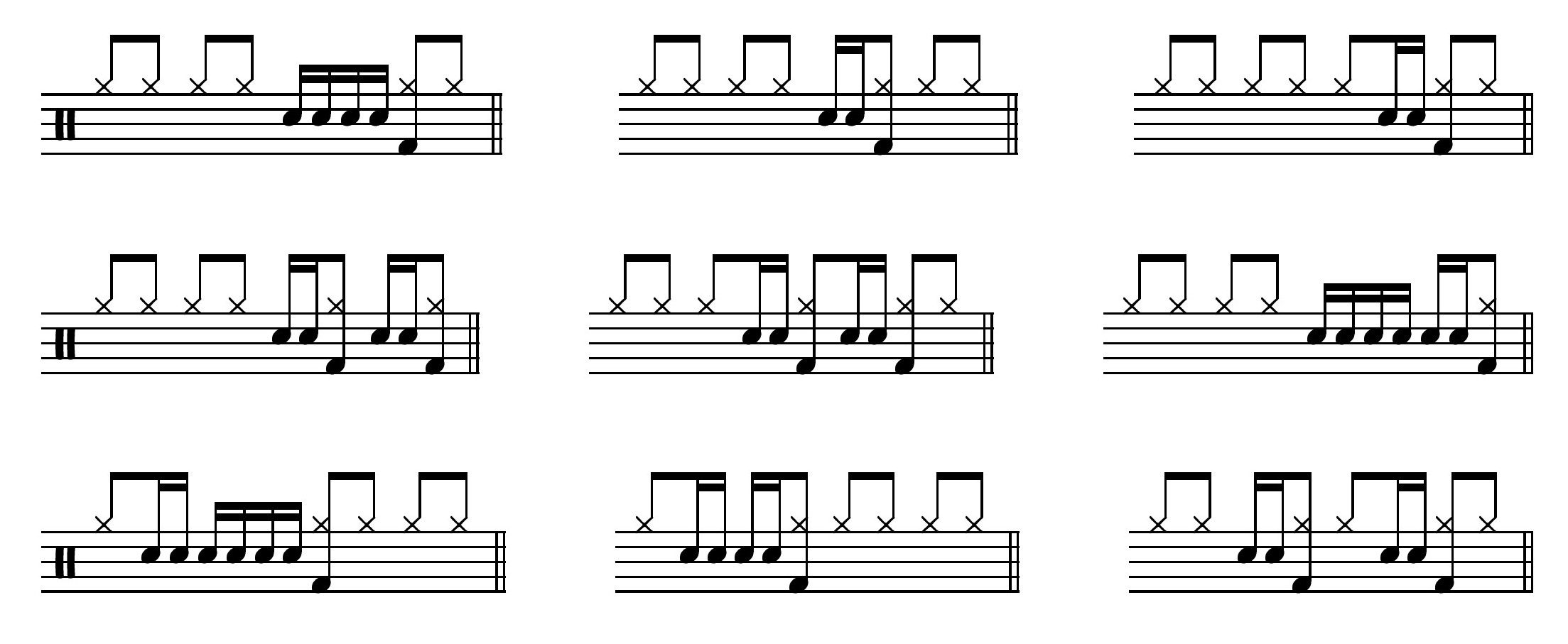
The examples will use these rhythms from Syncopation by Ted Reed, pp. 22-27. We counted each rhythm before playing them.  


First, we played the rhythms with the right hand on the hihat, left hand on the snare. We're using natural sticking, so the right is playing 1&2&3&4&, and the left hand plays any es and as: 


Then we played all the 16th notes on the snare drum— the right hand has to move to the snare a little bit. There was some confusion, that the right was already “playing 8th notes” on the hihat, we fixed that by looking at the rhythm in the book— the notes with two beams go on the snare, the notes with one beam go on the hihat: 


Then we added bass drum after the snare drum— the first cymbal note after any 16th notes: 


One possible next step is to add bass drum on 1, if it doesn't conflict with anything else we're doing: 


Then add the snare drum with the left hand on beat 2 and/or 4, if it doesn't conflict with what we're already doing:


At some point in the process we could play that cymbal note after the 16ths on a crash cymbal: 


Now we're at a pretty complete ordinary drumming texture. From here, someone could add some more bass drum— with some or all of the remaining cymbal-only notes; we could add a crash on 1, if it doesn't conflict; we could alternate a measure of groove with these patterns. You decide case by case how far to go pursuing this formula— what you're trying to accomplish for your playing, or your student's, and the limits of tolerance for thoroughness and boredom for all involved.  

Monday, October 04, 2021

Subtractive method overview

Here's a broad overview of this subtractive thing I've been working with. It's a new approach, but not unprecedented, and I think it's worth exploring. The idea starts with a Stone-type 8th note sticking pattern, and applying it to rhythms from Syncopation, leaving out any notes of the pattern that are not in the rhythm. 

It's simply the natural sticking concept applied to more complex patterns. Natural sticking, remember, means sticking a rhythm based on which hand would have played that note if you had been playing alternating singles.

The running 16ths represent the underlying pattern, the bottom part represents that sticking applied to a rhythm: 


We're just applying it to some other stickings, or voicing patterns. For example, if you did the above same rhythm with a paradiddle sticking, you'd get the following:  


The only other critical difference is that we're doing this on drum set, with a snare drum / bass drum pattern instead of a right hand / left hand pattern. I believe it's easier to do this on the drum set, using two different sounds, fulfilling a role in a particular style. Simply doing it on a practice pad with Rs and Ls is too abstract. We'll also be doing the entire system with 8th note patterns and 8th note-based rhythms, counted in 4/4 or 2/2.  

We've essentially done this already with my cut time funk drill— where the 3 is played on the snare drum, and everything else on the bass drum, implying an underlying pattern of:

BBBB SBBB

There's another funk interpretation (see step 2. in the link) where we play the first half of the measure on the bass drum, second half on the snare drum, which implies this pattern: 

BBBB SSSS

My rock method, with snare drum on 2 and 4, and everything else on the bass drum, basically implies this:

BBSB BBSB

To those we would add a cymbal rhythm played with the right hand. In fact those actual practice methods were a little different— if the snare notes were missing from the book rhythm, we would add them, or displace them to match the book rhythm exactly. But the basic principle is similar. 

And it's the same as John Riley's idea we called “that with interruptions”— his phrase— where he would play a SSBB 8th note pattern with a jazz cymbal rhythm, dropping out some notes of the pattern. It's the exact same thing, except now we're arriving at it by reading rhythms from a book, and voicing them according to whatever SB pattern we choose. 

This is a learnable system— personally I've been drilling the original pattern BSSB-SBBS in a funk style, and have had no problem applying it to all the pages listed below. I'm also working on it with the Mozambique bell pattern, which is much more difficult. I can do all the one line exercises, but the long exercises— even with just quarter note rhythms— are progressing much slower. I'll run some of the simpler jazz systems and report back.  

You could do this using all of the stickings from the beginning of Stone, or with my page of funk stickings, playing the Rs on the bass drum and Ls on the snare drum, in any number of styles. But the system is difficult enough that you should be selective about it. 

First patterns for jazz:

SBSB-SBSB
SSBB-SSBB
SSSB-SSSB
SSSS-BBBB
SBBS-SBBS


Funk patterns:
BSBB-SBSS
BSSB-SBBS
BBSB-SSBS
BSBS-SBSB
BSBB-SBBS
BSSB-SSBS

The BBBB-SSSS pattern above is probably the best place to start with the funk patterns; that gives the broad outline of all of the funk patterns, which are generally oriented around bass drum in the first part, and around snare drum in the second part.

Add any additional parts you want; jazz cymbal rhythm and hihat for the jazz patterns, quarter notes, 8th notes, or another rhythm for funk. If you want to tackle the Mozambique rhythm, I suggest starting with the rhythm for the first measure only, repeating, and then do the complete rhythm. 

Use those patterns to voice the top line rhythms for the following pages in Syncopation: 
4-5, 10-11, 30-32, 34-45. 

Warm up with the complete pattern, the complete bass drum part by itself, the complete snare drum part by itself, and then the pattern applied to some simple rhythms, as illustrated in the first post on this topic

We'll see where this goes. I'm very encouraged by what I've done so far with the BSSB-SBBS pattern, which has the practical effect of developing a lot of fluency with a tresillo bass drum rhythm— you end up playing a lot of the rhythm itself, and parts of it, and variations on it, with simple added parts on the snare drum. Some applied rhythms create some “hip” inverted/displaced beats; it's nice to arrive at that stuff not by sitting down and contriving something hip, but just by playing normal syncopated rhythms following a normal drumming pattern. More to come on this topic. 

Friday, May 29, 2015

Natural sticking timing exercise

This is something I'm working on with some students: a timing exercise using natural sticking, modified slightly from something we used to play in drum corps. Natural sticking, briefly, is a method of sticking hand-to-hand rhythms, in which the right hand always plays the strong side of the rhythm, and the left always plays the off beats; so with mixed 16th note rhythms, as we have here, the right plays all notes falling on the 8th notes, and the left plays any es and as. If it doesn't make sense the way I've explained it, look at the stickings on the page and figure out the pattern. I've included here a shortened version of the exercise in 2/2, since we've been using natural sticking in the half time feel funk series.


On exercises 1-3 and 7-9 the right hand will play a steady rhythm in both measures of the exercises— 8th notes in 1-3, quarter notes in 7-9; on exercises 4, 6, 10, and 12, the left hand plays an unbroken rhythm.

Get the pdf

Tuesday, August 21, 2012

On the varieties of stickings

Here's a nice geekish piece at by E.W. Flack at The Drumslingers, in which he goes in depth on the history and usage of the three basic sticking methods in US drumming and its derivatives-- rudimental, natural, and alternating; and I would add to that something I call pseudo-alternating. I've included some largish snippets of Flack's text, along with a few of my own comments and examples, but definitely go read the entire piece.


Natural

This is the sticking method I learned through drum corps, but it's also very drumset friendly. Basically the lead hand (usually the right) play all notes landing on the 8th note grid, and the left hand plays any e's and a's:


Much of what Flack says below is borne out by my own experience:

The natural sticking method... does not rely on the complex rudimental patterns of military drumming, although a mastery of basic rudimental technique is still important.
The concept behind natural sticking is based on the observation that most people are right handed and therefore the strongest beats which are the “pulse” beats should be played by the strongest hand which is the right hand. All subsequent up-beats are played by the left hand which results in naturally flowing sticking patterns throughout.
In his book, Championship Concepts for Marching Percussion, Thom Hannum wrote that the natural sticking system, “negates any awkward doublings of one hand or the other.” Hannum then prescribes a series of 16th note timing exercises based on duple and triple beat check patterns. To explain their sticking he says, “All stickings are derived by eliminating the stroke of the note which is rested. Then play the remaining values in the sequence of natural sticking.”(1)
Natural sticking is generally easier for most people to learn; it enables less experienced players to more readily produce an even and consistent quality of sound. Natural sticking is an excellent option for marching band drum lines because the simple sticking patterns facilitate the ability to play at faster tempos while presenting a visually uniform style. Drum lines using the natural sticking system can more quickly adapt to changes in musical scores, requiring less rehearsal time.

Much more after the break: