Showing posts with label figures. Show all posts

Saturday, September 10, 2022

The natural sticking / fill lesson

These are some steps I was running through with an adult beginner, to get oriented with some normal things you do on the drums, and to practice counting 16th notes. There are a number of directions you could go with it, depending on the student and goal.  

The examples will use these rhythms from Syncopation by Ted Reed, pp. 22-27. We counted each rhythm before playing them.  


First, we played the rhythms with the right hand on the hihat, left hand on the snare. We're using natural sticking, so the right is playing 1&2&3&4&, and the left hand plays any es and as: 


Then we played all the 16th notes on the snare drum— the right hand has to move to the snare a little bit. There was some confusion, that the right was already “playing 8th notes” on the hihat, we fixed that by looking at the rhythm in the book— the notes with two beams go on the snare, the notes with one beam go on the hihat: 


Then we added bass drum after the snare drum— the first cymbal note after any 16th notes: 
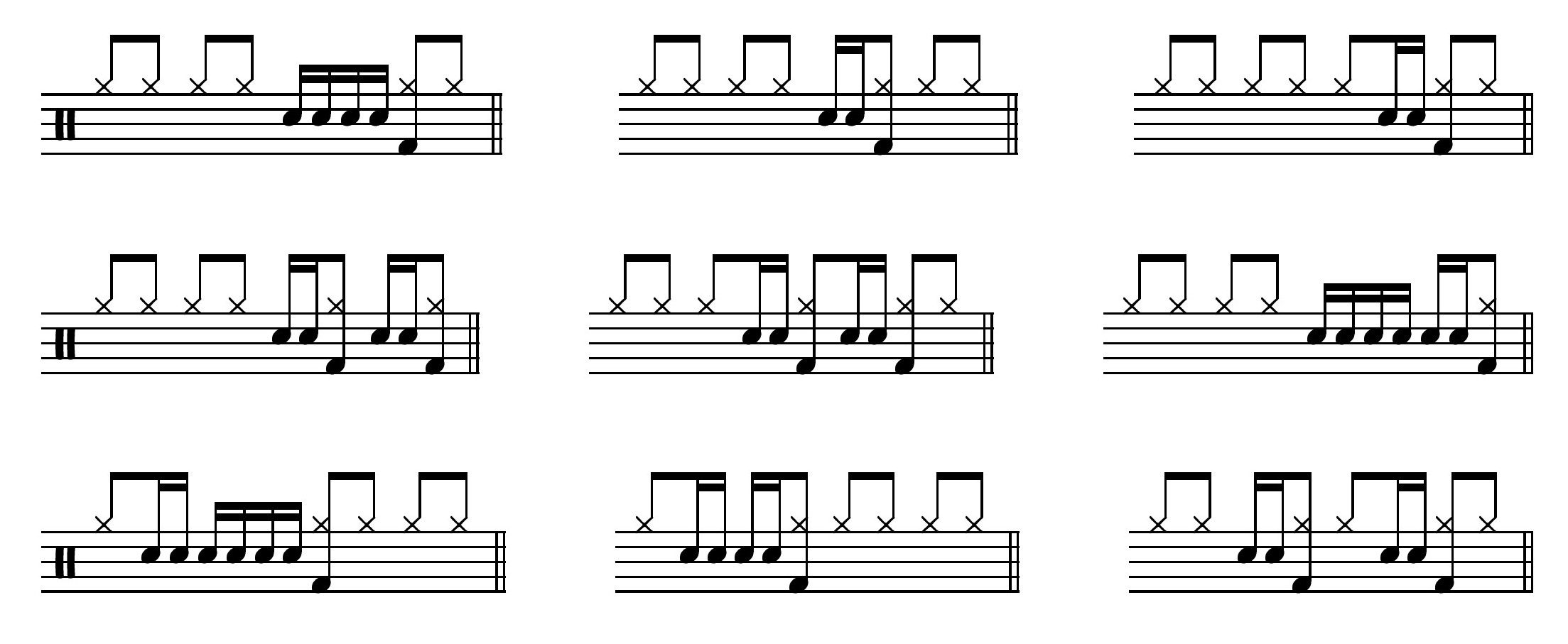

One possible next step is to add bass drum on 1, if it doesn't conflict with anything else we're doing: 


Then add the snare drum with the left hand on beat 2 and/or 4, if it doesn't conflict with what we're already doing:


At some point in the process we could play that cymbal note after the 16ths on a crash cymbal: 


Now we're at a pretty complete ordinary drumming texture. From here, someone could add some more bass drum— with some or all of the remaining cymbal-only notes; we could add a crash on 1, if it doesn't conflict; we could alternate a measure of groove with these patterns. You decide case by case how far to go pursuing this formula— what you're trying to accomplish for your playing, or your student's, and the limits of tolerance for thoroughness and boredom for all involved.  

Tuesday, February 26, 2019

Rub-a-dub lesson: Fables of Faubus

Another example of rub-a-dub applied, using a passage from the Charles Mingus tune Fables of Faubus. In previous lessons we've just used this idea on the head of some tunes as an exercise. Here we're using rub-a-dub for its actual purpose: setting up, playing, and filling in between arranged ensemble figures. When you play Fables of Faubus, you could actually play this part of the tune this way... if you choose, after having duly listened to the way Dannie Richmond plays it on Mingus's recorded versions.

Which... by the way: if you do play Fables, and are reading it out of the Real Book, that chart has this figure notated incorrectly. It puts the hit on 3 in the third measure on the & of 2— it's written as 1&-&. That's wrong. Make the band get their pencils out and change it to what is written here.


Practice each line individually, repeating several times at least— the figure doesn't repeat on the actual tune though, remember. The accents just indicate the rhythm of the figure; you don't necessarily have to accent all of those notes on the drums. I've given the running rub-a-dub lick in all its inversions, and a couple of lines with the lick modified to better fit the figure. As always, this is written in the initial orchestration, with the right and on the cymbal, and left hand on the snare drum. As you learn it you can move the left hand around the drums, and move the right hand note with no bass drum to the toms or snare.

Get the pdf

Here, I've made a loop which with which you can practice this:

Friday, December 28, 2018

Rub-a-dub lesson: Doxy

Another rub-a-dub lesson— getting as much of this in as I can before the end of the year, so there's a robust section on it in the upcoming 2018 Book of the Blog. This page is based on Doxy, a tune that should be familiar to everyone studying jazz.

I've done two different versions; the first sticks as close as possible to the basic rub-a-dub pattern all the way through. There are a couple of small deviations, but it's remarkable how well simply playing the pattern fits the tune. The second version starts on a different inversion of the basic pattern, and the pattern is changed more to fit the tune musically. The straight pattern may work surprisingly well, but it can sound a little formulaic if it's not broken up.

The stems-up part is the drum exercise, and the stems-down part is the rhythm of the tune:


Swing the 8th notes, of course. After you can play the exercises as written, you can begin moving your left hand to the tom toms, as well as any right hand notes that don't have a bass drum in unison. You could also omit any bass drum notes that are not in unison with a melody note, and move all of those right hand notes around the drums.

Here's a familiar lead sheet for Doxy:


Reminder: While it may come in handy for soloing over this form, and for playing some parts of the tune, this is not a lesson for how to play Doxy. You have to listen to recordings for that. What we're doing is learning to use this drumming pattern to set up and accompany normal jazz rhythms, of which this tune is a good example.

Get the pdf

Here is a practice loop for working on this, sampled from the Miles Davis album Bags' Groove. It includes the head of the tune plus one chorus of Miles's solo:


Tuesday, December 25, 2018

3+2 rub-a-dub phrases

Continuing in eking out a way of learning this rub-a-dub concept, here are a couple of pages of combinations of three-beat and two-beat patterns:


Practice these in the written meters, then try putting them into straight 3/4 and 4/4... and 5/4, if you want. There are a couple of ways you can do this:

1. Play the practice combination one time during a two or four measure phrase in 3/4, 4/4, or 5/4 time. As needed, add beats to the combination to complete the phrase. For example, if you're playing the seven-beat 3+2+2 combination in a four-measure phrase in 3/4:


Or the five-beat 3+2 combination played in two measures of 4/4:


You could also add the extra beats at the beginning of the phrase, and play the rub-a-dub combination at the end. At first play the extra beats as quarter notes on the cymbal, then improvise a time feel in the style you're practicing, or a fill.


2. Repeat the combinations, with no extra beats, along with a metronome or practice loop in 3/4, 4/4, or 5/4. Obviously, if you're playing a five-beat pattern in an eight-beat phrase (two measures of 4/4), the beginning of the pattern is not always going to fall on the first beat 1 of the phrase. Play along and listen to the click, then try counting out loud in the meter of the phrase while playing the practice pattern.

Some combinations of patterns/meters/phrase lengths will take a long time to resolve back to the beginning of the pattern falling on beat 1 of the first measure of the phrase. You can work that out if you wish; I think learning to count an eight-measure phrase in any meter while repeating the practice pattern is enough for this stage of learning this system.

Get the pdf

Thursday, November 01, 2018

Rub-a-dub lesson: Equinox

Here's an easy little lesson for doing this rub-a-dub business in a musical context, using the tune Equinox by John Coltrane. Equinox is based on some very common jazz rhythmic figures, so this should be useful for doing this in context generally.

An addition: as explained by Chris Smith, rub-a-dub is normally an 8th note thing, but there is also an easy triplet equivalent, which is illustrated in the pdf. I've written out the exercise in both 8th note and triplet form. Keep in mind, this is not about how to play Equinox— it's an exercise for practicing this idea.


Swing the 8th notes. Learn to play each version as written, then begin to improvise moving both hands around the drums and cymbals, maintaining the written sticking. The accented notes are the important accents in the tune, so try to keep those on the cymbals.

Get the pdf

I made up a practice loop of the head of the tune, for you to play along with:


Sunday, October 21, 2018

Developing a method for rub-a-dub

I've been working up a practice method for learning what Mel Lewis called rub-a-dub I hate to use his term, because I only just saw it explained for the first time in Chris Smith's video. I don't know enough about how it applies to Lewis's playing to claim I'm doing his thing. But I've used the same basic idea for many years, usually in the context of a modern, ECM-type feel. I can write about that, and work out a way of applying it to ensemble figures, and maybe approximate Mel's thing as explained by Smith. Or maybe it will just be something different, but still useful.

Basically it's a simple all-purpose idea for playing and filling around big band figures, and I'll be exploring some ways of working it up using the syncopation exercises from Progressive Steps to Syncopation (pp. 32-44 in the old edition). This will certainly evolve as I continue working with it. For now I'm trying to develop a very basic interpretation so we'll have some hope of executing it on the fly with the full page exercises in Reed.

Here's the basic rub-a-dub lick, played with the left hand on the snare and the right hand on the cymbal:


The snare and bass rhythm without the cymbal:


That rhythm written as one voice occurs throughout Syncopation, so that will be our main place for introducing the rub-a-dub:


Here's the rhythm in Syncopation— we most often see it starting on beat 1 or 3, less frequently as an equivalent rhythm starting on beat 2 or 4:


A basic way of playing that figure rub-a-dub style would be:


That ending quarter note could be played on the snare or bass drum.

In other instances that 8th-quarter-8th rhythm includes rests, which could be played by just dropping snare drum hits to match the written rhythm:


The 8th-quarter-8th rhythm repeating give a clue on how to handle running 8th notes:


This is only a beginning, of course. We're reconciling a few different concerns: doing the rub-a-dub lick, designing a system that will be readable with the long exercises in Reed, while making sense in terms of playing big band figures. Somewhere on the radar should be the idea of suggesting a standard time feel— jazz, funk, or samba— for when there is no obvious rub-a-dub type interpretation for a rhythmic passage, or when we need some variety.

Playing out of the book will be challenging, especially with the full-page exercises; interpretation is very dependent on the context. The way you play a rhythm will depend on what comes before and after it, so you may play a rhythm differently in the full-page exercises than in the one-line exercise. You can use a simple long-note/short-note interpretation with the cymbal in unison to get through parts where it's not obvious what to do.

Anyone actually playing around with this rub-a-dub idea should also check out Jack Dejohnette and Charlie Perry's book— they outline a method very similar to what Smith describes, that will be very helpful in working it up.

Thursday, June 14, 2018

A simple solo method

Here's a simple, non-technical solo method I was just working on with a student...


...a SKYPE student... did you know I teach lessons via Skype? I do. Anything you ever have questions about on the blog, I'm available to do a private lesson to work it out with you. Shoot me an email.


...this is very similar to some other things we've been doing here lately, like the Stick Control applications on the drumset. Basically identical in fact, except the Stone thing is geared towards funk and the ECM feel, and this is more about basic solo vocabulary in jazz— and rhythmic interpretation for ensemble playing in general. Basic, non-timekeeping rhythmic functionality on the drum set.

We'll use the one-line exercises starting on page 34 of Progressive Steps to Syncopation— current edition. Here's one measure of line 1 from on p. 34:


As I always do with this book, we're going to re-interpret the stems-up part, and ignore the stems-down part. We'll use a very common method for orchestrating that rhythm on the drum set based on long notes and short notes; short notes are untied 8th notes; long notes are everything else— tied 8th notes, quarter notes, and dotted quarter notes. Play the short notes on the snare drum with your left hand, and the long notes on the bass drum:


First play the cymbal (any cymbal, with your right hand) in unison with all of the notes:


Then play the cymbal only on the long notes— the bass drum notes:


Next play the short notes with both hands in unison, and long notes on bass drum only:


This is all simple enough that you can easily begin moving your hands around the drums and cymbals, and begin thinking about the melodic shape of what you're doing.

Let's look at the line 4 exercise:


The top line played on snare drum and bass drum, according to the short note/long note system, playing the cymbal along with all notes:


Then cymbal on the long notes only:


Short notes with both hands in unison— these unison notes can be played on any two drums, or on the snare drum with any cymbal:


Where there are two or more running 8th notes, you could also play them with an alternating sticking, with the hands on the same drum, or on different drums:


When doing that, I prefer to play the right hand on the &s, and the left hand on the beat. You could also do the alternating sticking on the cymbal-on-long-notes way.

Play through the one-line exercises with all of these interpretations, then begin working on the long syncopation exercises beginning on page 38. Move the hand parts of the exercises around the drums and cymbals, and change from one interpretation to the next without stopping. Then improvise your own solos while trading 4s or 8s.

Listen to some 50s-60s Roy Haynes (Out of the Afternoon, Misterioso by Thelonious Monk), Frankie Dunlop (the tune Jackie-ing, and the albums Criss Cross, or Monk's Dream by Thelonious Monk), and Billy Higgins (Art Deco by Don Cherry) to hear these types of things played in actual music.

Download this one page list of basic orchestrations if you haven't already memorized them.

Thursday, June 07, 2018

Figure and fills: Rover

Here's a page of drum orchestrations and fills based on a rhythmic figure from the tune Rover, on my album Travelogue, along with a practice loop sampled from it. The fills/orchestrations start very simply, building up to fairly complex. Learn to play them in your own way, and make your own variations on them.

We did a similar thing a few years ago with Herbie Hancock's Cantaloupe Island. I should write more of these!


Drum parts can and should be played on any drum, the cymbal part can be played on any cymbal. Vary the stickings as you see fit; the natural sticking for the drum set is to play the right hand on the cymbal, and the left hand on the drums, bringing your right hand to the drums as needed— in which case you can either play an alternating sticking, or doubles, or doubles mixed with singles, or a rudimental sticking. On items that don't have the hands in unison, you can also experiment with an alternating sticking— which will have your left hand moving to the cymbal sometimes. Whatever works for you.

Get the pdf

The tune was co-composed by me and Jasnam Daya Singh (née Weber Iago, née Weber Drummond), the pianist on the album. The loop is sampled from the intro, which was written by Jasnam:

Tuesday, February 27, 2018

Stairway to Heaven figure

This is something I did for a student who was looking for some help playing Stairway to Heaven by Led Zeppelin. On the out chorus— or whatever you want to call it; the song is basically just a four bar verse plus a bridge and a C section, and doesn't really have a chorus— there is a rhythmic figure which John Bonham plays a few different ways, and uses as the basis for his fills. I haven't transcribed what he plays exactly, but I wrote out some obvious ways of playing the figure which are very similar to what he's doing.


Learn the orchestrations individually, then practice them as part of the two-measure practice phrase— which happens to be the same way it happens in the song. When you have it up to speed, run them along with the practice loop. The orchestrations are not meant to be married to any particular drum or cymbal. They also don't need to be played exactly; you can improvise your own way of playing each basic idea.

Get the pdf

Monday, April 18, 2016

Orchestrations of a figure: Groove Elation

Today we'll do a little survey of ways of orchestrating on the drums a rhythmic figure— the bass line from the tune Groove Elation, by John Scofield. It's a bright New Orleans-influenced thing, with a light swing feel. There's nothing systematic about this; I just wrote up a series of largely groove-oriented things that work with the style and tempo of the tune. The orchestrations are similar to some common Reed interpretations, except I fill the space at the end of the second measure with some different, easy things.


You can play them with the 8th notes swinging, or straight; on the actual recording there's a light NOLA-style half-swing feel. Feel free to combine elements, of course— add hihat where it's not written, move the left hand to the toms, move the right hand to the toms where it's in unison with the left hand— numbers 5-7. These should be a jumping-off point for improvisation. When you get them up to speed, play them along with the recording. I'll have a practice loop of the vamp for you sometime— or you can just make your own.

Get the pdf

Listen to the actual track after the break:

Sunday, June 21, 2015

Figure and fills — Cantaloupe Island

Here's another practice loop, with a page of things to play with it. What I've done here is sample two measures from Herbie Hancock's Cantaloupe Island, and write out a page of fills to fit the figure:


Use the stickings I've given, or don't. Move snare drum line around the tom toms— I neglected to include a key, but by now you know that the top line is a cymbal, the middle line the snare drum, and the bottom line the bass drum. The triplet fills are pretty fast at this tempo, so you might want to take it down a bit, with a metronome instead of the loop.

Get the pdf

Audio— the original track, and a practice loop— after the break: