Showing posts with label subtractive method. Show all posts

Tuesday, May 07, 2024

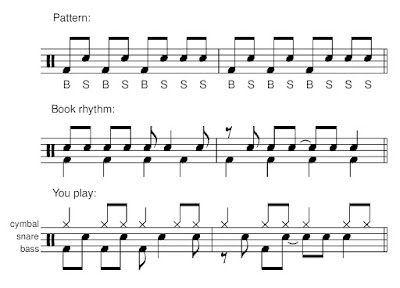
Subtractive method: key to BSSB-SBBS

If you're not doing anything with this system, you should give it a try. It's a way of orchestrating rhythms from Syncopation (or rhythms from wherever) between the snare drum and bass drum, based on an underlying 8th note pattern. 

This particular pattern— BSSB-SBBS— supports several areas of playing really well: clave based music, Baiao, New Orleans kind of funk/street beat, funk in general. I've posted about it a bunch of times

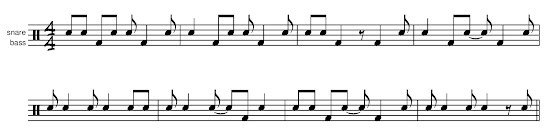
So this here is a key for it— all the basic parts of it, which you can use as warm ups for applying the system while reading from Syncopation. Or you can use this page as a complete set of practice patterns by itself. 


Get the pdf

Sunday, January 28, 2024

Tresillo unit

For a couple of weeks I've been working with an area of stuff covering several different styles— grooves with a tresillo rhythm, or part of it, in the bass drum. I've been polishing it for a recording session today. 

That bass drum rhythm occurs most famously in New Orleans drumming, Songo and other Caribbean styles, and Baiao. All different things from different countries, but with jazz groups things have a way of getting mashed up. The chart we're recording is marked “samba”, but the bass line is based on this type of rhythm, and nothing else about the piece is particularly samba-like.   


We have there: 

Systems for New Breed
I've been doing a few ostinato variations with the reading in The New Breed— which I've decided I like a lot. The reading portion of that book is different enough from Syncopation to be worth doing— more space, fewer runs of multiple notes, and of course 16th notes are the main subdivision. 

The ostinatos are played by the right hand on a cymbal, bass drum, and hihat played with the foot. On a couple of them the right hand moves to the floor tom. 

Subtractive method
Practicing from the book Syncopation, I've been running a subtractive thing I detailed before (the item at that link would actually be good to include in this unit)— voicing the melody rhythm in the book corresponding with a BSSB-SBBS pattern

Songo variations
A couple of different songo grooves, with fills, making variations on the fly. 


Street beat / alternating singles
Played on either the snare drum or hihat, varying the accents/articulations, with a move to the floor tom.  

Get the pdf


And here's one loop I've been using, sampled from Eddie Palmieri— Azucar, from the album Azucar Pa' Ti:


And another loop, a little faster, a baiao groove from Airto— Papo Furado, from the album Seeds On The Ground: 

Monday, July 03, 2023

Subtractive method: one practice approach

A lot of commitments right now, and posting will continue to be light through next weekend.

Congratulations to Justin in Omaha for getting the 22" Extra Special Janavar “Emilia”— there is now one of those remaining. I'll just keep shamelessly hustling the Cymbal & Gong cymbals, on faith that you'll thank me when you get one— as instruments, they're the most satisfying cymbals I've ever owned.

Tim @ C&G was talking to an endorser recently, asking him if he needed anything; his response was, no, he's content[!!!] with the set he got six years ago, that he has been using constantly since then. I understand the feeling. When you get the true right instrument, the greed for more stuff kind of goes away. I haven't bought another cymbal for myself in three years. 

So anyway, some real content: 

The “subtractive method”, as I'm calling it, is a system for splitting up a rhythm between the snare drum and bass drum (or any two sounds). Starting with an 8/8 drum pattern— here we'll use BSSB-SBBS*— you hit only the notes sounding in the rhythm you're playing. 

* - B = bass drum / S = snare drum 


We do that with a cymbal/hihat ostinato of some kind— e.g. a jazz rhythm, Mozambique, Guaguanco, or Baiao, which I was doing this week. This pattern is really well suited for all of those styles— though at times it may make a funk groove out of your jazz time. 

With a fairly complex base pattern like that, you need to work through it completely starting with some simple rhythms so you can do the interpretation accurately— especially if you're using a complex ostinato, like that Mozambique. 

So, reading out of Syncopation, I'll use the simple quarter note and 8th note pages (pp. 6-7, 9-10) as well as the usual more complex rhythms on pp. 30-45. With 8th note pages 9-10, you can break it down further from what's written by playing just the 8th notes, and/or the 8th notes and the note after: 


Here's how each of those rhythms would be played with the BSSB-SBBS voicing: 


I also played the complete pattern one time, starting on each note of the pattern, with the ostinato continuing:


You can spend a long time on that, but luckily you don't need to do a lot of different base patterns this way. And, after doing one hard one like this, the other ways are easier. 

Monday, February 20, 2023

Uptempo drill a la Riley

Major rehash alert: an uptempo jazz drill I was playing yesterday, using what John Riley once called “my C major scale”: an SSBB pattern in 8th notes, with notes omitted. The page below is very similar to what I wrote about that, but in a better sequence for fast tempos.    

I practice it reading out of Syncopation, using my subtractive method*— voicing the book rhythm according to that SSBB pattern. Anything sounding on a 1&/3& is played on the snare, anything sounding on a 2&/4& is played on the bass drum. 

* -  Rated by the same Mr. Riley as “convoluted, but sometimes that's necessary.”

Here are some key starter patterns:


Do this with Syncopation pp. 9-10, 30-31, and 34-45.

Tempo goals are half note = 120, 130, 143, 150, and beyond. Play straight 8ths at all tempos, even tempos you would normally swing when performing. I usually practice these playing double time along with a straight 8th jazz/fusion/modern music loop.   

I've written a number of these drills over the years, and there's another good one in Riley's book Beyond Bop Drumming. The best drill is the one you do— whatever works for you. 

Saturday, September 24, 2022

Subtractive method: an alternative approach

I just saw this from brother writer Jon McCaslin, over at the excellent and much hipper-named Four On The Floor blog: a Syncopated Stick Control method, which he's using to bring some rhythm interest to practicing Stone. It's sort of a parallel thing to my “subtractive” method. 

Both things are similar to the natural sticking idea, in which you stick mixed 16th note rhythms with the RH on all the #s and &s, and the LH on all the es and as. As if you were playing alternating 16th notes (an RLRL pattern), and dropping out notes to make the rhythm. We're just doing it with sticking patterns other than RLRL. 

It's hard to explain just in writing, much easier— and very worth it— to actually do it. 

Jon is basically eliminating the first note of any doubles, and the third note of any multiples, on either hand, or both hands— and some other things. Read his post, he illustrates it well. 

It's good to have slightly different angles on the same thing— it takes us to a total understanding of the basic materials and ideas we use in learning and teaching the drums, and the different ways might be better for doing some specific things. 

Saturday, January 22, 2022

Subtractive patterns for feathering the bass drum

A collection of subtractive patterns for developing feathering the bass drum in jazz— for sketching it in, and making punctuations, anyway, since this will mostly not have you playing running quarter notes. Learning to support the time with the bass drum in a more free, nuanced, modern way. So we can still play all our other super important stuff.  

In practicing this, feather any bass drum notes falling on the beat, and accent any bass notes falling on the &s. Play a jazz rhythm on the cymbal, hihat on beats 2/4 with your foot. 

The patterns below represent a full measure of 8th notes, played on the (B)ass drum and (S)nare drum. Use them with Syncopation pp. 10-11, 30-32, 34-45, playing the top line rhythm from the book on the drum indicated for the corresponding note in these patterns. See my previous posts for a fuller explanation. 


Try these warm ups, with the bass drum on all the downbeats in the book rhythm, snare drum on any &s— leaving out any pattern notes not sounding in the book rhythm: 

BSBS BSBS


And with the bass drum on all 1s/3s, and 2s/4s:

BSSS BSSS
SSBS SSBS


That will show you the terrain, so you can approach these combinations with some idea of which you'll want to spend the most time with:  

BSBS BSSS - bass drum on 1-2-3
BSBS SSBS - bass drum on 1-2-4
BSSS BSBS - bass drum on 1-3-4
SSBS BSBS - bass drum on 2-3-4
BSBS BSSB
BSBS SBBS
BSSB BSBS
SBBS BSBS 


With that last set, play any BD doubles naturally. You don't have to play the & loud and the second note soft. 

Throughout all of this subtractive thing, it's not necessary to do everything exhaustively with all of the suggested pages. Since the book rhythms have a lot of gaps, a lot of what you play will be the same even using different patterns. Pages 30-32, 35, and 39— which have denser rhythms— will highlight the difference between patterns the best. Or look for one line exercises containing six or more notes per measure. Or you can just play everything, since you're supposed to be practicing this general thing a lot anyway. 

See also my page of practice rhythms for feathering the bass drum. Alan Dawson's long note/short note method, found in John Ramsay's book, is also good for this. Who knows, practicing those things you might find this subtractive business TOTALLY SUPERFLUOUS. 

Saturday, January 01, 2022

Subtractive patterns for jazz snare and bass

Continuing to develop this subtractive method, here are some good patterns for snare drum and bass drum in a jazz feel. I'm digging the system. It allows me to put whatever part I want consistently in rhythmic places that don't happen regularly in the other common Reed methods. The density of the rhythms in Reed has also been an annoyance— this method allows me to break them up between parts of the instrument in ways I like— in a jazz feel, I can get a level of snare drum density I like.  

Use pp. 10-11, 30-32, and 34-45 in Syncopation. Play the regular jazz rhythm on the cymbal, plus hihat on 2 and 4 with the foot. The patterns below represent one measure of 8th notes; you play the top line book rhythms on the drum indicated for the corresponding note in the pattern. There is a fuller explanation here. 

For example, here's how you would voice the first two lines of Exercise 2 (p. 39), using the SSBS SBSS combination pattern below:


Warm up patterns:

BSBS BSBS
SBSB SBSB
 
SSBB SSBB
BBSS BBSS

SSSB SSSB
SBSS SBSS

BSSB BSSB 
SBBS SBBS

SSSS BBBB
BSSS SBBB


Combination patterns— similar alternates are on the same line: 

SSSB SSBS / SSSB SBBS
SBSB SSBB
SSBS SBSS / SSBB SBBS
SSBS SBSB
SSSB SBSB

We don't need many combination patterns. The possibilities are endless, but the real practical range is limited. The differences between patterns will be most apparent on the denser one line rhythms, and the horrible Exercise 2 on p. 39. 

And note: it is easiest to write these systems as sticking patterns, but when you're practicing it may be easier to think in terms of a verbal rule. For example: 

SSSB SSSB = bass drum on any & of 2, & of 4, the rest of the rhythm on snare drum

SSSS BBBB = first half of the measure on snare, last half on bass drum

The verbal rules are complicated to read, but easy to think. The sticking pattern form is easier to read, harder to think. With the more complex patterns you'll have to figure out your own strategy for thinking your way through them. It's easier than it seems, once you've done the warm up systems.  

As always, the idea is not just to pile on more stuff to practice, it's to have a thorough concept of a system, so you know how to work on what you want to work on, whenever you actually want to do it. So at whatever point in the next 30 years it occurs to you man, my bass drum doesn't hit the & of 2/& of 4 very well, you can break out the SSSB-SSSB pattern and really work that out. 

Monday, November 01, 2021

Page o' coordination: prep for subtractive method with Rumba bell

Continuing this subtractive thing using another common Latin bell rhythm, a Rumba rhythm, Guaguanco. There isn't typically a bell used in Guaguanco, but played on the drum set, it's the equivalent of the bell rhythm; if you want to be slightly less inauthentic, play it on a jamblock or shell of the drum or some kind of wood sound. I'm playing it mainly on the ride cymbal. I just want to play creatively in the kind of quasi-Latin stylings done by jazz musicians— and not be totally lost playing music that is actually clave-based.  


Before getting into it, it helps to think about the bell pattern a little bit. I found it helps to orient around the 2& in the first measure, and the 3& in the second measure. For me the rest of the pattern falls naturally if I just play the 2& and 3& in the right spot. 


Also note the three right hand doubles in a row from that 3& through the repeat: 


It's also a good idea to practice each measure individually before doing the full pattern. 

And once again, these two pages are very substantial by themselves. You could practice this system while reading out of Syncopation (pp. 4-5, 10-11, 30-45), or not. I think it's worthwhile. Playing the Mozambique bell part, I was able to do all of the one-line patterns easily; doing the longer exercises is going to take more practice. 

If you get into my Latin loops archive, there are several suitable loops at reasonable tempos— look for the ones labeled Rumba. 

Get the pdf

Monday, October 18, 2021

Subtractive method: batucada

This developing subtractive method is becoming really interesting. It makes it much easier to write and communicate more complex orchestrations than in the past— which is not an end in itself, it just makes it easier to adapt the system for specific styles, with specific constraints. 

I've been doing a batucada-type samba of samba thing with it. Part of the thing with this method is that we're converting a Stone-type sticking pattern to do things other than Right hand and Left hand. For this method we'll use A = accent on the snare drum, and B = add bass drum
    

AAAA-BBBB
AAAB-BBBB
AAAB-BBBA
AAAB-ABAB


Use either of these as the loose foundation: 


Those accents are default for this style; you don't have to reconcile them with the accents/bass drum in the practice systems. And you don't have to rigorously work out the buzzes/drags. It sounds best if it's not too worked out— let it be a little rough. 

As it says, accent the snare drum on any As in the book rhythm, add bass drum to any Bs. And don't do either of them on notes that aren't sounding in the book rhythm. If that instruction doesn't make sense to you, read the system summary post again.  

Here's how the first line of the p. 38 exercise in Syncopation would be played using the AAAA-BBBB system: 


Play the system accents as rim shots, or accented buzzes, or whatever you like. It's not about doing the system 100% perfectly, it's about using it to go for a sound. 

At slower tempos you could play the 8th notes half-swung— which takes it into more of a New Orleans street-beat type of feel— at faster tempos try the tripteenth-style samba feel, where all four 8th notes get squashed in to the same space as the first-through-last notes of a triplet. 

Saturday, October 09, 2021

Subtractive patterns for jazz hihat

What this new subtractive method is good for: making it easy to create and communicate rather specific, specialized orchestration/voicing systems on the drum set. Like, for the hihat in jazz— I have never cared for the normal Dawson methods, and I never came up with anything else really satisfactory on my own.  

With this method you can pick the exact thing you want to work on with the hihat, and get plenty of practice doing it, and variations of it, with a pretty realistic jazz texture overall, with normal density on the snare drum. 

To summarize the method again: the patterns below represent one measure of 8th notes, with S = snare drum, H = hihat played with the foot. Reading the top line rhythm from pp. 10-11 and 30-45 in Syncopation, play only the notes of the patterns that correspond with the rhythms in the book. See the previous posts for a more thorough explanation. Add a regular jazz cymbal rhythm. 

Warm up with these:

SHSH-SHSH
SSSH-SSSH
SHSS-SHSSS
SSHH-SSHH


Then these— note that the hihat will be on beats 2 or 4 in each of them:

SSHS-SHSS
SSHS-SHSH
SSHS-SSSH
SSSH-SSHS
SHSS-SSHS


Then try these more complex patterns: 

SHSS-HSSH
SHSS-HHSS
SHSS-HHSH
SHSH-SSHH
SSHH-SHSH


I usually don't want to mess with doubles with the left foot. I never do two triplet-rate notes in a row on the hihat at anything faster than ballad tempo. But you can practice that using: 

SHHS-SHHS 
SSHS-SHHS
SHSH-HSSS  


You'll find this works exceedingly well with the dreaded Exercise 2 (p. 39 in current edition of Reed)— it's very dense and is generally a pain in the neck, but these systems break it up nicely, and give you ample opportunity to practice the actual ideas behind the patterns. The sparser pages in Reed fragment the patterns so much that there would likely be a lot of redundancy. Play Reed Exercise 4 using SHSS-SHSS and then with SHHS-SHHS and you'll see what I mean. All this means is that, lucky us, we don't need to do endless systems this way. 

The systems above are mostly easy to interpret, and could be written as simple rules instead of a Stone-type pattern. You could describe SSSH-SSSH as play the hihat on any & of 2/& of 4 in the book rhythm, play everything else on the snare drum. But that's long winded when we're already used to memorizing these Stone-type patterns. You'll figure out the verbal rule as you practice them, which will make it easier to do them.  

Monday, October 04, 2021

Subtractive method overview

Here's a broad overview of this subtractive thing I've been working with. It's a new approach, but not unprecedented, and I think it's worth exploring. The idea starts with a Stone-type 8th note sticking pattern, and applying it to rhythms from Syncopation, leaving out any notes of the pattern that are not in the rhythm. 

It's simply the natural sticking concept applied to more complex patterns. Natural sticking, remember, means sticking a rhythm based on which hand would have played that note if you had been playing alternating singles.

The running 16ths represent the underlying pattern, the bottom part represents that sticking applied to a rhythm: 


We're just applying it to some other stickings, or voicing patterns. For example, if you did the above same rhythm with a paradiddle sticking, you'd get the following:  


The only other critical difference is that we're doing this on drum set, with a snare drum / bass drum pattern instead of a right hand / left hand pattern. I believe it's easier to do this on the drum set, using two different sounds, fulfilling a role in a particular style. Simply doing it on a practice pad with Rs and Ls is too abstract. We'll also be doing the entire system with 8th note patterns and 8th note-based rhythms, counted in 4/4 or 2/2.  

We've essentially done this already with my cut time funk drill— where the 3 is played on the snare drum, and everything else on the bass drum, implying an underlying pattern of:

BBBB SBBB

There's another funk interpretation (see step 2. in the link) where we play the first half of the measure on the bass drum, second half on the snare drum, which implies this pattern: 

BBBB SSSS

My rock method, with snare drum on 2 and 4, and everything else on the bass drum, basically implies this:

BBSB BBSB

To those we would add a cymbal rhythm played with the right hand. In fact those actual practice methods were a little different— if the snare notes were missing from the book rhythm, we would add them, or displace them to match the book rhythm exactly. But the basic principle is similar. 

And it's the same as John Riley's idea we called “that with interruptions”— his phrase— where he would play a SSBB 8th note pattern with a jazz cymbal rhythm, dropping out some notes of the pattern. It's the exact same thing, except now we're arriving at it by reading rhythms from a book, and voicing them according to whatever SB pattern we choose. 

This is a learnable system— personally I've been drilling the original pattern BSSB-SBBS in a funk style, and have had no problem applying it to all the pages listed below. I'm also working on it with the Mozambique bell pattern, which is much more difficult. I can do all the one line exercises, but the long exercises— even with just quarter note rhythms— are progressing much slower. I'll run some of the simpler jazz systems and report back.  

You could do this using all of the stickings from the beginning of Stone, or with my page of funk stickings, playing the Rs on the bass drum and Ls on the snare drum, in any number of styles. But the system is difficult enough that you should be selective about it. 

First patterns for jazz:

SBSB-SBSB
SSBB-SSBB
SSSB-SSSB
SSSS-BBBB
SBBS-SBBS


Funk patterns:
BSBB-SBSS
BSSB-SBBS
BBSB-SSBS
BSBS-SBSB
BSBB-SBBS
BSSB-SSBS

The BBBB-SSSS pattern above is probably the best place to start with the funk patterns; that gives the broad outline of all of the funk patterns, which are generally oriented around bass drum in the first part, and around snare drum in the second part.

Add any additional parts you want; jazz cymbal rhythm and hihat for the jazz patterns, quarter notes, 8th notes, or another rhythm for funk. If you want to tackle the Mozambique rhythm, I suggest starting with the rhythm for the first measure only, repeating, and then do the complete rhythm. 

Use those patterns to voice the top line rhythms for the following pages in Syncopation: 
4-5, 10-11, 30-32, 34-45. 

Warm up with the complete pattern, the complete bass drum part by itself, the complete snare drum part by itself, and then the pattern applied to some simple rhythms, as illustrated in the first post on this topic

We'll see where this goes. I'm very encouraged by what I've done so far with the BSSB-SBBS pattern, which has the practical effect of developing a lot of fluency with a tresillo bass drum rhythm— you end up playing a lot of the rhythm itself, and parts of it, and variations on it, with simple added parts on the snare drum. Some applied rhythms create some “hip” inverted/displaced beats; it's nice to arrive at that stuff not by sitting down and contriving something hip, but just by playing normal syncopated rhythms following a normal drumming pattern. More to come on this topic. 

Wednesday, September 29, 2021

Page o' coodination: prep for subtractive method with Mozambique bell

I wrote this for my own use— I was attempting to do that recent subtractive Reed method with the more complex Mozambique bell rhythm, and it will go much faster to see the warm up patterns written out. As I pointed out, that BSSB-SBBS rhythm sketches out a tresillo rhythm in the bass drum, and suggests the 2 side of clave in the snare drum, which makes it an attractive idea to develop for a Latin context. 


There are a lot of patterns, so we're getting quite a bit done even if we never get around to applying this method on the fly reading out of Syncopation.  

Get the pdf

Thursday, September 16, 2021

Reed interpretations: special voicing - 01

This came out of the groove part of my recent Country Rock thing. It's a kind of subtractive method for voicing the snare drum and bass drum. Not unlike my John Riley-inspired “that with interruptions” pages, not unlike the natural sticking concept, where you stick mixed 8th/16th rhythms according to which hand would have been playing that note if you were just doing alternating 16ths.With the Riley thing we started with a simple snare/bass pattern— SSBB— and eliminated some notes, keeping the remaining structure. 

We'll take that a couple of steps farther, using a more complicated foundation pattern, BSSB-SBBS, and learning to use that voicing while reading rhythms from Syncopation. Relax, it's doable, and I think it's worth the effort. 

Here's how you would voice some basic rhythms, following that pattern: 


Warm up with the above patterns along with the cymbal rhythm of your choice, then practice the system using Reed pp. 4-5, 10-11, 30-32, 34-45, revoicing the top line part from the book accordingly. If doing the complete pattern is too difficult at first, try doing just BSSB-BSSB, or SBBS-SBBS. Warm up with beats 1-2 or 3-4 in the examples above, repeating. 

I started doing this as a 2/2 funk/rock system, but there are a lot of other possibilities. It would work fine as a jazz thing. The bass drum part sketches an embellished tresillo rhythm, which makes it useful for some broken New Orleans funk type rhythms, or Baiao, or especially Songo— or whatever other Cuban-type styles/settings where creative funk-like playing is appropriate. The snare drum part makes a cut time funk rhythm, but also suggests the 2 side of a clave rhythm. There is the tantalizing possibility that if you made a two measure system out of it, reversing the pattern in the second measure, SBBS-BSSB, you'd have a complete clave rhythm. BSSB-SBBS-SBBS-BSSB. Play that, check it out.

Just within a regular funk setting, some of the more fragmentary rhythms in Reed create some interesting displaced groove patterns. Many of the rhythms lack that cut time back beat on 3— those patterns are useful for working on open hihat punches with the bass drum. Practice patterns that have a note sounding on beat 3 will sound most like a funk groove.

I'll be interested to try this with the other paradiddle inversions: BSBB-SBSS, BBSB-SSBS, BSBS-SBSB. At some point I imagine we'd get diminishing returns with this kind of thing, or possibly it just gets much easier and we can choose one way or another based on what it's good for stylistically.