Showing posts with label A Funky Thesaurus. Show all posts

Friday, May 12, 2023

Finessing Reed funk phrases

A baseline thing to do with Reed funk methods is to practice in two measure phrases. For example: one measure cut time funk* / one measure RH lead**.

* - CUT TIME FUNK: Reading from Syncopation, play melody rhythm on bass drum, except play the 3 on the snare drum— adding it to the written rhythm if necessary—add quarters/8ths on cymbal. 

** - RH LEAD: Play melody rhythm on cymbal with RH, plus bass drum in unison. Fill in gaps in rhythm with LH on SD to make a full measure of 8th notes. 
 
Here's how you would play that phrase reading line 1 on p. 34 of Syncopation— look it up, the rhythm is 1& &3 4:  


As you get deeper into practicing that, especially when running the full-page exercises, that formula creates some rather artificial connections between the two measures— the resulting thing is not how I would play. Or maybe there are some hipper possibilities, that move more naturally. We'll look at some examples of that from Exercise 1 on p. 38 of Syncopation. 


You could play the page straight through, or isolate any two measures and repeat them. Let's isolate measures 2-3 of line 2:


Played strictly first measure: cut time funk / second measure: RH lead: 


It's kind of weird to just start a measure with a ghost note. You could accent that note instead, or just start the RH lead portion earlier, on beat 4: 
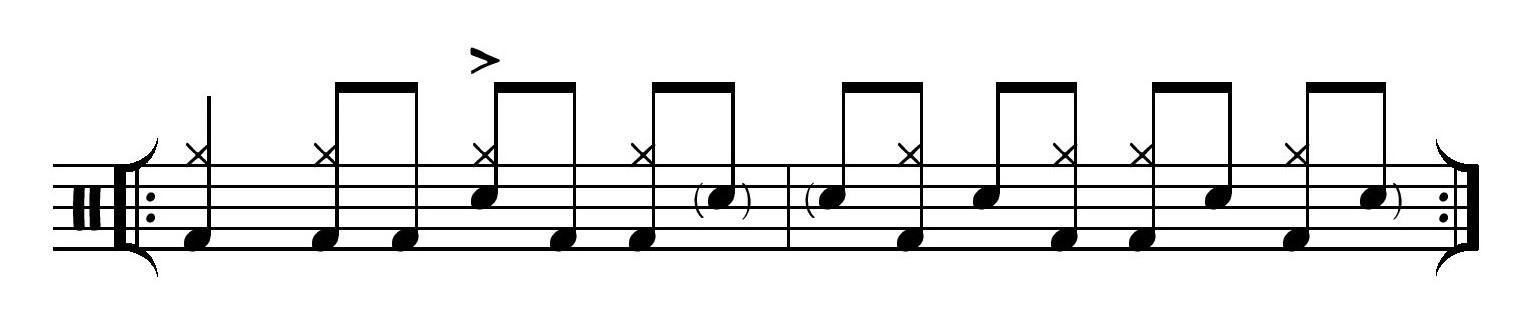

With measures 3-4, also on line 2: 


Played like this with the straight formula: 


On the repeat, we're hitting the cym/bd on the & of 4, and cym only on 1. I'm more inclined to put an accent on that & of 4— let's do it on an open hihat, closing it on 1. 

I'll also start the RH lead part early, as on the last example:  


The first two measures of line 3: 


By the formula: 


Like with the first example, I would start the LH filler early. And if I wanted to play a crash on 1 at the beginning of the phrase, I would not hit the cymbal along with the bass drum on the & of 4 at the end. The 4 at the end of the phrase would be a natural place to accent the snare drum, as well:  


Some ideas to think about. This covers most situations you'll encounter practicing from Syncopation. Maybe there will be spots where you'll want to figure your own thing out. Always feel free to make your own alterations. These types of practice systems are neither perfect nor sacrosanct. In a sense the point of practicing is to learn new stuff, but it's also to learn it in a way that connects to what you already know how to do. 

Saturday, March 24, 2012

Todd's methods: triplet funk with Reed

I guess it's going to be nothing but Todd's-this/Todd's-that this week. Fine. This is preparation for an old thing of mine I was just working through with a returning student, and I realized I had never written it up. I like using the easy parts of Syncopation- this uses the opening quarter note section to make a half-time feel triplet funk groove:


Play that until you can read exercises 1-15 plus the 16 bar exercises without stopping, and then improvise; I'll get to work on the second part, which sounds much hipper.

Get the pdf.

Sunday, February 13, 2011

Best books - Even in the Odds by Ralph Humphrey

The classic text on odd meter playing by Zappa/Don Ellis drummer Ralph Humphrey, this book covers swing, funk, and solo patterns in 5/4, 7/4, 5/8, 7/8, and longer odd time signatures. Each meter gets a concise treatment of four or five pages focused on learning its particular terrain. The written text is also minimal but effective- the instruction "repeat each exercise until a casual swing develops" is representative. This is a welcome change from many current books which tend to include way too many exercises, and assume a lot of ignorance (and isolation from real-world sources of information) with overly detailed verbal instructions. It appears to be geared towards college students who are going to tear through it, then run out and complete the process by applying it in performance.

For a partisan (like me) of the modern, interpretive Syncopation-based method of practice (reading a single melody line and orchestrating it for the drums on the fly), the process used in this book is rather old fashioned, in the Chapin mode. This entails learning by fully written-out one measure patterns, eventually adding up to at least a practical vocabulary, if not a lot of understanding. This does work well with the subject matter, though- many of us are back in the stone age (or at least the early days of the Chapin book) when it comes to odd meters, and it's fine to be spoon fed the patterns a little bit while the shape of the meters sinks in. And this book is well-constructed in that at leads you easily into going beyond the written exercises- in a way, it seems like the pinnacle of that approach.