Showing posts with label cut time funk. Show all posts

Friday, July 21, 2023

Reed tweak: RH lead with a backbeat

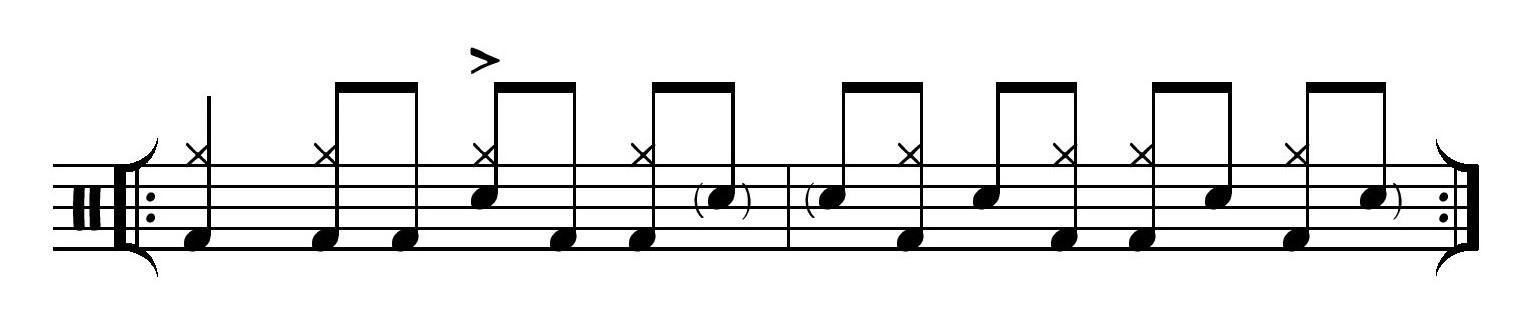
Another real simple tweak to a basic right hand lead method used with Syncopation: adding a half time feel backbeat. We've been doing a lot with this lately, and it's turning into a very robust system. We're getting into some things we used to have to just figure out (or not) individually, in an unstructured way, in the practice room. I've added a Reed tweaks tag to give these small changes to existing systems their own category.

The right hand lead method, once again, is: 

RH on cymbal + bass drum: play book rhythm
LH on snare drum: play spaces in book rhythm, to make a full measure of 8th notes


To give it a backbeat: 

If there's a snare drum on beat 3*, accent it. 
If there's a cym/BD on 3, substitute SD for BD, and accent it. Cymbal rhythm stays the same. 

* - In cut time the beat is counted in 2, but I still count the actual rhythms in 4/4. The backbeat is on the cut time 2, or on beat 3 in 4/4. 


Here's how that works out interpreting some rhythms from pp. 34-45 in Syncopation: 


Sorting out what to hit may be a little confusing at first, so keep the basic method as your point of reference. Sort it out by playing a two-measure phrase: 

1st measure: regular RH lead / 2nd measure: RH lead w/backbeat


This creates a nice open environment for adding embellishments, which we'll get into in the next post. 

Friday, May 12, 2023

Finessing Reed funk phrases

A baseline thing to do with Reed funk methods is to practice in two measure phrases. For example: one measure cut time funk* / one measure RH lead**.

* - CUT TIME FUNK: Reading from Syncopation, play melody rhythm on bass drum, except play the 3 on the snare drum— adding it to the written rhythm if necessary—add quarters/8ths on cymbal. 

** - RH LEAD: Play melody rhythm on cymbal with RH, plus bass drum in unison. Fill in gaps in rhythm with LH on SD to make a full measure of 8th notes. 
 
Here's how you would play that phrase reading line 1 on p. 34 of Syncopation— look it up, the rhythm is 1& &3 4:  


As you get deeper into practicing that, especially when running the full-page exercises, that formula creates some rather artificial connections between the two measures— the resulting thing is not how I would play. Or maybe there are some hipper possibilities, that move more naturally. We'll look at some examples of that from Exercise 1 on p. 38 of Syncopation. 


You could play the page straight through, or isolate any two measures and repeat them. Let's isolate measures 2-3 of line 2:


Played strictly first measure: cut time funk / second measure: RH lead: 


It's kind of weird to just start a measure with a ghost note. You could accent that note instead, or just start the RH lead portion earlier, on beat 4: 


With measures 3-4, also on line 2: 


Played like this with the straight formula: 


On the repeat, we're hitting the cym/bd on the & of 4, and cym only on 1. I'm more inclined to put an accent on that & of 4— let's do it on an open hihat, closing it on 1. 

I'll also start the RH lead part early, as on the last example:  


The first two measures of line 3: 


By the formula: 


Like with the first example, I would start the LH filler early. And if I wanted to play a crash on 1 at the beginning of the phrase, I would not hit the cymbal along with the bass drum on the & of 4 at the end. The 4 at the end of the phrase would be a natural place to accent the snare drum, as well:  


Some ideas to think about. This covers most situations you'll encounter practicing from Syncopation. Maybe there will be spots where you'll want to figure your own thing out. Always feel free to make your own alterations. These types of practice systems are neither perfect nor sacrosanct. In a sense the point of practicing is to learn new stuff, but it's also to learn it in a way that connects to what you already know how to do. 

Tuesday, May 03, 2022

More Tiki Fulwood funk fills

Another item I was working on with a student, for everyone waiting for the other shoe to drop on that 2013 Tiki Fulwood/Funkadelic fills post. It's a fun, low-intensity thing to do with Syncopation pp. 22-27, played in cut time— all the funk stuff I do with Reed is in 2/2. 

Here's a basic groove to use as an environment— we'll play one or three measures of this, one measure of fill: 


The fill is just one measure of the book rhythm, played on the snare drum. You can start the fill on the 1, or after. The fill here is line 5 on p. 24 of Reed.  


We settled on going to the fill on the & of 2— that sounded hippest. It also makes a good lead in— you can jump in with that while they're counting off the tune. Here's the practice phrase: 


And the fill portion of some lines from Syncopation:  


It usually works best if you start the fill with the right hand, and alternate— most of the time that will have you land on the cymbal with your right hand on beat 1. Drill it with this Betty Davis practice loop

We were talking about fills, and how they're difficult to teach, and how most books on the subject are not helpful— too specific and too “drummery.” The later parts of my rock drill are helpful for a kind of non-specific textural thing with unisons and singles, which is a lot of what filling is. But a lot of it is just listening and getting a concept in your ear. Ringo Starr's thing is easy to mimic. What we're doing here, copying Tiki Fulwood's 32nd note fills on the slower 16th note grooves on Maggot Brain is another thing. Ndugu Leon Chancler's tom tom fills with George Duke is another one for me. Now we just have to listen to a lot more records and get about 50 more like that. 

Thursday, September 16, 2021

Reed interpretations: special voicing - 01

This came out of the groove part of my recent Country Rock thing. It's a kind of subtractive method for voicing the snare drum and bass drum. Not unlike my John Riley-inspired “that with interruptions” pages, not unlike the natural sticking concept, where you stick mixed 8th/16th rhythms according to which hand would have been playing that note if you were just doing alternating 16ths.With the Riley thing we started with a simple snare/bass pattern— SSBB— and eliminated some notes, keeping the remaining structure. 

We'll take that a couple of steps farther, using a more complicated foundation pattern, BSSB-SBBS, and learning to use that voicing while reading rhythms from Syncopation. Relax, it's doable, and I think it's worth the effort. 

Here's how you would voice some basic rhythms, following that pattern: 


Warm up with the above patterns along with the cymbal rhythm of your choice, then practice the system using Reed pp. 4-5, 10-11, 30-32, 34-45, revoicing the top line part from the book accordingly. If doing the complete pattern is too difficult at first, try doing just BSSB-BSSB, or SBBS-SBBS. Warm up with beats 1-2 or 3-4 in the examples above, repeating. 

I started doing this as a 2/2 funk/rock system, but there are a lot of other possibilities. It would work fine as a jazz thing. The bass drum part sketches an embellished tresillo rhythm, which makes it useful for some broken New Orleans funk type rhythms, or Baiao, or especially Songo— or whatever other Cuban-type styles/settings where creative funk-like playing is appropriate. The snare drum part makes a cut time funk rhythm, but also suggests the 2 side of a clave rhythm. There is the tantalizing possibility that if you made a two measure system out of it, reversing the pattern in the second measure, SBBS-BSSB, you'd have a complete clave rhythm. BSSB-SBBS-SBBS-BSSB. Play that, check it out.

Just within a regular funk setting, some of the more fragmentary rhythms in Reed create some interesting displaced groove patterns. Many of the rhythms lack that cut time back beat on 3— those patterns are useful for working on open hihat punches with the bass drum. Practice patterns that have a note sounding on beat 3 will sound most like a funk groove.

I'll be interested to try this with the other paradiddle inversions: BSBB-SBSS, BBSB-SSBS, BSBS-SBSB. At some point I imagine we'd get diminishing returns with this kind of thing, or possibly it just gets much easier and we can choose one way or another based on what it's good for stylistically. 

Monday, August 30, 2021

Half time country rock with Reed

This swingy country, folky, gospel type of half time feel groove is all over the music of the late 60s/early 70s. You Can't Always Get What You Want, The Night They Drove Old Dixie Down, for example. It happens on a couple of tunes I was working on for a show with my wife, Casey Scott, on Friday, and I realized I wasn't very good at it. At least in the practice room, at the tempo of that song— in the show it worked out fine. 

But let's talk about a strategy for working on that— it requires some creativity and interpretation on your part. 

We're in a half time feel, so when reading out of Syncopation, the backbeat will fall on beat 3. The 8th notes will swing in a legato way, which will give it a feel not unlike a sixtuplet funk shuffle, though different. Don't overdo the swing feel.

For the grooves, use lines 1, 3, 4, 13-18, 42-43, 46-47 from pp. 34-36 of Syncopation. Play most of the book rhythm on the bass drum, except put beat 3 (not the &) on the snare drum. Play quarter notes on the cymbal.  Get out your four color pen and circle those lines in green or whatever. Note that all of those lines have notes sounding on beats 1 and 3. 

Basically do this, except play quarter notes on the cymbal instead of 8th notes:


To simplify the bass drum and add some interaction with the snare, play line 4, alternating notes between bass drum and snare drum:


That 8th-quarter-8th rhythm happens a lot— when it happens on beat 1, start with the bass drum; when it happens on beat 3, start with the snare, so lines 1 and 3 would be played:


You can then voice the other groove rhythms similarly— start and end on the bass drum on beats 1-2, start and end on the snare drum with beats 3-4:  


For the fills, you can use any of the book rhythms, played down the drums, with whatever sticking you like: 


You don't always have to go high to low— improvise the moves around the drums and see what else is effective. 

If the book rhythm has a rest on 1, play the cymbal or cymbal/bass drum there just to mark it: 


You could play quarter notes on the bass drum through the fill, to nail down the time. Especially on the sparser rhythms. If you watch the Dixie video linked to at the top of the post, you'll notice that Levon Helm played this type of groove with four on the floor bass drum all the way: 


This is the phrase I was practicing, from a particular song— but it's universal enough: 


Improvise the groove portion, and get the fill rhythms out of the book, and focus on the timing. For me the big problem was laying back enough. The vocabulary isn't necessarily new; this is more a template for refining it and nailing down the proper phrasing. 

Wednesday, November 04, 2020

Stick Control patterns for a certain type of funk

 A thing we do here is to rewrite/re-organize existing materials to make them better for practicing certain things. I hate hunting around the page while I practice, flipping pages, dodging things that are no good for what I'm practicing. 

Playing with a loop from a Meters song, I played some Stick Control combinations on the drumset to make a funk texture— I combined all the four-note patterns starting with an R with all of the four note patterns starting with an L. So beat 1 was an R, beat 3 was an L.  

You could just memorize the first thirteen patterns from Stone and figure out the combinations in your head while you play, as I did— or I can write them out so I have something to post on the blog, and maybe a few people will actually do it. Some of these combinations are already in the book, others are not. There are two pages, the first is most useful. 


Play this in 2/2, with the Rs as cymbal + bass drum, Ls as snare drum— with the appropriate hand. I put an accent on the cut time beat 2; or beat 3 if you're counting in 4/4... look, do this: 


I played quarter notes on the hihat with my foot, and played the unaccented snare drum notes pretty strongly— I wasn't ghosting them. It's an ordinary orchestration we do with Syncopation all the time, but it's hard to do this exact thing without using Stick Control-type patterns. 

It's similar to what Zigaboo Modeliste does at times, de-emphasizing the cymbal rhythm. And it's a lesson in a certain un-intricate concept of funk. I like unintricacy in funk. We're playing an 8th note grid, but it's a grid of interlocking parts, which creates a strong groove. To me, groove-wise, plain 8th notes played on a single sound is a weak structure; interlocking parts is a strong structure. You may not play this way all the time, but it sets you up to move some different directions— especially if you're used to playing funk with a repeating cymbal rhythm, or a linear cymbal rhythm. 

Get the pdf

Friday, August 30, 2019

Page o' coordination: cut time funk / fusion cymbal rhythm

A Page o' Coordination for getting together basic funk coordination using a common fusion cymbal rhythm, that comes from Latin drumming— it's also the jazz cymbal rhythm, not swung. The rhythm is difficult enough for students at a certain level, that it's worth writing it out this way, so all of the notes are visible. With more advanced, pro-aspiring students I will just assign my funk drill using this rhythm.

These aren't primarily intended to be stand alone grooves, though they can function that way. I was working with a non-jazz student on the Max Roach rubadub cells, playing them in a rock/funk context, and this is a companion to that.


Learn the patterns then drill them with a variety of my practice loops. Sometimes it's helpful to break them down in a way based on my so-called skiplet method— playing only the 2&3 or 4&1 portion of the pattern, one time, in isolation. Or just the &2&3 or &4&1— if the & of 1 or 3 are present in the pattern. 

Get the pdf

Thursday, December 14, 2017

Linear funk with a broken cymbal rhythm, using Syncopation

I don't know if you've noticed, but we've developed quite a robust collection of funk methods here, using Ted Reed's Syncopation. If you learned them all you should have some real creativity going by now.

So here's another one, a linear interpretation, using a broken cymbal rhythm. This is good for moderate tempos— around 60-90 bpm. Tempos where you might play 16th notes on the cymbal with your right hand. Since we're playing this in 2/2— cut time— that would be half note = 90 bpm, and 8th notes would be the functional equivalent of 16th notes in 4/4. In that range it's very effective to emphasize a solid grid of 16ths (or cut time 8ths), a la Ndugu Leon Chancler and others. It's not the most popular way of playing styles with a backbeat today— chunky— people don't know they want you to play this way, but when you do, it creates a very deep groove.

Let's walk through the steps for this, starting with exercise 1 on p 33 of Syncopation:


Ignore the stems-down part. Play the top line rhythm on the bass drum, filling in any gaps in the rhythm with the right hand on the cymbal or hihat, making an unbroken stream of 8th notes:


As a warm up, do the same thing with the snare drum playing the book rhythm:


Then voice the book rhythm like a cut time funk groove, with the snare drum on 3, and the bass drum playing everything else:


As in our earlier funk method using Syncopation, you can also play the last half of the measure on the snare drum, to make a fill-like variation:


We're generally very right hand oriented on this blog, but the broken cymbal rhythm with this method really changes our focus. Rather than leading with the cymbal rhythm, you'll be thinking more about the bass drum and snare drum, and filling in the cymbal to create a solid architecture. All the parts should be at a roughly even volume. Your left foot may also contribute more than usual— play it on 2 and 4, or 1 and 3, or running quarter notes. Be able to add it in and take it out without disrupting the groove.


Improvise the orchestration to make a complete phrase out of each four measure line of music from the book. I think of it as two two-measure phrases, with a normal backbeat in the first measure, and a fill-like variation in the second measure— a little fill in the measure 2, and a bigger fill in measure 4:


Many of the book exercises have a rest or a held note on 3— page 33, exercise 2, for example:


To figure out what to do with that, first play the entire top line rhythm with the bass drum, filling in the cymbal rhythm with the right hand as before:


Of the exercise rhythm, play the closest note to 3 on the snare drum. That will be our backbeat, displaced:


You can also just add the snare drum on 3, while doing everything else the same as you have been:


When doing the fill-type variations, you'll want to use the displaced backbeat, playing the rest of the measure after that note on the snare drum:


Work with the one-line exercises until you're able to apply the method while playing through the long exercises on page 37 and after. I don't believe it's necessary to work for extreme speed on this one. Use the Betty Davis loop.

Monday, June 19, 2017

Transcription: Ndugu Leon Chancler - Blues For Walls

I say that every time I post something about him: Ndugu Leon Chancler has to be the player I love the most, for the least exposure to his playing— for years I just had the one record, Reach For It, by George Duke. Here he is playing behind Oscar Brashear's trumpet solo on Blues For Walls, from the Hampton Hawes record of the same name— it should be interesting in light of the funk post from the other day:


The transcription starts at 0:36 in the recording. Swing the 8th notes— they're not triplets exactly, but they're close. And whoops, we're in half time feel, but I forgot to make the time signature 2/2 rather than 4/4. The tempo indicates half notes, anyway...

Ndugu appears to be playing a five piece set here— at least there are no more than three tom toms being played in the course of any one fill. Cymbalwise, there are hihats, ride, crash, and China type. Hihats are played half-open for most of the tune. Where there is an accent on a hihat note, usually the open sound is also a little more pronounced, which makes sense. Watch out for cymbal accents tied across the barline— often he'll crash before the downbeat, and play the bass drum again on the downbeat, but not the cymbal. There are a few filler ghost notes on the snare drum; it's possible he's doing more of that than is written here, and it's just not audible.

Get the pdf

Thursday, June 08, 2017

Todd's funk drill

I'm pretty sure I've posted this somewhere on the site, but maybe I didn't share it as a finished drill. This is a reasonably easy thing for getting your reading, bass drum chops, effective use of the snare drum, and all around moderate-tempo funk timekeeping happening. I do this all the time, especially if I have a gig coming up and I haven't played in a few days.

I use the long exercises from Syncopation (pp. 37-44, old edition). If your reading isn't together enough to do the long exercises, you can also do this with pp. 10-11, or 29-31, or the one-line syncopation exercises on pp. 33-36. But move to the long exercises as soon as you can.

We're playing in 2/2— cut time. The melody line written in the book (the stems-up part) is predominantly your bass drum part. Ignore the stems-down part in the book. We're going to add 8th notes on the hihat, and do two different things with the snare drum.

First play the entire exercise on the bass drum, add 8th notes on the hihat, and play the snare drum on 3. If there is a rest or a held note on 3, play the snare drum anyway. Don't play the bass drum on 3. So this well-known couple of lines from Reed:


Would be played like this:


The second thing is more involved. This time we're going to play the book rhythm exactly, with the snare drum on 3, or the closest note to it, if there's a rest or held note on 3— the backbeat is displaced. Often the & of 2 sounds best, if it's in the part, but you can try some different things and see what you like.

You could play the whole drill that way, but I do one more thing with it: every two bars I play the entire last half of the measure on the snare drum— all of beats 3 and 4. Or if, because of a rest or tie, the snare is played before 3, you play the whole rest of the measure on the snare, starting on that note. I'm giving detailed instructions, but you're free to do it however you like. Here is that same two lines played that way:


The only weird part is bar 6: there's a held note on 3, so we play the snare on the & of 2, and go ahead and play the rest of the measure on the snare, since it's one of those measures.

Here's another example, the first two lines of Exercise 3— this one has more tied notes and rests on beat 3:


The first way, with the snare drum on every beat 3:


The second way: snare drum on 3 or closest note to it, last half on snare every two measures:


Playing long exercises 1-8 this way makes a decent-length workout. I recommend playing everything at an even, strong volume; the hihat can be lighter, but don't accent it. Advanced students like to play a lot of internal dynamics, accenting the hihat, ghosting things, but in real world playing, playing everything strong = playing effectively. That should be your foundation, at least.

This Betty Davis practice loop @ half note = 64 bpm is excellent for this drill— it's an easy tempo and you'll definitely acquire the intended feel and attitude. Your tempo goal for this should be around half note = mid-90s bpm. If you're really pushing yourself you could get into the low 100s, but at a certain point the cymbal rhythm starts sounding a little silly— at that point I would try a different hihat rhythm.

Saturday, March 26, 2016

EZ cut time funk method

Here's an easy cut time funk technical study, sort of a flanker for my basic method, serving really no purpose except to set up a situation where unexpected things can happen. It's easy to get locked into your normal way of playing, so what we'll do here is disrupt that a little bit, playing some ordinary-sounding grooves in a non-ordinary way. It's challenging enough to introduce something new, but easy enough that you won't have to dedicate a ton of time to something of questionable direct utility. It hints at the open-handed thing, without going full-on “I'm going to mindlessly do everything backwards in the name of an idea”, which I hate.

You recall the foundation groove from my basic two-handed method, with the hihat and snare played with the right hand only:


What we'll do is play that groove, and a variety of others, with a mixed sticking derived from pp. 8-9 of Syncopation by Ted Reed (Lesson 3, in the new edition)— the section with the linear quarter notes. We'll interpret those exercises as stickings: stems down = left hand, stems up = right hand. So line 6, for example:


You can get the stickings from anywhere, but what the hell, these are already in the book we're using and they're in the right rhythm and everything. So: play that sticking on the snare drum and hihat, like in that funk groove— snare drum on 3 with whichever hand it falls on in the sticking, all the other beats on the hihat:


Then play these various stickings with that voicing over the bass drum parts from my pages of cut time funk beats. As a warm up for the mixed stickings, I suggest playing whatever groove you're working on with RH only and LH hand only.

First just add the bass drum on 1:


Continued after the break: