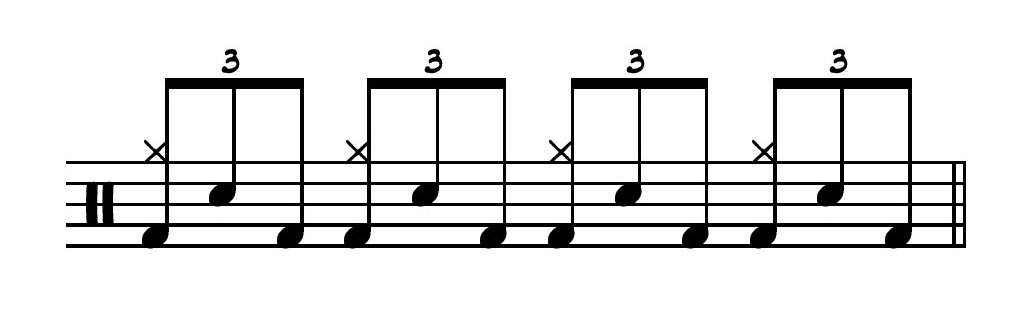
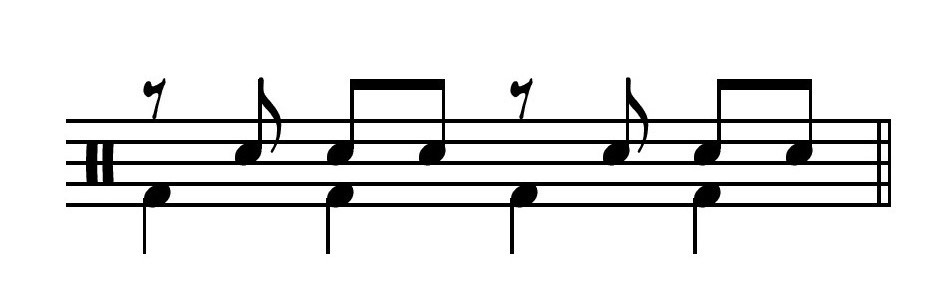
Here's a loop that be real useful to a lot of people, sampled from Soulful Brothers, from Kenny Burrell's record Blues - The Common Ground. The drummer is Grady Tate, and he's playing a shuffle in the manner we previously saw with the tune Midnight Special, as played by Tate, and by Donald Bailey, with Jimmy Smith, with the hihat on all the swing &s.
The form is 12 bar blues, the tempo is about 72 beats a minute. Practice all your swing stuff with this, not just the shuffles. It's supposed to groove that hard no matter what you play.
Here's a page for my students, working through the basics of a half time funk shuffle groove. It gets mentioned a lot more online than it comes up in real life, but it's a thing.
There are a number of ways to write it; I've put it in 6/8 and 12/8. In real life I might expect it to come up most often as a sixtuplet feel in 4/4.
Pay careful attention to the dynamics on the snare drum; play the accent strongly and ghost the other notes. I also accent the downbeats of the cymbal rhythm, you can do that if you choose.
Put on your headphones, here's a little listening this morning: this is Blues On My Mind from Blue Mitchell's album Out Of The Blue. A lot of blue there, and blues. Playing on it are Benny Golson, Wynton Kelly, Sam Jones, and Art Blakey on drums. Everybody sounds fantastic on it, I'm particularly in love with Sam Jones here.
The tune is a 12-bar blues, the feel is a nice relaxed shuffle. It's a hip tune, written by Benny Golson, not a stock hard bop item at all. There's no lead sheet for it in any of the usual books, you can purchase a transcription of the complete track (the head and solos anyway) via Qpress, a site that looks to be an excellent source for brass players.
Drummers tend to overplay when somebody mentions Blakey, shuffles, and hard bop. And when you give them/us an arrangement to play. So it's good to pay close attention to what's happening here, and dispel some perhaps one-dimensional concepts of those things. I know how you guys are, because I'm that way. Away from the actual thing you form these simplistic ideas about them. Maybe it's just me.
I would listen to this at least a half dozen times, including a couple times just paying attention to the quality of the groove, and the dynamics:
There are a number of stops and rhythm figures on the head, Blakey doesn't set them up except at the end of the form. He's very sensitive with the dynamics— the bar 1 is strong, bars 2-5 are soft, bars 6-12 are stronger. Each of those parts has dynamic movement within it. Check where he catches the cymbal and mutes it, or let's it ring out.
Blakey takes it easy, mostly playing straight time throughout, but he hits some pretty strong accents— usually at the end of solos. Most of us would be shy about punching them that hard when playing this smoothly overall.
As you would expect with a shuffle, he's keeping a straight rhythm on the cymbal, and there's some activity on the snare drum— a backbeat, and usually some part of the expected shuffle rhythm. At no point does he wail on the snare drum. He's playing the cymbal with a strong quarter note pulse, accenting on all four beats— he's not accenting just the 2 and 4, as if often stated about him. The hihat is on a solid regular 2 and 4 all the way. Blakey played the bass drum in his time feel, but I'm hearing none of it except for the accents. Maybe during the bass solo.
An aside: I don't know, once again, I think the popular concept of “feathering” is just misguided— especially as I see people focused on it to the exclusion of the audible elements. And as if it's one thing and one technique. The feeling I'm getting here is of a little pressure on the bottom with the foot, like the beater isn't even coming off the head.
The groove is seated very deep, and is definitely human created. As is often the case, you can feel the swing element being pulled some different directions. And the main pulse. There are some wild factors there. Religiously resolving everything to a perfect grid is a 21st century deformity— it's not what swing is. Blakey's cymbal beat is close to a dotted-8th/16th rhythm here; between the cymbal and the snare drum there's a suggestion of a double time feel at times. The soloists are generally swinging off more of a triplet foundation, when they're not double timing. The swing comes from the tension between the different concepts. In part.
For a moment I was going to say that this track is a lesson in not playing based on genre stereotypes, but stepping back it really is just a straightforward shuffle. I think the fact that I'm listening to this straightforward shuffle, and all I can hear is the ways that it's a unique piece of music, and not a genre stereotype, is a clue about how you're supposed to listen. It does help that these players are all so great, it makes the fact that we're hearing living music pretty unavoidable.
This is a triplet-feel R&B groove practice method we did in a lesson with a student recently. It has a snare drum backbeat on 2 and 4, quarter notes on the cymbal, and some triplet filler on the snare drum. You can do this with pp. 10-11, 30-31, and 34-45 of Syncopation by Ted Reed.
To make this kind of groove it would be simple enough to just play a swing version of our regular rock beat method, but where's the fun in that? This way has more notes.
To illustrate it clearly we'll go through a few steps, but once it's learned it's easy to do the finished method on the fly while reading out of Syncopation.
To begin, let's use the humble line 1 from p. 4:
Play the top line rhythm (coincidentally the same as the bottom line rhythm) on the bass drum, fill in with the left hand on the snare drum to make triplets, add quarter notes on the hihat (coincidentally the same as the pattern rhythm), like so:
We want to have a snare drum backbeat, so let's move the notes on the 2 and 4 to the snare drum— accent them, and play the rest of the triplets softly:
Now see p.11, line 11:
Again, play the top line rhythm with a swing interpretation on the bass drum, fill in the middle of the swing 8th notes on the snare drum, to make triplets; add quarter notes on the hihat:
Move the 2 and 4 to the snare drum, accented:
Now do this rhythm from page 30:
Again: play top line rhythm on bass drum, swing interpretation; fill in with snare drum to make triplets, add quarter notes on the hihat:
When there's bass drum sounding on the & only of beat 1 or 3, like that, you can drop out the first snare drum note on those beats, making a RLB pattern:
So— open your book now— here is how you would play the second line of the famous p. 38 (née 37) exercise:
And the same thing again with the RLB thing where appropriate:
You could also do this method while playing a shuffle rhythm on the cymbal, or a jazz-type rhythm, if you choose. This type of thing is more useful in a jazz setting than you might expect. In that case, I might drop out more of the snare drum filler like so:
In the end, there are no more variations for this than there are for standard rock beats— this is way easier than the large amount of materials in the book suggests.
Another page of Three Camps interpretations for drumset, based on a 4/4 funk shuffle groove, with a normal jazz rhythm on the cymbal. These focus on pretty normal vocabulary for that type of thing. I wrote it to go with a practice loop of Ummh by Bobby Hutcherson, with Mickey Roker playing a nice deep shuffle groove.
The foundation groove is the B portion of each drill— practice that by itself, if you need to, before playing the drills. Unlike the other TCFDS pages, these all use the normal form of the piece— there are no starting-on-2 or syncopated versions.
“I used to be a free jazz drummer, now I just want to play tight arrangements.”
— me a few years ago
That's not 100% true, but I've learned a lot of respect for the craft of arranging. Slow Freight by Ray Bryant is essentially a trio record made to sound like a larger ensemble with some good arranging, and the addition of a miniature brass section with Art Farmer and Snooky Young on trumpet and flugelhorn. And the right mix— the horns are mixed 60s pop style, in the background, in one channel.
It's not the type of record musicians get excited about today, but it's extremely solid. I don't know what's up with people, if they're too hip to write things that will go over with a general audience, or if they think there's no market for it, or what. The strength here is in the tunes, the arrangements, the groove, Bryant's voice, and the great rhythm section. No extended solos, not a lot of improvisation— there is not a lot of development that isn't written into the arrangements themselves. Freddie Waits and Richard Davis aren't playing anonymously, or uncreatively— they're just playing in support of the arrangement. Davis has the big solo on the record, on Satin Doll.
Programming-wise, there's an extended dance number (Slow Freight), one jazz standard (Satin Doll), five pop arrangements— one gospel (Amen), one soul (Prodigal Son), one quasi-bossa (Fox Stalker), and two Francophone-composer tunes (If You Go Away, Apple Tree). Everything but Slow Train and Satin Doll are under five minutes long.
Throughout the record you hear Waits being strategic about using a shuffle feel, or a backbeat, or a snare drum accent on 4. Except on Slow Freight, of course— it's not intended to develop. I personally always want to have a concept when I play a shuffle. The arrangement has to support it, and help you get away from it. Or there's a strong leader whose playing just demands it. I don't like doing a jam session-style endless shuffle, just because somebody said he let's play a shuffle. It's a mediocre groove for that kind of playing, and it just ends up being restrictive.
Let's do some more guided listening. Here's Art Blakey playing a little Quincy Jones groove arrangement with a nine piece ensemble: Plenty, Plenty Soul, from the Milt Jackson album of the same title. The form is 12-bar blues. I'm surprised to see that it's 9 1/2 minutes long; it feels like a little four minute radio number.
Put on the headphones and give this at least three close listens:
It's a clean, understated performance, with none of Blakey's trademark ferocity. At no point do you feel he's playing louder to compete with the five horns. I might say it's a professional performance, meaning he's playing it like a hired studio drummer, rather than like a featured show performer, which is more the vibe of his Jazz Messengers stuff. That's not to suggest that his playing there is “unprofessional.”
He plays a backbeat most of the time; it's deeply grooving but not at all loud. Most of the time he's playing the little shuffle pick up before it. He's playing a strong (not loud!) quarter pulse with the cymbal rhythm, typically with a dotted-8th/16th rhythm. The snare drum rhythm has a similar, very tight timing— it's not a triplet. You can hear at the points where he does play triplets in a fill, it's a very different rhythm from the main groove of the piece. No doubt he's playing quarter notes or half notes on the bass drum through most of this, but you never hear it except where he's making a deliberate accent or punctuation, or on the tutti sections.
There's some air between the bass (played by Percy Heath) and the drums. Generally sounds like the attack of the ride cymbal is a little ahead of the bass, and the snare drum is behind everything— playing the shuffle rhythm the way he does is a way of getting that behind-the-beat feel with it. At some points it sounds to me like the bass is more on the front of the beat. Your ears can fool you. It's worth it to give a very close listen to the timing of the major events on this track— everything is not perfectly squared off. That's not a flaw.
Blakey does a double time groove a few times— after 5:00 for example.
Mostly he does it with a straight 2 and 4 on the snare drum— no extra little shuffle note. He often comes in with that in the last two bars of the chorus. He may double times just those two bars, or continue it through the complete following chorus, or he may goes back to regular time on the turnaround— bar 9 of the form. Where things happen in the form is important information for playing blues. We're not just punctuating randomly.
There is no bebop-type comping activity at all. Instead he makes big statements here and there; usually at the end of a solo, leading into the next solo. He may do his crescendoing press roll, a Blakey trademark, or triplets on the tom toms. At the end of the trombone solo he does a pitch bend thing on a tom tom.
His playing on the arranged passages is simple, with simple one or two note set ups for the horn kicks; he'll keep playing the 2 and 4 until the end, when he hits the big figure in unison with the horns. He does a ruff on the toms/bass drum during the horn fall at the end of the short ensemble interlude passages— he lands on the 1 of the second bar of the new chorus with that.
At first I thought he was using two cymbals— but I think he's using one 20" sizzle cymbal and varying his playing area and touch. Listen closely to it— there is no more classic jazz sound than that, and it's very similar to the Cymbal & Gong cymbals [PLUG PLUG PLUG— tb]. The accent sound at 2:00 is exactly the explosive crash sound we look for in a ride cymbal. People call this a “dark” sound, but it's more accurate to call it complex; there are trebly elements to it.
Here's a loop you're going to need this week, as I finish writing the 6/8 prep for my patented(?) Harmonic Coordination Improved™ method. Sampled from Melvin Sparks's Blues for JB, the tempo is a stately 66 bpm which should give you ample space to work out the coordination— for my thing, or anything else you need to do slow with a triplet feel.
The drummer here is playing a Midnight Special-type groove, with the hihat on the &s of the shuffle— on the skip notes. Maybe that beat has a name, I just know if from that tune.
This replaces my earlier practice loop sampled from Stanley Clarke's Lopsy Lu— this one has the whole form of the tune. Nice to actually know how to play it, just in case you ever play with an electric bass player who knows it...
Page o' coordination based on the Midnight Special shuffle groove as played by Grady Tate and Donald Bailey with Jimmy Smith. We're using two different cymbal rhythms, and the snare drum part varies, but the main focus should be keeping the strong shuffle feel the whole time between the hihat, cymbal, and bass drum. When doing ostinatos people like to try to set them on auto pilot and concentrate on the independent part, but don't— think about all the parts all the time.
Normally we do a lot of left hand moves with these pages, but in this case you can just keep it on the snare drum. It's not exactly the same groove, but you could use my Lopsy Lu practice loop with this— I have a new version of the complete form of that tune which I'll be posting soon. Or just play along with either of the Jimmy Smith recordings of Midnight Special.
If you watched that video of Jabo Starks playing with John Scofield et al, you'll notice that he does some hip stuff on the bell of the cymbal behind the trombone during the bridge between solos. Here's a page for working up that independence— but it's mostly an excuse for spending a lot of time copying the way he plays his bass drum, snare drum, and hihat.
If you watch the video carefully, you'll notice that although we're hearing a strong quarter note pulse (dotted-quarter, since we're in 12/8), he's actually not ghosting any part of the bass drum rhythm, as I've notated here. I've given a couple of alternative bass drum rhythms— you could also practice all three bass drum rhythms leaving out the notes in unison with the snare. There's also a little more going on with the snare drum than just the backbeats I've indicated here, but they're basically inaudible. The backbeats are what you should be thinking about. And notice that the snare drum backbeats aren't perfectly in unison with the bass drum— they fall a little late, so there's a big, fat flam between the two drums. It would also be worth it to spend some time copying his hihat technique— he taps his heel on 1 and 3, and plays the hihats with his foot on 2 and 4.
I've worked on triplets and */8 feels a lot in my 35+ years playing the drums, and played a lot of music in the style, and still there's a certain type of shuffle or 12/8 feel that is just easy to mess up. I don't know what's up with that, but I'm working on it quite a bit lately. This is page contains a couple of things that came up when I was improvising along with Stanley Clarke's Lopsy Lu— an example of the style I'm talking about... also an example of the ease of messing it up, because if you listen to Tony Williams's performance on the original recording... it's slightly rough.
These are a couple of 5-note accent patterns broken down and metered in a variety of ways, with the main goal of putting them into 12/8 or a triplet feel in 4. I don't really care about developing this as a 5/8-within-12/8 lick; I'm more just interested in fluency.
Practicing this page is pretty straightforward. Maintain the same 8th note speed through the various meter changes. All of the patterns have an alternating sticking, so you're going to be playing the cymbals accents with both the right and left hand. Snare drum notes can also be played as drags— as double strokes. Moving around the drums is a little weird, but you can attempt that if you want.
In about 1991 I lived in Eugene, Oregon, and every once in awhile KLCC 87.9 would play something that would send you immediately to Cat's Meow (the jazz record store that survived for 30 years in that little town of 100,000 people) and cause you to give up a very dear $15 buying the CD. I typically felt rich enough (and compelled enough) to do that maybe once or twice a month. One such record was Fourmost, by the organist Jimmy Smith, with Stanley Turrentine and Kenny Burrell, and Grady Tate on drums— a very great drummer who just passed away this weekend. What grabbed me was the way Tate played a shuffle, with the hihat on &s of the shuffle rhythm:
I also liked a lick he played at the end of choruses, which I still use today; he would play quarter note triplets on the cymbal and bass drum, filling out the triplets on each note with the left hand on the snare drum:
Except he did it in a way that's very difficult to notate with the snare drum filler, with the quarter triplet inverted:
You could try thinking of it this way, playing the snare drum notes very legato, and dropping them in earlier than you would when playing a strict 8th note triplet timing:
Ending the lick is also weird if you're thinking in quarter note triplet terms. Here's approximately what Tate does on the record— he fudges it a little bit at times:
Here's the recording— I played along with this a lot:
I assumed the main groove was just Grady Tate's hip way of playing a shuffle, but here is Donald Bailey playing basically the same groove with Smith 30 years earlier. My knowledge of organ trio playing is not encyclopedic, and it's similar to what Al Jackson does on the Booker T records, so I wouldn't be surprised if it's a more common groove than I'm presenting it as. No matter, to me it's the Midnight Special groove. Bailey plays a normal swing rhythm on the cymbal (Tate mixes it up with straight quarter notes), and plays the rim click on 2 or 4 only during some sections:
This is a loose collection of stuff with which you can drill a rather busy, modern funk shuffle feel or triplet funk feel, a laLopsy Lu or The Brecker Brothers' Inside Out:
OK, those examples are 40 years old, but people still play this way— if they're lucky, actually...
And this is indeed another practice method for use with Ted Reed's Syncopation— if you're not practicing that way, you'd better get on it. Talk to your teacher about it, or get some Skype lessons with me— something. This is how you learn to play. The examples here use the very famous first line of the very famous p. 37 exercise (which is on p. 38 of the new edition of the book):
We'll be using the Syncopation section of Reed— pp. x-x— reading the top line only, as is usual for that book. Play the book rhythm on the bass drum, except notes on the 2 and 4, which you play on the snare drum. We want to have a running snare drum backbeat, so if there's a rest or a held note on the 2 or 4, go ahead and add snare drum. Play quarter notes on the hihat or ride. Swing the 8th notes.
Next, do the same thing, but play entire line on the bass drum as written, plus the 2 and 4 on the snare, and the quarter notes on the cymbal. There will be some unisons between the snare and bass now. I haven't notated anything for the left foot here, but when your right hand is on the ride cymbal, you can add left foot on 2 and 4, or wherever you like.
The next few things are based on a very common Reed method, in which the RH/RF are played in unison, and the LH fills in the triplets. I usually move the RH to the snare occasionally to break up any multiple lefts, you can do this, or not:
Do this same method, except accent the 2 and 4 on the snare drum. If there is no snare on 2 or 4, add it:
Do that again, with quarter notes on the cymbal:
And with a jazz rhythm on the cymbal:
You could also do it with a straight shuffle rhythm on the cymbal if you are so moved. That gets to be a whole lot of activity when filling in the triplets, so I only bother with it when playing the simpler version.
As I'm further along in drilling this, I will occasionally go to the alternating-sticking version of the triplet way, with accents on the cymbals. On either the last measure of a line or the last two measures, like a fill. In this style of playing, doing this fill-like thing, I will play the snare drum fairly strongly— for the rest of this drill the snare should be played softly, except for the 2 and 4.
That adds up to a lot of stuff. You can rigorously play all these things with all the exercises, and it will take maybe 90 minutes to just play through it. If you've played that first triplet interpretation before, you can get through it much faster. Make about a 30-45 minute drill out of it, moving fairly quickly through the easy parts, combining methods, adding your own fills (alternating triplets on the drums or with both hands in unison are always good). We're interested in improvising, reading, and developing musically here, so you don't need to be too picky about getting every detail of the instructions exactly right.
A slight variation on our usual page o' coordination thing; here we're doing a set triplet pattern on the snare drum and bass drum, along with various cymbal parts— some are standard rhythms, and some are just for technical practice:
1-2, 1-3, 1-4... 2-3, 2-4, 2-5... 3-4, 3-5, 3-6... etc.
Do each measure of the combinations one or two times. And you can play the page as written, with no hihat. or add the left foot on 2 and 4, or on all four beats.
Right, so it looks like we'll be doing a lot with this triplet feel this week— mainly getting comfy improvising within this 12/8-style blues, soul or pop groove. Think Lopsy Lu, Higher Ground, Isn't She Lovely, or shuffles like Back At The Chicken Shack or Inside Out. There's a 4 feel, with a strong quarter note pulse (dotted quarter, if we're actually in 12/8), and fairly even emphasis on all notes of the triplet. A deceptively difficult style at the faster tempos, and not very forgiving of lapsing into a duple feel, as many of us are apt to do— I get the feeling a lot of drummers come away from playing it feeling slightly burned. Maybe it's just me.
So there's no confusion about meter: in jazz parlance 12/8 is a meter, but it's also a feel. These exercises are all written as 8th note triplets in 4/4, which is basically exactly equivalent to 12/8— there are twelve 8th notes per measure in 12/8, and with these triplets we're also playing twelve 8th notes per measure in 4/4. They're both counted in 4, they both have a three-note “triplet” subdivision. This isn't the time to go into detail about it; just play the triplets and don't be thrown when I refer to it as a 12/8 feel.
I've put together an easy little set of methods, using Progressive Steps to Syncopation by Ted Reed. Pp. 6-7 and 10-11. We'll be playing the book rhythms with the triplet grid filled out in a way that should be very familiar, and adding several stock cymbal rhythms. For example, using the rhythm from page 6, line 7:
First way: Play the top line* on the bass drum, and fill out the triplet grid with your left hand on the snare drum:
* - 99% of what we do with this book is based on interpreting the top line, and ignoring the bottom line, even on the two pages where the bottom line is the same as the top. Let's move on.
Second way: Play the top line on the snare, and fill out the triplet grid on the bass drum. Except here, when there are multiple runs of bass drum notes, we'll put in a rest on the beat. So you're only ever playing the last two notes of the triplet on the bass drum— “John Bonham-style”, as it's known on the internet:
Also use the exercises from pp. 10-11. To get the practice rhythm, swing the 8th notes and fill in the middle note of the triplet. Quarter notes are handled the same as before. In the examples we'll use the line 5 rhythm:
First way: Bass drum-lead, fill in triplets on snare drum with left hand:
Second way: Snare drum-lead, fill in triplets with bass drum:
Keep reading— the actual practice routine is after the break:
Another page of coordination patterns for this Afro/shuffle cymbal pattern, which I'll go ahead and call “Afro Blues” because I feel like it. It came up in my own playing, and I'm not aware of it being used as a set part in African or Latin music, but it wouldn't surprise me if it was, either. I'm not using it as a set, repeating thing, either; the purpose of these pages is more to develop some freedom within a shuffle feel, and to be able to move freely between the shuffle rhythm and the “quarter note triplet” rhythm on the cymbal, while doing other things.
So here's entry 2 in this series, which is considerably more challenging than the first, developing some linear patterns between the snare and bass drum, along with our bell pattern:
As a warm up, you could try playing either the shuffle cymbal rhythm or the “quarter note triplet” cymbal rhythm for the entire measure— which could be difficult to do without having it actually written out. Maybe I'll be nice and write it up for you. Since stylistically we're in a Blues/Shuffle feel, I tend to stay on the snare drum and not to do our usual (for the POCs) left hand moves so much. No reason not to do them, though.
This is something that came up in playing Back At The Chicken Shack, a shuffle by organist Jimmy Smith . We play a pretty open interpretation of the style on that tune, not a strict Blue Note shuffle, and I found myself playing this cymbal rhythm repetitively quite a bit. It's quite similar to the Afro 6 bell patterns we've been working with extensively over the last couple of years:
Here's the same rhythm written as 8th notes in 12/8:
I've written up a page of left hand independence patterns based on that, with a couple of standard bass drum and hihat rhythms. “Afro shuffle” is not a real style or type of groove that I am aware of; the name just sounded good because of the similarity to that Afro 6. We could've called it “Afro Blues.” Just know the name is made up, and no one else is going to know it or use it.
You could do our standard left hand moves (do you have them memorized yet?) with this page, but I don't feel it's strictly necessary; my goal is to get a more open texture within a standard shuffle feel. It wouldn't be a terrible idea to practice beats 1-2 and 3-4 of each exercise separately— looping those two beats for each pattern before doing the whole measure.
It's a busy, busy, busy, busy time here— lots of gigs, lots of teaching, lots of work to be done on my house as we convert our little back house into an Air b'n'b. Nevertheless, here's a normal-difficulty POC for getting your bass drum together when playing a normal jazz shuffle:
Patterns 1-6, 14, maybe 15, you may end up using your actual time feel at some point. The remainder are for developing facility so you can make variations and build intensity without falling apart.
You have the option of just playing the hands in unison, both hands playing the shuffle rhythm; or you could play dotted quarters notes (or quarter notes in 4/4) on the cymbal, eliminating the skip note. But learn that page as written first.
If you want a track to play with, try Jimmy Smith's Back At The Chicken Shack. Or root around in Smith's catalog for a slower or faster shuffle.
Here's a set of basic patterns for making a 70s-style triplet groove, or a moderate, triplety, shuffle,, as you hear on songs like Isn't She Lovely, How Sweet It Is To Be Loved By You, Higher Ground, or Lopsy Lu. Nobody likes working on this style— as I noted before, a combination of factors make it a more challenging style than it appears— but it does come up if you're working commercial jobs, and it's a drag to get caught unprepared. Work on it a bit, and you'll kill it.
Play each of the patterns as written, then combine parts. Start by learning each of the cymbal variations along with each of the bass drum variations, then play each of those patterns with all of the snare drum variations.