Showing posts with label Todd's Reed funk method. Show all posts

Friday, May 12, 2023

Finessing Reed funk phrases

A baseline thing to do with Reed funk methods is to practice in two measure phrases. For example: one measure cut time funk* / one measure RH lead**.

* - CUT TIME FUNK: Reading from Syncopation, play melody rhythm on bass drum, except play the 3 on the snare drum— adding it to the written rhythm if necessary—add quarters/8ths on cymbal. 

** - RH LEAD: Play melody rhythm on cymbal with RH, plus bass drum in unison. Fill in gaps in rhythm with LH on SD to make a full measure of 8th notes. 
 
Here's how you would play that phrase reading line 1 on p. 34 of Syncopation— look it up, the rhythm is 1& &3 4:  


As you get deeper into practicing that, especially when running the full-page exercises, that formula creates some rather artificial connections between the two measures— the resulting thing is not how I would play. Or maybe there are some hipper possibilities, that move more naturally. We'll look at some examples of that from Exercise 1 on p. 38 of Syncopation. 


You could play the page straight through, or isolate any two measures and repeat them. Let's isolate measures 2-3 of line 2:


Played strictly first measure: cut time funk / second measure: RH lead: 


It's kind of weird to just start a measure with a ghost note. You could accent that note instead, or just start the RH lead portion earlier, on beat 4: 
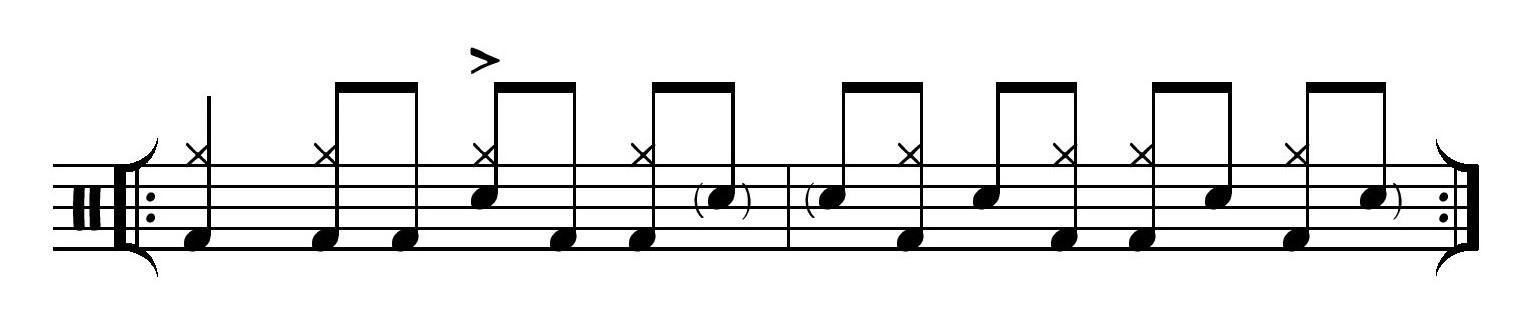

With measures 3-4, also on line 2: 


Played like this with the straight formula: 


On the repeat, we're hitting the cym/bd on the & of 4, and cym only on 1. I'm more inclined to put an accent on that & of 4— let's do it on an open hihat, closing it on 1. 

I'll also start the RH lead part early, as on the last example:  


The first two measures of line 3: 


By the formula: 


Like with the first example, I would start the LH filler early. And if I wanted to play a crash on 1 at the beginning of the phrase, I would not hit the cymbal along with the bass drum on the & of 4 at the end. The 4 at the end of the phrase would be a natural place to accent the snare drum, as well:  


Some ideas to think about. This covers most situations you'll encounter practicing from Syncopation. Maybe there will be spots where you'll want to figure your own thing out. Always feel free to make your own alterations. These types of practice systems are neither perfect nor sacrosanct. In a sense the point of practicing is to learn new stuff, but it's also to learn it in a way that connects to what you already know how to do. 

Thursday, September 16, 2021

Reed interpretations: special voicing - 01

This came out of the groove part of my recent Country Rock thing. It's a kind of subtractive method for voicing the snare drum and bass drum. Not unlike my John Riley-inspired “that with interruptions” pages, not unlike the natural sticking concept, where you stick mixed 8th/16th rhythms according to which hand would have been playing that note if you were just doing alternating 16ths.With the Riley thing we started with a simple snare/bass pattern— SSBB— and eliminated some notes, keeping the remaining structure. 

We'll take that a couple of steps farther, using a more complicated foundation pattern, BSSB-SBBS, and learning to use that voicing while reading rhythms from Syncopation. Relax, it's doable, and I think it's worth the effort. 

Here's how you would voice some basic rhythms, following that pattern: 


Warm up with the above patterns along with the cymbal rhythm of your choice, then practice the system using Reed pp. 4-5, 10-11, 30-32, 34-45, revoicing the top line part from the book accordingly. If doing the complete pattern is too difficult at first, try doing just BSSB-BSSB, or SBBS-SBBS. Warm up with beats 1-2 or 3-4 in the examples above, repeating. 

I started doing this as a 2/2 funk/rock system, but there are a lot of other possibilities. It would work fine as a jazz thing. The bass drum part sketches an embellished tresillo rhythm, which makes it useful for some broken New Orleans funk type rhythms, or Baiao, or especially Songo— or whatever other Cuban-type styles/settings where creative funk-like playing is appropriate. The snare drum part makes a cut time funk rhythm, but also suggests the 2 side of a clave rhythm. There is the tantalizing possibility that if you made a two measure system out of it, reversing the pattern in the second measure, SBBS-BSSB, you'd have a complete clave rhythm. BSSB-SBBS-SBBS-BSSB. Play that, check it out.

Just within a regular funk setting, some of the more fragmentary rhythms in Reed create some interesting displaced groove patterns. Many of the rhythms lack that cut time back beat on 3— those patterns are useful for working on open hihat punches with the bass drum. Practice patterns that have a note sounding on beat 3 will sound most like a funk groove.

I'll be interested to try this with the other paradiddle inversions: BSBB-SBSS, BBSB-SSBS, BSBS-SBSB. At some point I imagine we'd get diminishing returns with this kind of thing, or possibly it just gets much easier and we can choose one way or another based on what it's good for stylistically. 

Sunday, January 27, 2019

Todd's methods: Gospel 6

Get me.
Here's a practice method for people who have bought my new print book Syncopation in 3/4. It's closely related to my standard Reed 2/2 funk method, except here we'll be doing a slow gospel 6 feel, a la Natural Woman. On the drums this kind of vocabulary is normally learned in 12/8 or 6/8, which makes the reading rather difficult when you have to play this feel on an arrangement written in 3/4... like Natural Woman. In that case the drum groove is two measures long, and the backbeat is on 1 of the second measure. I found it to be more of a challenge than reading in 6/8 or 12/8, anyway.

Starting with this example, line 3 from page 6 (all references are to the print edition, not the e-book). In all cases we are reinterpreting the top line, stems-up part, and ignoring the stems-down part.


It's very simple: play the book rhythm on the bass drum, except the 1 of the second measure, which you play on the snare. Add quarter notes on any cymbal:


Using line 2 from page 18:


You would play this:


If you're copping the Natural Woman-type feel, the 8th notes will swing. There are many other instances of this type of feel where the 8ths should not swing.

On some exercises there is a rest or the end of a tied note on 1, like on line 3 of page 26:


You can either add the snare drum on 1:


Or displace the snare drum to match the book rhythm:


With all of the exercises, you can also play all of the second measure on the snare drum:


And then make a longer phrase out of it by playing all of measure 4 only on the snare drum:


Later you can change up the cymbal rhythm— here using line 1 from page 26 as the example groove:


This becomes a comprehensive way of working through triplet-feel grooves universally, while learning a challenging (though fairly rare) reading situation. I think there are other benefits to using this format, which are beyond the scope of this post. You should be aware of how these same grooves would be written in 6/8, 12/8, or as triplets in 4/4— the more usual ways this type of thing is written.

Thursday, September 06, 2018

Todd's funk drill - another tweak

Another small tweak to my Reed-based funk drill, improvised by a very talented 6th grade student of mine. It's very obvious, and I don't know why I didn't think of it before. Maybe I did, but didn't think to write it up until I heard him playing it and sounding great.

This is something you can do with one of the most common rhythms occurring throughout the syncopation section of the Ted Reed book (pp. 33-45): 8th note - quarter note - 8th note or 1&-&. It happens all the time in those pages, sometimes with rests or ties on some of the notes. It's almost the entire point of those pages.

For the normal funk drill we'll take a rhythm like this, as it appears in the book:


And make it into a half time feel funk groove like this— with most of the rhythm played on the bass drum, except the 3, which is played on the snare. The added cymbal rhythm here happens to be the same as the “bass drum” part from the book, but the cymbal rhythm can be anything. Reread the original explanation of the method if you need to.


With today's tweak, we'll play the quarter note on the & of 1 on the snare drum, giving us this:


When that 8th/quarter/8th rhythm happens in the second half of the measure, like this:


The normal funk groove would be:


With this tweak let's play the 8th note on the & of 4 on the snare drum:


So with rhythm:


With this normal funk groove:


You could do our new thing on both sides of the measure, like this:


You could play these extra snare drum hits a little softer than your backbeat on 3, but I don't think you should “ghost” them— they're part of the written rhythm and they should speak. Part of the game here is that we're pretending the rhythms in the book are an actual piece of music for which you are creating an interpretation on the drum set. So the written notes should all be heard. I actually favor developing a chunky, Ndugu Leon Chancler-like feel, and playing them at an even volume with the 3.

Soon I'll write up a summary of all the variations on this practice method, or maybe I'll just put it in an e-book. Why not.

Wednesday, May 20, 2015

Half-time feel funk: the “Syncopation” section — a small tweak

Continuing with my late Reed funk method here, which now has its own label— click on that link to get the whole series. It's becoming quite substantial— I see a book in our future...

If you've been working on the last entry in this series, you might have felt, as I have, that none of the interpretations is 100% satisfactory in creating a real, final-product funk feel. You need to apply your own musicianship, and transform the materials with your playing and improvising to turn them into something real. That's fine, you can continue developing the things you like, and understand that the things you don't like have a purpose as well. But we can also continue refining our method, to make the results hipper and more like a finished drum groove, without making the reading too absurdly, counter-productively difficult.

One of the things I don't like in the interpretations, is where you get into running 8th notes on the same drum. So let's break up any groupings of four 8th notes beamed together with a BSSB (when the grouping falls on beats 1-2) or SBBS pattern (when it falls on 3-4). To apply that, then:

When you see this rhythm in Syncopation:


You would orchestrate it this way when it falls on beats 1 and 2:


And this way when it lands on beats 3 and 4:


Continued after the break:

Tuesday, May 12, 2015

Half-time feel to regular 4/4

We'll be marking time a little bit this week, saving up the big, good stuff for our fund raiser, which is going to be next week. As I mentioned in our last half-time feel funk entry, you want to keep in mind that you're also going to be playing these same ideas in regular old 4/4, with the rhythmic values doubled— to make 16th notes and 8th notes, mainly. That's usually how you're going to use them, in fact.

To illustrate how that works, here again is our source idea as it appears in the book Syncopation. It says 4/4, but in playing half-time feel, we're really playing 2/2— “cut time.”


Here is the same line of music with the values doubled, which will reduce each two measures into one measure. I've added dotted barlines in the middle of the measure so it's clear where the original barlines were:


So here's the basic-form half-time feel funk groove from our last entry, as you play it reading out of the book. There's no key, but the top line is the cymbal, the middle line is the snare, and the bottom line is the bass drum:


Here's that same thing with the rhythm doubled:


Since you will mostly be playing these grooves in the 8ths-and-16ths-in-4/4 form, you might think we're making extra work for ourselves by developing them in 2/2 this way. But I've concluded that's actually a strength of this method; it gives you a commonality between your funk vocabulary and your jazz and clave-based playing— playing which is based largely on 8th note and quarter note values, at all tempos.

Friday, May 08, 2015

Half-time feel funk: the “Syncopation” section — 01

Here's a new chapter to our recent half-time feel funk series, using Progressive Steps To Syncopation, by Ted Reed. Here we're going to get into the “Syncopation” section of the book— pp. 32-44 in the old edition, the part of the book where we start seeing jazz style notation, with ties and quarter notes written on the & of the beat.

Keep in mind through all of this, we're focusing this much on half time feel because it's the best way of deriving funk-type rhythms from this book— which I like using because everyone owns it and is familiar with it. Everything we're practicing with this series is portable directly into normal playing in 4/4.

The first thing we'll do is just make an inventory of some possible orchestrations based on those pages of Reed. With the last series entries we were using the written rhythm to make a hand part, to which we added some stock bass drum parts; this time, we'll use the written rhythm to make our snare drum bass drum parts, and add a basic cymbal part to that. As in normal funk/pop/rock style, play the ride cymbal or hihat with your right hand, and the snare with your left— we won't be doing the right hand move between snare and hihat which we were doing before.

For the examples, we'll reinterpret the top part of this very familiar line from Reed— we will ignore the stems-down part written in the book. If anything is unclear, there's another set of examples in the pdf.


1. First, play the snare drum on 3, and the bass drum on everything else. When there's a rest on 3, play the closest note to 3 on the snare. You can use any cymbal part you want, but a good one to start with is quarter notes, which I've written here:


2. Play the first half of the measure on the bass drum, and the second half on the snare:


3. Then alternate between the snare and bass, starting with the bass:


4. Alternate again, but start every measure with the bass:


Now we'll divide up the parts based on short notes and long notes. Short notes are 8th notes. Long notes are everything else: quarter notes, dotted quarter notes, and tied 8th notes— those are the only values that appear in this section of Syncopation.

6. First play the short notes on the snare drum, and the long notes on the bass drum:


7. Then play the short notes on the bass drum and the long notes on the snare drum:


8. Then start each measure with the bass drum, which will determine which drum plays the long and short notes. If the first note is a short note, than the bass drum plays the short notes on that measure; if the first note is a long note, the bass plays the long notes on that measure.


Playing through the exercises, you will find plenty that sounds pretty cool, and plenty that doesn't, but don't worry about that; just play through pp. 32-44 with each of the orchestrations, and familiarize yourself with this way of reading the rhythms. There's more interesting/hipper stuff to come.

Get the pdf [PDF is fixed!]

Tuesday, April 28, 2015

Half-time feel funk: advanced method — open hihat

Here's the next step for this half-time funk method we've been doing, using Syncopation, by Ted Reed. On the intermediate method and on this one we'll be using the pages with quarter notes, 8th notes, and 8th rests, pp. 29-30 and 33-36 in the old edition— in the new edition I think the page numbers are one off from that. First master the basic and intermediate methods with all of the bass drum patterns before doing this method. This method is exactly the same as the intermediate method, except we'll add a closed hihat note with the foot during the rest, and an open hihat sound with the hand on the note before the closed note.


We're using natural sticking for this entire method; reading the rhythms out of the book, the right hand play all notes on the beat— the 1, 2, 3, and/or 4— the left hand any &s. The right hand plays the snare drum on 3. If there's a written rest on 3, or if an open note is called for on 3, play the snare drum on the closest available notes to beat 3, with either hand— or play the snare drum on whatever beats sound good to you. Just look at the examples on the page and play accordingly.

If you need to, you can break this down by steps:
1. Play the rhythm from the book on the hihat, with natural sticking, as described above.
2. Add the closed hihat notes with the foot on the written 8th rests.
3. Time opening the cymbals before the closed notes so that you get an open sound.
4. Move the right hand to the snare drum on 3; if that conflicts with an open hihat note, or if there's a rest on 3, play the snare drum on a different note or notes, whatever sounds good.
5. Add the bass drum rhythms from the cut time funk beats page to make a complete groove.

Get the pdf

Monday, April 20, 2015

Half-time feel funk: intermediate method

Here's the next phase of our little half-time feel funk method, using Ted Reed's Syncopation. We'll use pp. 29-30 out of Reed, with the quarter notes, 8th notes, and 8th rests, along with the page of bass drum grooves from before. Make sure you first play through all of the bass drum grooves along with the foundation hand part  (that's the first example on today's page), as well as the basic method from last week. We'll use the same sticking scheme as before: the right hand plays all the notes on beats 1-4, on the hihat and snare; the left hand plays any notes on the &s.

We'll still play the snare drum on beat 3, when possible; where there are rests on 3, we'll catch the snare drum on the closest note(s) to beat 3— often on an &, using the left hand. See the examples on the page, and play all of the options when you practice the exercises.


As you start moving the snare drum part around to accommodate any rests on 3, there will be some conflicts with the bass drum parts— I usually try to avoid playing a lot of unisons with the snare drum and bass drum— you can either choose to play the unisons, or drop out the bass drum where there would be a unison.

The last example on the page shows a way of making a fill— just play the end of the phrase all on the snare drum, or toms, and drop out the bassd drum. When doing the practice routine, you can do that on the 2nd/4th measure of each line, or just on the last measure of the line.

With this method and the previous one, the immediate goal is to be able to play straight through all of the exercises on the pages indicated, without stopping, with each of the bass drum patterns from the grooves page. The big test will  be to play the 48 bar exercise on page 31, with several of the bass drum patterns— whichever are your favorites.

Get the pdf

Monday, April 13, 2015

Half-time feel funk: basic method

Here's a basic method for working with the half time feel funk grooves from the other day. We'll be reading out of Syncopation, by Ted Reed, pp. 10-11 (from the old edition) or Lesson 4 (in the new edition).


Start by getting used to the feel of the foundation pattern, with the right hand move to the snare drum. Then play through all fifteen lines of exercises, plus the 20 bar exercise, from Syncopation, with hands only. Just keep playing the quarter note foundation pattern with the RH, and add any LHs needed on the &s to make the rhythms in the book. Then play through all the patterns again, adding a bass drum hit on beat 1— pattern 1 from the basic cut time funk grooves page. You should be able to repeat this with the other first four bass drum patterns without too much difficulty; grooves 5-18, with the BD on the &s, may be more of a challenge.

Finally, when you're able to play straight through all of the exercises with all of the bass drum patterns, play them again omitting the circled bass drum notes from the grooves page. It sounds like a lot of stuff, but once you learn a few key patterns, the rest of them become very easy.

Get cracking, the hip things we'll do with this are yet to come...

Get the pdf

Saturday, April 11, 2015

Basic cut time funk beats

Today we have a page of basic funk grooves in 2/2— cut time, half-time feel, whatever you want to call it. I haven't given a cymbal part, because we'll be doing some different things with it, using Syncopation.


For now, play them with any cymbal pattern of your choice. You'll probably want to start with quarter notes, 8th notes, half notes, and 2 and 4. Once you have the basic groove, continue playing it while omitting the circled bass drum note. Then improvise your own grooves. You could also combine first and second measures from different exercises, but that will eat up a lot of practice time, and I think it's unnecessary.

Get the pdf