Here's a drum solo by Billy Higgins, from the tune Third World on Freddie Hubbard's album Bolivia.
I've never played this tune and didn't count out the form. It starts with 8 bars of an ensemble figure with drum fills, which also occurs at the end of every solo chorus. The transcription begins with that section at the end of the piano solo, then Higgins's actual solo begins at bar 9. And you hear Higgins play the figure in the last 8 bars of his solo, then the band comes in with it on the head out.
Snares off. 8th notes are swung, or half-swung. The bass drum is feathered through a good part of this; also there are some random hits I didn't notate. The hihat really isn't used at all, maybe one or two random notes I didn't notate. Look for places to add doubles when moving around the drums— like in measure 11, the first two triplet partials are played with the same hand.
At measure 41 there's a little rhumba part that is difficult to notate There are a variety of sounds happening, and changes in pitch— which I didn't indicate. The regular Xs are rim clicks, the alternate Xs are played on the rim (possibly with the R instead of the L indicated), and the house top accents are rim shots.
The sticking I've given should help you do something with it. Your left hand should be in rim click position with your palm resting on the drum, muffling it, and the right hand playing the head near the edge of the drum. I think the pitch changes result from moving the left hand across the drum— not from putting pressure on the head and changing its tension, but from changes in harmonics, from changing the position of his hand muffling the head. Experiment.
“When I was playing the Vanguard with Freddie Hubbard, I went back to the kitchen and Philly Joe was there. He said, 'You're playing good. You gotta kick Freddie's ass, make his lips burn.' All the while Freddie was telling me I was playing too loud.”
-Lenny White, Modern Drummer interview by Aran Wald, 1977
I'm hard at work writing this new book that you will want to BUY BUY BUY, so enjoy this Freddie Hubbard record Keep Your Soul Together, with Ralph Penland on drums. I've been playing this on a loop for about a week.
I got to see Ralph play with Hubbard, and with Joe Henderson when I was in school in Los Angeles. He was never a very famous, but he was a great drummer, and worked with a lot, with some great people.
The new book should be coming a little before Christmas.
More soloing from Billy Higgins, on Dear John, on Freddie Hubbard's record Bolivia. The tune has the same chord changes as John Coltrane's Giant Steps, which is a 16 bar form, but the drum solo here is basically open— it's 55 bars long, with a cued ending, broadly phrased in 8+7+16+16+8 bars. Shifting that one bar one way or the other, depending on how you hear it.
A lot to learn about musical development with him. Sometimes he follows a measure to measure bop type of phrasing, like in the first 8 bars; other times he'll sit on an idea for a while, like most of the middle of this solo, first with the repeated accents on the cymbal, then with the Latin style thing. The last 8 bars is setting up the horns to come in with the head out.
Like the last Billy Higgins solo we looked at, this is mostly about the hands— the bass drum is used mainly for accents. As always, his articulation is very legato. I've given a few stickings, you can assume the same types of things are happening throughout. Figure it out and mark it up yourself. There are some interesting things happening with flams and ruffs in the second line.
Between measures 32-44 he plays a six-beat motif that is easy to see when you write it out with three bars per line, not so easy to follow just listening to somebody solo. I don't if it's a regular thing of his, or if he just vibed it, or what.
The solo begins at 5:13 in the track, but the video below is of the entire album, so you'll have to find it— the piano and bass play through the top of the form in the first few measures of the transcription.
Finished my taxes and I am exhausted, so here's something for you to practice with: Freddie Hubbard's solo on Stolen Moments, from Oliver Nelson's Blues And The Abstract Truth. At 111 bpm, it's a good introductory tempo for that jazz drill I posted a few weeks ago.
While I finish up my taxes, here's the practice loop I was playing with when I was doing that Reed in 7 thing: Heidi-B, from Freddie Hubbard's album Sweet Return. Tempo is quarter note = 189. Scroll through this if you're hurting for things in 7 to practice.
Jack Dejohnette playing a straight 8th groove on Freddie Hubbard's Polar AC. This gets called an ECM feel today, but maybe we should start calling it a CTI feel. Change it up, direct people to some other records.
I've transcribed the intro of the tune, right up until the trumpet comes in:
The groove suggests a 2/2 or half time feel— a free texture somewhere between a samba and funk feel. The main point of interest is the mostly-linear snare drum and bass drum activity, with some overlapping. The accents are subtle— he plays the snare drum at a pretty even volume.
I started transcribing this, but was too distracted by Ukraine developments to finish more than a page of it. It's Up Jumped Spring, by Freddie Hubbard, from his album Backlash— I'm listening to a lot of Freddie Hubbard lately. Otis Ray Appleton is on drums. This is one of the first tunes in 3/4 I ever learned, and like most tunes I know, I learned it on the job, playing a little gig.
The form is AABA, with 16 bar A sections and 8 bar bridge, so here's most of one chorus [hahahaha, I suck- t] of the drumming on it, from the beginning of Hubbard's flugelhorn solo, starting at 2:09:
The drumming is straightforward, grooving, driven by mostly a quarter note rhythm on the cymbal— not a lot of skip notes happening. He's playing the tune; not a lot of stock jazz waltz stylistic things happening. He plays the hihat on beat 2 sometimes. Comping on the snare drum is mostly simple offbeats (often the & of 3), with larger statements at phrase endings— often a roll on the snare or floor tom, singles or closed roll. He uses the bass drum and cymbal strongly to outline the form. He does a few basic combinations the bass drum and snare drum, which you can easily pick out.
Overall it's a great example of how to play the form, and play great time, simply and functionally without just playing stock jazz waltz drum groove.
Nice cymbal sound, too— a rather dark, dry 20" cymbal, with good ride and accent sounds.
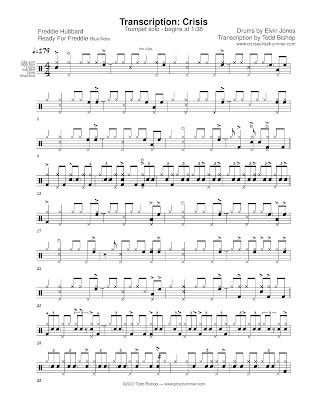
Here's Elvin Jones's drum solo on that tune Crisis, from Freddie Hubbard's Ready For Freddie, which we looked at a couple of weeks ago. It contains some classically Elvin stuff, and is good for some close study.
The form is 56 bars long (AABA, 12+4 bar A sections, 8 bar B section), and he plays one full chorus, with a few odd measures— measure 18 is short by about an 8th note, and he adds three 16th notes to measure 25 (you can easily eliminate that when you practice the lick). And he drops two beats during the long roll in the last four bars— I've written a 6/4 bar instead of two measures of 4/4.
I've given some possible stickings, which may be what he played— at least they'll get you in the correct spirit and sound. In measure 19 is the thing that inspired this other recent post. Starting at measure 50 there's a classic thing he does, RLB triplets nested in a quarter note triplet rhythm. The odd looking beat 1 of measure 52 is just a continuation of that— the last note of that beat falls on the last note of a regular 8th note triplet.
This is kind of a special item— I'll go ahead and post the pdf, but if you're not a regular contributor on Patreon or PayPal, I request that you help me out by sending $3 to:
Venmo: @Todd-Bishop-16 PayPal: toddbishop [at] cruiseshipdrummer [dot] com
Does the site need another Elvin Jones transcription? I don't know. I'm just putting in my devotional time listening very closely to Elvin. What you all do with it is up to you.
This is his playing behind Freddie Hubbard's solo on the tune Crisis, from Hubbard's album Ready For Freddie. Form is 56 bars, AABA— A sections are 12+4 bars of Latin alternating with swing; the B section swings for 8 bars. Funnily enough, the tune is rather similar to my tune Headlights, and Jorge Rossy's identical tune Post-Catholic Waltz.
The transcription begins at 1:38, tempo is quarter note = 179. The action really starts happening on the tenor solo— maybe I'll do that another time. He also plays a good drum solo.
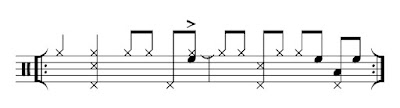
Here's the basic form of the Latin groove, played with a light swing feel. Those 8th notes on the toms are played with both hands— LRL sticking:
On the third page he plays this three-beat triplet figure in basically textbook form:
This is a free download— I am starting to ask for a donation for the more substantial downloads. If you feel like throwing in a few dollars:
Here's the album I mentioned in that Freddie Waits Latin post— Fastball - Live at the Left Bank. Part of a cache of live recordings made at a club in Baltimore in the 1960s, discovered and released in 2001. This was recorded in '67. It's got Bennie Maupin, Kenny Barron, Herbie Lewis, and Freddie Waits on drums. It's not a real pretty sounding record, it's kind of raggedy at times, and it's really what playing in a jazz group is, in a modern club setting. This is how you're supposed to play.
Sidebar: Did you know used CDs are dirt cheap? You can go into the record store and get half a dozen records for $25. Basically what used records cost when I was a student. Then you can put them in your CD player and play listen to them over and over for days, the way you're supposed to when you're a serious musician, or serious music student, and then the thing is in your permanent library of music, mentally and literally. The internet is a con, it's false abundance.
I suggest listening to it many times. Here are some key points of interest:
It's loose People learning to play jazz out of a book could get the idea that you need to play seamlessly put together drum parts, with everything spelled out to the letter. You've got to have the hihat on 2 and 4, and you've got to feather the bass drum because of x, y, and z historical reasons, you've got to have the “microtiming” of your swing rhythm worked out across the board. Are your comping “ideas” good enough? Textbook correctness, historical accuracy, blah blah blah.
On this recording, grooves and the obligatory timekeeping parts are not played repetitively— he may do those any time, or not do them. Mostly there are constant variations, propelling the groove and phrase forward.
And it's loose broadly— there are moments of uncertainty between the musicians. Everyone will be reaching at once, and you can sense there's some question about how it will come out.
He plays big dynamics Waits plays very strong at times, but he picks his spots, and doesn't relentlessly hang at one level— until it's time to do that. It took me a long time to learn this lesson— I was waiting for other people to feed me the dynamics— downwards, mostly, I had no problem getting louder. What you actually do is just play the dynamics where you think they should be, and that creates them, and others follow them. The more you play, the more you learn to make dynamic changes that make sense, that support the structure, and the progress of a solo, as is happening here.
He plays the form Everybody talks about comping, nobody talks about playing form. Most of what you hear the drums doing on this recording is not comping. He's playing things that conduct the band through the structure of the tune, hitting/implying whatever arrangement elements are unique to the tune.
Pensativa especially is one of those tunes with a form that's kind of restricting— I feel kind of stuck playing the arrangement all the time. The Hubbard tune Crisis here is also like that. But they illustrate what I'm talking about playing form— most everything played on them has an arrangement function, during the solos and everything.
Listen to Crisis: you hear him doing left hand stuff to make the Latin texture during the Latin sections; during the swing sections you'll hear some single notes on the snare drum, mostly you hear big accents on the bass drum and cymbal, propelling us in to the next section. Not stuff that ever gets filed under the heading of comping. You only learn how to do this kind of playing through the Reed-based methods, and/or from doing a lot of real life playing— it isn't discussed in the regular jazz books.
This is how you play blues In a jazz context. Blues is not just an easy form to play a lot of crap on, or to slam out an R&B beat. You have to dig a little deeper emotionally, and groovewise. On Echoes of Blue, everything played by all the instruments tells you something about how to play blues on the drums.
Took a break from the really long and hard Elvin Jones transcription and did something else really hard. From the Freddie Hubbard album Straight Life, this is Jack Dejohnette playing behind Joe Henderson's solo on Mr. Clean. It's quite dense. The transcription begins at 3:58.
It gets so dense I was presented with some formatting problems— like if anyone's going to do anything with it, I have to do one measure per line on a lot of it:
I've put brackets over a few things that are easy to work out as patterns. There's probably more, but I didn't take a lot of time to analyze it. You could actually write a whole book breaking down what he plays here.
He plays 8th notes on the ride cymbal almost the entire time, when he's not doing textural/soloistic stuff. You can hear that the accents on the cymbal vary dramatically— he's not just playing it at an even volume.
All of the slashes indicate 32nd note open doubles. I've also written out the actual 32nd notes. If you want to work some of this out, be looking for ways to use doubles or mixed paradiddle type stickings. I think relatively little of the fast stuff will be played as singles.
Regarding the 32nd note quintuplets— do what you will. What I've written is accurate, but than can be deceptive as to what's really going on. It's really fast, do what you want with it. With much of the fast stuff you can hit main accents and fill it up whatever way is most comfortable to you. Without knowing the actual stickings he used, it's pointless to try to play something weird exactly accurately to the transcription.
The hihat is irregular, and is not integral to the rest of what he's doing. I notice he tends to play it in the middle of the measure. I include it for information purposes; you can play it on the &s, or play it on all the 8th notes, or not at all.
Let's listen to some more Freddie Hubbard, again with Louis Hayes on drums. The album is The Black Angel, recorded in 1969, same as Hub of Hubbard. With James Spaulding, Kenny Barron, and Reggie Workman— all still alive, except for Freddie. It sounds like we're in post-Bitches Brew mode (or at least post-Filles de Kilimanjaro), but this was recorded before the Miles album; both were released in 1970. The tune is Spacetrack, and it's over 16 minutes long, so settle in. DO NOT skim around like some kind of no-attention-span-having 2020s weirdo.
I don't know what to say, the whole thing kills. The tune is great. Reggie Workman and Kenny Barron are super hip. I always file Louis Hayes under 60s hard bop, and you can hear that, but he's also right in the moment here— with post-Tony Williams and textural free jazz things happening. I guess I've been listening to the wrong Louis records. He has a couple of great drum breaks.
The vibe is very different from the fast tunes on Hub of Hubbard, that pure machismo— and something else. An online reviewer speculated that on HOH the band was getting tired of playing standards, and it's hard not to feel that way. Here everybody is in the zone, and it's the same zone. As on HOH the time is floaty, but as a deliberate thing— not that anxiety producing thing where it sounds like there's a fight going on.
A couple of standards from the album The Hub of Hubbard, by Freddie Hubbard. With Louis Hayes on drums and Richard Davis on bass, plus Roland Hanna and Eddie Daniels. Recorded in Germany in 1969 while this group was on tour. Normally one would expect a band to be sounding really tight after a tour— here it led to something really wild. When Without A Song came up in a mix, my impression during the first 30 seconds was this sounds bad.
And some of it does— that happens. Hayes is real busy, blowing through the parts where a drummer would normally be playing arrangement stuff— it doesn't work for me. And the bass and drums are generally in different time zones, with the bass often way ahead, to the point that Davis's quarter notes are landing on Hayes's &s. It creates a real chaotic edge, and leads to some real confusion at times— like at the end of the tenor solo. I've heard Davis do this in a less extreme a way on other records— floating it in, playing around with being way ahead of the beat. Music can sound good when it's on the edge of falling apart— at best here there's a kind of wild Mingus-like energy; at worst it sounds like everybody is powering it in from different wings of the building and conflicting with each other.
Next they play Just One Of Those Things rather quickly. The tempo starts around quarter note = 430, and gets up to around 470 at times. Much of it hangs around 450... insofar as it's possible to get an accurate tempo from that. That's more relatable as whole notes, at 108-117. In my mind the normal top absurd tempo is around 400, or whole note = 100. As an experiment you can try playing 16th notes with one hand at 100, 108, and 117, that gives you an idea of the scale of tempos we're dealing with. It's all totally ridiculous.
Louis Hayes starts it with an intro played on the cymbals, reminiscent of Philly Joe Jones playing Tune Up with Miles Davis— to me two notable occurrences = a pattern, and now that's something you do when playing real fast tempos.
Strange things happen when you try to play a jazz feel at a tempo where it's impossible to do so. Hayes's default time feel is sort of a mutant Charleston— following the rhythm of the tune. You hear something like this during the head and for much of Hubbard's solo:
His quarter notes on the cymbal are shuffling out— that's the actual rhythm he plays, when you slow down the recording— and there's no hihat at all that I can hear. The time feel is mostly driven by half notes and dotted half notes played on the bass drum and cymbal, with a little snare drum. He's fluffing in some texture in between as best he can. Really the harmonic rhythm is the primary pulse all of this is hanging off of.
Eddie Daniels half-times the last chorus of his solo, which you would think would be a big smoking invitation for the rhythm section to join him for a breather, maybe play half time on the piano solo— but they don't take it— some kind of ethic of not punking out, perhaps. As wild as it all sounds, Hayes is right on it when Hubbard comes in on the head out. Freddie Hubbard is horrifying through all of this— a pure freight train. At the end of the track one of the players says “Now let's try it at the real tempo.”
The other tunes on the album are a medium blues and a ballad, and they sound great.
I really think people don't know what groove is any more— I heard the worst thing in the world on the radio* a few days ago, and I WISH the station kept their playlists up to date so I could show it to you. It was a fairly normal R&B song, set to drumming that was absolutely atrocious in the guise of being hip. I was hoping to AB it with something good, to demonstrate the total absence of the primary quality the drums are meant to bring to music. Alas.
The opposite of that is Andy Newmark playing on Dream Weaver— from Freddie Hubbard's Windjammer, a big budget album with an all-star orchestra. Newmark is a little bit in Steve Gadd composed-groove mode here, except he's playing non-repetitively— no two measures are the same. We've seen that before from him, even on pop songs. Groove does not require strict repetition, pop craft does not require playing strictly composed “parts.”
And the overt funkiness of the patterns is beside the point— groove is not just “playing funky.”
The intro and chorus transcriptions are accurate; on the trumpet verse I've only written the audible hihat— whatever else he's doing with it is buried under the rhythm guitar. He plays the intro repetitively with a couple of fills, everything else on the track varies every measure.
Here's a fusion classic, Red Clay, by Freddie Hubbard, as played by Lenny White. For a time this was one of the most-played tunes in the world among college-age jazz musicians:
Lenny plays really on the front of the beat here, in a way I think a lot of people would be uncomfortable with today. That's the way I tend to play, so I like having some hard data on what the best people before me did. I took a close look at it in Audacity, and calculated that the second measure of the vamp consistently averages out to being a couple of BPMs faster than the first measure. The tempo overall does pick up in a minor way; at Lenny's entrance, the tempos on the first two measures is 64 and 66. By the middle of the head we add about 3-4 BPMs, and the tune ends around 69/70. I took a look at the double time during the sax solo, and they do maintain the established tempo— there's no dramatic tempo shift with the feel change.
Via Larry Appelbaum @ Let's Cool One: today is the 50th birthday of one of the greatest albums in jazz, Oliver Nelson's Blues and the Abstract Truth. Like a lot of other people, the first jazz tune I learned was Stolen Moments (at least that I can put a title to- the first thing I ever played was a Sammy Nestico chart).
Unfortunately my favorite track, Hoe Down, isn't available on YouTube, but here's the opening from MySpace Music.
In keeping with our current theme, here, via AllAboutJazz.com, is a podcast of Ben Sidran talking to Don Cherry on NPR in the mid-80's. I'm listening to it now- you should be too.
There are free podcasts of other Sidran interviews with Miles Davis, Freddie Hubbard, Dizzy Gillespie, and others at SoulAndJazz.com.





 . Like a lot of other people, the first jazz tune I learned was
  (at least that I can put a title to- the first thing I ever played was a Sammy Nestico chart).
 , isn't available on YouTube, but here's the opening from