This is an excerpt from a pretty amazing 1981 Modern Drummer article by Barry Altschul, in which he discusses the drummer's relation to tunes, form, and melody, and playing melodically:
It is [...] the drummer's responsibility to know where the chord changes fall in the tune, and the song form. Knowing the names of the chords isn't necessary, but you should know where the chords change, and when a chorus is over.
Drums are a musical instrument and melody can be implied. Many drummers seem to get lost within a tune. If this happens to you, you should be able to find yourself by listening to the bass player. But, in order to know where he is, you must be familiar with the tune yourself.
Short of studying a melodic instrument, there are ways to achieve this familiarity. First, you must listen! Listen to tunes, sing them, learn the chord changes. Listen to saxophone, piano, and trumpet players. Learn to improvise around the melody of the tune by singing or whistling. Hear the chord changes while you're improvising.
A good method for accomplishing this, and one that will also help your conception and technique, is to learn a saxophone solo. Take a Lester Young solo, for example. Sing the solo away from the record. (The actual notes are not as important for the drummer as is the contour and the rhythms of the solo.) Tap the solo out on the snare drum. Then play it as if you are accompanying a band, with your right hand playing steady time, two and four on the hi-hat, and the solo between your left hand and bass drum! Interpret the sax solo as if it were a drum solo. You'll soon start to develop a melodic approach. You'll also become familiar with tunes and forms, and become aware of what the melodic instrumentalists are actually doing.
To imply melody, sit down at the drum set and make one sound. Then make another sound. Don't be afraid to be unconventional in your approach to making that sound or in the sound itself. Any sound imaginable can be used if it's used in a musical way. Do this again and again until you have explored all the sounds your set will give you. Concentrate on doing the same thing on each part of your set. A cymbal, then your snare drum, another cymbal, your bass drum. Even your stands and whatever else you use! If you want more sounds, use percussion instruments.
After you've found your sounds, utilize them when you are playing the saxophone solo we talked about earlier. Play the contour of the sax solo with your sounds to imply the melody. The only “notes” a drummer has are the high, low and middle pitched sounds. These must be related to in a melodic way with a drummer's own conception. Once this is achieved, melody can be implied. Melodies are also rhythmic, so to play in a melodic way, think that way!
Showing posts with label musical interpretation. Show all posts
Saturday, May 30, 2015
Wednesday, May 20, 2015
Species of ride cymbal interpretation in jazz
Following up on George Collligan's commentary on this subject: The way you play the cymbal pattern is really the center of your artistry as a jazz drummer, so let's do a little survey of the ways of interpreting it— the variations in accenting and rhythm people do to make their personal thing, and to do their job within the ensemble.
I've written the patterns in the now-standard triplet form, but swing rhythm is more complicated than that; even more so with swing rhythm on the cymbal, which can vary dramatically depending on the player, the tempo, and the style. That's beyond the scope of what we're talking about here— just don't be too triplet-fixated in your swing interpretation.
And don't overdo it with the accenting; if you listen to the music, it's fairly subtle the way the players do these things. You have to find a musical balance: if the accent obliterates the other notes of the pattern, you'll be blowing a hole in your time feel. And the cymbal is going to be making this pattern all night, and if you're hammering the 2 and 4, well, people's ears will get tired of that after the fourth or fifth hour.
50s / bop / Blakey-like
For a long time this driving interpretation was just the way you played the cymbal. This is generally played repetitively, with a moderate-to-strong accent on 2 and 4. Listen to Art Blakey, Max Roach, Kenny Clarke, Paul Motian, Philly Joe Jones, Art Taylor, and many others.
In attempting be “loose”, it's easy to play the unaccented notes sloppily, which can drop the bottom out of groove— so, articulate the 1 and 3 even as you accent the 2 and 4. This interpretation is usually supported by a consistent, strong hihat on 2 and 4, so, again, it's not necessary to overdo the accent on the cymbal.
Quarter note pulse
In recent years I've been favoring this as my default way of playing jazz time. It communicates a strong groove to the other musicians and to the audience. I've heard it be effective even when a drummer's cymbal pattern doesn't sound very swinging by itself— as soon as the band comes in, it sounds great.
I don't know if this feeling is accurate, but it seems to me that I've most seen this approach in veteran players who were young in the 70s and 80s, when big-drum Tony Williams influence was at its peak. Younger players seem to favor the other styles, and you can really sound different if you emphasize and sustain this type of feel. That's just my impression— maybe it's BS.
Elvin-like
Accenting the “skip” note, sometimes “ghosting” or omitting the note after the accent. Everyone does this today, but it was once very special. When I figured out that it was a thing, I thought I was the only person in the world doing it. This is especially helpful in making a two feel without sounding hokey. It also tends to make the music lay back, so you can deploy this if you need to make that happen. Doing this in an exaggerated, overly-regular, over-practiced way can easily sound stylized, so beware.
This is often done in a mixed rhythm, with a strong pull towards a dotted quarter note pulse:
Listen to drummers who do this interpretation, especially Elvin Jones, and in the 1960s and later, Pete LaRoca and Roy Haynes. In his jazz playing with Chick Corea, Steve Gadd does a form of this, with a legato, tending-towards-straight-8th swing interpretation.
Continued after the break:
I've written the patterns in the now-standard triplet form, but swing rhythm is more complicated than that; even more so with swing rhythm on the cymbal, which can vary dramatically depending on the player, the tempo, and the style. That's beyond the scope of what we're talking about here— just don't be too triplet-fixated in your swing interpretation.
And don't overdo it with the accenting; if you listen to the music, it's fairly subtle the way the players do these things. You have to find a musical balance: if the accent obliterates the other notes of the pattern, you'll be blowing a hole in your time feel. And the cymbal is going to be making this pattern all night, and if you're hammering the 2 and 4, well, people's ears will get tired of that after the fourth or fifth hour.
50s / bop / Blakey-like
For a long time this driving interpretation was just the way you played the cymbal. This is generally played repetitively, with a moderate-to-strong accent on 2 and 4. Listen to Art Blakey, Max Roach, Kenny Clarke, Paul Motian, Philly Joe Jones, Art Taylor, and many others.
In attempting be “loose”, it's easy to play the unaccented notes sloppily, which can drop the bottom out of groove— so, articulate the 1 and 3 even as you accent the 2 and 4. This interpretation is usually supported by a consistent, strong hihat on 2 and 4, so, again, it's not necessary to overdo the accent on the cymbal.
Quarter note pulse
In recent years I've been favoring this as my default way of playing jazz time. It communicates a strong groove to the other musicians and to the audience. I've heard it be effective even when a drummer's cymbal pattern doesn't sound very swinging by itself— as soon as the band comes in, it sounds great.
I don't know if this feeling is accurate, but it seems to me that I've most seen this approach in veteran players who were young in the 70s and 80s, when big-drum Tony Williams influence was at its peak. Younger players seem to favor the other styles, and you can really sound different if you emphasize and sustain this type of feel. That's just my impression— maybe it's BS.
Elvin-like
Accenting the “skip” note, sometimes “ghosting” or omitting the note after the accent. Everyone does this today, but it was once very special. When I figured out that it was a thing, I thought I was the only person in the world doing it. This is especially helpful in making a two feel without sounding hokey. It also tends to make the music lay back, so you can deploy this if you need to make that happen. Doing this in an exaggerated, overly-regular, over-practiced way can easily sound stylized, so beware.
This is often done in a mixed rhythm, with a strong pull towards a dotted quarter note pulse:
Listen to drummers who do this interpretation, especially Elvin Jones, and in the 1960s and later, Pete LaRoca and Roy Haynes. In his jazz playing with Chick Corea, Steve Gadd does a form of this, with a legato, tending-towards-straight-8th swing interpretation.
Continued after the break:
Friday, March 13, 2015
Interpretation and playing expressively
I hate long instructional videos, except when I don't. Usually they go long because they underestimate their viewers' knowledge, and get caught up in explaining WHAT IS A DRUM STICK and a lot of other elementary background stuff. So they waste a lot of your time getting to their actual message, which itself usually ends up being less than Earth-shattering, and you hate yourself (and them) for having wasted 15 minutes watching it. Very rarely they will go long because they contain a lot of information, and, if they are telling you something you already know, it's something you actually need to hear spoken again and again.
In adherence to the stupidly dramatic style where you then say “this is such a video”, I will say this is such a video. The latter kind— the good kind. Tony Cirone is a well-known percussionist, educator, and author internationally, but he's really the center of the percussive universe here in the northwest quadrant of the US. My college professor Charles Dowd studied with him, and many of my peers, and most of my teachers, including drum corps instructors, studied with Dowd, or Cirone himself, or both. One of the big unifying things with all those people is that they've ingrained the idea of percussion as an expressive family of musical instruments. They do not have the deep meatheadedness that is—sorry to say— a feature of much of the drumming world.
This video gives you a little sample of why that is. It's directed at classical percussion students, but the spirit of it can, and should, be applied to every area of drumming:
In adherence to the stupidly dramatic style where you then say “this is such a video”, I will say this is such a video. The latter kind— the good kind. Tony Cirone is a well-known percussionist, educator, and author internationally, but he's really the center of the percussive universe here in the northwest quadrant of the US. My college professor Charles Dowd studied with him, and many of my peers, and most of my teachers, including drum corps instructors, studied with Dowd, or Cirone himself, or both. One of the big unifying things with all those people is that they've ingrained the idea of percussion as an expressive family of musical instruments. They do not have the deep meatheadedness that is—sorry to say— a feature of much of the drumming world.
This video gives you a little sample of why that is. It's directed at classical percussion students, but the spirit of it can, and should, be applied to every area of drumming:
Tuesday, January 13, 2015
The Lulu line
Here's a little four measure phrase by Thelonious Monk, which has been a big influence on my thinking, in playing the drums. It's a little microcosm of the way you develop a melodic idea in jazz, and easy to relate to the drums since it consists of only two pitches. This happens around the 2:00 mark on Monk's solo intro to Lulu's Back In Town, from the album It's Monk's Time:
It's easy to intuitively grasp what's going on when you hear it; I've been listening to this record for years, and have never actually analyzed the line until now. But, to go ahead and break it down a little bit, with the melody written in a form we're used to seeing, on a drum staff:
A) Our starting motif is very basic.
B) Rhythmic variation, slightly syncopated.
C) More syncopated, begins before we expect it, on a weak beat.
D) Inverted and syncopated; an extension of C.
E) Same as the first variation, with a two-note ending on the phrase.
These are easy ideas to use on the fly while improvising, without a lot of thought or contrivance; while playing along, you recognize that you have just played a melodic idea, then you play it again with a rhythmic variation, and again, starting in an unexpected place. Just a simple way of developing ideas.
The line happens at 1:57:
It's easy to intuitively grasp what's going on when you hear it; I've been listening to this record for years, and have never actually analyzed the line until now. But, to go ahead and break it down a little bit, with the melody written in a form we're used to seeing, on a drum staff:
A) Our starting motif is very basic.
B) Rhythmic variation, slightly syncopated.
C) More syncopated, begins before we expect it, on a weak beat.
D) Inverted and syncopated; an extension of C.
E) Same as the first variation, with a two-note ending on the phrase.
These are easy ideas to use on the fly while improvising, without a lot of thought or contrivance; while playing along, you recognize that you have just played a melodic idea, then you play it again with a rhythmic variation, and again, starting in an unexpected place. Just a simple way of developing ideas.
The line happens at 1:57:
Saturday, January 19, 2013
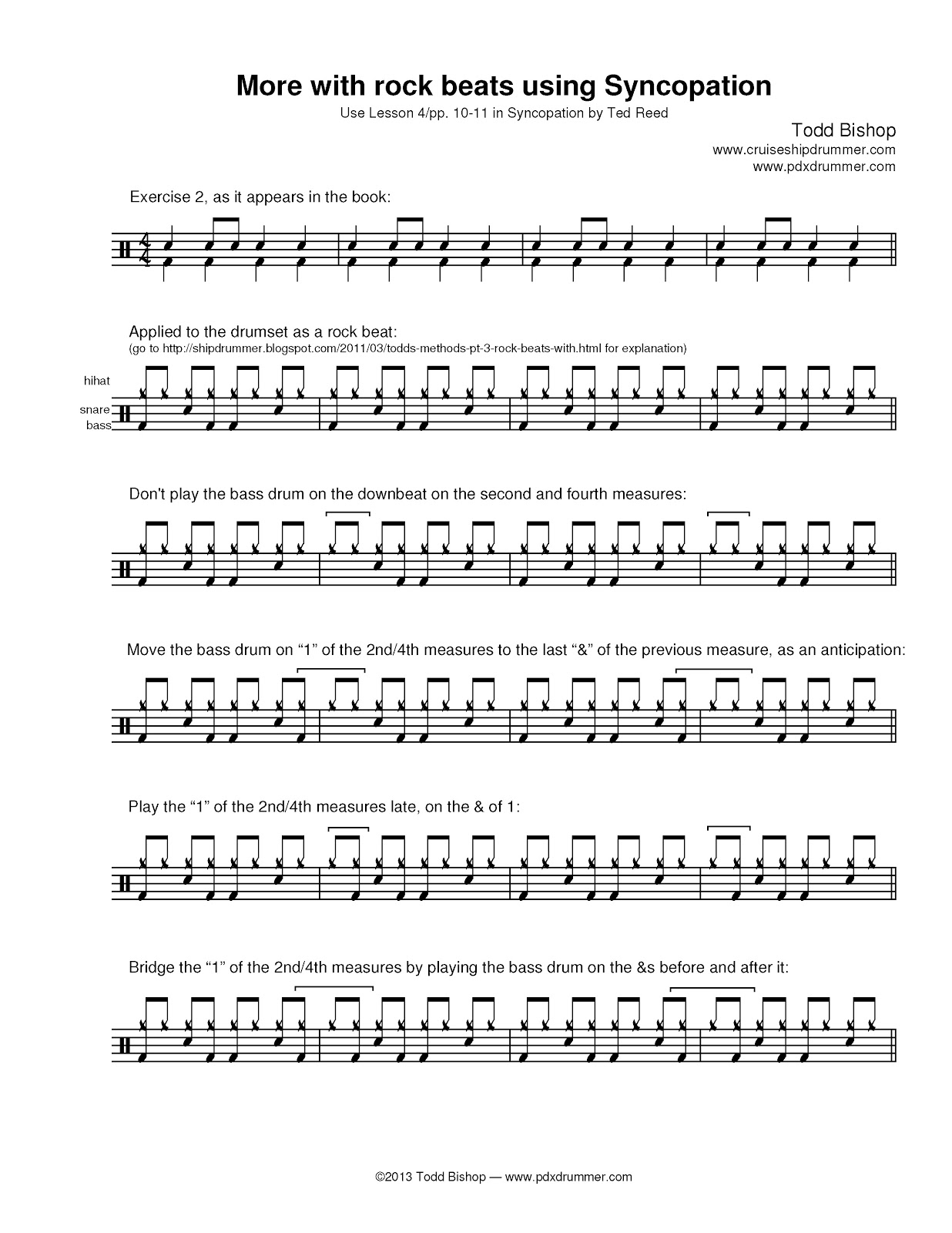
More with rock beats using Syncopation
Going a little further with my earlier piece on making rock beats using— say it with me— Ted Reed's Syncopation. In doing this, there will be many duplicate beats, but that's not important— our purpose is not to create new beats, it's to apply a thought process: taking a melody line, converting it to a drum beat, and then doing basic modifications to it. It's the beginning of playing with creative control over what you are doing, rather than just playing familiar beats. It's all simple enough that most people will internalize the concepts quickly, and begin applying them purely instinctively.
Be sure to review the previous thing first, and be able to play it with Reed Lesson 4 (pp. 10-11 in the old edition), #1-15, straight through without stopping. The current exercise involves shaping your phrases by doing things with beat one of the second and fourth measures— omitting the bass drum, moving it to one side or the other, or bridging beat one by playing on both sides of it.
Get the pdf
Be sure to review the previous thing first, and be able to play it with Reed Lesson 4 (pp. 10-11 in the old edition), #1-15, straight through without stopping. The current exercise involves shaping your phrases by doing things with beat one of the second and fourth measures— omitting the bass drum, moving it to one side or the other, or bridging beat one by playing on both sides of it.
Get the pdf
Monday, October 22, 2012
What it is: swing rhythm
Extremely preoccupied with tour preparations, obviously, but fortunately I have a couple of things on deck:
Swing interpretation is something we use a lot here, and I've mostly assumed people know what it is— you probably wouldn't be reading all of this high-flying jazz drumming nonsense if you didn't. It's still a good idea to spell it all out, so people aren't working with partial information; so here are my ideas about it. I'm a player who happens to also be a teacher, and not a scholar, so other people may have different, better, or more complete ideas about it, despite the unequivocal-sounding title of the post.
Swing is a way of playing 8th notes. If you look at a fake book, a big band chart, or sheet music for standard tunes, for the most part they are written in regular old 4/4, using mostly 8th notes and longer rhythmic values:
Often explanation of how to play that with a swing feel is limited to this, or its verbal equivalent:
Swing = triplets. Got it. NEXT!
Except... no. Swing = triplets approximately the same way a “flesh”-colored Crayola = the color of human flesh:
That is, the circumstances under which flesh is flesh crayon colored are actually rather few, depending on the complexion of the individual, and the lighting in which he or she is viewed. Likewise with music, swing interpretation varies according to the player, the tempo and style of the piece, and what's going on musically at the moment.
Continued after the break:
Swing interpretation is something we use a lot here, and I've mostly assumed people know what it is— you probably wouldn't be reading all of this high-flying jazz drumming nonsense if you didn't. It's still a good idea to spell it all out, so people aren't working with partial information; so here are my ideas about it. I'm a player who happens to also be a teacher, and not a scholar, so other people may have different, better, or more complete ideas about it, despite the unequivocal-sounding title of the post.
Swing is a way of playing 8th notes. If you look at a fake book, a big band chart, or sheet music for standard tunes, for the most part they are written in regular old 4/4, using mostly 8th notes and longer rhythmic values:
Often explanation of how to play that with a swing feel is limited to this, or its verbal equivalent:
Swing = triplets. Got it. NEXT!
Except... no. Swing = triplets approximately the same way a “flesh”-colored Crayola = the color of human flesh:
That is, the circumstances under which flesh is flesh crayon colored are actually rather few, depending on the complexion of the individual, and the lighting in which he or she is viewed. Likewise with music, swing interpretation varies according to the player, the tempo and style of the piece, and what's going on musically at the moment.
Continued after the break:
Subscribe to:
Posts (Atom)