Showing posts with label Barry Altschul. Show all posts

Thursday, December 05, 2024

Very occasional quote of the day: technique

What if you think of something to play that doesn't have a standard technique? That's what jazz cats have been doing since jazz was born. All of a sudden, you want to play something that a flam doesn't encompass, or a paradiddle doesn't encompass, or anything else.

What is it? Maybe it's a flubadub. I don't know, but you play this flubadub, and the only way to play this thing is to use the technique you discovered to play it. So you have added to the standard technique by playing this thing. And if you can use it musically—it works!

There is no right and wrong. If it's musical, it works. So just to sit and practice standardized techniques from drum books will not make you freer. The concept makes you freer, not your technique.

- Barry Altschul, Modern Drummer interview by Rick Mattingly, November, 1982

Thursday, July 04, 2024

Very occasional quote of the day: play what you hear

“Play what you hear, and if you can't play it, then practice it.”

- Barry Altschul, Modern Drummer interview by Rick Mattingly, November, 1982


Periodic reminder that, creatively, the fundamental equation is real simple. Of course, if you don't hear anything, you have to get some stuff in your ear by listening to records and seeing people play. 

Friday, March 02, 2018

Transcription: Barry Altschul - Jitterbug Waltz

Here's a drum solo in 3/4 by Barry Altschul, on a modern arrangement of Fats Waller's Jitterbug Waltz, from Altschul's album Irina— a pretty obscure (to me) record you can now download off Amazon. The tune is 64 measures long and the solo is 60 measures long. The solo starts on a tempo change, and the overall vibe is loose, so I'm kind of surprised he ends up playing almost a full chorus exactly.


There's something funny happening with the time in the first measure— it works if you just put a little fermata over the first note, then continue normally in 3. The tempo of quarter note = 165 which I've given is approximate; there's a lot of forward motion here, and it probably speeds up a bit. The execution on the technical passages— anything faster than triplets— are pretty organic. It's an Elvin-like vibe. Get the broad outline in rhythm, and play the fast bits however your hands want to play them.

Get the pdf

Saturday, May 30, 2015

Barry Altschul on playing melodically

This is an excerpt from a pretty amazing 1981 Modern Drummer article by Barry Altschul, in which he discusses the drummer's relation to tunes, form, and melody, and playing melodically: 

It is [...] the drummer's responsibility to know where the chord changes fall in the tune, and the song form. Knowing the names of the chords isn't necessary, but you should know where the chords change, and when a chorus is over.

Drums are a musical instrument and melody can be implied. Many drummers seem to get lost within a tune. If this happens to you, you should be able to find yourself by listening to the bass player. But, in order to know where he is, you must be familiar with the tune yourself.

Short of studying a melodic instrument, there are ways to achieve this familiarity. First, you must listen! Listen to tunes, sing them, learn the chord changes. Listen to saxophone, piano, and trumpet players. Learn to improvise around the melody of the tune by singing or whistling. Hear the chord changes while you're improvising.

A good method for accomplishing this, and one that will also help your conception and technique, is to learn a saxophone solo. Take a Lester Young solo, for example. Sing the solo away from the record. (The actual notes are not as important for the drummer as is the contour and the rhythms of the solo.) Tap the solo out on the snare drum. Then play it as if you are accompanying a band, with your right hand playing steady time, two and four on the hi-hat, and the solo between your left hand and bass drum! Interpret the sax solo as if it were a drum solo. You'll soon start to develop a melodic approach. You'll also become familiar with tunes and forms, and become aware of what the melodic instrumentalists are actually doing.

To imply melody, sit down at the drum set and make one sound. Then make another sound. Don't be afraid to be unconventional in your approach to making that sound or in the sound itself. Any sound imaginable can be used if it's used in a musical way. Do this again and again until you have explored all the sounds your set will give you. Concentrate on doing the same thing on each part of your set. A cymbal, then your snare drum, another cymbal, your bass drum. Even your stands and whatever else you use! If you want more sounds, use percussion instruments.

After you've found your sounds, utilize them when you are playing the saxophone solo we talked about earlier. Play the contour of the sax solo with your sounds to imply the melody. The only “notes” a drummer has are the high, low and middle pitched sounds. These must be related to in a melodic way with a drummer's own conception. Once this is achieved, melody can be implied. Melodies are also rhythmic, so to play in a melodic way, think that way!

Saturday, June 30, 2012

Cracking 5/4: further listening

Aaaand I thought we'd end this series with some more listening, starting with some more modern things:

Jive Coffee - Brad Mehldau with Jeff Ballard


 Much more after the break:


Saturday, March 03, 2012

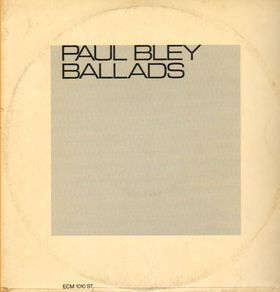
Favorite albums: Ballads by Paul Bley

Ballads by Paul Bley
1967 - ECM 1010

Paul Bley - piano
Gary Peacock, Mark Levinson - bass
Barry Altschul - drums

Compositions by Annette Peacock


This is kind of a funny entry to this series. It has taken me a long time to come to fully appreciate this record. It's very open, very impressionistic, and offers few, ah, "conventional satisfactions"; each track is in broadly-paced free time,  harmonically ambiguous (not to say atonal), with little in the way of tension and release, and no explosive performances.  It's nobody's idea of a fist-pumping jazz record.

So, I've had it in my bins since the late 80's, and putting on every few years it's stayed kind of aloof, but it kept its hooks in, and eventually clicked. The record is more an environment than a conventional piece of music, and the perfect embodiment of pure improvised music, and of a certain player's space. 

Barry Altschul is one of the most urgent-sounding drummers ever- pushing even beyond Roy Haynes or Alan Dawson for the amount of forward momentum in his playing- and he manages to keep that quality through this spacious, non-climax-seeking record. There's also a very different type of free playing at work here than the familiar dense style of drummers like Sunny Murray or Rashied Ali, or Paul Motian's naive/primitive thing- Altschul seems to be among the first very polished free players.

Annette Peacock also has become one of my favorite composers for her work recorded by Bley- her bio is rather interesting as well. The compositions here are perfect for this record, meaning they don't immediately jump out and grab you as needing to be played again.

YouTube audio of "So Hard It Hurts" after the break:

Wednesday, February 22, 2012

A crash course in the ECM feel

Look for the photos with water
and the Helvetica font.
The "ECM feel", as it's now being called, is a style that evolved in the late 1960's and 70's, and has since become one of the major time feels of modern jazz. It's associated with the ECM record label because that's where you find most of its major early practitioners and first/best recorded examples. Before you do anything, I suggest hitting the read more link at the bottom of the page and listen to the audio examples.

Some of its features: Even 8th notes, non-repetitive, linear, broken-up (pick your adjective), possible suggestion of a backbeat, Brazilian influenced. Light, airy, ride cymbal based feel (get yourself a Paiste 602 Flat Ride to complete the period effect). Had it's beginnings in the 1960's work of Tony Williams, Roy Haynes, Paul Motian and Barry Altschul. The drummers it is most generally associated with include Jon Christensen, Jack Dejohnette, Bob Moses, and Airto.

There is no standard method that I'm aware of for developing this feel, but if you work through one or more of these suggestions and do a lot of listening and playing you should begin to find it

UPDATE: In the comments Clint lets us know that Berklee professor Skip Hadden has a method book and mini-series of videos at the Vic Firth site dealing more broadly with this style. Onward:


Practice methods:

Basic coordination using the 8th/2-16th cym pattern. You can also think of it in cut time:


Use regular jazz vocabulary with even 8th notes (converting them 8th note patterns to 16ths if you're thinking of it that way). Working out the same materials with two or three more complex cymbal patterns- and with plain 8th notes- would also be helpful; you could pick a pattern from Syncopation pp. 34-37 (new edition) and put it in double time, for example.

Stick Control- the first section, and maybe the flam section- and the same part of Syncopation as above, plus the long syncopation exercises. Play this (and all the following) with the right hand on the cymbal and the left on the snare. Also play the first section with the hands together on the cymbal and snare on the Rs, and the bass drum and/or hihat (w/foot) on the Ls.

Paradiddles and paradiddle-diddles and their inversions, plus plain old doubles- RRLL and RLLR RLLR- with/without a flam at the beginning of the R or L hand double:


And Swiss triplets in a 16th note rhythm. They make a 4:3 polyrhythm, so find a place to stop to fit them within one or two measures of 4/4:


Using the feet:

Again, with the right hand on the cymbal and the left on the snare, play all of the above over an ostinato with the feet; either samba or baiao, or double some/all of the right hand part with the bass drum. Also play an ostinato with one foot let the other play sporadically to fit with the hand part.

Note: It would seem to be an obvious choice for developing this style, but I don't like to recomend Dahlgren & Fine's Four Way Coordination to anyone seeking immediate results; as I've written before, I've seen it turn into a bit of a tar pit for more than one young drummer. But if you keep your eye on the practical result you want to achieve, and don't get bogged down with the need to learn it "completely", it should also be useful here. Vol. 2 of Dahlgren & Fine's Accent On Accents would be a good substitute/supplement for Stick Control for the exercises above, though.

Audio examples and discography after the break:


Monday, November 14, 2011

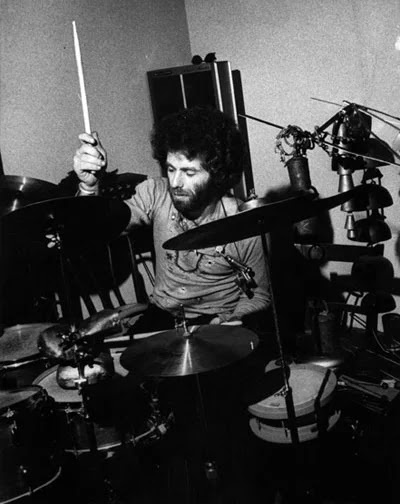
Barry Altschul interview

Barry Altschul has been on my mind a lot lately- this performance kind of got stuck in my head, plus I was listening to a lot of Paul Bley before my recording session last week- he really puts you in a mindset to be reaching for pure music, as opposed to that of delivering an "amazing" performance; so Altschul (along with Paul Motian and Billy Elgart) came up a lot- particularly on the great Ballads album.

Anyhow, here are a few excerpts from a 2010 Altschul interview from Burning Ambulance, a jazz/arts blog I haven't read before. Like most interviews it's more about current events, career and listener issues, than about things drummers/artists want to know, but there are some interesting things.

Here, you can re-listen to these great clips in another tab while you read:

PIGEONHOLED
...a lot of my recording career has been what we’ll call the avant-garde. Yet a lot of my professional career has been fairly equal between playing with avant-garde people and playing with inside people, but my reputation is pretty much avant-garde. I remember once going out with Art Pepper, and we were on the road and one of the newspapers said, “The surprise of the evening was the avant-gardist Barry Altschul swinging.…”

  Q: Did you ever feel any sense of regret or frustration about this idea that you had been painted into a corner?

BA: I feel frustration about it because I think that it has affected my work—not my playing but my ability to get gigs. I think a lot of people when they think of me, think of me a certain way and feel that they can’t think of me another way.

[...] I do know that certain musicians who are close friends of mine have told me that other people have asked them about my abilities. “Can he play time more than three bars in a row?” Or, “Can he really swing?” There have been some of those questions asked to friends of mine who came back to me and told me that.

FREE vs. BOP
I remember one time, playing at Slug’s with Paul Bley. I’m not going to mention names, but one of the more established trumpet players almost got physically violent [when he heard] the music that was being played. He was very upset that we could do that to music.

...the more inside musicians felt that the players that were playing more out had to establish themselves first. They felt, I think, that you had to prove yourself that you can play a certain way before you took the liberties of extending.

Continues after the break...