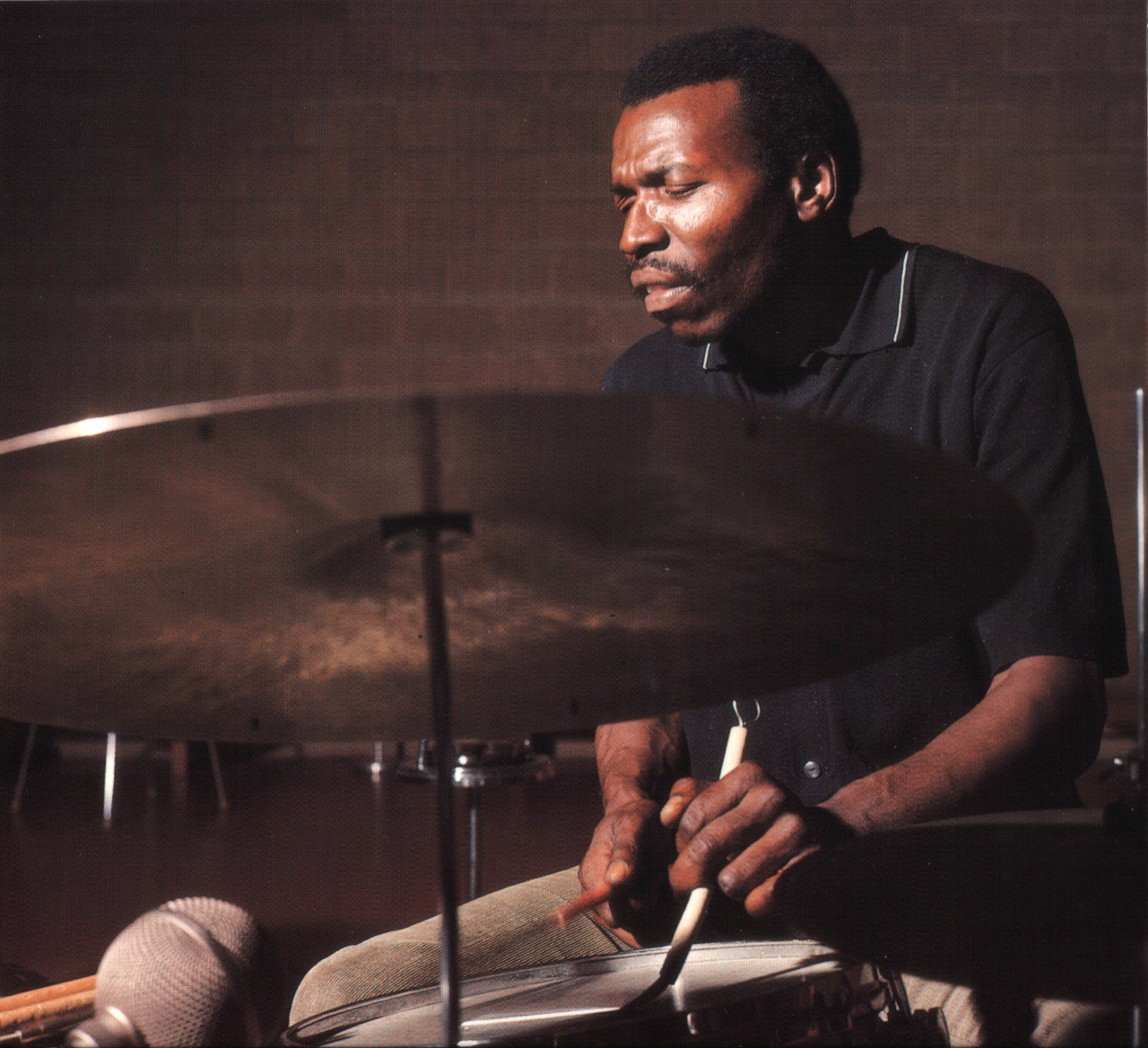
Showing posts with label Haskell Harr. Show all posts

Tuesday, December 13, 2022

Elvin's Biddy Oats

No, this is an ALL Elvin Jones site. I think we have to earn it if we're going to talk about him, put in some work, have some humility, don't be a leech. I imagine at D*umeo they refer to him as a “premium name”, with the monetary impact every time they use him all mapped out. Optimizing the Elvin Jones product to attract high-value consumers and suck off the most credibility and appearance of soul algorithmically.  

It's not cool, Elvin Jones is special. 

Anyway, following up on that post about that Haskell Harr march he played, I've transcribed exactly what he plays, more or less. There were some minor variations on the different recordings. The main difference from the original version is the added bass drum, the fp rolls at the beginning of the second half, and the roll off at the end:


The rolls are all multiple-bounce. The 5 an d 7 stroke markings are from the original piece, I didn't check to see if he did them that way. On the fp rolls he sometimes does that Elvin thing of putting putting in an extra bass drum note before the downbeat.  

A scholarly cat could dedicate some study to just how he handled the roll off solo break off on all the different recordings. He played it pretty loose. My scholarly instructions would be to vibe it, and don't be too exact about it. Make them come in on the 1 where you put it, not where it would be if there was a metronome running. 

In fact I think the study of Elvin Jones requires a serious commitment to figuring things out by vibe. It can't all be done analytically. Let's talk about that sometime. 

Get the pdf

Here it is on the new bootleg recording they just put out: 

Monday, October 17, 2022

Elvin's march

“I did go through [Harr's snare drum book] as a matter of fact. I went to public school in Pontiac, Michigan, so I didn't do anything extra. [...] I didn't have that advantage of being able to take private lessons, so I had to get everything that I had, at least up to that point, for myself. [...] So I got that book and that night I went home and sat over it and pored over it and read it from cover to cover, trying to make some sense out of it. Finally, all of a sudden I understood what it was. I knew exactly what it meant, what all of it (meant) from page one to the back cover. I pondered over that the next day, and so I learned how to do it. In two days, I mastered that book, and the rudiments.”

- Elvin Jones, Percussive Notes interview

UPDATE: See this post where I transcribed the way he actually plays this, usually. 

A little piece of Elvin Jones musical lore here today. Elvin has a march beat he plays, maybe most famously on Zoltan, from Larry Young's album Unity— I got this record in 1987:


Here he is playing it with his trio, I don't know this tune— maybe he wrote it?  

[Update: It's Keiko's Birthday March— thanks Ed Pierce! -t]

[Update again: It's also The Long 2/4 by Donald Bird! Same tune, released on Pepper Adams's 10 To 4 At The Five Spot in 1958— I don't know what happened there, but thanks Paul Wells! ]


I'm sure there are other recordings— he also played it at a clinic I attended in the early oughts.

It basically comes straight out of Haskell Harr, book 2— page 80 in my edition. He plays this almost verbatim on both records:  


He's playing bass drum on some of the accents. He plays longer rolls in the middle of the second line, after the repeat sign— 13 stroke rolls with an extra bass drum note at the end. He also hits the cymbals there. On the live thing he ends it with his own kind of roll off— it starts normally, and ends with a big Elvin style fill. 

On the live video he plays the full thing with repeats at the top, and after his solo. On Zoltan he switches to the Latin groove in the fourth measure of the repeat of the B section— the organ march vamp starts at the top of the repeat of the first part, then the horns come in with their fanfare thing in the fifth bar, and then the organ starts the Latin vamp in the fourth bar of the repeat of the B section. The fanfare section is 15 bars of 2/4 total. I wrote out the Latin groove from this tune in 2016. 

There you go— I've been listening to him play this for about 35 years, and just thought to look it up in Haskell Harr today. 

Monday, March 18, 2019

Rudiments in 5/8

A page of snare drum rudiment practice phrases, written in 5/8, in a 3+2 phrasing. Keep this with your copy of Haskell Harr (book 2) or Rudimental Swing Solos.


These can all be played at normal rudimental tempos— quarter note = 105-126. You'll probably have to set your metronome to give you 8th notes at 210-252 bpm for that. Or you can set it to give you downbeats only, at 21-25 bpm. The closed 7 stroke rolls are played with a 16th note triplet pulsation; the other closed rolls are played with a 16th note pulsation.

Get the pdf

Saturday, January 07, 2017

Odd meter Harr: flamadiddle study in 5/8

I've said before, I practice out of Haskell Harr's Drum Method a lot. It's the stodgiest traditional rudimental snare drum book available this side of the Moeller book, but it uses accurate modern notation— many books of its era do not. It's a part of the drumming literature many, many great drummers have played through at one time or another— like Elvin Jones and Terry Bozzio— and most importantly, it really conditions my hands for real-world playing— better than any other book I've encountered. I don't know why— I don't use a whole lot of rudiments in my actual playing.

To continue: I also play out of Mitchell Peters's Odd Meter Rudimental Studies, which contains a number of fairly traditional but sophisticated pieces in a very Harr-like vein. It seems like a natural enough things to adapt the actual Harr etudes into odd meters, too. So here's the first major study in book 2 of Haskell Harr's method, a flamadiddle study, transcribed into 5/8:


It's an easy piece, with a nice little waltz-like lilt to it. Standard tempo for pieces like this is around quarter note = 100-120; you'll want to push it up to around 130. Harr makes a practice of defining his rolls— the little numeral 7 at the beginning indicates that it's a 7-stroke roll. You'll play that with a 16th note triplet pulsation. More of these coming!

Get the pdf

Saturday, November 29, 2014

Very occasional quote of the day: figuring things out

Elvin Jones on Haskell Harr and learning the rudiments:
“I did go through [Harr's snare drum book] as a matter of fact. I went to public school in Pontiac, Michigan, so I didn't do anything extra. [...] I didn't have that advantage of being able to take private lessons, so I had to get everything that I had, at least up to that point, for myself. [...] So I got that book and that night I went home and sat over it and pored over it and read it from cover to cover, trying to make some sense out of it. Finally, all of a sudden I understood what it was. I knew exactly what it meant, what all of it (meant) from page one to the back cover. I pondered over that the next day, and so I learned how to do it. In two days, I mastered that book, and the rudiments.”

From an old interview in Percussive Notes— it now appears that you must be a member of PAS to access the archives, and I've let my membership lapse. What an excellent time to renew or join! 

Sunday, August 19, 2012

I think this is what is referred to as a "chestnut"

Here's a book that has been part of the terrain forever, but which is much more valuable than you might expect: Haskell Harr's Drum Method. It's a two-volume item, and I've only used Book 2, which I've found to be excellent for general conditioning.

First published in 1938, and mostly derived from military drum and fife repertoire, it represents the most retrograde style of rudimental drumming, with scarcely a trace of any kind of modernity-- certainly none of the swing influence found in books by Wilcoxon or even the much earlier Edward B. Straight. The pieces included have names like Mildred Waltz, Cuckoo Quick-Step, Ancient And Honorable Artillery, and Bunker Hill. Included, of course, is the turgid old Downfall Of Paris. They are mostly two-part little pieces, which I suspect are meant to be played AABA, or AABBA-- I'm no expert in traditional military music. The book is actually usable because unlike many other older sources, it mostly uses modern notation.

There's nothing exceptionally challenging in it, and there's little in the way of equality between the hands, with no special attention given to strengthening the left. The left has certain little special things it does regularly-- the flamacue; seven stroke rolls, etc-- but mostly it follows the right. The only time the left has the lead is on rudiments that alternate, following the right handed version of the rudiment.

Here's a representative example:


And a nice performance of one of the pieces:


Now, despite my background in drum corps, I don't consider myself to be any kind of rudimental drummer, or to have a big rudimental influence in my regular playing. But I've found that as a jazz drummer, a few days of playing through a good chunk of the book-- 30-60 minutes worth-- is really good for my hands. It seems to "foreground" a variety of things I'm able to play, but that don't always come out when improvising. I haven't experienced quite the same effect with any other single book. So rather than using it as a primary method, I use it more as a "finish" book. I play it straight, without any kind of jazz-like interpretation, mf, and in the originally intended tempo range-- roughly quarter note = 92-126 in 2/4, and dotted quarter = 69-100 in 6/8.

Purchase Book 2 of Haskell Harr's Drum Method through my Amazon store.

Monday, April 30, 2012

Three Camps round up

I recently picked up a stack of Mitchell Peters books, one of which contains several variations on this classic, and it seemed like a good time to round up the various sources and variations on it. In case anyone doesn't know, Three Camps is a military drumming piece over 200 years old, based on rolls and accents in a triplet rhythm. I've been playing it since drum corps legend Ghost (known to his mother as Bill Linen) taught me an unusual (possibly mis-remembered) version in 1982. Since at least Charles Wilcoxon's day, drummers have been using it as a template for working on other things- accented singles, paradiddles, ratamacues, etc. Here's what I could find online and in my own library: 


Books

The Moeller Book, and Haskell Harr Drum Method, book 2
Each of these has it written out in the archaic notation, with an unusual ending in Harr- two 5-stroke rolls plus release. Due to the notation they're pretty useless to modern users readers.

Rudimental Swing Studies for the Advanced Drummer by Charlie Wilcoxon
In traditional form, paradiddles, and ratamacues. Unfortunately both the original edition and the typo-riddled Sakal edition present it with the old-fashioned notation, though it's marginally more readable than the Moeller version. (To be fair to Mr. Sakal, I think there are many more typos in his edition of Rolling in Rhythm than in RSS. Still looking for an original edition of RIR to confirm that...)

Intermediate Snare Drum Studies by Mitchell Peters
Includes the usual triplet roll form (in modern notation), and in rolls with a 16th note, quintuplet, and sixtuplet pulsation.

Variations on Three Camps by Marvin Dahlgren
This was an unexpected find. I was continuing my so-far-in-vain search for a copy of Dahlgren's Drum Set Control, and came across Really Good Music, which publishes his books- including DSC. According to the site: "The first half of the book is designed primarily for Snare Drum. The second half is designed for use with Drum Set. As usual with Marv Dahlgren books, one can easily spend the rest of your life perfecting these patterns. This 61 page book is in easy to read manuscript with sticking patterns indicated." Naturally I ordered a copy- along with DSC and a book I had never heard of, Complete Text for the Rock & Roll Drummer. I'll let you know when I get them.

Variazioni in Three Camps by Daniele Sabatini
Never seen this before. Ten different variations. No information on what they are, but the preview has it written in flamacues. Available through a German site.

Online versions after the break:

Saturday, January 29, 2011

Three Camps

This is a traditional rudimental piece going back to at least Civil War days- it consists of accented rolls in a triplet pulsation. Originally it functioned as a sort of camp alarm clock, as part of the Reveille. More recently- since the 30's or so- it has been used by drummers as a framework for practicing rolls and a variety of other rudiments. I learned it when I was in drum corps in the 80's, and it was the first thing I pulled out when I decided to get my fast singles together once and for all, ten years ago or so. I learned this the old fashioned way (verbally and a little bit wrong) from corps legend Bill "Ghost" Linen.


Ghost was in the great Boston Crusaders drum lines of the 60's, and was a corps instructor in Salem, Oregon in the 70's; my instructors pulled him out of "retirement" I think to give us a taste of the old school, a connection to the tradition. He had a long beard and raggedy clothes, swore a lot, chain smoked Drum cigarettes, and used to tell us hair-raising stories about corps in the 60's, brawls in the parking lot after shows, which corps you went to to get which kind of drugs. He used to build his own marimbas and Harry Partch-style instruments, and had a funky, ramshackle studio full of all manner of percussion instruments where the drum line would occasionally rehearse. He seemed ancient at the time, but he was maybe 40-45.