This is the second in an extremely short series covering the bare essentials of what you need for “drumistic” fill, variation, and solo material across a variety of styles— you can read the intro to the previous entry to get a sense of what I'm about here. Usually you arrive at these patterns via a Reed interpretation, but for my purposes here I wanted to present them in their complete state:
Play these with your right hand on the toms, snare, and/or cymbal with the bass drum in unison. Run them in a moderate-to-fast 4 (two or three notes per foot tap, that is), and in a moderate 2 (four or six notes per foot tap). Try to get off of the page as quickly as possible— there are actually only a few basic moves for each rhythm, and you should be able to improvise with these “by feel” pretty quickly.
Get the pdf
Tuesday, January 08, 2013
VOQOTD: the Blakey hang
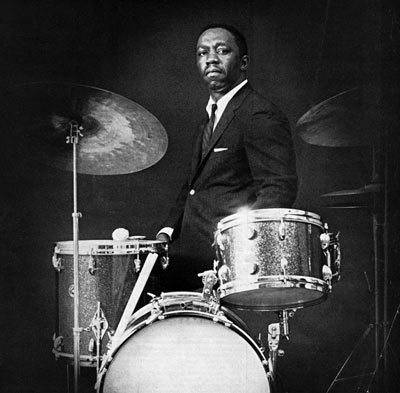
“I used to play every night. It didn't matter how much money I was making, I just had to play every night. When we'd get through playing at night, it was daybreak: 6:00. Then we'd play the breakfast show. After that we'd have a jam session which would go on until like 2:00 in the afternoon. So maybe by 3:00 I'd get to bed, and be back in the club again at 8:30. So I never stopped, really. I was playing all the time so I didn't have to worry about practicing.”
— Art Blakey, Modern Drummer, September, 1984
Interview by Chip Stern
— Art Blakey, Modern Drummer, September, 1984
Interview by Chip Stern
Monday, January 07, 2013
8th notes around the drums — one hand
Here's a conditioning page of 8ths notes played around the drums, with one hand. It's easy enough that most drummers should be able to learn it well enough to play the page straight down in fairly short order, and then begin working for speed.
Play each exercise four times, and go on to the next one with out stopping; it will take about three and a half minutes do play the whole page at 130 bpm. Do them with both the right and the left hand, of course.
As noted at the bottom of the page, you can also substitute a cymbal accent, with bass drum, on the first note of the exercise.
Get the pdf
A few practice alternatives after the break:
Play each exercise four times, and go on to the next one with out stopping; it will take about three and a half minutes do play the whole page at 130 bpm. Do them with both the right and the left hand, of course.
As noted at the bottom of the page, you can also substitute a cymbal accent, with bass drum, on the first note of the exercise.
Get the pdf
A few practice alternatives after the break:
Sunday, January 06, 2013
Googled: “Elvin Jones triplets”
What the heck, we haven't done a “round up” style post in awhile. Here's a quick survey of Internet lore, briefly reviewing some of the information returned when you google “Elvin Jones triplets”:
First, the unambiguous winner:
Four on the Floor — Elvin Jones Independence Exercises
Extremely valuable piece in which Jon McCaslin shares some insights into Elvin's approach, learned in a clinic from the master himself. Revealingly, the concepts are fairly simple, at least by current standards of drummeriness. I won't summarize it here— just go read it and live it for awhile.
Drum! Magazine —Inside the Drumming of Elvin Jones
Transcription of the drum performance on the Jones composition Three Card Molly, with a lead sheet for the tune. The tune is found on the recording Genesis— the author neglects to mention that in the piece. This is a good illustration of the gap between all of the things you can say and write about music, and the music itself: it's pretty vast. Even the author, a highly qualified musician and jazz educator who knew Elvin personally, doesn't offer a whole lot of fresh verbal information about Jones's thing. That's because there is no verbal explanation to be had; it all happens in the playing and listening. In fact, most of what you can write about any art is either 1) false, 2) true, but obvious, 3) technical. Literally-stated deep insights are extremely rare.
More after the break:
First, the unambiguous winner:
Four on the Floor — Elvin Jones Independence Exercises
Extremely valuable piece in which Jon McCaslin shares some insights into Elvin's approach, learned in a clinic from the master himself. Revealingly, the concepts are fairly simple, at least by current standards of drummeriness. I won't summarize it here— just go read it and live it for awhile.
Drum! Magazine —Inside the Drumming of Elvin Jones
Transcription of the drum performance on the Jones composition Three Card Molly, with a lead sheet for the tune. The tune is found on the recording Genesis— the author neglects to mention that in the piece. This is a good illustration of the gap between all of the things you can say and write about music, and the music itself: it's pretty vast. Even the author, a highly qualified musician and jazz educator who knew Elvin personally, doesn't offer a whole lot of fresh verbal information about Jones's thing. That's because there is no verbal explanation to be had; it all happens in the playing and listening. In fact, most of what you can write about any art is either 1) false, 2) true, but obvious, 3) technical. Literally-stated deep insights are extremely rare.
More after the break:
Friday, January 04, 2013
DBMITW: Tanzania and Kenya witchcraft & ritual music
These are from a Nonesuch compilation, Tanzania and Kenya Witchcraft & Ritual Music, that has made a big impression on me since the 90's. This first clip features a comical-sounding instrument, the “bungo” horn. To people from the European sphere of influence, for whom purity of tone is a big deal, it sounds like a joke. Your classical trumpet professor would hit the ceiling if you came into your lesson sounding like this:
But it triggers this thing of making the listener question for a moment— Is this music? Is he kidding? What's going on? — which is an important thing to me. It's also present, to varying degrees, in some free jazz, in Paul Motian's drumming, Ornette Coleman, Thelonious Monk, Miles Davis, Marc Ribot, Bill Frisell, and elsewhere.
More after the break:
But it triggers this thing of making the listener question for a moment— Is this music? Is he kidding? What's going on? — which is an important thing to me. It's also present, to varying degrees, in some free jazz, in Paul Motian's drumming, Ornette Coleman, Thelonious Monk, Miles Davis, Marc Ribot, Bill Frisell, and elsewhere.
More after the break:
Thursday, January 03, 2013
Transcription: Elvin Jones — Summertime
Let's start out the new year with a more substantial transcription than we've done in a while, in this case a very famous drum solo by Elvin Jones, on Summertime
from John Coltrane's My Favorite Things. This is one of those things that everybody transcribes at some point— you can check out Steve Korn's site for his transcription and analysis, and there are probably other examples on line.
The bass (and some piano) plays through the solo, and I've included its rhythm so you can see what Elvin is playing off of. The 7/8 bar on page one is a mistake— he drops half a beat on that break.
[2017 UPDATE: On proofing my transcription for the e-book release, I discovered that the mistake was, of course, mine— that particular break is just extremely oddly-phrased, and difficult to follow. The band is a little rough coming in off that break, so at least I'm not the only jerk in the world who had trouble with it.]
He does play more hihat than I include, but much of it is very soft and seems to be non-intentional. A few things look a little strange on paper— in those instances you can defer to the recording, and do your best to duplicate the sound of the passage.
Buy our e-book 5 Elvin Jones Transcriptions to get the complete transcription
Audio after the break:
The bass (and some piano) plays through the solo, and I've included its rhythm so you can see what Elvin is playing off of. The 7/8 bar on page one is a mistake— he drops half a beat on that break.
[2017 UPDATE: On proofing my transcription for the e-book release, I discovered that the mistake was, of course, mine— that particular break is just extremely oddly-phrased, and difficult to follow. The band is a little rough coming in off that break, so at least I'm not the only jerk in the world who had trouble with it.]
He does play more hihat than I include, but much of it is very soft and seems to be non-intentional. A few things look a little strange on paper— in those instances you can defer to the recording, and do your best to duplicate the sound of the passage.
Buy our e-book 5 Elvin Jones Transcriptions to get the complete transcription
Audio after the break:
Wednesday, January 02, 2013
Another best of 2012 list
Another Best of 2012 list for my CD Little Played Little Bird, this time on the Bird Is The Worm blog, written by eMusic contributor Dave Sumner. We're in the number 12 slot:
You can buy my infectious record through links in the sidebar, either as a CD, or digital download.
So, take obscure compositions from the songbook of a challenging artist and perform renditions… the math for that equation should result in something resembling a didactic lecture of music theory and not the refreshingly listenable Little Played Little Bird. Todd Bishop tackles the music of Ornette Coleman, and without watering down the source material, has created a recording that was both tuneful and a fun listen. It’s an impressive accomplishment, and a solid album when judged on its own merits. I find this album as infectious at the end of the year as I did when it originally came out.
You can buy my infectious record through links in the sidebar, either as a CD, or digital download.
Crossing accents
This very simple idea occurred to me while I was working on an Elvin Jones transcription today— either I had an insight into an underlying concept in his playing, or I was just daydreaming. What I've done here is to just accent every three beats during a repeated one-measure rhythmic idea in 4/4— in this case, good old pp. 10-11 in Syncopation:
Play these with an alternating sticking, in a bright 2/2. Also repeat just the first three measures of each line, noting that on most of the exercises the lead will switch hands each time through. Once you get familiar with the accent pattern, it shouldn't be too difficult to apply it on the fly to some other parts of Reed— the pages with quarter notes and triplets or 16ths would be logical places to start.
Get the pdf
Play these with an alternating sticking, in a bright 2/2. Also repeat just the first three measures of each line, noting that on most of the exercises the lead will switch hands each time through. Once you get familiar with the accent pattern, it shouldn't be too difficult to apply it on the fly to some other parts of Reed— the pages with quarter notes and triplets or 16ths would be logical places to start.
Get the pdf
Tuesday, January 01, 2013
Subscribe to:
Posts (Atom)