Sunday, February 02, 2014

Transcription: Tony Williams — Seven Steps to Heaven, head in

Man, I am getting tired of writing words. Let's get back to what you actually come here for: drum shit. In honor of the Superbowl— which they tell me is today— here is something that's bigger than any football game, ever: Tony Williams's playing on Seven Steps to Heaven, from Miles Davis's album Four & More. Like every other jazz musician in the world, I've listened to this about a thousand times before today, but have never transcribed it. Every part of this song deserves close study, but I'm not writing the whole thing out today, so maybe I'll try to do it in installments. Here's the first time through the head, then:


Tony is very much in “jazz percussion” mode here— playing very linearly, not-so-much layered in the traditional way. At the end of the first page begins the first iteration of a meter-within-meter thing that recurs throughout the piece. The tempo here is around 310, or half note = 155. Everything speeds up severely on this record, and as I recorded in my earlier piece on fast tempos on albums, the tune ends at 356/178. That's supposed to be a Very Bad Thing, which will almost always get you in trouble with anyone, but F&M is universally acknowledged as one of the greatest jazz albums ever (...ever... EVAR) so... draw your own conclusion. It would be nice if some technically-wrong things were just regarded as facts of that particular performance, and judged for their real musical effect, but it doesn't work that way with most players, and you will still get in trouble for rushing.

Get the pdf

Audio after the break:


Saturday, February 01, 2014

Books are here!

With alternate covers
Hey, the new books have arrived! Lulu.com cranks them out fast. If you haven't ordered your copy of the 2013 Book of the Blog yet, there's an added enticement to buy it now: Lulu is offering 14% off book orders through February 14th— just enter the code AMOR14 on check out. you like it because it's a couple of bucks off, I like it because it doesn't come out of my end. That's on top of the 15% discount I'm offering on the 2011 BOTB, if you've been thinking about picking that one up.

Tempoze

“Phaw, please, it's tempi, not temPOS.” 
In which the blogger once again addresses the voices in his head berating him for minor breaches of correctness in the application of musical terminology. 

You may have noticed that, writing on the blog, I just add an s when pluralizing certain musical terms, like tempo and ostinato— I say tempos and ostinatos. Speaking proper Italian, and using conservatory terminology, the correct plurals are of course tempi and ostinati. But I'm a drummer, and I'm writing this in America, and to people like me, that sounds a little snooty. Like, outside of the classical music world, we don't say flautist, or pianist with the emphasis on the first syllable, if we can help it. Throwing those into everyday musical conversation sounds a little affected, and puts others in the awkward position of having to decide whether to follow your lead in sounding kind of pompous. It's a little rude, even if correct. You can usually slide tempos in there without the same ripple of discomfort.

In using musical terms, we're not actually lapsing into Italian. The word tempo actually has become a slightly exotic English synonym for speed; and in English, when you want to make two or more of something, you slap an s on the end of it. Since at least the Battle of Hastings we've been freely slapping s-s on the end of foreign nouns and calling them English; it's only Americans' feelings of cultural inferiority that cause us to be defensive about that. It's the same thing that motivates us to miserably, cluelessly sit through operas presented in a foreign language, and read subtitles on films, while Europeans are happily listening to Don Giovanni translated into Flemish, The Godfather dubbed into French, and the quintessentially German Inspector Derrick dubbed into everything:


At one point in the history of music, the major practitioners all spoke Italian, and they weren't trying to be fancy about the words they chose for their terminology. They were using mostly straightforward, even terse, descriptive words in the native language of most of the expert musicians— or at least a language in which most of them would be fluent, the way computer people worldwide are with English today. Today, musicians come from everywhere, and few of us speak Italian, and to us those words sound a little mysterious and high-flown. But really, when you see a piu forte on the page— and you know you're in the serious repertoire when you see a piu; they don't put those in for just anybody— all it means is more loud. Fortississimo (indicated by an fff) basically means louderer. It's not a real Italian word. If we think for a moment about where the fff marking comes from, it may as well be LLL for loud loud loud. That's the kind of primitive-ass use of language we are actually dealing with, here.

And with the word drummer— which a lot of American youngsters struggle with when they are first getting serious, calling themselves “percussionists” instead— the European example again is instructive. Mainly: the sexy, dynamic-sounding French batteur is even more primitive than our word drummer— it means hitter. Not even a reference to an instrument— it could just as well describe someone working in a slaughterhouse. Talk about a step backwards in our self-conception as artists. 

Anyhow, when we say tempos, or ostinatos, or whatever, we're not speaking pidgin Italian, we're correctly using an adopted English word according to English rules. I'll admit that, being musical jargon, these words are in a little bit of a gray area— most non-musicians kind of know what tempo means, but they rarely have reason to pluralize it; and ostinato isn't used at all outside of music— so the normal rules that also make le week-end a correct French word, may have to be used with caution. You do want to be careful how many liberties you take with technically-correct terminology— you can easily sound like you don't know what you're talking about.

And for the record, I do insist on watching foreign films with subtitles, and put Todd Bishop: batteur on posters whenever I have the opportunity. And I never, ever, say timpanis. 

Tuesday, January 28, 2014

Art Blakey in a nutshell

Play it strong.
Hard at work with new record stuff and next-tour stuff this week, so we'll be on light posting for a moment. But here's a little something from the Art Blakey web site: a brief style analysis of Blakey's playing, written by Chip Stern, and originally published in Modern Drummer in 1984 along with Stern's Blakey interview.

Sunday, January 26, 2014

Groove o' the day: Elvin Jones Latin

We want to get a sense of the texture of this groove, and just writing out one time through of it would be misleading, so here's the whole intro from I Wish You Love, from Grant Green's Street of Dreams album, on Blue Note. Elvin Jones is the drummer.


There was an Afro-Cuban style somewhere in this groove's ancestry, but now it's just Elvin Jones Latin Jazz. He puts a little bit of a swing feel on it, and plays it very loose— not all of the notes written as unisons land exactly together. Listen, and try to cop the feel. Elvin tends to lean on the &s a little bit, or a lot, throughout his playing. Here he plays the bass drum strongly and the floor tom lightly.


Audio after the break: 

Friday, January 24, 2014

2013 Book of the Blog now available!

Now I remember why it takes me so long to do these things; it's a lot of work, even when 98% of the content is already written. But! The 2013 Book of the Blog is finished, and now available for purchase.

It's 122 pages long, and includes all of last year's downloads, including a very robust set of Pages o' Coordination, in 3/4, 6/8, 5/4, and more; transcriptions of Elvin Jones, Tony Williams, Frankie Dunlop, Philly Joe Jones, Al Jackson, and others; and just a ton of other good stuff dealing with odd meters, polyrhythms, metric modulation, jazz, funk, Afro-Cuban, and Brazilian drumming. It's a prodigious volume of stuff that should keep you (and your students) busy for a long time.

Now, it's true, you could just download them and print them yourself, but where's the fun in that? It will probably cost more than the book in just printer ink, and you won't have this sweet-looking book on your stand. Plus, purchasing the book supports the blog, and helps us continue doing what we do. Be a participant— get your copy today.

By the way, the original, 2011 BOTB is now discounted 15%— get it along with the new book, and save on shipping.

Oh, I don't know...

Probable dialogue: “Come on, swing,
you mother— SWIIIIIING! YEAH! YEAAAH!”
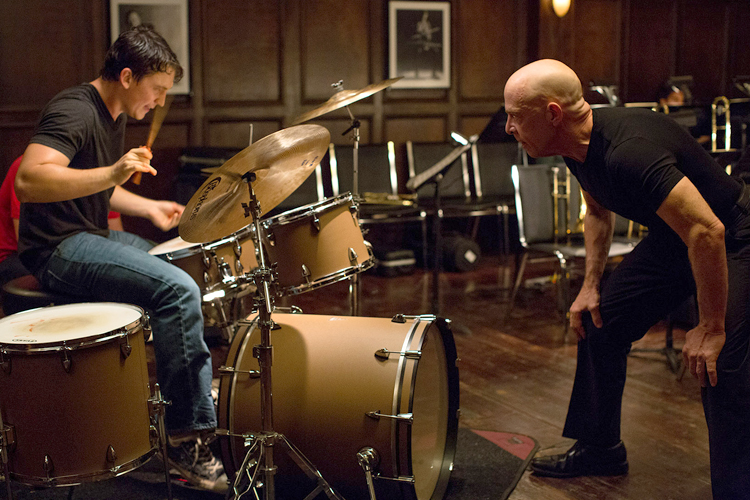
So, I hear the big hit at this year's Sundance Film Festival was Whiplash, a movie about the tumultuous relationship of an abusive, hard-driving jazz drum teacher and his student, and the shatteringly emotional, high-stakes world of jazz education... 

Now, I've been... ahm... I... gaha... yeah. Let's everybody settle down... try to keep it together. 

I guess any mainstream acknowledgement of the existence of jazz, and that playing music is a thing people do, is a good thing, but I have to say, I am cringing from the get-go here. I look at the still, and all I see is a very sympathetic drum teacher understandably screaming at his student for not knowing how to set up his drums, and for having just rotten-looking technique. (Alternate probable dialogue: “You play like an actor who picked up the drums four months ago for a role in some crummy made-for-cable-melodrama!!!”) 


This is a muscular and accomplished work of kinetic cinema built around two tremendous acting performances, and it’s really about teaching and obsession and the complicated question of how to nurture excellence and where the nebulous boundary lies between mentorship and abuse. 
Chazelle [the director] clearly understands the intensely competitive world of music schools in general and jazz education in particular,

Italics mine. College was intensely something, but I don't know if competitive is the first adjective that springs to mind. There was a little bit of that, and there was always some judging of abilities going on among the students, but mostly everybody was just really into music. Maybe I went to the wrong schools.   

but “Whiplash” is about jazz in almost exactly the same way that “Black Swan” is about ballet. Miles Teller (of “21 & Over” and “The Spectacular Now”) really does play the drums, and that’s where his character, a socially awkward 19-year-old conservatory student named Andrew, is most at home. (I’m pretty sure a professional drummer is used for the most difficult passages, but Teller’s pretty good.)

No, he's not. I saw the photo.

The musical performances in the film are intensely compelling, and drive the drama forward to a large extent, just as the big game drives a football movie or opening night drives a backstage musical. Chazelle also captures the fact that music is always a physical endeavor, a fact exaggerated by the demands of the drum kit; Andrew literally sheds blood, sweat and tears in his pursuit of greatness.

Well, Andrew is an asshole. If he's in this for “greatness.” Maybe I could stand to watch a real musician beat some decent artistic and human values into this kid for 90 minutes, after all...

More after the break:

Tuesday, January 21, 2014

Lighting round: four new books

New to me, anyway— I think these have all been around awhile. I thought I'd give my rapid-fire opinion on some things I just got in the mail:

Daily Drumset Workout by Claus Hessler
We'll see about this one. It came highly recommended by a good professional drummer friend, so I'm going to give it ample opportunity to prove itself, despite my feeling a little mixed about it on first glance. It nominally consists of about 100 two-page workouts (one page exercises, one page notes); I see that many small differences which could be explained verbally are given their own fully-written-out workout, so I call it quite a bit fewer than that, actually. Many of the entries appear to consist of written-out versions of things normally done with Syncopation, which may be good for some students, but which I ultimately do not dig. But the book is broken down into manageable portions, and appears to stay oriented in musical reality. Initial verdict: You could probably do worse than to let this command 20 minutes of your practice routine every day.


Odd Time Stickings by Gary Chaffee
An extension of Vol. 2 of Chaffee's Patterns series of books, and I daresay more useful. Gives practice phrases for his seven usual sticking patterns, in 3/4, 5/8, 5/4, 7/8, 11/8, 13/16, and 15/8. Even if you don't anticipate playing in many of those meters any time soon, with a little creativity, you can adapt the exercises to whatever meter and subdivision you choose by making the exercise part of a measure. For example, you can play an exercise in 3/4 as the least three beats of a measure of 4/4, and so on. Chaffee's stickings are few, and easy to play fast, making this an ideal book for getting your “Gospel chops”-type blazing fills together.


Understanding Clave and Clave Changes by Kevin Moore
Part of the Beyond Salsa series of books, which I was not familiar with before stumbling across it on Amazon— it looks like a pretty heavy series, and I'll be checking it out further. This book is a supplement aimed at musicians and non-musicians, explaining absolute beginning to advanced clave concepts, using conventional rhythmic notation, and a couple of varieties of “tabs”, and many recorded examples— both its own accompanying tracks and references to commercial recordings. I haven't had much of a chance to sit down with it yet. Looks good for fleshing out ideas that typically get covered in a page or two of other books, for learning the correct terminology, and, especially important to me, for learning what will get you into trouble with actual Salsa cats.


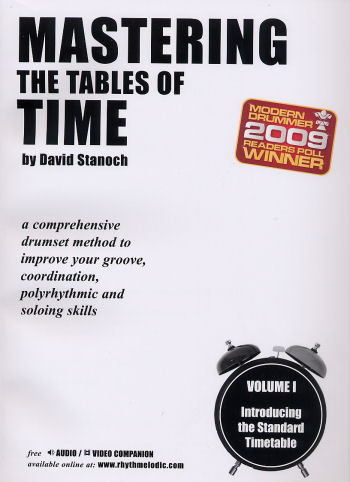
Mastering the Tables of Time by David Stanoch
Stanoch is a former student of Eliot Fine, who wrote the introduction here, and at once, this does look like an extension of Dahlgren and Fine's books— the format and ideas are very similar to things found in Four Way Coordination, Accent on Accents, and Dahlgren's Drum Set Control. Though I'm using their books on a daily basis these days, I do have reservations about using their stuff as the foundation of your playing— their logic is a little alien to a player's mental processes. MTTOT is maybe a little better than their books in that regard, and is especially good for helping students get the most out of an idea— it will help many to just recognize the idea in the licks they play in the first place. It's certainly more approachable than the other books I mentioned, and I do like that it takes some creativity to figure out what's hip about it.

Saturday, January 18, 2014

Too triplety

1-&-A-2-&-A-3-&-A
Just a some thoughts on a few lines from the introduction to Ari Hoenig's book Systems: 

“In jazz or other triplet-based music, melodies which are written as eighth notes are often swung (played with triplet subdivisions). In this interpretation, the melody can fall only on the first or third triplet, but never on the second. After a while, this approach can create a limitation in your idea of swing. There was a time when the second note of the triplet was rarely played in jazz. Recently, however, it has become a more common part of the language and can be effectively used to build tension in the music. A large part of this book concentrates on hearing the second note of the triplet and understanding its correct placement.”

I would dispute the idea that jazz is triplet-based music, and that swing interpretation = playing a triplet subdivision. I would say it's triplet-compatible in a certain range of tempos, and interpretations, but that the triplets are incidental to the swing 8th notes. You can read more on that here.

As a practical matter, tempos are often too fast to be thinking about the whole triplet, and conceiving swing that way tends to bog down the time. Oh, hell, Bob Moses can say it better than I can— from his book Drum Wisdom:

“Perhaps some people have heard that jazz is based on triple meter or triplets, while rock and Latin music are based on duple meter or 8th notes. I think this distinction is a mistake and actually misleads people. The music I call “American groove music” is, for the most part, based on [8th notes]. There is a place for triplets, but [...]they're generally used on slower tempos.  
[...] Thinking of it as triplets clutters the bar; the more subdivide the beat, the more tendency there is to make the music slower.  
 [...] The tempo tends to come down a little when people play a lot of triplets, and the same thing can happen if you try to keep triplets going in your mind. [...] Even if you are not playing triplets, if you are thinking triplets, you are filling each beat with too many notes. By thinking 8th notes, be they [swing] or straight, you are leaving the music more open. You can still play some triplets if you want to; however, I advise you not to think triplets.”  

The large part of what I've been about with triplets is to be able to play them without stating them, if you can dig that. If you look at the common Syncopation methods, the goal is not to make perfectly-articulated triplets, it is to fill out the texture while playing a swing melody line consisting of quarter notes, 8th notes, and dotted and tied notes.

The middle of the triplet, in jazz, is a filler note, or part of a quarter note triplet. It also has some special functions: at certain tempos you could base a modulation to a Mingus double-time waltz on it. Or it can also act like a deliberately late-sounding hard shot in the ribs— a pretty harsh tension-builder. I once played with a Dutch Dixieland saxophonist who used that one a lot, and it was an effective device, but you don't want to hear it all night. And it can be used to take the groove into an African-sounding direction— the middle of the triplet is more of a felt thing in that music. But in general it's subordinate to the 8th notes, and I would be wary about making it a permanent feature of your swing conception. To me that creates a very artificial swing feel.

And finally, for all the time we spend working on triplets— and I do work on them a lot— I can't help but notice how much of what I (and the players around me) play is not triplets, and does not sit on a triplet grid. Listen for it.

[h/t to AA for inspiring the conversation, and post title.]