Sunday, January 30, 2022

Todd's five-note pattern

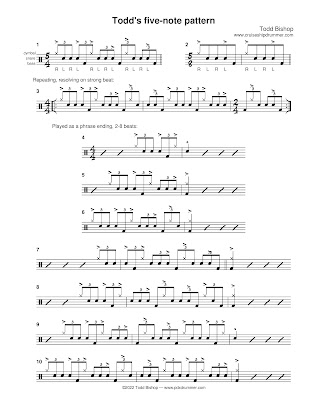
Here's a five note pattern that I play all the time, without ever knowing what I'm doing with it. I've written about a couple of these accidental items before— an 11 note pattern and my grocery store hemiola  thing.

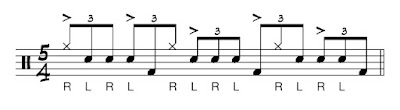
When other people play this— a very common modern thing: 


...I do the following thing. Sort of a Tony-like lick. It's actually a Gary Chaffee pattern exactly, but I re-made it up in this voicing specifically. It's always a little bit sketchy, because not everyone is comfortable hearing that, and I don't know how to get out of it— I have to wing it, with varying degrees of grace and success. So here it is written out in a couple of repeating forms, and as a two-to-eight beat long fill, ending on 1: 


Practice the repeating forms, then practice the fills as part of a longer phrase in a modern jazz feel. 

I recommend practicing it this way, too, accenting on the beat every beat: 


All of the fill examples end on 1; I'll also be figuring out how to end those with an accent on the last note of beat 4. 

Get the pdf

Saturday, January 29, 2022

Linear Reed tweak

This is a sticking system for a Reed linear solo/fill method, which I improvised while practicing. In the past, I mostly improvised the stickings, which is not a bad way to practice, but it's limiting, and not great for developing this as a real solid, reliable area of vocabulary. This resolves that. 

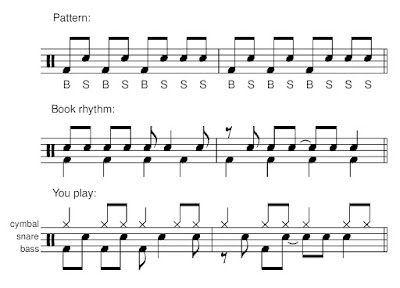
Use pp. 34-45 from Syncopation. The book rhythm is played with the hands, with the bass drum filling in the gaps— usually, to make a full measure of 8th notes. I'll use the next-to-last line of the well known p. 38 (famously p. 37 in old editions) for the examples: 


Basic linear interpretation, with the bass drum filling in: 


I like to simplify the bass drum part, by only playing the first note after a hand note— so we're only playing single notes on the bass drum: 


Start all runs of two or more 8th-note-spaced notes in the book rhythm with the right hand, and alternate: 


Play any isolated single notes in the book rhythm as a left handed flam. I've talked before about why left handed flams are good to work into your drum set practice. 


Start with the one-line patterns on pp. 34-37, then try the full page exercises. Improvise varying the accents, and moving your hands around the drums. I rarely play anything like this with a flat, undynamic practice-room interpretation. I play them like I'm playing. You can do this in a fast 4/4, or in 2/2, in a funk, Latin, or swing feel. Add left foot on beats 2/4, or on all four beats. 

Wednesday, January 26, 2022

Very occasional quote of the day: a thousand answers

“Teaching requires just as much time and effort as playing. There are a thousand ways to ask one question and a thousand ways to answer it. You've got to have the time to understand your students problems and convey your ideas to really offer something.” 

- Steve Gadd, Modern Drummer interview with Aran Wald

Monday, January 24, 2022

Freehand sketching

A couple of interesting art books available “free” on Scribd, for anyone interested in art, or in getting into art, and trying some non-music related creativity.

... which I highly recommend. I gave myself permission to start painting from a drummer friend when I was at USC. He had a pretty cushy set up, studying with Erskine, and Freddy Gruber, and also had some kind of therapist who encouraged him to do something creative in an area he didn't know anything about, so he could turn off the constant critical judgment that he felt was messing with his creativity in music. 

So I got some paint and did it, except I quickly started being serious about it— in a rock & roll kind of way. I decided to paint a lot and study a lot, and do the best pictures I could, without getting into developing a lot of technique. I've done pretty well with it, for a few years in the 90s I was making more money as an artist than I was making as a musician.    

So, the books: Freehand Drawing and Sketching by Karl Christian Heuser, and the Paul Klee notebooks, of which there are several.

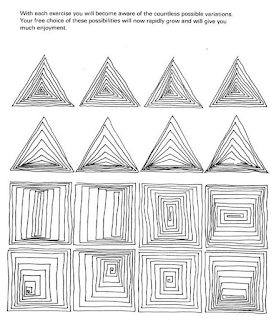
In Heuser's book, the thing most interesting thing to me related to drumming, are the exercises aimed at developing control of the hand and pencil, and hand/eye coordination. Doing exercises like the ones you see above, I found was very similar to working with touch and timing on the drums. You become very  aware in of the movement and mechanics of your arm, shoulder, and hand. The exercises themselves also have a logic analogous to things we do in drumming— working with simple forms and their logical permutations.  

The book is also very good for getting people into the idea of drawing, who may be hesitant to do it. The level of information quickly becomes overwhelming, but it's always stimulating, if you keep the focus on playing around, rather than mastery. It doesn't require any kind of artistic  ideas, or “vision”, or wanting anything other than to do it; the practice forms are enough. They're nice to look at, they become art. 

In music, getting playing ideas from exercises and patterns is not very musically pure, but it happens on some level. Maybe the drawing will help us appreciate the music in these mechanical form— pure music people, like me.  

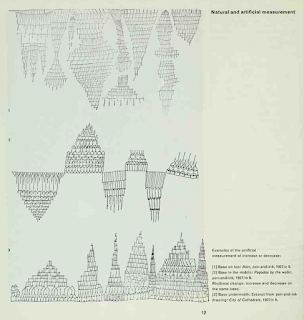
The Paul Klee notebooks are similar, but vastly more inspirational— the written content is intellectually way above my head. He explores basically everything in the world about the logic, function, and use of lines on paper. The illustrations are mostly simple, many look rather childish— which gives you an easy opening to trying it yourself. Getting into art, you have to be into art that looks like you could do it. 

Saturday, January 22, 2022

Subtractive patterns for feathering the bass drum

A collection of subtractive patterns for developing feathering the bass drum in jazz— for sketching it in, and making punctuations, anyway, since this will mostly not have you playing running quarter notes. Learning to support the time with the bass drum in a more free, nuanced, modern way. So we can still play all our other super important stuff.  

In practicing this, feather any bass drum notes falling on the beat, and accent any bass notes falling on the &s. Play a jazz rhythm on the cymbal, hihat on beats 2/4 with your foot. 

The patterns below represent a full measure of 8th notes, played on the (B)ass drum and (S)nare drum. Use them with Syncopation pp. 10-11, 30-32, 34-45, playing the top line rhythm from the book on the drum indicated for the corresponding note in these patterns. See my previous posts for a fuller explanation. 


Try these warm ups, with the bass drum on all the downbeats in the book rhythm, snare drum on any &s— leaving out any pattern notes not sounding in the book rhythm: 

BSBS BSBS


And with the bass drum on all 1s/3s, and 2s/4s:

BSSS BSSS
SSBS SSBS


That will show you the terrain, so you can approach these combinations with some idea of which you'll want to spend the most time with:  

BSBS BSSS - bass drum on 1-2-3
BSBS SSBS - bass drum on 1-2-4
BSSS BSBS - bass drum on 1-3-4
SSBS BSBS - bass drum on 2-3-4
BSBS BSSB
BSBS SBBS
BSSB BSBS
SBBS BSBS 


With that last set, play any BD doubles naturally. You don't have to play the & loud and the second note soft. 

Throughout all of this subtractive thing, it's not necessary to do everything exhaustively with all of the suggested pages. Since the book rhythms have a lot of gaps, a lot of what you play will be the same even using different patterns. Pages 30-32, 35, and 39— which have denser rhythms— will highlight the difference between patterns the best. Or look for one line exercises containing six or more notes per measure. Or you can just play everything, since you're supposed to be practicing this general thing a lot anyway. 

See also my page of practice rhythms for feathering the bass drum. Alan Dawson's long note/short note method, found in John Ramsay's book, is also good for this. Who knows, practicing those things you might find this subtractive business TOTALLY SUPERFLUOUS. 

Thursday, January 20, 2022

On Stanley Spector

In the spirit of that recent quasi-paranoid rant, here's something I wrote some years ago and never posted. Any time I think I'm getting too dogmatic in my writing, I look up the following personality.

I was re-reading an extended rant from the 80s by Stanley Spector, a drum teacher based in New York from the 50s through the 80s. All I know about him I got from his wordy advertisements and occasional letters to the editor in in Modern Drummer magazine. They had approximately the same tone and content as we see here:  

Would you imagine in your wildest hallucination that a jazz or rock drummer of yesterday or today could derive artistic stimulation and creative preparation through a method of drumming accepted in 1869 as a Manual of Instruction by the United States Army? When you sit down at the practice pad every day and go through the 26 rudiments of drumming to build up your "technique" so that you may better express your "ideas" what you are actually practicing is the Strube Drum and Fife Instructor approved by John A. Rawlings, Secretary of War, War Department, Washington, D.C. 111 years ago. That was years before the invention of the bass drum pedal, hi-hat cymbals, wire brushes, and the discovery of the rim shot. It was years before Louis Armstrong first picked up a trumpet and discovered that when he blew in one end that jazz music came out the other end. When I see that the Strube Drum and Fife Instructor came off the press at a printing shop located at 284 Asylum Street in Hartford, Connecticut, I get the feeling that somebody is trying to tell us something. 
Is it reasonable to suppose that in the present age of space travel, atomic energy, and television that what was good for a Board of Officers meeting at Fort Columbus, New York Harbor in 1869 is still relevant for the jazz or rock drummer? Are we to believe that Major General G. L. Hartsuff, Brigadier General H. D. Walden, and 1st Lieutenant E. O. Gibson, the officers of that board knew where it was at with drumming for all-time when they decided that the Strube Drum and Fife Instructor had to replace Upton's Tactics because the latter was "deficient in preliminary instruction" for training drummers and fifers of the United States Army in the Army Camp Duty of 111 years ago?

It goes on and on like that. He had a real thing about rudiments. But he never getting around to explaining his own concepts— a recurring theme, we'll see.

Spector died in 1999 [correction: 1987], but there is a site selling recordings of lessons with him, and the people running it have really amped up the mysterious/hard sell/paranoid angle:

WARNING. This was and still is considered the most controversial course in drum set study ever created. It's for the most discerning and ambitious drummers worldwide. When it was first introduced almost Fifty [sic] years ago it divided the drumming community. Either you tried it and believed in Stanley's method or you were a doubter who went with the conformist crowd, never to consider it. 

Then they make you pay way more than you should to find out what it is. 

Keep in mind, we're talking about teaching people how to play bebop. It's music for grownups, but we're not re-splitting the atom here. In the old days you would get yourself some Chapin, some Cusatis, maybe Wilcoxon, and go to town. It's hard but not that hard.

And valuable drumming information isn't that valuable. Personalized expert guidance on what you should be doing right now is valuable— that's what private lessons are about— but a book of information and exercises is not valuable. The best things the best players and teachers in the world could think to write down sells for about $8-30 for permanent, total access— 40-100 pages of written materials. 

You have to give it up: put out a book, charge $0-30 for it, and let people see it and use it... or not use it, if it proves to be not good enough.

If you like being frustrated, listen to the free introductory lesson from Spector's site— it's a cassette recording of a lesson given in the 70s. 

The main point of that lesson is to figure out what the lesson is. Spector gives incomplete information, then spends a long time critiquing the student's thought process when he isn't able to figure it out. It's very strange. He's trying to have a student play a three beat pattern while counting in 4, a simple polymetric thing we do every day, which is normally learned by doing the thing, not by having to figure out what the thing is in the first place. Even if I wanted a student to do that, there's an effective way to communicate it— you stay focused on the problem, you don't wander off into meta-issues about how the student is thinking wrong. Who knows if it's a fair representation of his teaching. 


I imagine there was more to the guy than is apparent today. People who were in New York in the 60s-80s probably could tell us. Otherwise we don't know, because he didn't publish anything. He decided secrecy was his ticket to business success, and then died, and now we have nothing to gain from his career, except for some written rants, and some taped lessons locked away behind a paywall.

You have to write, you have to publish. 

Tuesday, January 18, 2022

Groove o' the day: Jack Dejohnette - Soft Blue

Another item from Jack Dejohnette, playing on Jackie McLean's album Jackknife— Dejohnette's first major recording, made when he was 24 years old. We've seen a couple of other things from this album, a groove o' the day and a longer transcription. His playing on it is very interesting— like the previous GOTD, he's playing an Elvin-like groove, very repetitively. At this point when everyone is letting it all hang out, he virtually never deviates from the exact pattern below. A curious decision on a jazz record— I guess they wanted to make an instrumental single out of it, a la Lee Morgan:


He does add another tom hit on the & of 3 of the first measure, occasionally. And there are some very small variations in the cymbal occasionally. He plays the little ensemble figure on the head exactly, on the snare and cymbal, with no embellishment. If there are any fills at all I missed them. He handles dynamics very sensitively. 

Monday, January 17, 2022

EZ solo method: six stroke rolls with brushes

I was doing this easy Reed method with a student— it's a rare one for using the triplets-and-8th-notes pages of Progressive Steps to Syncopation,  pp. 16-17. This is good for brushes, OK for soloing with sticks. Let's bang it out: 

On measures with one beat of triplets play RRL and RLL stickings on the triplet, alternate the rest:


Swing the 8th notes, try some different accent possibilities: 


On measures with two beats of triplets, play a six stroke roll sticking: 


Or a reversed* six stroke roll sticking:


* - We need a name for this rudiment. Inverted SSR, Half Reversed SSR, something... 


Typically we'll accent the single strokes in those patterns: RLLRRL or RRLRLL.

On measures with three beats of triplets, extend either sticking by adding a RRL at the end:


Note that the result of that is a six stroke roll with an added RRL at the beginning or end. 

On the full measure of triplets, do either sticking, RLLRRL or RRLRLL

Play exercises 1-15 and the 16-bar exercise as written, then practice one measure of time, one measure of solo pattern: 


On exercises where the triplets run across the barline, you could play them as written— line 4, for example:


Or start the solo part where the across the barline triplets start: 


Note that the sticking is different depending on how you do that. It's up to you how you handle any remaining 8th notes in the measure— they're really not the critical part of this exercise. 

Add hihat on beats 2 and 4, add quarter notes on the bass drum if you choose. As with all jazz solo materials, it's important to finesse the dynamics so you don't play it too ricky-ticky. I retain much of my normal timekeeping motion with this type of thing, so this integrates smoothly with the ongoing texture, I'm not stopping my motion to execute some triplets. Since I play matched grip, it's easier for my left hand to do a lateral motion than a circular motion, and that naturally has an alternating 8th note motion to it. Much of brush playing is just doing it, so your personal natural motion emerges. 

Sunday, January 16, 2022

Most recorded jazz drummers

A list of the 134 most-recorded jazz drummers and percussionists, created by Mark Stryker, a Detroit jazz writer, which I'm pilfering directly, because it's not currently live anywhere. I had to look at it through Google Cache. This internet thingy is cool, but people need to take care that their stuff actually stays up. Save your work, people. 

It's a useful and impressive piece of research. I reached out for permission on a couple of different platforms— he's on Facebook, and Twitter— but, like me, he apparently never reads his messages. If anybody knows him, tell him I'm stealing his stuff. 

The list: These are the guys— the true elites of our trade. What they do and don't do is what a good drummer is. About forty of them I've listened to a lot. About twenty I never listened to at all. The rest of them, I can point to at least one record or thing about them that is/was significant to me. And I'm kind of narrow in my listening— I've mostly focused on a few people, and relatively few records.   

Here's Mark's original post:

A conversation with Ethan Iverson about Billy Hart led me to spend WAY too much time compiling statistics from The Jazz Discography by Tom Lord to see who are the most-recorded drummers in jazz. What follows is list of the top 136. The numbers represent total number of sessions, not individual records. They also include only jazz sessions as defined by Lord's inclusion — no pop, R&B, film, TV, jingles, etc. They do include broadcasts and bootlegs that have been released.

The results are interesting. The biggest numbers belong to top-call studio cats – Shelly Manne, Grady Tate, Osie Johnson, Mel Lewis. But there are surprises: Billy Hart is 5th(!) on the list, particularly impressive because his appearances are mostly single-session, modern jazz records dating back to 1961. Of course, he's still going strong at age 80. I went deep in my memory banks thinking of drummers whose numbers I should look up. I also looked at some online lists of jazz drummers and percussionists to jog my memory. Finally, after I posted earlier versions on Twitter, folks there pointed out a gaggle of omissions. I'm sure I've still left out some players, but this is fairly comprehensive.

1. Shelly Manne - 902
2. Grady Tate - 698
3. Osie Johnson - 692 (among the most impressive because his recording window was an insanely short 17 years, 1949-1966). 
4. Mel Lewis - 690
5. Billy Hart - 646
6 Gene Krupa - 620
7. Buddy Rich - 606
8. Sonny Greer - 589 (Ellington made a LOT of records – all but about 25 of these are with Duke)
9. Don Lamond - 569
10. Steve Gadd - 554 (and God knows how many pop records, TV/Film dates, and commercials)
11. Papa Jo Jones - 539
12. Peter Erskine - 536
13. Kenny Clarke - 535 (woulda been higher had he not moved to Europe in the late ‘50s)
14. Jack DeJohnette - 502
15. Larry Bunker - 500
16. Billy Higgins - 498
17. Alvin Stoller - 497 (if you didn’t call Manne on the West Coast, you called Stoller).
18. Harvey Mason - 479
19. Louie Bellson, 472
20. Alex Acuna - 469 (percussionist)
21. Victor Lewis - 442
22. Lewis Nash - 421 (at 62, he’s obviously going to keep moving up the ladder.)
23. Elvin Jones - 417
24 (tie). Roy Haynes - 410
     Ray McKinley - 410

Continued....