Showing posts with label Reed tweaks. Show all posts

Thursday, November 21, 2024

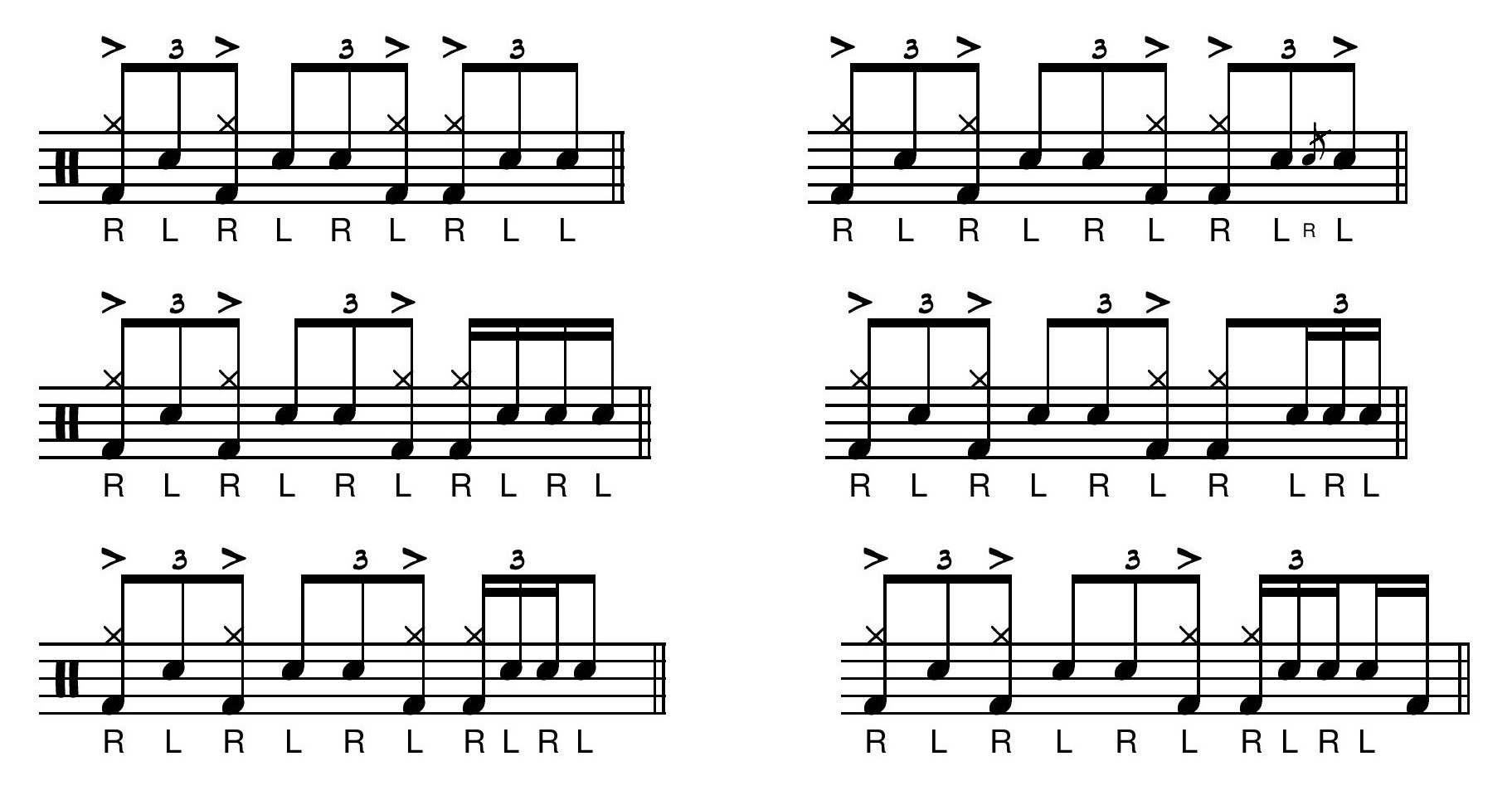
Reed tweak: RH lead triplets - fast within slow

This has been an item of interest for a long time— playing fast in a slow tempo. In a master class Peter Erskine mentioned that Jack Dejohnette was the only drummer he knew who could play fast on a slow tempo. He was referring to Jack's playing on John Scofield's Time On My Hands, which Erskine had produced the year before. I've mentioned it a bunch of times here.   

Here are a couple of ways of doing this as a Reed system, reading out of Syncopation, with both 16th notes and 16th triplets, within 8th note triplets. 


I've chosen to lead the filler with the left hand, favoring an inverted diddle sticking, with the diddle up front, beginning with a LRR where possible. See this page from last year for some other options. Obviously there are a lot of possibilities for stickings, and linear patterns. And it's real similar to some things on the recent 3/8 and 4/8 fills pages. And see this page as well. 

Where there are two cymbal hits in a row, you can also play them with the R then L hand. 

Get the pdf

Sunday, September 15, 2024

Double time Reed tweak: one step beyond

Launching to the outer limits of what you can reasonably do with Syncopation, verging on losing the melody rhythm as a point of reference. Or not, see what you make of it. 

Using one of the more useful double timing things (the second item on this page of warmups), and changing what we do with bass drum. Reading from pp. 34-45 in Syncopation.

After playing the plain right hand lead version of the book rhythm with hands only, the steps are: 
  • Do the added 16ths— single Ls = two 16ths / LR, two Ls = LRRL, three Ls = LRRLRL. 
  • Add bass drum on beat 1. 
  • Add bass drum to the added RH 16th notes— immediately after the snare drum. 
  • Add bass drum on any remaining isolated notes of the melody rhythm. 
Here, figure it out: 


This actually creates a kind of a double time rubadub. The bass drum added on beat 1 is a little random— don't do it if it creates any kind of problem. Like if there's not a cymbal note on 1. 

On the second page of the pdf I wrote out how lines 2-3 of the p. 38 exercise will go, with each step. 


Doing all this systematically while reading full page exercises in Reed is rather difficult— we can give ourselves a pretty wide latitude for errors/inconsistency with that— if you can read p. 38 at a bright tempo with the bass drum part landing somewhere between items 4 and 5, you'll be doing pretty well.   

Tuesday, August 20, 2024

More on that double timing tweak...

Clarifying the method behind that Reed tweak from last week, double timing the very familiar, friendly, happy, easy RH lead Reed system— RH plays book rhythm on a cymbal + bass drum in unison, LH fills in the gaps in the book rhythm on the snare drum. Hopefully you know it well by now. 

The concept is very simple: 
  • Play some 8ths as a 16th note double— single 8ths, last 8th in a run with same hand. 
  • Play some 8ths as alternating 16ths— single R becomes RL, single L becomes LR. Last 8th, first 8th, or all 8ths. 

We'll use this pattern for the examples: 


Playing single 8ths, or the last in a run of 8ths as a double— LH, RH, both hands: 


You'll never do that before another note on the same hand, so you have to do three in a row. Unless you want to. No reason not to do that too, it's just not what I'm outlining here. 
|
Playing a single 8th note L as two alternating 16ths, LR— last 8th, first 8th, or all 8ths.

Or playing a single 8th note R as two alternating 16ths, RL— last 8th, first 8th, or all 8ths: 


And of course you can do whatever of combinations of those things you want, that you can execute while reading from Syncopation:


There are a couple of different ones on that last page. Obviously, the reading part can get rather complicated, so people will want to build it up one step at a time. The thing itself it easy to play, and play fast. That's the whole point. 

It's a lot of stuff, but it shouldn't require a ridiculous amount of time getting through it. It goes fast, and is easy once you have the reading together. And it's not necessarily even about working it out completely, it's about adding some moves when you're improvising. Playing some fast stuff while thinking that simple underlying system. 

Friday, August 16, 2024

Reed tweaks: double timing RH lead

A collection of warmups for adding 16th notes to our good friend the right hand lead Reed system. You can work them up to practice them while reading from Syncopation, or these could be your whole drill. Whatever. 

These are just some things I'm doing, it's not a fully worked out system, not all of these will agree with each other. Some of them are single embellishments, some of them are combinations. You can probably devise some more combinations.


It gets a little complicated practicing out of Reed this way— the underlying melody rhythm can get a little obscured. Build up to the more complex ones by running each individual thing with all of p. 38. If the reading isn't happening, start with pp. 10-11, 30-32, and 34-37. Keep the original plain RH lead system as your point of reference, figure out how each thing is just an embellishment of that. 


UPDATE:
I should have put this on there as well— you'll have to pencil it in on the top two lines. Play each note with the marking as two 16ths. That'll be any snare drum note right before a cymbal note: 


Thursday, July 18, 2024

Reed tweak: RH lead with single cym / flam

Yet another right hand lead Reed tweak— YART, or YARHLRT, for short. It's a little convoluted, but works out a slightly different thing from the other systems/tweaks we've done, and I think it's worthwhile. 

The plain straight 8th right hand lead system involves playing the melody rhythm from Syncopation on a cymbal* with the right hand, with the bass drum in unison, while filling in the spaces with the left hand on the snare drum, to make a full measure of 8th notes. 
* - You can also play the right hand on the toms, with no bass drum— most of my systems are written for the cym/BD way. 
Here, where there are two or more melody notes in a row, we'll hit the cymbal on the first note only, with the bass drum playing the full melody rhythm. We'll also add some flams. Play these warmups to get a feel for the kind of movement that creates:


Taking it in steps, here is how the first three lines of p. 38 in Syncopation would be played, with cymbal on the first note of any run of bass drum notes: 


Then add a flam right after each last unaccompanied bass drum note: 


Before, we added a flam at the end of the runs of multiple lefts, and there are several spots where we can do that in this system: 


Sight reading that gets a little silly, so you might just want to work out some one line exercises, and the p. 38 exercise. [UPDATE: Having played it a little more, it's not that bad, just do it.] 

Wednesday, May 08, 2024

Reed tweak: linear fill in another setting

A similar item to another recent thing, with a Reed system I use pretty often, but don't talk about much— with the hands plaing the book rhythm, and the bass drum filling in the spaces. Hands lead / bass drum fills. I play this system with a (mostly) alternating sticking, you can also play the melody part with both hands in unison, or as flams, if both are on the same drum.   

The tweak is to do a linear 16th note fill on the longer spaces in the melody rhythm— on the runs of two or more 8ths on the bass drum. Where there would normally be two 8ths on the bass drum, play BRLB (B = bass drum); where there would be three 8ths on the bass, play BRLRLB. 

For each lettered example below, I give the basic way of playing it in this system, and how to play it with the linear fill: 


Move your hands around the drums, of course. I never worked out a perfectly satisfactory sticking system for this method. I do it mostly alternating, with a bias for leading the multiples with the right hand. Always stick the 16th note fill the same way. 

Work it up with the one line exercises in Syncopation pp. 30-31 and 34-37, then try the full page exercises starting on p. 38. Go for speed with this, you can do it fast. 

Sunday, April 28, 2024

Reed tweak: filling in 16ths - 02

Boy, if you're not doing all my Reed stuff, you're really missing out. These things square away a ton of stuff that people generally have to put together piecemeal— I had to do that. Figure it out, contact me for a lesson if you need to. 

This is a preliminary item to part 1, but I didn't feel like posting this first. A very simple tweak to the basic RH lead system, filling in the bass drum after each snare drum note. Basically every snare drum note becomes two 16ths, split between the snare and bass. There's an option of filling in a 16th before each snare note as well. 


Take it as a bass drum endurance drill. It should be easy to get it up to a pretty bright tempo— with both systems the bass drum should just flutter. If you're leaning into it with a funk kind of touch, you're dead. 

You can take this a step further and play the snare drum notes with an alternating sticking— each group of two or more snare hits after a cymbal hit— starting with the left hand (or two lefts, if doing the optional filler in patterns 6/9. There's room to develop that more if the reading materials have more space in them— like in Chuck Kerrigan's excellent Syncopated Rhythms book

Saturday, April 20, 2024

Reed tweak: filling in 16ths

Another in this endless series of tweaks to a basic RH lead system, commonly associated with the book Progressive Steps to Syncopation, by Ted Reed. Perhaps you've heard of it. 

Let's be clear, I am not screwing around daydreaming about new drum patterns here— this is about taking things we've worked out as isolated licks or patterns, and getting them into our playing by working them into an ongoing texture... which is provided by the Reed system. Learning any pattern or lick in isolation, the hard part is always how do I get this into my playing naturally. This is it, baby.  

Or it's one of the its. Today's thing extends and connects with a paradiddle inversion tweak we did a couple of years ago. And it's slightly different— here we're busying up the cymbal rhythm— or the bass drum rhythm— by filling in some more 16ths.


In playing the normal RH lead system reading from Syncopation, generally there will be one, two or three notes of left hand filler. Parts A, B, and C above show possible ways of handling them. At the bottom of the page there is a three bar excerpt from Syncopation Exercise 1 on p. 38, written out the way it would be played with the first cymbal option. 

The one thing this page doesn't address is when there are two or more BD/cym notes in a row— in the example you just play them as 8th notes, but you could fill in between them with the left hand to make them 16th notes. That would give you an unbroken 16th note texture. 

I associate all of this type of stuff with Jack Dejohnette, Jon Christiansen, Bob Moses, but it's all over current drumming. 

Get the pdf

Friday, April 12, 2024

Reed tweak: BRL linear fill

Fun little item here, modifying the straight 8th right hand lead system commonly applied to the book Syncopation.

Where there are two or more 8ths of left hand filler, we'll play 16ths, starting with a BRL pattern (B = bass drum). On two 8ths of filler, play BRLB; on three 8ths of filler play BRLBRL. 


I've put all the fills on floor tom and snare drum to help make the sticking clear, but use any drums you want of course. Practice the warm ups, then do it within the right hand lead system while reading from Syncopation pp. 30-32 and 34-45.

Friday, November 17, 2023

Reed tweak: RH lead with LH drags

Reedtweakapalooza continues! I really need to round these up in a book. 

This is yet another thing to do with the straight 8th right hand lead Reed system. Refreshing your memory on that: reading from Syncopation by Ted Reed, pp. 30-45, RH plays the rhythm in the book, LH fills in the spaces in the rhythm to make a full measure of 8th notes. Hit the link above to see an example of that. 

Here we'll play all the single LH notes as doubles, in a 16th note rhythm. Where there are two or more LH notes, play alternating 16ths, starting with two Ls: LLRL, LLRLRL, etc. You could use our other favored sticking, LRRL, LRRLRL, but this way is more consistent with what we're doing with the single notes: all the filler starts with LL. 

Here's how you would play the third line of Exercise One on p. 38 of Syncopation: 


For visual clarity I've omitted the sticking on the repeated RH cymbal hits, and on the repeated LLRs in the last two measures. 

This is really developing into a kind of Grand Exercise, to borrow a term from piano literature. Run one of my sampled loops, and blow through the full list of stuff with the p. 38 (37 in the old edition) exercise. Have fun with it. 

Wednesday, November 08, 2023

Reed tweak: RH lead triplets - five stroke rolls

This is where my thinking is going lately, towards breaking up some Reed practice systems so they're not pure formula. Which I have always done anyway, just not very systematically. We want to make our practice systems non-systematic systematically... skip it.   

This tweak is pretty specific, for the extremely useful right hand lead triplet system, played at medium tempos, putting a five-stroke roll at the end of the longer runs of filler. If you review the basics of that method, the right hand plays the rhythm in the book, and the left hand fills in the triplets, with the right hand helping break up longer multiple notes of filler, to aid in playing it at faster tempos.  

This requires a slightly different sticking system— most of the multiple-note filler will simply alternate, with doubles on the last two notes. With the most common situation, illustrated in reading example 1, the sticking is the same for the original system and for this tweak, LLRL.  


Play the warm ups, analyze the reading examples, and you're ready to run this reading out of Syncopation, pp. 30-45, assuming you could do that in the first place.  

Get the pdf

Monday, September 11, 2023

Reed interpretations: tom ruffs

Fun item inspired by watching some Bob Newhart Show reruns— I watched it a lot as a kid, and the drumming on the theme music made an impression well before I started playing. 

In the fourth season they did a funkier arrangement of the theme song, that had a cool fill at the end, with a ruff on the tom toms, ending on the bass drum. They used the toms differently then, and very effectively:


I say “they” used the toms differently, maybe it's just John Guerin, the drummer here. Any time I hear a lot of concert toms on some 70s movie or TV music,  he's my first guess. There's a real school of using the tom toms there. Somebody should write a paper. Thanks to David Crigger for sharing that credit.   

It was a hip item at the time, and one of the first licks I tried to figure out on the drums. Now it seems a little dated, and ripe for revival.  


Play the warm ups, then work it out with Reed, as a variation on the right hand lead system. You fit the ruffs into any quarter note (or longer) length space in the book rhythm— where there are two or more filler notes. On the three 8th note long spaces, play the first filler note normally, then the ruff on the last two— that's illustrated with warmups 4 and 5. Notice also the added flams there, which you can do after getting the system together. They sound cool. 

For more of this, see my transcription of Deep Purple's Lay Down, Stay Down, played by Ian Paice, from way back.

Get the pdf

Saturday, September 02, 2023

Round up of recent Reed tweaks

In the last few months we've done a number of tweaks to the basic right hand lead method used with the book Syncopation, and I thought it would be good to summarize them on one page. It's a good collection of stuff for rock and funk, and other straight 8th feels. The examples are all based on line 8 from p. 38 of Syncopation. 

The examples are: 

  1. Basic RH lead system. 
  2. Alternate sticking on runs of three or more notes, in either part. Click link for the exception on longer runs of notes. 
  3. Add LH flam on last note of filler on runs of two or more notes.
  4. Add LH flam (or double stop on two different drums) on every note of filler.
  5. Play all filler as alternating RH lead 16ths (see above link).
  6. On previous two: also alternate all runs of two or more cymbal notes; always begin with RH.
  7. Fill with paradiddle inversion on runs of two or more notes. 
  8. Play backbeat; SD accent on beat 3, replacing BD if necessary. Cym rhythm stays the same. 


Practical tempo range for this is up to around 200 bpm, or the cut time equivalent.

It's kind of hard to read crammed onto one page like this, but that's not how you do it. Learn the principle, and then practice it by reading out of Syncopation. 

You can develop these using pp. 6-7, 10-11, 30-33, 34-45. Depending on how simply you or your student needs to begin. A good practice drill would be to run all the systems with p. 38, or with any single long exercise from the above pages. You could also alternate one measure groove / one measure system— groove could be an ad lib beat, or a rock or funk beat based on the book rhythm, or the backbeat system above.  

There are some different possibilities for the filler substitutions as well. 

Get the pdf

Tuesday, August 22, 2023

Reed tweak: alternating cymbals on rock drill

Incrementalism is the word du jour around here— lately we've been all about supplementing/altering some basic Reed systems in small ways, to make a living, evolving thing out of it, and not just pure formula. 

Today's thing introduces some alternating stickings to a rock drill I wrote about in 2019:

•  Book rhythm = cymbal (with RH) + bass drum in unison
•  Fill spaces with left handed flams, or double stops, on drums

Here's the second line of Exercise 1 on p. 38 in Syncopation, played that way— for clarity, I put the filler notes as double stops, and given the sticking for the cymbal part only: 


For today's thing, we'll alternate the cymbal part when there are two or more notes in a row— always starting with the right hand. Single cymbal notes are always played with the right:  


We want to maintain it as primarily a right hand lead system— with left handed flams (rL), when flamming— because that gives you some options on the filler: 


Whatever you can do with one-three 8th notes worth of space, starting and ending with the right hand:  


If you're one of those “weaker hand” guys, you could always learn the baseline system so the left hand is doing all the cymbal hits, and then do all these same variations. 

Friday, August 04, 2023

Sidebar: it's things you do with rhythm

It is funny, I find myself typing the words SYNCOPATION and REED an awful lot, but this entire category of thing is not owned by that one book and that one author. We really talking about things you do with rhythm. 

Say it again: 

THINGS YOU DO WITH RHYTHM


It just happens that Ted Reed's book is a convenient and widely used practice library for that type of thing. We could just as well slap Louis Bellson's name and book all over this, except I hate Louis Bellson's book. There are some other books you could use (and I see that list is in dire need of updating)— I really like Chuck Kerrigan's book. 

Anyhow, this whole field of study is nothing but common ways (and ways that are personal to me) professional drummers interpret rhythm

Carry on... 

Reed tweak of a tweak: ending a solo phrase

Here's a very small but useful tweak of a tweak: remember the Reed system with alternating triplets, hitting the accents on cymbals + bass drum... except we'd leave out the LH cymbal hits? It's a good little system, creating a bridge between linear materials and ordinary alternating triplets. I recommend learning it. It's good for jazz, good for 12/8 settings. 

A student and I figured out a good way to end a solo phrase or fill: Do hit the last left hand accent of the phrase. 

So: line 3 from p. 34 of Syncopation (look it up), which would be played like this* the normal alternating triplet way: 

* - I've put all the cymbal hits on one line, but use two cymbals— hit a cymbal on your right with your RH, and a cymbal on your left with your LH. 


...and played like this with the LH cymbal hits omitted: 


...would be played like this as a two measure solo break, catching only the last LH cymbal hit: 


Instead of hitting another accent with the RH on 1 after the solo part, you could tie that last LH accent, and come in with the time feel on 2: 


Often that final LH cymbal accent will fall on beat 4, and there are some possibilities for that. Here's line 6 from p. 34, the normal alternating way, and the no-left accents way: 


Hitting an accent on 4 and an accent on 1 is a little hokey— not that there's never a reason to do it: 


You could just end the solo with an anticipation, accenting the 4, without completing that triplet: 


Depending on the tempo you might come in with the time feel on 1, as written there, or on faster tempos, come in on 2.  

For the sake of illustrating the system I've used the one-line exercises— and you should be very clear on all the rhythms individually with this system— but you'll get more plausible sounding solo ideas using excerpts from the full page exercises— you could trade 2s, or 4s. Play 2 or 4 measures of solo/fill this way, then 2 or 4 measures of time. 

Friday, July 21, 2023

Reed tweak: RH lead with a backbeat

Another real simple tweak to a basic right hand lead method used with Syncopation: adding a half time feel backbeat. We've been doing a lot with this lately, and it's turning into a very robust system. We're getting into some things we used to have to just figure out (or not) individually, in an unstructured way, in the practice room. I've added a Reed tweaks tag to give these small changes to existing systems their own category.

The right hand lead method, once again, is: 

RH on cymbal + bass drum: play book rhythm
LH on snare drum: play spaces in book rhythm, to make a full measure of 8th notes


To give it a backbeat: 

If there's a snare drum on beat 3*, accent it. 
If there's a cym/BD on 3, substitute SD for BD, and accent it. Cymbal rhythm stays the same. 

* - In cut time the beat is counted in 2, but I still count the actual rhythms in 4/4. The backbeat is on the cut time 2, or on beat 3 in 4/4. 


Here's how that works out interpreting some rhythms from pp. 34-45 in Syncopation: 


Sorting out what to hit may be a little confusing at first, so keep the basic method as your point of reference. Sort it out by playing a two-measure phrase: 

1st measure: regular RH lead / 2nd measure: RH lead w/backbeat


This creates a nice open environment for adding embellishments, which we'll get into in the next post. 

Wednesday, June 14, 2023

Reed tweak: quasi-right hand lead

I really do try to practice when I practice, not just do writing sessions for the blog. But these things just come up. 

This is yet another small change to the straight-8th right hand lead method (RH plays book rhythm, left hand fills in 8th notes), breaking up the longer runs of 8th notes on either hand.  

This has been a long term thing: those multiple 8ths on one hand are kind of monotone, and limiting, and day to day I mostly just avoid them, in favor of the parts of the book with no more than two notes in a row with either hand. I've written some exercises like that

My examples all have cymbal/BD on the book notes, this can also be done with hands only, on the snare and toms. 

So: the basic system:

1) Play the notes in the book with the RH, on a cymbal, with BD in unison
2) Fill in spaces with the LH on the SD, to make constant 8ths.
3) ...now with the following exceptions:  


Where there are three notes in a row— 8th note spacing, written, or filler— alternate them:


Where there are four notes in a row, play RRLR, or if it's filler, LLRL:


Note that on pp. 30-45 of Syncopation, there are no instances of needing more than four notes in a row of filler. 

Where there are five notes in row, play RRLRR, or if it's filler, LLRLL. 


Where there are six notes in a row, play RRLRLR, with filler, LLRLRL:


Where there are seven notes in a row, play RRLRLRR, or if it's filler, LLRLRLL: 


If you're practicing this with another book besides Syncopation— like Bellson's Reading Text in 4/4, or Chuck Kerrigan's Syncopated Rhythms book— and encounter longer runs of 8ths, you can follow the same formula:
 

•  Even numbers of notes start with a double (RR on the main part, LL on the filler), then alternate. 

•  Odd numbers of notes start and end with a double, alternate in the middle. 


It makes the most sense to do this with the full page exercises, so you have a mix of normal RH lead, with some of this— a lot of one line exercises will end up being mostly alternating, following these rules. I was able to play through all the full page exercises on pp. 38-45 this way, with some stopping because I didn't catch everything. It would be easy to perfect with a little practice, and this will likely become my default way of doing this. 

Tuesday, May 23, 2023

That last Reed tweak: one further

Going one further with that last Reed tweak in 3/4, in which we played alternating triplets, beginning every measure with the right hand. Normally with alternating triplets, every second measure would start with the left hand, so to make that work we had to do some different things on beat 3 of each measure. 

Quick summary of the larger method: reading from my book Syncopation in 3/4, play alternating triplets, accenting according to the rhythm in the book, swing interpretation. Play those accents on a cymbal with bass drum in unison, and the rest of the rhythm on the snare drum. It's an ordinary thing. See the last post for how we made each measure start with the R hand. 

With this tweak of the first tweak, we're going to use an idea from another alternating triplet item, where we omitted any of the cymbal notes falling on the left hand— while continuing to play the bass drum there. 

Best to just illustrate it. Here are the first two lines of the full page Syncopation Exercise 1 from Syncopation in 3/4: 


Here's how you would play it with the original tweak (one way of doing that, there are other options for how to handle the third beat of each measure):  


Here's how to do it omitting the lefts on cymbals: 


The situation in measures 3 and 6 is a little funny to me,  but everything doesn't have to work perfectly. 

A good application for this is to play a repeating rhythm in 3/4, in 4/4. For example, the first measure from the above example, played over two measures of 4/4: 


Or four measures of 4/4:

Small typo: add bd/crash one 1 of the first measure only, every time you play the whole phrase.


There you go. I'm looking to develop living textures, not pure licks, so I do any part of this part of the time. I don't overwork it, I change it up.  

Tuesday, May 09, 2023

Reed tweak: alternating triplets in 3

This came up while I was practicing out of my book, Syncopation in 3. An extremely ordinary practice system used with Syncopation is to a) swing the top line rhythm, b) fill in the remaining triplets softly, and c) play the whole thing with an alternating sticking. For example: 

a) Book rhythm: 


b) That rhythm swung: 


c) Triplets filled in, played with alternating sticking: 


Using this on the drumset, there's some value to being able to consistently land with the right hand on 1— it takes a little extra attention to land on the left. With alternating triplets, your right hand lands on a downbeat every two beats— your hands are telling you you're playing in 2.    

So, following are some ways of always landing with the right hand on 1, some of which I've been doing for years, without thinking about it— it only just now occurred to me to write it down. We get into some cool Elvin-like stuff here. 

Playing book rhythms that have a quarter note on the third beat, like the one above, there are a number of interesting options— I'll write it out for drum set, playing the accents on the cymbals, with bass drum in unison: 


Typo alert: I left off the accents on some of the cymbal hits on 3. Accent all the cymbal notes, or don't.

Some of those work better than others, depending on what's happening on the 1 when you repeat, or in the next measure, if you're reading the full page syncopation exercises. 

If the book rhythm ends with an 8th note on the & of 3, it's simpler— just don't hit the cymbal on that note, but do play the bass drum. So these two rhythms: 


Would be played: 


And you can take that a little further with some Elvin type things: 


You have to take a loose attitude about all of this stuff— the goal is not always to do a pristine rendering of the system, it's to make something musical out of it that is personal to you.