I was half an hour early for an appointment with Tim at Cymbal & Gong— picking out a career ride cymbal for one of my students— so I hopped over to Music Millenium, the venerable SE Portland record store, for a few minutes, and bought some CDs.
And, gang, buying records has really never been cheaper. I got used CDs of Sketches of Spain, Bill Evans with Joe La Barbera, and a Joey De Francesco record with Idris Muhammad, for $16. For $50 you could get enough of Miles Davis's catalog to occupy your listening for the rest of the year.
For the rest of the year— that's how you're supposed to listen: to one thing over and over for a long time, until it occupies a corner of your mind, soul, and musical ear. There's a limited amount of music you can take in that way. For a relative pittance you get all the music you can realistically absorb, and you're supporting an economy that is healthy for music.
And anybody serious about music needs to control their own library. You can't have your stuff be sitting on somebody else's server, with your access to it beholden to your internet connection, and the good graces of whatever corporate streaming platform. Beholden to the state of their licensing contracts, whether those are sufficiently lucrative for them. The streaming people don't care what business they're in, if they can figure a way of making more money without having to handle music, they'll take it, and you'll get stuck.
See Spotify— offering up virtual ownership of all the music in the world for $0 was a good way to drive everyone else out of business, but— shocking everyone— they can't figure out how to make that profitable. Right now it's dawning on them that they can do better with inflammatory podcasts, and are paying millions to broadcast “Joe Rogan” doing what he does. While cutting royalties for music.
They have a much better feel for that kind of “content” than for music, which is a more difficult product to predict. Listeners' attraction to music is less than tangible than a guy talking and deliberately trying to make you mad about nothing real in your life. Manipulating people to anger is a mechanical skill, and easily drowns out fulfilling, happiness-producing things like music.
See also the movie streaming platforms: having driven every video store in the country out of business, they've decided they don't like being in that business very much, and are cutting a lot of movies:
No s***.
“Consumers, the poor ridiculous saps, thought they'd be able to see what they want forever.”
No, they will screw you at the first opportunity, regardless of what promises they made about being “the future of movies” going in. The director Guillermo Del Toro recently made this statement:
So there's a larger picture. They tried to sell you an image of a future reality that benefitted them, where there would be no physical media, but then they decided there are easier ways of making money than giving you the things they promised. Thus you become stuck— potentially or actually— without access to art that is an essential part of your life.
Last point: buy people's CDs— at shows, gigs, clinics. Pay the extra $10. Doesn't matter how many times you think you'll listen to it, just buy it. They lost money making this record and need a little encouragement that there is value in losing money making the next one. Thus this whole music making ecosystem is able to continue to exist. You can afford it— how many shows do you go to?
You have to be a part of the money machine— you have to pay into it.
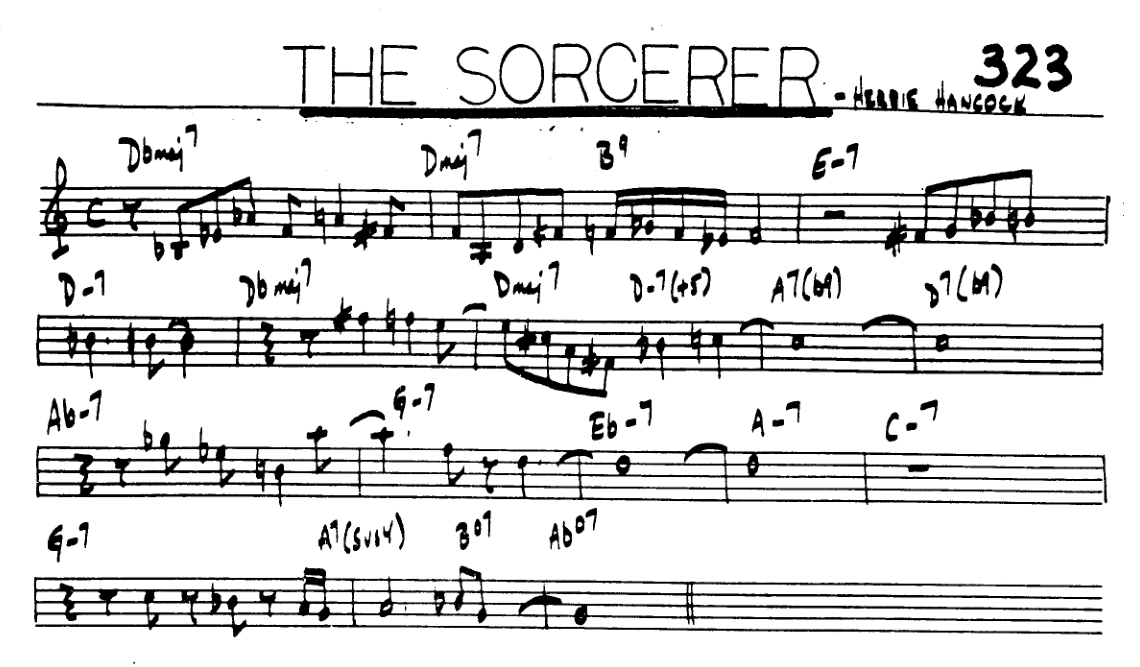
Phew, long post here, but the topic merits it. Let's listen to the Miles Davis record Sorcerer, with his famous 60s quintet including Wayne Shorter, Herbie Hancock, Ron Carter, and Tony Williams. I bought it around 1987 as a vinyl reissue— I never heard of it before I saw it at the store, and was real excited to find another Miles record with Tony Williams on it.
Recorded in 1967, mostly. Several of the tunes appear in the original Real Book, but are not often played. Among records by this group (and the George Coleman iteration) Sorcerer is a little bit of a dark horse— compared to Nefertiti, Miles Smiles, Four & More, for example. Maybe there's more stuff music students get excited about on the other records.
Overall the frame here is very loose, very open— nobody's nailing down the time for much of it. The time modulations of the earlier records have evolved into a general floating feeling. Much of it is straight 8ths, but we're not yet getting into the rock direction we hear evolving on Filles de Kilimanjaro and Miles In The Sky. This one is more about time areas, sketched out by everyone together— the time often seems like it's somewhere in between what everyone's playing. Same with the form.
Lots of beautiful playing here, individually and as an ensemble, my focus here is on what I'd be thinking if I were playing or learning these tunes.
Put on your record, or run this, and read on:
Prince of Darkness 16 bar tune, played twice. Tempo is about 239. Nominally a samba, played with very open modern jazz language. You can broadly hear the form going by, but they're handling it in a very open way, no piano comping, and not a lot of firm markers being played. It kind of hangs off those dotted half note accents in bars 11 and 13— listen for who suggests that during the solos. Wayne Shorter wrote some tunes like this— El Gaucho is another one— very concentrated, distinct forms. Like Giant Steps but way more interesting, speaking as a drummer.
Ron Carter's foundation groove is a samba rhythm, but much of the time he's playing off of dotted quarter notes or half note triplets. Tony is supplying the regular pulse, but a lot of angular stuff too. Texture opens up on Herbie Hancock's solo.
Pee Wee I forget if Tony Williams actually composed this, or if Wayne did, and they wanted to give Tony a writing credit. Low key waltz, tempo is about 124. 21 bar form. This may be the most commonly played tune on the record? Miles don't play at all on this track.
Phrased 8+7+6— though my hear hears the melody itself as 6+9+6. It lays across the chord structure in a funny way. But it's 8+7+6— on the blowing there are two measures of the same chord at the end of the first 8 bars, and a big change in bar 9, beginning the odd phrase. The key spot is in bar 16, the one measure that has two chords in it— it's easy to hear even if you're lost the whole rest of the time, and easy to finish the form from there. It's worth listening through a couple of times just listening for bar 16, while not otherwise keep tracking of the form. The change at bar 9 is also distinctive, get that in your ear.
You see how my mind works on these things. I don't want to count, and I don't want to fight my ears, I want to know how to recover from getting lost. Learning this tune, I would first learn to orient myself around what's obvious to my ears, however feeble, and then learn to hear the parts where I don't know what I'm doing— which I've here narrowed down to bars 13-15.
Tony plays light time and textural stuff with brushes through the first chorus of Wayne's solo, after which he switches to sticks. Mostly plays off a quarter note pulse, double timing and playing off a dotted quarter pulse in a few spots. Phrases are broad swells or arcs, both in dynamics and density.
Masqualero The very dramatic 2001 recording of this tune on Wayne Shorter's Footprints Live! is possibly more famous now, with Brian Blade on drums, channeling the whole world's love and enthusiasm for this band. Very loose playing from everyone here, but there is a clear tempo and they mostly follow the form... with modifications.
The tune is a modal ABA, with a short form that is very drawn out. Played with a straight 8th feel. Below is a chart from the Jazz Ltd fake book, illicit pdfs of which are widely distributed digitally. The choice to write it in 4/2 is strange to me, playing it I would count it in 4/4— one measure of 4/2 on the chart = two measures of 4/4 @ 134 bpm.
The first line is the intro, the second line is the A section, and the third line is the B section. The last A section is indicated by the “D.S. (first 4)” at the end, and by the sign at the beginning of the second line, and by the fine at the end of the second line. So the form is 4+3+4 bars of 4/2, or 8+6+8 counted in 4/4. The whole thing is played in the key of G. Phrygian, except the B section. On the blowing Ron also implies a change in bar 4 of the A section.
The intro is very loose, with Tony playing free, and settling on the tempo as the A section begins.
During the blowing, except on his own solo, Herbie always hits the first dotted quarter figure in the last bar of the B section— Ron hits it during Herbie's solo. That really sounds like the end of the form, and sometimes it is treated as the end of the form. Like the last chorus of Miles's last chorus is just AB, then Wayne's solo's begins with a fresh ABA.
The end of Wayne's solo gets a little flaky; Herbie drops out at the beginning of his last chorus, from there they seem to play AB+AB+mystery phrase. Herbie's solo starts very fluidly, though it's still in time and still adhering to normal phrase lengths. At some point the bridge is cued, and they finish it on the form from there, including a final A section before going into the head out— where the play AB-AB and out, with no horns on the second AB.
If you get lost in space on the A sections you should be able to hear when they go to the B section; at least the end of the B section is always 100% clear. And the top of the repeated A sections is clear as well— they don't just play 8 (in 4/2) bars of vibe. And you can hear the implied chord change in the last bar of the A section as well.
Listening to it I would learn to first hear those markers when they happen, and notice how they're handled. Sometimes they're the one definitive thing in the phrase, other times they're touched lightly, sometimes dramatic, sometimes not. Generally not everyone is hitting them at once.
The Sorcerer Uptempo through-composed Herbie Hancock tune, 16 bars, AB, 8+8. On the blowing Miles and Wayne trade 8s, then play the head again, twice.
Form-wise, there's not a lot for me to grab onto, aurally— the chords don't really allude to the melody, and we never feel like we've arrived anywhere, which is deliberate. From my perspective it might as well be free bop. You can't play it looking to resolve to a big down beat, because it's not going to be there, you have to leave everything open. Counting 16 bar phrases from when they play the head after the trading, the horns come in with the head out on bar 9, so something off the form happened there.
In terms of learning this tune, I would listen to the version on Herbie's record Speak Like A Child. It's still real ambiguous, but they play more conservatively, and there are some arranged figures on the head that give you a little more to hang onto.
Limbo Another taken from the Jazz Ltd book— who knows how similar it is to how Wayne wrote it. Form is basically 8 bar AB, with two extra beats in the middle. Kind of a funny choice writing it the way they did; on the head Tony plays a fast 3, based on the quarter note triplet on the written chart (listen to his hihat), then on the solos they go into that double time samba like on Prince of Darkness. They play a medium 4/4 on Herbie's solo, then back to the fast 3 on the head out. Tempo is ~ quarter note = 123.
The 2/4 bar and the chord changes every two beats suggest that this could have been written as a fast 2/2, or a fast 3/4, with one chord change per measure, 9+8 bars long. That's probably how I would think of it.
Figuring out how closely they're following the form on the blowing takes better ears than I have. There is harmonic movement, but they might as well be playing totally open, if they aren't. They bring it around to some semblance of the form on Herbie's solo. It takes some nerve to try to do what Tony's doing here— it's well beyond routine combo intensity.
Vonetta Cool walking ballad by Wayne Shorter, I can't locate a chart for it online or in my books. Too bad.
The form is 14 bars long, let's call it AB, 8+6. Bar 4 of the B section is in 5/4.
Rubato on the head, Miles plays the first half, both horns play the second half. On the solos they play a medium 4, and Tony makes the interesting choice of playing the solos on the snare drum with sticks. Miles and Wayne solo, Herbie gets two half choruses, with the horns playing the head on the B sections, ending the tune on the second chorus.
Great tune, maybe I'll write a chart for it.
Nothing Like You Recorded in 1962 with the singer Bob Dorough, who was very much in the Blossom Dearie/Dave Frishberg cute/hip mode. With Jimmy Cobb on drums, arranged by Gil Evans. I like the opening, Jimmy Cobb is all over that. He has a real particular sound, that's very staccato and on the front of the beat, distinct from other players like that— maybe Roy Haynes or Charli Persip, or Alan Dawson.
A list of the 134 most-recorded jazz drummers and percussionists, created by Mark Stryker, a Detroit jazz writer, which I'm pilfering directly, because it's not currently live anywhere. I had to look at it through Google Cache. This internet thingy is cool, but people need to take care that their stuff actually stays up. Save your work, people.
It's a useful and impressive piece of research. I reached out for permission on a couple of different platforms— he's on Facebook, and Twitter— but, like me, he apparently never reads his messages. If anybody knows him, tell him I'm stealing his stuff.
The list: These are the guys— the true elites of our trade. What they do and don't do is what a good drummer is. About forty of them I've listened to a lot. About twenty I never listened to at all. The rest of them, I can point to at least one record or thing about them that is/was significant to me. And I'm kind of narrow in my listening— I've mostly focused on a few people, and relatively few records.
Here's Mark's original post:
A conversation with Ethan Iverson about Billy Hart led me to spend WAY too much time compiling statistics from The Jazz Discography by Tom Lord to see who are the most-recorded drummers in jazz. What follows is list of the top 136. The numbers represent total number of sessions, not individual records. They also include only jazz sessions as defined by Lord's inclusion — no pop, R&B, film, TV, jingles, etc. They do include broadcasts and bootlegs that have been released.
The results are interesting. The biggest numbers belong to top-call studio cats – Shelly Manne, Grady Tate, Osie Johnson, Mel Lewis. But there are surprises: Billy Hart is 5th(!) on the list, particularly impressive because his appearances are mostly single-session, modern jazz records dating back to 1961. Of course, he's still going strong at age 80. I went deep in my memory banks thinking of drummers whose numbers I should look up. I also looked at some online lists of jazz drummers and percussionists to jog my memory. Finally, after I posted earlier versions on Twitter, folks there pointed out a gaggle of omissions. I'm sure I've still left out some players, but this is fairly comprehensive.
1. Shelly Manne - 902
2. Grady Tate - 698
3. Osie Johnson - 692 (among the most impressive because his recording window was an insanely short 17 years, 1949-1966).
4. Mel Lewis - 690
5. Billy Hart - 646
6 Gene Krupa - 620
7. Buddy Rich - 606
8. Sonny Greer - 589 (Ellington made a LOT of records – all but about 25 of these are with Duke)
9. Don Lamond - 569
10. Steve Gadd - 554 (and God knows how many pop records, TV/Film dates, and commercials)
11. Papa Jo Jones - 539
12. Peter Erskine - 536
13. Kenny Clarke - 535 (woulda been higher had he not moved to Europe in the late ‘50s)
14. Jack DeJohnette - 502
15. Larry Bunker - 500
16. Billy Higgins - 498
17. Alvin Stoller - 497 (if you didn’t call Manne on the West Coast, you called Stoller).
18. Harvey Mason - 479
19. Louie Bellson, 472
20. Alex Acuna - 469 (percussionist)
21. Victor Lewis - 442
22. Lewis Nash - 421 (at 62, he’s obviously going to keep moving up the ladder.)
For my jazz students, here is a list of much loved, mainstream, historically important recordings to listen to in your first few years of learning.
I'm also in the process of updating the practice loop labels, to group them by genre or interest. So here is a link for all my loops, and a link for just the jazz loops.
Miles Davis Round About Midnight - Philly Joe Jones The New Miles Davis Quintet - Philly Joe Jones Workin' / Steamin' /Cookin' / Relaxin' - Philly Joe Jones Milestones - Philly Joe Jones Kind of Blue - Jimmy Cobb Bags' Groove - Kenny Clarke Walkin' - Kenny Clarke
Thelonious Monk Trio - Max Roach, Art Blakey Monk's Dream - Frankie Dunlop It's Monk's Time - Ben Riley Criss Cross - Frankie Dunlop Misterioso - Roy Haynes
Sonny Rollins Saxophone Colossus - Max Roach Freedom Suite - Max Roach Newk's Time - Philly Joe Jones
That's mainly an instruction to myself, but I invite you to do it, too. My first Sony turntable from 1981 finally died once and for all in the mid-00's, and like a big jerk I did not replace it. Since then CDs and mp3s have become my main formats by default, with my crates of LPs sadly exiled to the basement. I didn't realize how impoverished I had made myself until I walked into a record store the other day and started handling records again.
I immediately noticed that:
- Used LPs are cheap. In 20 minutes in the store (Crossroads Music in Portland, a used record co-op) I found a couple of dozen easy purchases I have never seen online, for 3 to 5 bucks. A lot of classic recordings were reissued many times with different packaging, and tend to be dirt cheap. Some things have gone up in price- Miles Davis In Concert cost me $4 in the mid-90's, before people started liking 70's Miles again; today I saw it for $8. The most expensive things I would've considered buying were about the same price as a new CD.
- Computer music is formatted for casual listeners (or "amateurs"), which you are not. As a musician, albums of music are your medium- they are your large-scale works. You need to have a strong sense of the collection of tracks as a whole, played in a certain order (preferably with an A side and a B side) and a certain amount of time between tracks, strongly associated with a title, the artwork, the group of musicians who played on the record, the songwriters, and the recording date, studio, engineer, and producer.
- By the way, have you ever searched for Tony Williams on iTunes? They tell you only albums he recorded as leader. No indication whatsoever that he once played with a minor group known as the Miles Davis Quintet. Same with Elvin Jones- searching for him returns a big fat "Coltrane who?"
- The packaging is incredibly efficient. To get all of that info, you turn the cover over and look. Instead of the dozen-plus clicks it takes to open a file browser and rooting around for the info file, or googling the album title and clicking around within a couple of different sites before you maybe find the information you want. Or just succumbing to the inertia and never finding out.
Here are some exciting drummer-led things I found while paying a visit to the thriving community of record-collecting bloggers dedicated to ripping out-of-print LPs and making them available for download. Apparently no one wants to sell you this music any more, and this is the only way you can get it, short of dedicating your life to scouring the used bins and getting really lucky. This does raise some ethical questions, which I've addressed after the break.
Download links for the albums are usually located in the comments section; Mediafire links are quick and easy, Rapidshare links are a pain.
Bob Moses - Bittersuite in the Ozone
A famous record, and extremely rare- I've never seen it in close to 30 years of trolling the used bins. Features Billy Hart, Randy Brecker, Dave Liebman, Howard Johnson, Eddie Gomez, and more.
Roy Haynes Hip Ensemble
Haynes' "jazz-rock" band from the 70's. I've only seen one other record by this group, and I own the only copy of it I've ever seen in the wild. Recorded in Rome in 1975 for the Horo label. With Don Pate, Bill Saxton, John Mosley, and Mark Fiorillo.
Jack DeJohnette - Have You Heard?
I have not, in fact, ever heard of this great, very free Milestone release. Features Bennie Maupin, Gary Peacock, Hideo Ichikawa.
Elvin Jones - The Town Hall
Smoking John Coltrane memorial concert from 1971. One of the first Elvin LPs I bought, used, in '86 or so. With Frank Foster, Chick Corea, Joe Farrell.
Via Larry Appelbaum @ Let's Cool One: today is the 50th birthday of one of the greatest albums in jazz, Oliver Nelson's Blues and the Abstract Truth. Like a lot of other people, the first jazz tune I learned was Stolen Moments (at least that I can put a title to- the first thing I ever played was a Sammy Nestico chart).
Unfortunately my favorite track, Hoe Down, isn't available on YouTube, but here's the opening from MySpace Music.
Max really warms up Cecil's thing, doesn't he? This reminded me of Momentum Space, with Cecil alongside Elvin Jones and Dewey Redman, which gave a similar feeling; and the Tony Williams/Cecil duet on Joy of Flying. And Gary Peacock on Albert Ayler's Spiritual Unity. I guess it shouldn't be a huge mystery- you put someone with the greatest drummers in the world and they're going to sound good. But his music is so impenetrable it's hard to imagine Max being able to do anything with it at all...
I just updated my lessons site to include a bunch of recordings of me playing the drums. Some people want to make sure you're really burning before they'll study with you. Anyway, checkem out. Enjoy.




 . Like a lot of other people, the first jazz tune I learned was
  (at least that I can put a title to- the first thing I ever played was a Sammy Nestico chart).
 , isn't available on YouTube, but here's the opening from