Wednesday, March 30, 2011

Feel in samba

I'll start this post with an enormous caveat that Brazilian music is not my field of expertise at all.  Many people around me are learning Portuguese, making trips to Brazil and being very serious about it, making me feel a little like the guy who sat next to the class clown, as I mentioned to someone recently. Still I thought this might be helpful to people who are, like me, seeking to put together some understanding from multiple, imperfect bits of information. See my "samba builder" download for applications for these concepts.

First, for reference:


The subject of feel in samba is intimidating because it has never been clearly and fully analyzed, at least that I've seen. Here in their entirety are three of the most helpful things I've read about it:
Duduka da Fonseca/Bob Weiner in Brazilian Rhythms for Drumset: One of the keys to understanding Brazilian music is feel the pull towards a "triplet pulse" against the 2/4 feel of the samba.
Eliane Elias quoted by Peter Erskine in The Drum Perspective: "You Americans don't know how to swing samba; you all sound like TI-KA TI-KA TI-KA TI-KA." I smirked and said, "Well then, how should it sound?" She sang, "DO-goosh-ga, DO-goosh-ga, DO-goosh-ga, DO-goosh-ga."

Peter Erskine in Drum Concepts and Techniques: Remember to accent on 2. 

Tuesday, March 29, 2011

The DNA of swing drumming

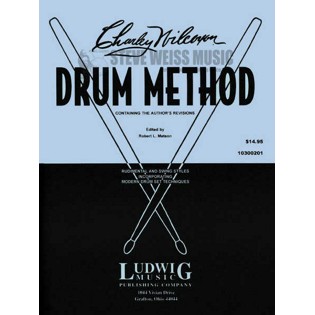
I picked up this interesting book- Charley Wilcoxon's Drum Method- as one of my local sheet music stores was going out of business. I'd been working with Wilcoxon's more advanced Rudimental Swing Solos, but this seems to be the true key book (as far as a book can take you) for understanding pre-modern jazz drumming.

The emphasis here is on rudiments and syncopated phrases, in the the 30's swing drumming mode, before before four-way coordination, and before use of the ride cymbal and hi-hat were universal. The approach to rudiments is different than in traditional military-style drumming, as in Haskell Harr. Even the march-like etudes have a distinctly swinging feel absent from the other style.

Most of the book deals with quarter and 8th notes in 4/4 and cut time, plus 3/4 and 6/8. Syncopated and even meter-within-meter rhythms and accent patterns are introduced early, in the quarter note section, and exercises generally have a swing lilt. Remarkably, 16th notes in #/4 meters are not fully explored until page 91. Notably absent are the mathematical/logical sequences of exercises that became a primary feature of many drum books after George L. Stone's Stick Control. Often sequences of exercises will be related by embellishments, or sticking variations as in the single page of 16th note exercises, which shows the unadorned rhythm, then several sticking, accent, embellishment options. Usually they just follow a musically-related progression.

It's somewhat easy to miss the fact that this is a drum set method book. The bass drum is used simply throughout, playing either quarter notes or half notes, and occasionally filling in breaks or supporting an accent pattern in the hands. Aside from a few dedicated hihat exercises, most of the book uses only the bass drum and hands. Jazz ride cymbal and hi-hat patterns are presented as stand-alone time feels, with no comping in the modern Kenny Clarke/Max Roach/Chapin mode. Brushes are mentioned, to introduce the left hand sweep, and to mention that "brush technique is usually developed individually by each drummer." There are a number of multi-voice exercises and etudes using tom toms and cowbell.

I've found it to be very useful in my own practice- I'm very fond of the pages of two bar breaks, "rhumba studies", 3/8 studies, 16th notes, and triplet/8th note combinations. Along with several of the later etudes, which are less dense and more focused on a single idea than those from Wilcoxon's other books. And it's nice to see earlier versions of the the type of phrases used in more modern books, like Ted Reed's Syncopation. The history lesson plus the dozen or so pages I actually use make it well worth the purchase price.

Purchase the Wilcoxon Drum Method.

Monday, March 28, 2011

Todd's Methods: Samba builder

Here's a little method I improvised for developing some flexibility with the samba- I put this together pretty quickly away from the drums, so I'm sure I'll add to it as I work with it in my own practice. The idea here is to get comfortable with bringing the feet in and out, making changes in dynamics, and using the bass drum independently, like a surdo player, instead of being locked into the usual dotted-8th/16th pattern. Check out the notes at the end for some fairly important things about interpretation. A good first approach is to work from a base of the most comfortable hand part, and practice making adds and changes to that.

 
Update: my man Boomka over at the Drummerworld.com forum offered a couple of excellent links- an interview with Duduka da Fonseca where he discusses the importance of a sensitive approach to the bass drum, plus a video demonstrating the feel of the repinicado part (video embedded after the break).

Download the pdf.

Sunday, March 27, 2011

Page o' Gadd

Still slow getting my own stuff completed this week, so instead you'll have to enjoy this nice page of Steve Gadd motifs from Bang! the Drum School, a Brooklyn teaching studio. They have a blog over there as well, with a bunch of other good things.


Get the pdf from Bang! the Drum School.

Krupa G.P.

Still light posting, but listening to the Mel Lewis history of jazz drums interview and they're discussing a favorite move of Gene Krupa's- during a shout chorus leaving a dramatic silence where there would normally be a fill. Here he does it at 0:38:

Saturday, March 26, 2011

Massive Mel Lewis interview

More great stuff from Jon McCaslin at Four on the Floor: extended radio interview of Mel Lewis by Loren Schoenberg, discussing the history of the drums in jazz from Baby Dodds to Elvin Jones. An essential document for all jazz drummers, and anyone serious about the drums, period.

2020 UPDATE: You can now get the interviews on the University of North Texas site. Thanks to Manuel, our man in Augsburg for the notice!

Wednesday, March 23, 2011

Hal Blaine interview

Great article and interview with Hal Blaine at Jazz Wax, absolutely worth reading. If you haven't heard of him, Marc Myers'  introduction should pique your interest:
Except for the Beatles, the Rolling Stones and a few other groups, most rock bands of the early and mid-1960s didn't play on their own records. Which groups? Try the Beach Boys, the Mamas and the Papas, the Byrds, Jay and the Americans, Gary Lewis and the Playboys and dozens of others.
Who did? Hal Blaine and a tight-knit ad hoc group of about 30 highly skilled Hollywood studio musicians known as the Wrecking Crew. They could read anything put down in front of them and could nail the song the first time through, bringing enormous snap to the results. For years I've been fascinated by this little-known secret hit-making machine.
How big a deal is Hal? He recorded on 39 No. 1 hits on Billboard's 
Hot 100. Which hits? Here are just a handful: Can't Help Falling in Love, He's a Rebel, Surf City, I Get Around, Everybody Loves Somebody, Help Me, Rhonda, Mr Tambourine Man, I Got You Babe, My Love, These Boots Are Made for Walkin', Monday Monday, Strangers in the Night, Cracklin' Rosie and The Way We Were.
Hal also was the drummer on six hits to win the Grammy for Record of the Year for six years in a row. A staggering stat. Which six? A Taste of Honey, Strangers in the Night, Up, Up and Away, Mrs. Robinson, Aquarius/Let the Sunshine In and Bridge Over Troubled Water. Hal also was inducted into the Rock and Roll Hall of Fame in 2000.
Like Detroit's Funk Brothers who backed up virtually all of the Motown groups, the Wrecking Crew did the same in Los Angeles. The difference, of course, is that everyone knew the Funk Brothers, and the artists they played behind were singers. The Wrecking Crew, by contrast, was a phantom band of killer musicians, and their vast contribution wasn't disclosed on albums until recently on CD re-issues.

Visit Jazz Wax to read the entire piece, including video and more.

Tuesday, March 22, 2011

Why we transcribe

Yes, I look the same
when I'm transcribing as Duke
did when he was copying
parts- immaculately-coifed, reclining
in my suit surrounded by reams
of parchment.
I'm a pretty big transcriber, and I thought I would offer some thoughts about it- some whys, why nots, and things I have to think about when doing it. This is not a how-to- that will be coming soon as a separate post. Please excuse the laundry list format- I don't have a lot of time to go real in depth right now. I guess that's why God gave us blogs...

Why I transcribe:
- To facilitate listening. All the other whys follow from this.
- To see exactly how a drummer does his job. How he handles the craft end of things- time feel, ensemble figures, set ups, fills, comping. This is a short entry, but a really big thing.
- To get a sense of the size of tool box a drummer brings to a performance. How many types of things does he play? How many ideas?
- To clarify mysterious things. Some drummers play things that are easy to understand, some play things that defy real instant analysis- Elvin Jones and Jack Dejohnette are examples of that. In the case of Vinnie Colaiuta, I might want to see how in the hell he gets through an extended guitar solo in 19/16.
- To get statistical information- how often he make strong crashes, how often he uses the toms, how often does he vary or leave the ride cymbal. How much space he leaves, how long he stays at certain dynamic levels. I just want a better impression of those things than I might get just from listening- I'm not actually counting up cymbal crashes.


What I don't do:
- I don't transcribe to learn cool things to play on the drums. Musical context is the entire point. So I don't transcribe burning "set piece" drum solos that have nothing to do with anything musically.
- I don't play my transcriptions. My feeling is that on the drums especially, it's a little bit like trying to forge someone's signature- you can mimic the outward appearance, but not the true process.

Monday, March 21, 2011

Best Books: Basic Drumming by Joel Rothman

In case you haven't figured it out already, I'm a big fan of Joel Rothman's books. His many, many books- I think he has written about a hundred of varying lengths since the early 60's. Basic Drumming is probably the most widely-owned, and contains more than a little of just about everything, without being in any way dumbed-down. A drummer who mastered everything in this book, with an equal amount of performance experience, would be cooking indeed. So the word "basic" is a little misleading.

Rothman has a unique logic to his presentation, which he follows selectively, with a bias in favor of practicality. Often he will use a common performance pattern as a starting place, and then compose a number of variations based on it, which gives the student a starting place, then a number of musical directions to go from it.