Showing posts with label Mel Lewis. Show all posts

Monday, December 02, 2024

Mel Lewis stuff!

A flurry of drumming activity of actual interest on Bluesky this morning. So far much of the drumming content there has been pretty mundane, but they've added ~ ten million new users in the last month, and things are developing rapidly. 

Anyway: here's a new repository of the Mel Lewis history of drumming tapes, edited, cleaned up, and generously shared by Flip Phillips. Previously the digital files were divided up by show, under the heading of the name of the drummer they were discussing. Phillips has broken those up, with individual files for the recordings played, and subjects of conversation. It's super helpful.

It's a work in progress, so you'll probably want to check in there for updates in coming months. 

Also Gary Kennedy has shared a link to some Mel Lewis interviews I hadn't seen before, with Les Tomkins, several times between 1971-88. That site has a whole ton of interesting interviews, actually. 

And Jon McCaslin has written a new post on Mel Lewis you're going to want to read. 

Follow everyone on Bluesky: 
@flipphillips.com‬
@fouronthefloorblog.bsky.social‬
@jazzsnob99.bsky.social
@cruiseshipdrummer.bsky.social

Sunday, February 05, 2023

Transcription: Mel Lewis comping

On Chess Mates, from a 1985 Joe Lovano record, Tone Shapes & Colors— a live recording with Mel Lewis on drums, and Kenny Werner on piano. A lot of what I'd call “non-independent” drumming here, lots of examples of his rubadub thing. A good example of how to play bright tempos economically while still sounding like you're doing something.

The YouTube video won't embed, so hit this link to hear it.

The form is short and unusual, I guess we'll call it ABC: 

A - 12 bars  |  B - 4 bars 3/4 + 1 bar 4/4  |  C - 8 bars  


That B section is not a trap— it has 16 beats total, same as four bars of 4/4, so on the blowing you could miss it and not get lost. He probably actually wrote the whole thing in 4/4— on the solos Mel plays it like it's a figure in 4/4. Playing the head it would be easier to count it in 3/4; I'm writing it 3/4 to outline the figure, which is played pretty strongly even on the solos.   


Here are a couple of choruses of Mel's playing during Kenny Werner's piano solo, starting at 4:32. Tempo is 258. 


He plays the hihat pretty softly— not necessarily quiet, but with a soft foot, not a lot of force, with some splash sounds, and the volume is irregular. He's mashing the stick into the snare drum a bit, so a lot of the notes have a wide attack, not quite a buzz stroke. All of the tom tom notes are played with the right hand. Any time the bass drum is played on an offbeat, it's not played strongly.

There's a little more happening with the bass drum than I notated, but I'm not hearing any evidence of regular “feathering”, that he talks about so much. Maybe he's doing it, it's up to you how much you want to struggle with that. 

Bars 3 and 4 have the fundamental rubadub lick he plays throughout this. Maybe the best individual phrase of that is bars 30-33. Also note the fills in bars 25 and 46— sticking is RRLL RRLL both measures.

Also look at the way he phrases the last four bars, 47-50— he does that kind of phrase often: 

First bar: big accents on 1 and 4. 
Second-third  bars: nails down time, brings the hihat in. 
Fourth bar: fill / end of phrase


He does that most of the time here, actually.

What he's doing is modern, but this is definitely night club drumming, an evolved texture from playing in clubs, doing that job. There's nothing contrived about it, none of our usual jazz student worry about ideas or creativity or being interesting or using our technique.      

Get the pdf

You'll have to hit this link to hear the track in a new tab. 

Saturday, January 08, 2022

Mel Lewis master class

Here's a one hour master class lecture given by Mel Lewis in the early 80s at North Texas State University (now the University of North Texas). Embedding on blogger is weird now, so you'll have to follow that link to watch it. 

Lewis extremely opinionated as always, going into detail about everything that's wrong with everyone and everything. It's good to hear this stuff, without resisting it, whether or not you run with all of it for the rest of your life. He makes an important point around 44 minutes in, that listening to old music is about education— he's not telling you to play like it's the 1930s. You take him seriously, while understanding it's not just about accepting opinions, it's about paying attention to the things the opinions suggest. 

There's an extended sequence about keeping time with the bass drum— “feathering.” This is one thing Lewis says that has become an article of faith today. I still have a more nuanced view of it— soon I'll revisit my old 2012 post on the topic.  

I talk about about the drum set as being a very right handed oriented instrument— Lewis's solo break near the end of the video is a graphic demonstration of that.  

Timely reference: there's a question about Joey Baron— this is early in his career when he was with Carmen McRae. I just played a session with Ed Bennett, who was the bassist in that band. There must have been a buzz about Baron then, that I wasn't aware of. I was younger, and only learned about him later, when he played with Bill Frisell.  

Wednesday, June 17, 2020

Mel Lewis intro - One for Pat

I'm just taunting myself now— I've got this book of intros sitting around, almost completed, and I keep finding new things that should probably go in it, but I don't have the nerve to open it up and add them it because it will mean reworking the whole thing. That's probably what's going to have to happen.

Whatever. Here's a little intro by Mel Lewis, on the tune One for Pat, from Got 'Cha, Lewis's first record as leader, released in 1956. I never saw or heard the record before, I just saw it listed in Chris Smith's book on Lewis, The View From The Back Of The Band— it's out in paperback now, so there's no excuse for not buying it.

The tempo is around quarter note = 250, and it's a funny little thing— as Paul Motian said about Max Roach, “not-so-correct”: 


The main attraction is the rubadub passage from the middle of the second measure to the middle of the last measure. Just move your right hand to the tom tom in the third measure; left hand stays on teh snare drum. The hihat is played open all the way through.


Sunday, January 19, 2020

Building rubadub - 01

For intermediate jazz students, here is a page for learning the basic pattern for Mel Lewis's rubadub concept (as helpfully explained by Chris Smith), about as thoroughly as possible, while also developing solid execution with swing rhythm generally. The only thing I've really left open to question here is the ability of the student to interpret swing 8th notes. We can't do everything in one page. Another page is coming for putting this into 4/4 time.

This is approximately what I would have a student do in a lesson if he was not immediately able to play the pattern, or was having problems with the rhythm. I prefer to do this verbally, but it helps some students to see it written out. It looks like a lot, but it's really only nine actual things.


As you can see, we are learning the pattern starting on each of its notes— first the partial pattern in 2, stopping on beat 2, then the partial pattern in 3, stopping on beat 3, then the full pattern in 3, stopping on beat 1. Each of those is written twice, with the right hand staying on the cymbal, and with the right hand moving to a tom tom. Practice each pattern played once with a long pause or a measure of rest afterwards, then play them repeating. I suggest learning it at three tempos: ~100-120, ~160-200, and at a bright tempo with straight 8ths.

That's a lot of ink dedicated to only one pattern, but it's an extraordinarily useful pattern, but one that can get inexperienced players in trouble. And again, we're using this as an excuse to polish the student's execution of swing rhythms overall. The page can be worked through quickly, and will isolate and correct anything problematic with the student's execution.

Get the pdf

Monday, December 16, 2019

1985 Mel Lewis clinic

Surprised I haven't already shared this Mel Lewis clinic, given in the Netherlands in 1985. He talks about his familiar opinionated subjects: playing the bass drum, drum sounds, fighting with recording engineers. Somewhere in there he addresses handling fast tempos not as an exercise in pure chops, which relates to some things I've written about that. After about the 1 hour mark he gets into talking about cymbals, which is always interesting with him. Everything he says about Istanbul cymbals holds for the Cymbal & Gong cymbals I sell through my Cymbalistic site.

After 1:35 he fields questions and gets into talking about playing the ride cymbal, playing shuffles, brushes. After 1:50 he talks about the very important concept of thinking and phrasing like a horn, and at the end are a few good words about spontaneity vs. working things out.


Monday, July 08, 2019

Transcription: Mel Lewis fours

Here is Mel Lewis trading fours on Stoppin' at the Savoy, from Bob Brookmeyer's album The Blues Hot and Cold. These are pretty interesting. Lewis isn't anybody's idea of a chops guy, but he's not dumb. The fours begin at 3:49 in the track.


There are a couple of funny items— at one point he's throwing a stick down on the floor tom, hitting the rims. The part on the sixth line with the ruff right before the stick shot will take a little practice. Play this by itself, a lot, and work it up to speed:


It's a natural motion; you have to get the left stick onto the head to make the stick shot, so you just press it into the head on that note. We're not going for a quality buzz stroke there. I have a feeling Mel didn't practice it, but just played it on the job a few tens of thousands times.

Get the pdf

Thursday, November 15, 2018

Mel Lewis on rub-a-dub

Loren Schoenberg, who conducted the famous Mel Lewis history of jazz drumming interviews, has begun posting excerpts from the interviews on his YouTube page. Which is lucky, because I think the source from which I originally downloaded it has dried up.

In this video Mel talks about the rub-a-dub concept, with an excellent example of it being done as a high-energy comping idea by Tiny Kahn. Most of it happens during the solos after the vocal scatting. If you have checked out Chris Smith's video outlining this idea, it should be easy to hear how Kahn is using it:


Once again I highly recommend getting Jack Dejohnette and Charlie Perry's book The Art of Modern Jazz Drumming— the meter-within-meter chapter is basically indistinguishable from rub-a-dub.

Friday, October 26, 2018

Syncopation p. 37: rub-a-dub method, mach 1

Now this is the level of drum geekery I aspire to, with the defiantly gibberish post title, and everything. I was writing out a very laborious explanation of the next steps in my evolving quasi-Mel Lewis “rub-a-dub” practice method, but... let's do this: I'll show you what I've done with Exercise 1 from Progressive Steps to Syncopation— on p. 37 or 38, depending on the edition— and you can figure out how it works.

The key rhythms in interpreting this long exercise are the three-beat pattern I outlined in the last post— being able to recognize it wherever it falls in the measure, with rests or not— and the two-beat 8th-quarter-8th note rhythm, also with rests. See measure 5 in the pdf below to see how that rhythm is handled.

Those two things cover most of what happens in this piece. There are a few leftover quarter notes that don't fit within either of them; for now we'll play those on the snare drum, with no cymbal. The only other place I deviate from this basic system is when there is a quarter note on 3 and a rest on 4; I treat those as actual stops. If I was following the system exactly, there would be a double on the cymbal on 3.


First look this over and compare it to the p. 37 exercise in the book, then play it as written, with a swing interpretation, or straight 8ths. Then begin moving the unaccented cymbal notes to the tom toms or snare drum— with your right hand. Then move the left hand notes around the toms, then both hands. It's best to try to make the interpretation while reading out of Reed; but my written-out version may be helpful for initially getting the moves to the tom toms.

Next I'll attempt the same thing with Exercise 2 from Reed, which has much more rhythmic activity that does not fit neatly into the basic system. Ex. 2 has always been a big pain in the neck.

We'll see how this develops. Ideally, we want to be able to sight read the other full page exercises in Syncopation, and eventually do it while reading actual charts, while making the appropriate ensemble hits reliably. It's no good as a method for big band kicks unless we can catch the cymbals when we're supposed to while following a real chart.

By the way, I'm pretty certain that Mel did not develop this as systematically as we are doing it here. It really seems like something developed in the field, on stage, while constantly performing. Players like that sound different from today's very practiced players. It's real easy for us to sound mannered. 

Get the pdf

Sunday, October 21, 2018

Developing a method for rub-a-dub

I've been working up a practice method for learning what Mel Lewis called rub-a-dub I hate to use his term, because I only just saw it explained for the first time in Chris Smith's video. I don't know enough about how it applies to Lewis's playing to claim I'm doing his thing. But I've used the same basic idea for many years, usually in the context of a modern, ECM-type feel. I can write about that, and work out a way of applying it to ensemble figures, and maybe approximate Mel's thing as explained by Smith. Or maybe it will just be something different, but still useful.

Basically it's a simple all-purpose idea for playing and filling around big band figures, and I'll be exploring some ways of working it up using the syncopation exercises from Progressive Steps to Syncopation (pp. 32-44 in the old edition). This will certainly evolve as I continue working with it. For now I'm trying to develop a very basic interpretation so we'll have some hope of executing it on the fly with the full page exercises in Reed.

Here's the basic rub-a-dub lick, played with the left hand on the snare and the right hand on the cymbal:


The snare and bass rhythm without the cymbal:


That rhythm written as one voice occurs throughout Syncopation, so that will be our main place for introducing the rub-a-dub:


Here's the rhythm in Syncopation— we most often see it starting on beat 1 or 3, less frequently as an equivalent rhythm starting on beat 2 or 4:


A basic way of playing that figure rub-a-dub style would be:


That ending quarter note could be played on the snare or bass drum.

In other instances that 8th-quarter-8th rhythm includes rests, which could be played by just dropping snare drum hits to match the written rhythm:


The 8th-quarter-8th rhythm repeating give a clue on how to handle running 8th notes:


This is only a beginning, of course. We're reconciling a few different concerns: doing the rub-a-dub lick, designing a system that will be readable with the long exercises in Reed, while making sense in terms of playing big band figures. Somewhere on the radar should be the idea of suggesting a standard time feel— jazz, funk, or samba— for when there is no obvious rub-a-dub type interpretation for a rhythmic passage, or when we need some variety.

Playing out of the book will be challenging, especially with the full-page exercises; interpretation is very dependent on the context. The way you play a rhythm will depend on what comes before and after it, so you may play a rhythm differently in the full-page exercises than in the one-line exercise. You can use a simple long-note/short-note interpretation with the cymbal in unison to get through parts where it's not obvious what to do.

Anyone actually playing around with this rub-a-dub idea should also check out Jack Dejohnette and Charlie Perry's book— they outline a method very similar to what Smith describes, that will be very helpful in working it up.

Tuesday, October 16, 2018

Mel Lewis rub-a-dub

Well, we ignore the blog Four On The Floor at our peril. I hadn't visited in awhile, and then yesterday,  BLAM, there's a great post with a video from Chris Smith— he's the author of The View From The Back Of The Band, an invaluable book about Mel Lewis's career. If you've listened to the recordings of Lewis's jazz drumming history, you heard him mention something he calls “rub-a-dub.” He doesn't talk about it in detail, except to say it's a way of playing figures while filling in around the drums.

I was wondering about it, because the recorded example in reference is pretty bad ass. In this video Smith explains it:


It's very much the kind of thing we're into here at CRUISE SHIP DRUMMER!: a simple idea that sounds great and is easy to improvise with. It's actually very similar to something I've been doing for many years, that I picked up from Jack Dejohnette's book. The explanation and context is different, but it's the same idea. I always felt it was covered pretty poorly in Jack's book, so I'm working up a way of practicing it using Syncopation, of course. Stay tuned for that...

Be sure to follow/subscribe to FOTF, and Chris Smith's Drum Hang channel on YouTube. Hell, follow me while you're at it. Scroll down to where it says “followers” on the right.

Thursday, March 05, 2015

Very occasional quote of the day: “You shouldn't be able to do that.”

A pull from Ethan Iverson's Whiplash/Buddy article, which deserves its own space:

A story about Mel Lewis: Mel hated giving lessons, but finally a kid talked him into letting him come by a record session and watch Mel at work. During a break Mel gestured for the kid to sit behind the kit, and said, “Play me a snare roll.” 
The kid played a good, professional roll. Maybe not as good as the one that starts the movie Whiplash, but still, a good roll. Not easy to do. 
Mel took his sticks back and said, “See, right there is your problem. You shouldn't be able to do that. I can't do that. You gotta quit that shit and start becoming a drummer.

Now, Lewis was to all accounts a super-opinionated, cranky guy, who apparently was not above saying things for effect, which might not be the 100% literal truth. He could play a roll, and he certainly would've thrown the student out of the lesson if he couldn't play one. But it's such an article of faith today that more chops is always better, the idea that being a good drummer is independent of, or even possibly at odds with your chops, is something worth thinking about.

(h/t to Ethan Iverson)

Thursday, February 12, 2015

New Mel Lewis biography

There's a book I'm reading right now, in preparation for doing a proper review, which a lot of you will want to buy regardless of what I say about it. It's a new biography of Mel Lewis, written by drummer Chris Smith, entitled The View From The Back Of The Band. It's a really outstanding scholarly work, written for a pro musician audience. It definitely belongs in every serious jazz musician's library— if you know the name Mel Lewis, you should probably just go ahead and  buy it. It's published by University of North Texas Press, and you can get it on their site. Review is coming as soon as I can get it finished.

Tuesday, February 25, 2014

Groove o' the day: Mel Lewis — Jive Samba

Mel Lewis plays a funk groove. The tune is Nat Adderly's Jive Samba, and the album is Thad Jones / Mel Lewis, Central Park North, from 1969. The intro has some fun tom fills, so let's write that out, too:


The tempo is around ~126-128, and the 16ths have just a slight lilt to them. Today the fashion would be to give the fills some shape by accenting part of them— well, I guess even at the time most good jazz drummers would've played them that way, too— but Mel plays every note of them at a pretty even volume, like you might expect a studio drummer of the time to do. Most good players now would be too hip to do them that way, but it sounds great.

Here's the groove he plays after that, when the band is in, with obvious bass drum variations:


Later in the tune, he also moves to an earlier-60's style groove, playing all four beats on the snare drum.

Audio after the break:


Wednesday, May 22, 2013

Mel Lewis on cymbals

More on cymbals from Mel Lewis's 1985 Modern Drummer interview. This is pretty much the bible of the subject, as it relates to jazz:


Number and type
The average drummer usually uses two to four cymbals. To have any more than that is totally unnecessary, because where are you going to put them anyway, and how are you going to reach them? They shouldn't be there just for looks. I notice that most people have crash, crash, splash, ride, and hi-hat. Very few young drummers play on their hihats, except in the rock situation where they generally play them closed and they play their 8th-note beat on them. They should learn that the hihat is another ride cymbal to be played properly—"ta, da-ka, ta, da-ka, ta," changing rhythms and all that, open/closed, all open, half open, half closed. There are a lot of effects. To me, the hi-hat is another ride cymbal.
Every cymbal I use is a ride cymbal. Every one of my cymbals is also a crash cymbal. I only use three. Three is enough.
But every cymbal should be a ride cymbal and every cymbal should be a crash cymbal. I've been noticing that almost everyone has only one ride cymbal and a million crash cymbals. You don't need the crash cymbals. You need the ride cymbals, because that's where your whole thing is coming from. Crash cymbals are only for accents, so you can hit any cymbal for a crash.  

Dark
I find that all the cymbals should be dark. If you want a high-pitched splash cymbal or crash cymbal, fine. That's to your own taste. But darker cymbals are more complementary to horns than any other kind of cymbal. High-pitched cymbals have a tendency to obliterate high sounds. 
 The more high-pitched cymbals you have, the more trouble you're going to give the band. Also, for riding in a big band, I think that the pingier a cymbal is and the less overtone and spread it has, the more empty everything will be. It's important that you have a good, full, fat-sounding cymbal. Finding cymbals like that today seems to be a problem. They are all too heavy. Definition is one thing, but those pings do not cut through. There has to be a little more sound to a cymbal than they're creating right now. They've forgotten how to make ride cymbals with color. They don't know what dark sound is. That's why I still like the old K.'s. They're hard to find, but it seems like they are the only cymbal that was made for music. 


Orchestrating cymbals for big band
[W]hen you hit a high crash cymbal with the brass section while they're up in that high register, you will knock out half their sound. But if you hit a cymbal that will blend with that section—in other words, if there are four trumpets and the fourth is playing the lowest part, you should be the fifth trumpet, which is lower yet. Now of course, we can't go that low all the time, but that's the way I'm thinking musically. Trombones, of course, can go lower than my cymbals can, so I want to be somewhere in the middle register where I don't obliterate the lead and I don't destroy the bottom.
With the saxophones, you want a roaring sound to envelop, because reeds don't have the power that the brass has. That's why I believe that during a sax soli— where you have five saxophone players standing up playing together—nothing sounds better behind them than a Chinese ride cymbal, because there's a blend. Bass violin players love Chinese cymbals because the low sound and the Oriental type of roar make the bass sound spring forward. That's why, when we play big ensembles, I'll go to that cymbal, and you can hear the bass just singing through everything. When you've got a whole ensemble, you want a strong, enveloping, low sound with a lot of clarity as far as the beat is concerned. It's like a picture with a beautiful metal frame around it. It gives tremendous fullness to the sound of the band.

Continued after the break:

Wednesday, March 21, 2012

Several big band drumming books

A couple of new/old big band drumming books dropped into my lap recently, so what the heck, I thought I'd round them up for you:

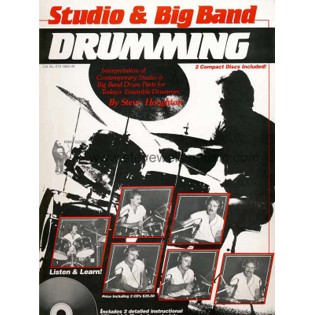
Studio & Big Band Drumming by Steve Houghton - 1985

This has been the definitive book on the subject for almost as long as I've been playing. Includes an essential, very concise but thorough explanation of terms and notation in professional charts. There are one or two page introductions to swing, rock, "Latin" and country styles. The swing section is good, the single page of Latin grooves is pretty dated; people have gotten much more serious about authenticity with those feels since the mid-80's. Probably most important for drummers are the pages on articulating a horn part, the "eighth note rule", and jazz phrasing. There are also many pages of sample ensemble figures, and authentic playalong charts.

College level. 68 pages, with 2 CDs of recorded figures, ensemble passages, and studio charts.


Monday, March 12, 2012

VOQOTD: Mel Lewis


"...you should start with a crash and end with a crash. I see drummers ending with a crash cymbal, but then choking it. When you hit that big chord at the end, let it ring. Hit that bass drum and hit that cymbal—"POW" instead of "pop." That's exciting. There should be a finality to that final blow, unless it's a soft ending, of course. Then you don't even need a cymbal at the end, although I like to hit one softly. But that's always been a thing of mine: Start with a crash and end with a crash." 
- Mel Lewis

Sunday, March 27, 2011

Krupa G.P.

Still light posting, but listening to the Mel Lewis history of jazz drums interview and they're discussing a favorite move of Gene Krupa's- during a shout chorus leaving a dramatic silence where there would normally be a fill. Here he does it at 0:38:

Saturday, March 26, 2011

Massive Mel Lewis interview

More great stuff from Jon McCaslin at Four on the Floor: extended radio interview of Mel Lewis by Loren Schoenberg, discussing the history of the drums in jazz from Baby Dodds to Elvin Jones. An essential document for all jazz drummers, and anyone serious about the drums, period.

2020 UPDATE: You can now get the interviews on the University of North Texas site. Thanks to Manuel, our man in Augsburg for the notice!

Wednesday, January 19, 2011

March 1985 Modern Drummer interview: John von Ohlen


Interview with big band drummer John von Ohlen from Modern Drummer, March, 1985, by Scott K. Fish, with the many good parts pulled out here, by me. Von Ohlen toured with with the Woody Herman and Stan Kenton bands before retiring from the road to live in Cincinnati, where he formed the Blue Wisp big band. I forgot how much this influenced me- I must've reread this a dozen times during the long bus rides on drum corps tour when it was originally published. I was never much of a big band player, but Greg Hall did have us playing Blue Wisp's Love For Sale arrangement at South Eugene High School that year.

Interview excerpts are after the break: