Showing posts with label Joel Rothman. Show all posts

Monday, February 12, 2024

Practical comping lesson with Rothman

Joel Rothman's books don't get a ton of attention in the jazz drums-learning world, but they're good. I like the comping materials in his book Basic Drumming (duplicated in his book Drumming And All That Jazz). They cover the practical basics, bridging into more modern*, filled in, Elvin Jones-like textural playing.
 

* - Yes, Elvin Jones died 20 years ago[!!!] at age 76, but his playing is still modern; everybody who plays gets into him in a serious way, and he did drumming as art, not simply accompaniment (I think he would have disputed that). Modern doesn't just mean contemporary.


The other usual books tend to deal more in pure rhythm/independence/reading problems, and I've never found them to be totally satisfactory for getting to a realistic comping texture with new jazz students. Rothmans' stuff is friendlier to my teaching purposes that way. 

They're notated as just a snare drum and cymbal rhythm, written as triplets, with the swing interpretation baked in. It's assumed we'll add the hihat on beats 2 and 4, and maybe feathering the bass drum if you swing that way. 


You'll notice that the first two beats of each pattern are the same— hopefully that teaches you the first idea really well, and teaches you some places to go with it. 

One thing I do— not necessarily first, but first now— is add some bass drum. I'll circle some notes or rests in the student's book, and have them add bass drum there. For example: 


Most of the snare drum part should be played softly, with usually one or two accents per measure. I'll also pencil in some accents to give an idea of how to shape the measure: 


The problem here, as with almost all comping materials, is we're dealing with one-measure ideas repeating on the 1. We're too 1 oriented, too single-measure oriented.

There are some ways of making a musical phrase out of this, more like how drummers realistically play, with some space. For the examples below, we'll use pattern 4 above, with the added bass drum, and hihat on beats 2 and 4: 


First, obviously, play 1 measure of jazz time, one measure of the exercise: 


That's a good way to learn the patterns in the first place, as part of a continuity, not just as an isolated measure. If a student is able to read the patterns correctly the first time, that's how we'll do it. 

We can also get off the 1, and play the pattern across the barline, a couple of different ways. 

First, just play the pattern as written, except starting on beat 3 of the last measure of the phrase: 


Or play beats 3-4 of the pattern on beats 3-4 at the end of the phrase, and beats 1-2 at the beginning of the new phrase: 


If that seems weird, it's not, it's what you were playing on the repeat of the one measure pattern: 


Here's what a four measure practice phrase would look like, playing that way: 


Obviously there are other possibilities. It's not necessary to take it too far faking a drumming performance from book materials, we're just giving people a sketch of how you might actually play. The next step turning book patterns into music is to play music— with people or with recordings.  

Friday, December 04, 2020

New Joel Rothman book - Ambidexterity

So new I have to use this
crappy scan I did myself.
I just received a new book in the mail:

Ambidexterity
The Holy Grail for Total Independence At The Drum Set 
by Joel Rothman
41 pages. 

Joel Rothman has got to be the most prolific drum author in the world. He must have written at least 100 books in approximately the last 60 years. Many of them are micro-focused on one issue, others are extremely expansive— to the extent that they sometimes duplicate each other's material. Surprisingly(?) a lot of his stuff is quite modern, and he has a lot of good materials for developing an Elvin Jones type of thing, an ECM feel, and Jack Dejohnette's playing-fast-at-slow-tempos thing. I encourage you to familiarize yourself with his catalog, and don't hesitate to order any titles related to you your current interests. 

Rothman and I share a practical focus, and we agree on a number of basic principles— one of which is that writing practice ideas different ways, in a different context, helps you practice more productively. So the idea for this book is not necessarily new, but it's written in a way that should be useful for people getting deep into a certain thing— putting it in a single volume is a major help in developing this one idea. 

This book has the look of a technical library, with a lot of patterns written as two drumming voices, on opposite stems— as you see on the cover of the book. The rhythms generally overlap, and swap each other in the second measure or beat. There are some linear patterns with no unisons, which are more ordinary; I imagine they're included as warmups. Patterns are mostly written as 8th/16th note combinations in 4/4 or 2/4. There are also patterns with 16th note triplets; and with 8ths in 6/8, 9/8, and 12/8. And with 8ths and 16ths in 5/8 and 7/8.    

The idea is that you practice the patterns with every combination of individual hands/feet, and with unisons of both hands and both feet vs. the remaining single limbs. I would suggest also doing them with right hand/right foot unisons, and left hand/left foot unisons.

This would be a good book for anyone developing an independence-heavy way of playing. There's plenty of that going around the drumming world. Jazz drummers working on an Ed Blackwell kind of thing will like it— you could play the hands on the tom toms with a simple rhythm in the feet for a crash course in that type of playing. It could also just function as a Stick Control like “conditioning” manual.

It seems like a rather dense, abstract book, but I think it's pretty accessible for ambitious students, and it stays within the realm of musical reality. The right student or teacher to do a lot of useful practice with it. As with any purely technical study, students should have an idea of where to go with it musically— played with a funk interpretation, or Latin interpretation, or ECM-like interpretation, mainly. 

Get Ambidexterity and other books from JoelRothman.com.

UPDATE A COUPLE OF DAYS LATER: I've been practicing this book a bit, and it's quite enjoyable. It's an alternative kind of independence study, that's a little different from everything else I do. There are some interesting things happening with resolving these patterns and playing them— it exercises your brain in a special way. 

Thursday, August 09, 2018

New Joel Rothman title

In the mail I just received a new book by Joel Rothman: Drumming Outside The Box - for Rock & Jazz. It's basically a library of patterns focused around creating an unbroken rhythm on the drumset, a la Bob Moses's non-independent method— an ECM-type feel. Also good for taking a jazz feel into a triplety, Afro 6-like feel. Or a Mike Clark or David Garibaldi type funk feel. Anything modern and quasi-linear.

The patterns are for two voices— nominally cymbal and snare drum, though you can play them with whatever limbs (or combinations of limbs) you want, adding feet, adding ostinatos— it's designed to be used creatively. Half the book deals with triplets in 4, 3, and 5; the other half covers 8th notes in the same meters, plus a few pages on 16th notes (I usually play 8th note exercises in 2/2, which is functionally the same thing— a four-note subdivision). The patterns usually don't have more than two notes in a row with a limb, so they're designed to be played fast and with minimal technique— a system I heartily approve of. Basically if you can play the first page, you can play the whole book; the focus is on gaining fluency. You're supposed to smoke through a lot of patterns working on this book.

There are other ways of practicing the basic concept of this book— Reed-based methods, Stone-based methods, my Funk/Figure Control system, which is derived from both of them— but sometimes you want to change gears and look at something different. Different sets of patterns written different ways sometimes help you come up with different things. I'm in favor of having a lot of materials around, and doing the same thing different ways.

40 pages. I don't see a price for it yet, but it's bound to be reasonably inexpensive. No reason not to grab it if you're working on this type of thing.

Get Drumming Outside The Box from Joel Rothman Publications

Get other Rothman titles from Amazon via the links below:

Thursday, February 25, 2016

Two new linear drumming books by Joel Rothman


Received a few new books in the mail from author/publisher Joel Rothman, two of which I'll review today: Drummin' In The Rhythm Of Rock with Linear Patterns, and Linear Jazz Drumming. Rothman has been an extremely prolific drum author for over 50 years now, and he has a number of very valuable titles to his credit: Basic Drumming, most famously, as well as The Compleat Jazz Drummer, and the Mini-Monster Book of Rock Drumming— favorites of mine. I like that his books always keep a practical focus, are very masterable— they always include a lot of patterns, but you can devour them pretty quickly. Everything in them you will use in the field, or is immediate background for things you'll use in the field.

My biggest complaint is that he is sometimes too prolific. He may put in too much stuff, making a very long and shallow curve— you can wear out your user your running endless permutations. There are only so many practice hours in the day, and at a certain point, the extra pages of stuff can become a barrier to people getting to the best part of your book.

That's not a problem with the books we're looking at today; they're each focused on a single idea, which are treated fully without wandering, and without bogging down in endless variations. They each deal with linear drumming patterns for three voices— cymbal, snare, and bass. There are shorter sections using four way coordination. The patterns are derived from a single idea: starting with a cymbal rhythm, and filling in the gaps with the snare drum and bass drum. There are no unisons between limbs written, and there are rarely more than two notes in a row without a rest with any limb— both limitations I like. The jazz book deals with triplets, and the rock book deals with 16th notes. Many or most of the cymbal rhythms are not standard jazz or funk/rock ostinatos, so I don't see the particular value of organizing the books around them— except that it makes more sense than organizing them by one of the other voices.

The jazz book is good for developing a modern, abstract, and very triplety Jack Dejohnette-like way of playing jazz at slow-to-medium tempos. You could regard it as Stick Control for that type of playing. It's superficially similar to Elvin Jones's thing too, but most of the cymbal rhythms are so abstract that the total package of materials is really quite a different thing. Despite the cymbal-based format, we've really mostly abandoned the right hand dominated, ride-cymbal focused method, so central to jazz drumming in general and Elvin's thing in particular, in favor of a true three-limb approach. I'll say that if you've been doing my Afro 6/8 exercises, this book will be a good addition to that.

Continued after the break:

Wednesday, March 21, 2012

Several big band drumming books

A couple of new/old big band drumming books dropped into my lap recently, so what the heck, I thought I'd round them up for you:

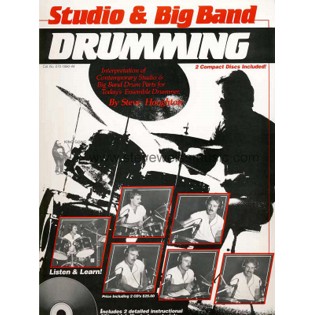
Studio & Big Band Drumming by Steve Houghton - 1985

This has been the definitive book on the subject for almost as long as I've been playing. Includes an essential, very concise but thorough explanation of terms and notation in professional charts. There are one or two page introductions to swing, rock, "Latin" and country styles. The swing section is good, the single page of Latin grooves is pretty dated; people have gotten much more serious about authenticity with those feels since the mid-80's. Probably most important for drummers are the pages on articulating a horn part, the "eighth note rule", and jazz phrasing. There are also many pages of sample ensemble figures, and authentic playalong charts.

College level. 68 pages, with 2 CDs of recorded figures, ensemble passages, and studio charts.


Monday, November 28, 2011

A bargain on a great book - UPDATED

UPDATE: The book is now coming up at the usual $99.95 price. Hopefully a few people were able to take advantage while the opportunity was there. It's still a worthy addition to your library at the full price, if you can afford it.

I couldn't resist bringing this to your attention- Joel Rothman's Compleat Jazz Drummer is currently available at less than half price at Amazon.com- $45, when it normally goes for $90-120. It's not exactly commonplace, so forget about finding a used copy. I've been meaning for months to do a review, but you'll forgive me for finding writing about this 500 page behemoth a little daunting. I think the only way I can deal with it right now is just to make a laundry list of what it is/what I like about it.

Here we are, in no particular order:

1. Takes the Chapin-style of jazz book just about as far as it can go. Contains coordination/comping patterns for one, two, or three limbs in a variety of feels- triplets/swing 8ths, 16ths/even 8ths, double-time feel, 12/8 feel. That last is, I believe, the key to understanding and copping Jack Dejohnette's elusive fast-within-slow thing.  So you can be the first kid on your block to nail that one.

I believe- but haven't gotten confirmation- that Dejohnette may have actually worked with Rothman's materials in developing that. I haven't seen similar materials anywhere else, and this book is one of two drum books referenced in the Dejohnette/Charlie Perry book.

Read on:

Monday, May 16, 2011

Interview: drum author Joel Rothman

[UPDATED 5/16 - Something I had to add to the piece came up in my correspondence with Mr. Rothman. See the new section labeled "PROFIT"]

Joel Rothman
is one of the more mysterious figures in the drumming world; he is an extremely prolific and widely-known author of of well over 100 drum books, over 70 of which are still in print, titles including the popular Mini Monster Book of Rock Drumming, and "the pink book", Basic Drumming (read my review), as well as the massive c. 2500 page "compleat" series of hard bound books. He has sold well over a million books through his publishing house, JR Publications. For other publishers he has also written approximately 35 humor books for both children and adults, a dozen or so hardcover children's books, as well as several crossword puzzle and quiz books. He has nevertheless remained largely unknown personally, keeping a very low profile into the Internet age, with virtually no personal information available on line.

Though published over a period of five decades or more, his books continue to be absolutely relevant, and are an important contribution to the literature of drumming. I'm not going to attempt to summarize such a large body of work, or analyze its appeal- I have several new reviews coming in the near future that will delve into that- but I'll say he investigates areas of drumming unexplored by others even today, dedicating entire books to very particular drumming problems- slow tempos, hi-hat splashes and endings, for example. Over the course of many volumes he has expanded upon the world Stone's Stick Control in ways not found in that book or in its other successors. He deals with more familiar material with a unique player's logic I believe is very well adapted to the practical needs of drummers. It is not difficult to fill many volumes with variations on familiar materials ("now play the accent on the LOW tom"), or by mindlessly reeling off mathematical/logical permutations, as many have done; so creating such a large volume of work of continuing value, with minimal redundancy, is a major writing feat. Writing even one good book is beyond the capability of most authors.

I wasn't sure what to expect when I contacted Mr. Rothman- I thought he might be very protective of his privacy- but he has turned out to be a very affable person with a fine sense of humor. Here he has very generously agreed to share the story of his life and business:


BEGINNING
I'm 73 years young, but if there were 24 months in a year I'd only be 36 1/2. And in dog years I'm just over 10.

I was born in Brooklyn, NY in 1938. My mother understood me to be a musical prodigy, but she was wrong. I was much more than that- I was probably a total pain-in-the-a--.

Continue to the complete interview: 

Light posting

I'll be on light posting for a couple of days while I finish up a bunch of Ornette Coleman arrangements for an upcoming recording session. In the mean time, enjoy a whole mess of Paul Gonsalves while reading the updated Joel Rothman interview:

The evening began inauspiciously. Some of Ellington's band members showed up late. The earlier numbers in his set were met with tepid, if pleasant, applause. As Ellington announced the next numbers, Diminuendo and Crescendo in Blue and the soloist, tenor man Paul Gonsalves, there was no indication that something very special would happen within the next 10 minutes. The band made its way through the Diminuendo section in about 4 minutes when Gonsalves approached the mic and IT happened.


h/t to one of my favorite political blogs, Crooks and Liars for the comment and clip.

Saturday, May 14, 2011

Rothman book recommendations

While the interview is fresh, I want to give my recommendations for Joel Rothman book purchases. God knows I haven't seen his entire catalog, but these are very strong books:

Basic Drumming - An everything classic. See my review for more information.

Mini Monster Book of Rock Drumming - Embrace the goofy cover. The best overview of rock/pop/funk/backbeat-oriented drumming I've seen. Review coming soon. You may also be interested Rothman's newest book, which I have not seen, Son of the Mini Monster for Rock Drumming: "...concentrates on developing simple to complex-sounding bass drum patterns against a variety of rock cymbal beats in various time signatures."

Drumming And All That Jazz - An excellent overview of primarily triplet-based jazz concepts.

Basic Drum Technique and Beyond - Contains a lot of material further developing things found in Stick Control. Particularly interesting are the parts dealing with stickings of mixed rhythms, and the dynamics section.

Rock with Hand-Foot Drum Breaks - Primarily a book of drum fills including the bass drum, much of this is more like Stick Control for three voices. Very valuable.

Swingin' in 3/4 Time - One of his earlier books, this first came out when the jazz waltz was still a fairly exotic style- Elvin Jones had just joined John Coltrane's band, and was expressing (I think to Charlie Persip?) what a difficult time he was having playing in 3/4. This is still a solid introduction to playing in three, and an excellent companion to Joe Morello's later New Directions in Rhythm. [Note: Mr. Rothman informs me that this book has been out of print for some time, and most of the content has been included in Drumming And All That Jazz above; there do seem to be a few copies of Swingin' in... available through Steve Weiss Music. I think it's worth the purchase price just for the cover.]

The Compleat Jazz Drummer - The big one, 500 pages of materials, with some very unique stuff. Review coming soon. I personally think every student of jazz should own this book.

Monday, March 21, 2011

Best Books: Basic Drumming by Joel Rothman

In case you haven't figured it out already, I'm a big fan of Joel Rothman's books. His many, many books- I think he has written about a hundred of varying lengths since the early 60's. Basic Drumming is probably the most widely-owned, and contains more than a little of just about everything, without being in any way dumbed-down. A drummer who mastered everything in this book, with an equal amount of performance experience, would be cooking indeed. So the word "basic" is a little misleading.

Rothman has a unique logic to his presentation, which he follows selectively, with a bias in favor of practicality. Often he will use a common performance pattern as a starting place, and then compose a number of variations based on it, which gives the student a starting place, then a number of musical directions to go from it.

Saturday, February 19, 2011

Best books: Like Syncopation

For many years Progressive Steps to Syncopation for the Modern Drummer (better known as just "Syncopation") by Ted Reed was virtually the only drum book I used. As I alluded to in the Joe Cusatis book post, I'm a big advocate of the interpreting-a-melody-line approach to practice, for which Syncopation is basically the Bible. Or Das Kapital, Origin of Species, whatever you like. It does have its limitations, which caused me to look into sources for similar materials. Here is a survey from my library:

Modern Reading Text in 4/4 by Louis Bellson. A classic in its own right. I find the majority of it a little too difficult for daily use- either Bellson is going way outside what is conventional in order to challenge the user, or maybe he is including things more likely to be encountered by horns. I use it primarily for its "10 Syncopated Exercises", which are long exercises similar to the ones in Reed. I haven't devised much in the way of practice methods adapted to the strengths of this book.

Odd Time Reading Text by Louis Bellson and Gil Breines. A thick book dealing with a wide variety of odd meters. There are several pages suitable for Syncopation-type applications, and quite a few more involving triplets and 16ths. Much of it is extremely difficult, in changing or */16 meters, which are frankly of limited value to me.

The Rhythm Book
by Martin Bradfield. Bradfield is a teacher in Pennsylvania who has self-published this book and two accompanying volumes of interpretive methods. Covers roughly the same territory as Syncopation, but with a number of rhythms Reed left out. Maybe the best companion volume of these, and a great value. Highly recommended.