Showing posts with label big band. Show all posts

Saturday, February 18, 2023

Transcription: Buddy Rich - Big Mac

Buddy Rich drum solo on Big Mac, a prodigious funk/rock arrangement by Ernie Wilkins, from Rich's album Ease On Down The Road— it's actually better known from Roar of '74, but I have it on EODTR. I'm not particularly a lover of Buddy Rich's playing, but my God. 

Ever feel like basically all instrumentalists— and arrangers— have forgotten that this kind of energy is a thing? Everybody's moving sideways, fussing around in the fine subdivisions. I'm complaining about the young, people in their 60s definitely haven't forgotten.  
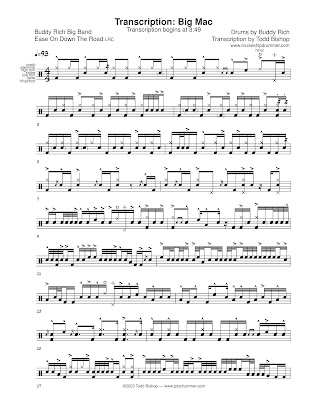
Tempo is 93, the solo begins at 3:49. 


It's Buddy, so lots of rim shots, he's extremely aggressive with his accents. We hear more unisons between the snare drum and bass drum than perhaps with other drummers. It's a powerful sound but kind of crude. His rock thing doesn't sound fully formed, but he's certainly bringing the energy. Who needs fully formed. 

I would expect him to be doing a lot of paradiddles, but here I believe the stickings on the denser stuff are mostly singles. He seems to be playing some very thin little hihats, and mostly hanging out on a very bright 70s 20" A. Zildjian. Tom toms sound good, classic rockin' late 60s/early 70s sound. Very little left foot activity that I can hear. 

Style note for you transcribers: when there's a lot of double time— 32nd notes and sixtuplets— it's best to create a little imaginary beat separation between the downbeat cluster of notes and the &-of-the-beat cluster of notes, connecting them with a single beam, as I've done here. 


Sunday, June 30, 2013

Three Buddy Rich transcriptions

London-based drummer Caroline Scott has posted three Buddy Rich transcriptions— Big Swing Face, Mexicali Nose, and Love For Sale— sort of the big three of Buddy tunes for me, plus Ya Gotta Try. Very worth grabbing.


Visit her site to get the pages, plus some other things— a Brian Blade transcription, and more.

Audio of the tunes after the break:


Wednesday, May 22, 2013

Mel Lewis on cymbals

More on cymbals from Mel Lewis's 1985 Modern Drummer interview. This is pretty much the bible of the subject, as it relates to jazz:


Number and type
The average drummer usually uses two to four cymbals. To have any more than that is totally unnecessary, because where are you going to put them anyway, and how are you going to reach them? They shouldn't be there just for looks. I notice that most people have crash, crash, splash, ride, and hi-hat. Very few young drummers play on their hihats, except in the rock situation where they generally play them closed and they play their 8th-note beat on them. They should learn that the hihat is another ride cymbal to be played properly—"ta, da-ka, ta, da-ka, ta," changing rhythms and all that, open/closed, all open, half open, half closed. There are a lot of effects. To me, the hi-hat is another ride cymbal.
Every cymbal I use is a ride cymbal. Every one of my cymbals is also a crash cymbal. I only use three. Three is enough.
But every cymbal should be a ride cymbal and every cymbal should be a crash cymbal. I've been noticing that almost everyone has only one ride cymbal and a million crash cymbals. You don't need the crash cymbals. You need the ride cymbals, because that's where your whole thing is coming from. Crash cymbals are only for accents, so you can hit any cymbal for a crash.  

Dark
I find that all the cymbals should be dark. If you want a high-pitched splash cymbal or crash cymbal, fine. That's to your own taste. But darker cymbals are more complementary to horns than any other kind of cymbal. High-pitched cymbals have a tendency to obliterate high sounds. 
 The more high-pitched cymbals you have, the more trouble you're going to give the band. Also, for riding in a big band, I think that the pingier a cymbal is and the less overtone and spread it has, the more empty everything will be. It's important that you have a good, full, fat-sounding cymbal. Finding cymbals like that today seems to be a problem. They are all too heavy. Definition is one thing, but those pings do not cut through. There has to be a little more sound to a cymbal than they're creating right now. They've forgotten how to make ride cymbals with color. They don't know what dark sound is. That's why I still like the old K.'s. They're hard to find, but it seems like they are the only cymbal that was made for music. 


Orchestrating cymbals for big band
[W]hen you hit a high crash cymbal with the brass section while they're up in that high register, you will knock out half their sound. But if you hit a cymbal that will blend with that section—in other words, if there are four trumpets and the fourth is playing the lowest part, you should be the fifth trumpet, which is lower yet. Now of course, we can't go that low all the time, but that's the way I'm thinking musically. Trombones, of course, can go lower than my cymbals can, so I want to be somewhere in the middle register where I don't obliterate the lead and I don't destroy the bottom.
With the saxophones, you want a roaring sound to envelop, because reeds don't have the power that the brass has. That's why I believe that during a sax soli— where you have five saxophone players standing up playing together—nothing sounds better behind them than a Chinese ride cymbal, because there's a blend. Bass violin players love Chinese cymbals because the low sound and the Oriental type of roar make the bass sound spring forward. That's why, when we play big ensembles, I'll go to that cymbal, and you can hear the bass just singing through everything. When you've got a whole ensemble, you want a strong, enveloping, low sound with a lot of clarity as far as the beat is concerned. It's like a picture with a beautiful metal frame around it. It gives tremendous fullness to the sound of the band.

Continued after the break:

Monday, December 03, 2012

Groove o' the day: “They called him Craw.”

This new grooves book is almost done, believe it or not— the 20% discount on the transcriptions book should be good for just a couple of more days. The last new thing I put in the new book is this 12/8 groove by Jimmy Crawford, played on the snare drum first with brushes, then with sticks:


The sticking is mine, and the groove may be a composite because there is at least one other uncredited drummer playing along with him, and it's difficult to say who's doing what. Here's the audio:


After the break: the meaning of that headline.

Wednesday, March 21, 2012

Several big band drumming books

A couple of new/old big band drumming books dropped into my lap recently, so what the heck, I thought I'd round them up for you:

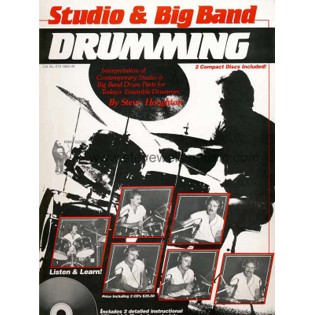
Studio & Big Band Drumming by Steve Houghton - 1985

This has been the definitive book on the subject for almost as long as I've been playing. Includes an essential, very concise but thorough explanation of terms and notation in professional charts. There are one or two page introductions to swing, rock, "Latin" and country styles. The swing section is good, the single page of Latin grooves is pretty dated; people have gotten much more serious about authenticity with those feels since the mid-80's. Probably most important for drummers are the pages on articulating a horn part, the "eighth note rule", and jazz phrasing. There are also many pages of sample ensemble figures, and authentic playalong charts.

College level. 68 pages, with 2 CDs of recorded figures, ensemble passages, and studio charts.


Monday, March 12, 2012

VOQOTD: Mel Lewis


"...you should start with a crash and end with a crash. I see drummers ending with a crash cymbal, but then choking it. When you hit that big chord at the end, let it ring. Hit that bass drum and hit that cymbal—"POW" instead of "pop." That's exciting. There should be a finality to that final blow, unless it's a soft ending, of course. Then you don't even need a cymbal at the end, although I like to hit one softly. But that's always been a thing of mine: Start with a crash and end with a crash." 
- Mel Lewis

Tuesday, February 07, 2012

Butch Miles on ensemble playing

Big band drumming tips from Butch Miles, from the Oct. 1977 issue of Modern Drummer. They apply to all types of music, of course: 

SUPPORT. If the band has a difficult passage, support them strongly. Let them rely on you for cues and dynamics.
DON'T GET IN THE WAY. There's no reason for you to play something rhythmically difficult if it detracts. Simplify it. You're responsible for keeping the band together.
DIRECT. Learn the entrances for ensembles and cue them in with authority. Always let the band know where they are.
DON'T OVERPLAY. Sometimes a well-placed rim shot in an arrangement has more impact than 10,000 notes. Learn the importance of silence.
KEEP THE ENERGY LEVEL UP. There's nothing that sounds as sad as a band dying in the middle of a passage.
LEARN THE CHART. Get your nose out of the music and be comfortable.
LEARN TO PHRASE. This is an art in itself. You don't have to play every note the band plays. Let them breathe. Learn when to punch, and when to back off. Talk to the leaders of the other sections and ask them exactly what they might want in the way of support in an ensemble passage. They may have some very valid ideas that you hadn't thought of. Don't be afraid to ask.
TIME. Never lose sight of the fact that you're the keeper of the time. That's the first and foremost job of a big band drummer - much more so than that of a small group drummer.
LISTEN, LISTEN, LISTEN. Learn the nuances, the dynamics of the arrangements. My boss, Count Basie, put it all together when he simply said, "LISTEN". As a big band drummer, you must be listening all of the time; listen to the soloist and support him; listen to the ensemble and guide them — cue them correctly; listen to the dynamics and play within that framework, but most importantly, listen to the overall sound and to yourself in the whole picture. Do you detract or do you support? A tape recorder is a great help. Listen to yourself on tape and be your biggest critic. That tape recorder never lies.

After the break are a couple of clips of Miles playing with Count Basie's band in the late '70's.

Sunday, March 27, 2011

Krupa G.P.

Still light posting, but listening to the Mel Lewis history of jazz drums interview and they're discussing a favorite move of Gene Krupa's- during a shout chorus leaving a dramatic silence where there would normally be a fill. Here he does it at 0:38:

Tuesday, March 08, 2011

Basic big band set-ups

Another in the recent series of easy stuff, here is a page of basic set-ups for ensemble kicks on the & of 4. You can apply these to my earlier piece, Kicks and Set-ups Using Syncopation.


Download the pdf.

Friday, January 21, 2011

Kicks and set-ups using Syncopation

Here's a little method I devised for working on basic big band-style kicks and set-ups, using Ted Reed's Syncopation. Like many of the ways of working with Reed, it involves some selective reading/interpretation, but in a constructive way. We're not just making things difficult because we don't feel like buying another book- the interpretive skills developed in this method are very close to what's required in playing actual charts. The biggest leap of imagination is putting in the ties, and you can mark those in with a pencil if you want.


Download the pdf from www.pdxdrummer.com.

Wednesday, January 19, 2011

March 1985 Modern Drummer interview: John von Ohlen


Interview with big band drummer John von Ohlen from Modern Drummer, March, 1985, by Scott K. Fish, with the many good parts pulled out here, by me. Von Ohlen toured with with the Woody Herman and Stan Kenton bands before retiring from the road to live in Cincinnati, where he formed the Blue Wisp big band. I forgot how much this influenced me- I must've reread this a dozen times during the long bus rides on drum corps tour when it was originally published. I was never much of a big band player, but Greg Hall did have us playing Blue Wisp's Love For Sale arrangement at South Eugene High School that year.

Interview excerpts are after the break: