Showing posts with label Bill Stewart. Show all posts

Thursday, October 17, 2024

Bill Stewart

I've been listening to a lot of John Scofield this week, and realized I basically never talk about Bill Stewart here. It's weird, he's on anyone's short list of top living jazz drummers, particularly of those who became known in the past 35 years. As a massively influential drummer, he became well known right between Joey Baron and Brian Blade. 

I first heard him on Scofield's 1991 record Meant To Be, and it was one of those epochal moments, like the first time I heard Dave Weckl— like this undeniably is the new thing. I associated what I was hearing with Roy Haynes, who was getting revived about that time via Pat Metheny's record Question & Answer, and it seemed cool that Stewart seemed to be influenced by him. 

In particular there was one spot where he just played some quarter notes— Big Fun, the track below, at the end of the head— from which I took a big lesson, about using the full range of what you could play, having creative access to all of it. Any time something like that jumps out at you, it's a big deal. 


He definitely seemed like a completely fresh animal, a new generation of player— highly musical, a highly skilled improvisor, clearly with broad tastes, a very sharp musical intellect, and creative with all four limbs. He seemed to be on a new level with all of that, while not being merely amazing.  

He has been massively influential in terms of sound— I'm thinking about his sound on three fairly early recordings, that were very influential on me, at least: Scofield / Meant To Be, Pat Metheny & John Scofield / I Can See Your House From Here, and Joe Lovano / Landmarks. It's a very cute sound, with a cranked snare drum, and high, round-sounding toms and bass drum. It's very clean, pretty, and musical— maybe Jack Dejohnette's sound was the closest recent influence to it. It's so ubuquitous now that it seems inevitable, but the other big people before Stewart were Joey Baron and Jeff Watts, both of whom used bigger bass drums, and had punchy or medium tunings with their toms, respectively. 

His cymbal didn't jump out at me so much, but it's clearly an exemplary sound— a smaller, more transparent K sound than Brian Blade's, the other big recent influence in that area. Youtubers have turned his sound and technique into a meme— of course it came simply through him dealing with a slightly too-light cymbal, a familiar situation: 


And listen: I'm not being disparaging calling his sound cute, it's a particular vibe to me, like Jan Garbarek here:


He has a distinctive touch on the snare drum as well— expressed here in a New Orleans-type street beat groove, which was hip “new” thing about that time. Since then it has become an expected regular type of groove in jazz, largely* off the strength of what Stewart was doing with Scofield. 

* - I can't not mention Jeff Watts here, who had the famous recording of Caravan with Wynton Marsalis, and also Terri Lynn Carrington, who played the groove on a previous Scofield record. 


Finally, here's a great interview with him, by Pablo Held— I hadn't listened to it before writing this, and I'm happy to see a couple of my observations confirmed.  

There's a great part about improving time at about 43 minutes in: 


So, I don't know why I don't talk about him much— partly I've been more immersed in older players since I've been writing this site. He's clearly a durable artist, he's doing the real stuff— I'll listen to some players, and they may be great, but their concerns clearly seem different from mine, and I can't sustain a lot of interest. Stewart is not in that category, I'll be listening to him a lot more in coming weeks. 

Friday, December 11, 2020

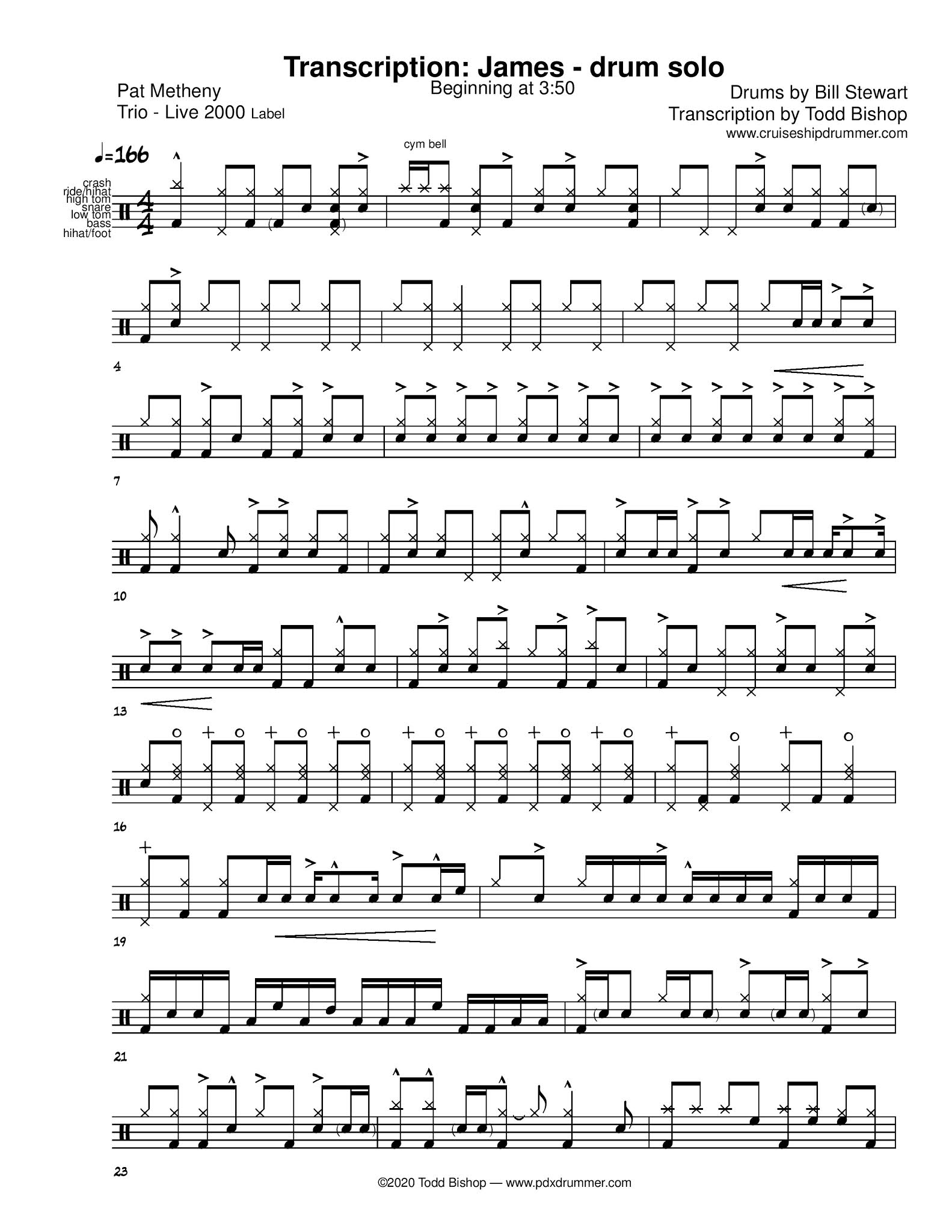
Transcription: Bill Stewart solo

Something released in a year starting with a 2, for once. Here Bill Stewart solos during James, from Pat Metheny's Trio - Live record. Stewart is a few months older than me, and is sort of the archetypal drummer artist of my generation. I first heard him on John Scofield's Meant To Be in 1991, and it was instantly obvious that he was doing something fresh and extra-musical. It's routine now for drummers to sound like him, with that pretty tom tom sound.    


The solo begins at 3:50, the tempo is quarter note = 166— on the real scale of tempos, that's pretty bright to be double timing, playing 16th notes. I'll talk about what I mean by that another time. 

It's mostly 8th notes, and he mostly stays on the cymbal and snare drum. There are some open drags with the left hand— that's the occasional 16th notes you see— and a big 16th note lick near the end of the first page. He plays his one note on the third tom tom on that. There's a passage of 16th notes in the second page, too— notice he repeats the same idea in measures 30, 31, and 33. Plus a BSSB pattern with a cymbal on the first note. 

He uses that pattern repeatedly. As I do— it's extremely useful and sounds cool— it's good to get very friendly with it. Let's credit Elvin Jones for originating that one. 

The open hihat lick in the middle of the first page is questionable. I've written it as if he plays the open notes with his left hand, but he could be splashing it with his foot. If that's the case it's a pretty developed technique, which you'll need to spend some time with. 

Get the pdf

Monday, February 18, 2019

Groove o' the day: Street beat in 7

Here's a New Orleans street beat-style groove in 7/4, played by Bill Stewart. The tune is 7th Floor, from John Scofield's album Hand Jive. This is the basic groove from the intro of the tune; he mixes it up for most of the track.


Swing the 8th notes slightly. Play the 16th notes as an open drag with the left hand, and crush the buzz on beat 7 with both hands. Hihat splashes with the foot every two beats all the way through. Some call that playing the “big” 7— playing two measures of 7/4 as one measure of 7/2... with the hihat on the offbeats, in this case.


Monday, March 19, 2018

Bill Stewart on cymbal technique

Here's a nice video of part of an interview with Bill Stewart, speaking with Quincy Davis of the University of Manitoba, in which he discusses his cymbal technique. It relates to my earlier ranting and raving about technique in that the conversation is entirely about sound— nothing about speed or high performance in here anywhere. Nothing about technique in the abstract. It's all about getting a sound he seeking from a cymbal he was using at the time.


The rest of the interview is great, too.

Saturday, May 09, 2015

George Colligan on playing the ride cymbal

THAT cymbal— listen and copy the sound.
Some good advice from former-New York/now-Portland/Jack Dejohnette-sideman/pianist/(and drummer, too) George Colligan, on the importance of your ride cymbal interpretation in jazz. The context is that he was judging student combos at the Reno Jazz Festival:

The ride cymbal is the most important part of a jazz beat. I would say that almost every other group I listened to in Reno had the same issue; on a swing beat, the ride cymbal was being accented on 1 and 3, rather than 2 and 4, and the hi hat was being used as a crutch to keep the 2 and 4 prominent. 
Now, I'm not saying that 2 and 4 have to be super loudly accented on the cymbal, and that you should never play the hi hat on 2 and 4. It's more subtle. To my ears, a strong accent on 1 and 3 on the cymbal sounds less than optimal( i.e. not swinging). Every jazz drummer from Max Roach to Jimmy Cobb to Billy Higgins to Ralph Peterson to Bill Stewart has a different way of riding on the cymbal. But I believe in all of the great jazz drummers, the ride cymbal beat is what makes them distinctive, and what makes the music flow the best. We can identify jazz drummers by their solo vocabulary around the kit also, but the great jazz drummers were and are in demand because of the feeling they gave the groove of the music, not because of their solos! 
I was on the road recently with Bill Stewart, and I think we were talking about rudiments, and Stewart said something like, "You might know all the rudiments but if you don't get the ride cymbal together, nobody is going to call you! So the point is, the ride cymbal has to feel good. Don't worry so much about the rest of the kit; I would rather have the ride cymbal be good than having someone play all around the kit without good time.

There's more good stuff on other subjects in the post, and I suggest you head over to Colligan's Jazz Truth blog and give it a read.

It's probably time for a little in-depth discussion on how to play the ride cymbal. It's not the 50s anymore, and we don't have the luxury of just being in the present and doing our one thing; we have to be able to cover ~50 years of history like we invented it. There are a number of popular cymbal interpretations, all of which I may use in the course of an evening's playing. Coming soon...

Saturday, June 30, 2012

Cracking 5/4: further listening

Aaaand I thought we'd end this series with some more listening, starting with some more modern things:

Jive Coffee - Brad Mehldau with Jeff Ballard


 Much more after the break: