Showing posts with label ECM. Show all posts

Sunday, September 15, 2024

Double time Reed tweak: one step beyond

Launching to the outer limits of what you can reasonably do with Syncopation, verging on losing the melody rhythm as a point of reference. Or not, see what you make of it. 

Using one of the more useful double timing things (the second item on this page of warmups), and changing what we do with bass drum. Reading from pp. 34-45 in Syncopation.

After playing the plain right hand lead version of the book rhythm with hands only, the steps are: 
  • Do the added 16ths— single Ls = two 16ths / LR, two Ls = LRRL, three Ls = LRRLRL. 
  • Add bass drum on beat 1. 
  • Add bass drum to the added RH 16th notes— immediately after the snare drum. 
  • Add bass drum on any remaining isolated notes of the melody rhythm. 
Here, figure it out: 


This actually creates a kind of a double time rubadub. The bass drum added on beat 1 is a little random— don't do it if it creates any kind of problem. Like if there's not a cymbal note on 1. 

On the second page of the pdf I wrote out how lines 2-3 of the p. 38 exercise will go, with each step. 


Doing all this systematically while reading full page exercises in Reed is rather difficult— we can give ourselves a pretty wide latitude for errors/inconsistency with that— if you can read p. 38 at a bright tempo with the bass drum part landing somewhere between items 4 and 5, you'll be doing pretty well.   

Wednesday, August 21, 2024

Transcription: Jack Dejohnette - Tumbleweed - 01

Jack Dejohnette playing on Tumbleweed, from Michael Brecker's album Pilgramage— released a few months after his death. This is the type of playing much of what we do here is in service of. 

For a moment it sounded like the tune is in 7, but that's because the bass hits the root on the & of 4, and again on the 1, which is a little unusual. The transcription starts at the beginning of the track, and goes through the first time through the head— it repeats quite a few times. Tempo is 89 bpm. 


There's some random-ish hihat activity, which I usually don't include, except I think it's a co-equal voice with the ride cymbal, almost, as far as constructing the groove is concerned. In the last two measures there's some unusual bass drum activity, partly in unison with the hands, partially in the gaps. Not all of it is real audible, that interaction between the snare drum/tom tom and bass drum is a little buried, the statement there is about the hands.  

Get the pdf

Monday, August 08, 2022

Transcription: Jack Dejohnette - Gentle Rain

This tune shows you one way of opening up a Bossa Nova groove, in a modern jazz setting. It's Jack Dejohnette playing on Gentle Rain, from George Benson's album Beyond The Blue Horizon. I'm listening to a lot of CTI records lately. I like the cymbals sounds, and the music. 

This is the first part of George Benson's solo, starting at 1:38. He mostly stays in the original 8th note bossa groove, taking it in a rather funky direction at times. This is largely about cymbal and bass drum. Early on he plays some isolated 16th, later he gets denser— on this part he doesn't fully double time it, on the next part he goes into a more double time post-bop feel. The organ keeps the bass line in the original groove. 


The bass drum here is a rather high and dry sound, so it's nimble enough to do all the stuff he's doing by just touching it. Note that he plays a tresillo-type rhythm on the bass drum sometimes— to my ear that's suggested by what the organ is doing. The written accents are subtle— just a suggestion that the groove has some dynamic shape within itself you might not expect. He's using a narrow range of sounds here— one cymbal, rim clicks on the snare drum (sparsely), and bass drum. If he's playing the hihat, it's mostly inaudible. 

Things get busy in part two, I'll post that whenever I get around to doing it. 

Get the pdf

Wednesday, May 25, 2022

EZ ECM: entry to 7/4

Hey, a few broad, non-technical creative possibilities for playing a straight-8th, ECM-type texture in 7/4, which also apply to using Ted Reed's Syncopation on the drum set broadly.  

First, we need some rhythms to work with— print my photoshopped page of Reed rhythms in 7/4, or use Syncopation itself and read creatively— two measures of 4/4 minus one beat at the end of either measure = 7/4. In this post the rhythms used are all from page 34 in Syncopation, converted to 7/4 time. 

Start by playing the rhythm on the cymbal— here's the line 4 rhythm converted to 7/4. Play it on a cymbal with one hand, or on two cymbals with both hands, with an improvised sticking: 


Here are some possible rhythms to add with the left foot: 


And some possible bass drum rhythms: 


You can add snare drum and bass drum based on long and short notes— add snare drum on some or all of the 8th notes, add bass drum on some or all of the quarter notes and tied notes:  


Also try filling in the gaps in the rhythm on the snare drum, and add some bass drum in unison with the right hand:


We don't want to be always tied to the 1, so try this two measure practice phrase, with an added tie on the last note of the first measure. For general fluency, and so you don't blow it and get lost when this type of anticipation comes up in playing. 


Get my archive of sampled practice loops, find the loops in 7/4, and play along with them— start with two moderate tempo ones by John Zorn: Hadasha and Hodaah.  

Saturday, March 26, 2022

Groove o' the day: Jack Dejohnette - Polar AC

Jack Dejohnette playing a straight 8th groove on Freddie Hubbard's Polar AC. This gets called an ECM feel today, but maybe we should start calling it a CTI feel. Change it up, direct people to some other records. 

I've transcribed the intro of the tune, right up until the trumpet comes in: 


The groove suggests a 2/2 or half time feel— a free texture somewhere between a samba and funk feel. The main point of interest is the mostly-linear snare drum and bass drum activity, with some overlapping. The accents are subtle— he plays the snare drum at a pretty even volume.  


Tuesday, August 03, 2021

Dejohnette patterns

UPDATE: Oops, there's a duplicate pattern in there— I think pattern 9 happens three times. And I got sloppy with my beaming standard. Oh well, it happens when you're rushing to post stuff.   

Some patterns extracted from these recent two Jack Dejohnette transcriptions. You could do essentially this with every transcription on the site— get your pencil, draw a bracket over any part of a transcription that looks interesting, practice that, develop it into something you can do in a musical texture. Sharpie a big rectangle around it. 

These are not particularly unique patterns— you can make something similar to them using a variety of sources, especially Stick Control and Syncopation. We'll take advantage of them all being written on one page (two pages) to practice combining them. Many of them are four note patterns played twice. At the end of page 2 there are some patterns that are essentially grooves. Patterns 7 and 19 are polyrhythmic/polymetric patterns that can be played over two or more bars of 4/4 or 2/2. 


Practicing these, I essentially play around with them as musical ideas, moving them around the drums and cymbals, varying the accents, playing obvious variations on them, and finding ways to end them other than by stopping on beat 1. I might practice them the same way as my “Funk/Figure/Cliché Control” pages, combining measures without stopping, one time each: 1-2, 1-3, 1-4, etc, 2-3, 2-4, 2-5, etc, 3-4, 3-5, etc, and so on.  

Get the pdf

Sunday, August 01, 2021

Transcription: Jack Dejohnette - Directions

Here's that Jack Dejohnette transcription I mentioned yesterday— on the intro of Directions, from Miles Davis Live at the Fillmore East - It's About Time.

The 8th note quintuplets I mentioned happen right up front, when he's playing half-free, not quite settled on the main groove. It's possible he worked out the 5s, or maybe he's thinking something else and is just pushing the rhythm around, a la yesterday's post.

The transcription begins at 0:38 in the recording.


All of the squirrelly stuff happens in the first four bars; after that he's in the main groove for the tune. It's mostly straightforward “non-independent” drumming, not unlike what we saw on another recent Dejohnette transcription. The simplest formula for doing that kind of thing is to play a Stone-type sticking pattern, with the RH on the cymbal (with bass drum in unison), LH on the snare. Here the snare drum is a little more active, and sometimes overlaps with the RH/cymbal part. And he doesn't play the cymbal on all of the bass drum hits. It would be easy to make some kind of formula to do that— and I probably will— or you can just do the Stick Control type thing a lot and play around with it, which is probably what Dejohnette did. 

I just made a label non-independent drumming, which is so far only attached to this post. If you dig around in the posts under the ECM label, you'll find most of what will eventually get that new label.  

Get the pdf

Saturday, June 19, 2021

Dejohnette-like method

The cosmos gave me a couple of instances of Jack Dejohnette yesterday— I got to work on that Jack Dejohnette transcription, and also happened to also catch him on the radio (KMHD.org, The Afternoon Bridge, hosted by my friend Ben Turner), playing with Michael Brecker. I thought about it for a few minutes and wrote this. I wish I had thought about it 30 years ago, I could have used this.  

It's another way of practicing Ted Reed's Syncopation— or any other rhythm book in the world— to develop some Dejohnette-like free flowing busy stuff. Good for soloing, or for that dense accompanying textural playing that nobody ever talks about as a thing.  

Its major elements: 
•  Play the melody part on the cymbal and bass drum with the right hand.
•  Fill in 16th notes on the snare drum with the left hand, ending with bass drum, where it fits. 
•  Break up the longer runs of filler by bringing the right hand to the snare drum. 

It's relatively difficult method to read—you need to be really quick at identifying how much space there is between notes. Here's the key— I've included syncopated versions of a couple of them, and a couple of longer values not found or not common in Reed: 


Note that I accent the singles at the end of the snare drum part. That just happened naturally when I was practicing it. Practice the patterns, then practice them substituting the appropriate pattern for the rhythms in the book. 

I'm practicing this along with my John Zorn / Beeroth practice loop, or with Betty Davis / If I'm In Luck...— in cut time, so the 16ths of the exercises are 32nd notes in the meter of the loop. I think you'll find it goes easier if you practice Reed pp. 35, 37, 34, 36 in that order, before getting into the full page exercises.

Get the pdf

Sunday, June 06, 2021

EZ ECM feel - 01 - unisons

This is the first part of a little method I used in a lesson recently, for introducing what has become known as an ECM-type feel— a modern, non-repetitive, quasi-linear, straight 8th jazz feel. See Jon Christensen's playing on Keith Jarrett's Rejoicing or Jan Garbarek's Dansere for a quick introduction to it. This method should help in learning to create an ad lib texture, interpret a melody line or bass line in a chart.  

As always, using Syncopation by Ted Reed...

...increasingly I feel this is like saying “Today we're using letters from the alphabet to write this poem.” “We're going to use colored to paint to make a painting.” Syncopation is a book of rhythms and, as drummers, rhythms are our raw materials. 


So, we'll read the rhythms from the book, pp. 34-38, and interpret them a certain way on the drumset, to simulate a simple improvised drumming texture, and prepare you for improvising your own similar texture, and to simulate a real life reading situation.

For the examples we'll use the first line of the full page exercise on p. 38 of Reed:


1. Play the top line book rhythm on the cymbal: 


As a general rule, you'll want to accent the long notes slightly. Make it sound nice, this is your lead voice.


2. Play with left hand added in unison: 


Play the snare drum and bass drum quieter than the cymbal. Improvise bigger accents wherever you like. 


3. Play with left hand added on short notes only— untied 8th notes: 


4. Play with bass drum added on long notes only— anything longer than an untied 8th note:


Play the snare drum and bass drum together for a denser texture:


You could practice alternating measures of 3. and 4. to create a realistically sparse, varied texture: 


A next step would be to repeat the previous items while playing 8th notes on the cymbal, and then improvise textures similar to all of the things you've done here:


See also my other ECM-related posts, and my other EZ methods, many of which will be similar to what we've done here. 

This does rely on you having an idea of the kind of kind of music in question, so you have to listen to some records and try to copy that sound and basic vibe. 

Listen to: 

Pat Metheny / Bright Size Life - Bob Moses on drums
Jan Garbarek / Dansere - Jon Christensen on drums
Keith Jarrett / Rejoicing - Jon Christensen on drums
Gary Peacock / Tales of Another - Jack Dejohnette on drums
Gary Burton / Ring - Bob Moses on drums

Friday, March 19, 2021

Reed tweak: filling the long gaps

Here's a tweak to an ordinary straight 8th note Syncopation practice method: right hand plays the melody rhythm, left hand fills in the remaining 8th notes. Usually with the RH on a cymbal, with the bass drum in unison, left hand on the snare drum, like so:  


We could call this the stick control interpretation, because the result is exactly what we'd get if you played the first pages of Stone with the Rs on the cym/bass drum, Ls on the snare drum, each played with the indicated hand. This is the major Reed method you use to get an ECM-type feel.

With that basic drill, the left hand fills in one, two, or three 8th notes in a row. With this tweak we're going to play a left handed paradiddle where the left would have played two notes, and a left handed double paradiddle where the left would have played three. Play the single lefts normally. Do this with pp. 30-32 and 34-45 of Reed (current edition). 

First play these warmups— they cover all the forms the paradiddle fills will occur when practicing the method out of Syncopation:


Here are the first six lines of the well known p. 38 (née 37) Syncopation Exercise 1, written out with this tweak. I don't feel like writing up a full-blown key, so you'll have to get out your book and compare the two. 


This is not unlike my recent uptempo method, in that we have to do some next-level reading— we have to do different things with spaces (or runs of 8ths) of different lengths. It seems daunting in the abstract, but it's reasonably easy when you just do it. 

Finally, try using your own four or six note stickings or patterns as well. Best if they start with the left hand, and release with the right, at first. I'll share some of mine soon.  

Get the pdf

Friday, December 11, 2020

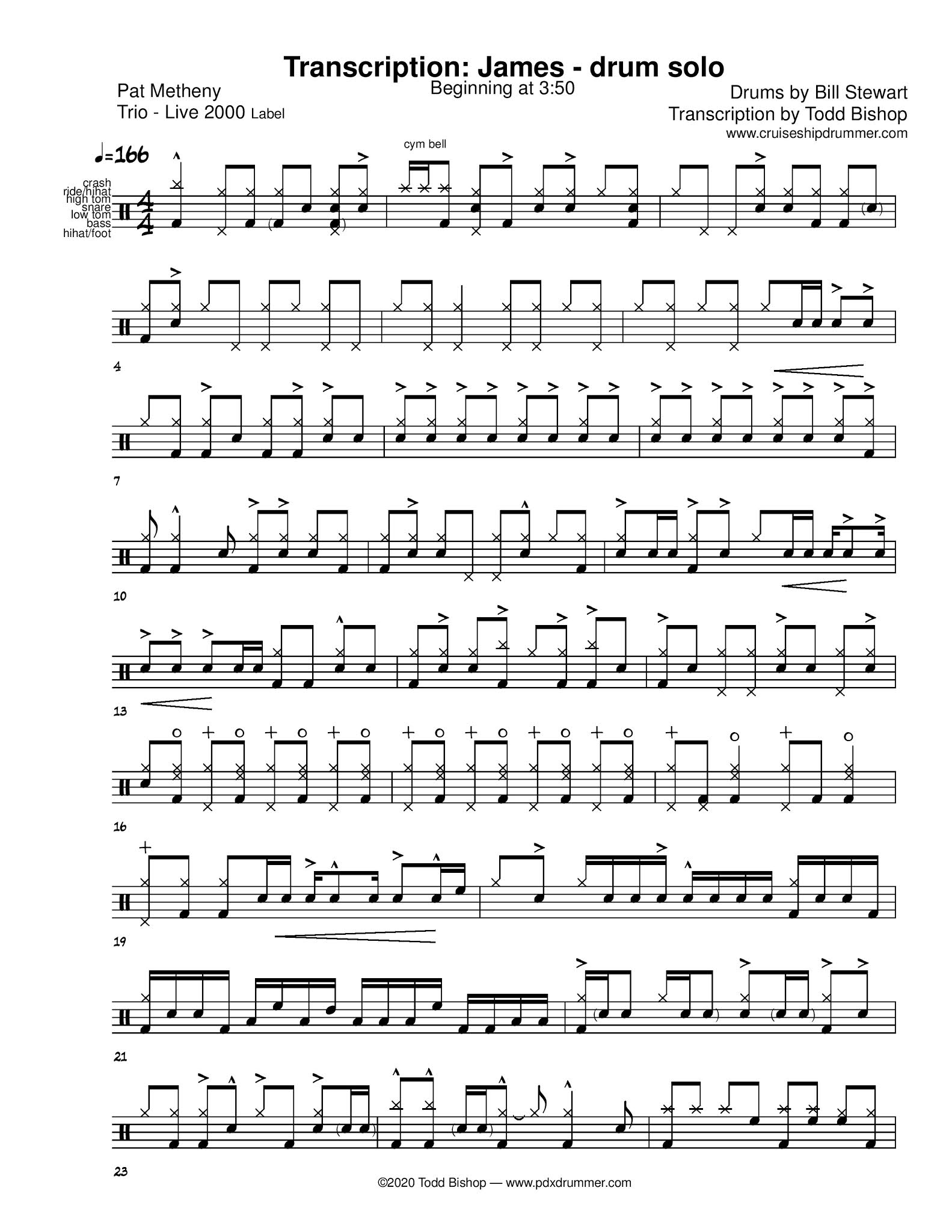
Transcription: Bill Stewart solo

Something released in a year starting with a 2, for once. Here Bill Stewart solos during James, from Pat Metheny's Trio - Live record. Stewart is a few months older than me, and is sort of the archetypal drummer artist of my generation. I first heard him on John Scofield's Meant To Be in 1991, and it was instantly obvious that he was doing something fresh and extra-musical. It's routine now for drummers to sound like him, with that pretty tom tom sound.    


The solo begins at 3:50, the tempo is quarter note = 166— on the real scale of tempos, that's pretty bright to be double timing, playing 16th notes. I'll talk about what I mean by that another time. 

It's mostly 8th notes, and he mostly stays on the cymbal and snare drum. There are some open drags with the left hand— that's the occasional 16th notes you see— and a big 16th note lick near the end of the first page. He plays his one note on the third tom tom on that. There's a passage of 16th notes in the second page, too— notice he repeats the same idea in measures 30, 31, and 33. Plus a BSSB pattern with a cymbal on the first note. 

He uses that pattern repeatedly. As I do— it's extremely useful and sounds cool— it's good to get very friendly with it. Let's credit Elvin Jones for originating that one. 

The open hihat lick in the middle of the first page is questionable. I've written it as if he plays the open notes with his left hand, but he could be splashing it with his foot. If that's the case it's a pretty developed technique, which you'll need to spend some time with. 

Get the pdf

Wednesday, November 25, 2020

From the zone: ECM feel

Here's something sent in by Ed Stalling of Missoula, Montana. He mentioned being inspired by my ECM feel post from 2012— which definitely needs to be revisited and some links updated— but he's got his own thing happening here. 


I like the idea of notating flam rudiments for two voices this way. Normally on drumset I would write them with two complete rhythms on one set of stems. Here you can ignore some of the notes, and just play the basic sticking pattern, and add the flams to make the more challenging overlapping independent rhythms. It really suggests some interesting possibilities for ways of practicing Stick Control. You could do that with the flam pages from Stone, but I don't find it real inspiring with the flams/unisons in the same place every time.  

Get the pdf

I encourage you to send in your own writings for inclusion in a “FROM THE ZONE” post— seriously, anything scraped off the floor of your practice room, where you wrote something out to figure it out. I don't care how bad it looks. I want it to look bad. Take a picture with your phone and send it to my email link you see in the sidebar. 

Friday, August 28, 2020

World's shortest Roy Haynes waltz lesson

UPDATE: See the page of practice suggestions for more on this!

Someone on the internet asked me to explain what Roy Haynes is doing on the Chick Corea tune Windows, from the album Now He Sings, Now He Sobs, so I wrote up a little lesson on some of the basic elements, on getting started making the approximate vibe:


Listen to the recording, play through the page in all of the suggested ways, then improvise combinations of things to make a continuously developing waltz texture— that's the part that will take some practice; the ideas themselves are not difficult. Vary the dynamics and articulations with your left hand— use buzzes, rim shots, etc. Roy really exaggerates his accents, and tends to put them in odd places.

Obviously there are some other things happening— he plays some triplets between the snare and bass drum, and plays both hands on the snare drum occasionally— usually 3- or 4- stroke ruffs, open, as singles.

To continue developing this beyond the scope of this page, you should be able to play a regular jazz waltz, and have some basic coordination together with that. See Joel Rothman's 3,5, 7, 9, Jazz! or Joe Morello's New Directions in Rhythm for materials. Get my book Syncopation in 3/4 for more practice resources.

Get the pdf

Sunday, July 21, 2019

Vashkar

The other day I listed some often-played tunes that had some kind of an mystique, at least in my mind. Here's a tune that nobody ever plays, with a lot of mystique. Apropos of nothing— I've just been thinking about it a lot.

Vashkar is a rather impenetrable, hardcore, short little tune— almost a miniature— written by Carla Bley. It has been recorded several times by Paul Bley, and Gary Burton, and Tony Williams Lifetime.

It's like an 8 bar blues written on a gas planet, with a Giant Steps-like air of pitilessness about it. It's not designed to be easy to play on the drums, and it's not amenable to just playing it and getting it by vibe. But it's also weirdly attractive, and seems readable enough to make you want to learn it. Then when someone calls it sometime in the next 15 years, you can be the hard case who insists that you follow the form and make the hits on the solos.

It's not hard to whack out the notes. It is hard to just follow your nose and end up with a good performance. It doesn't develop in a normal way, or give you any room to do normal drummer things like fill, set up figures, or establish a groove.

Above is the lead sheet from Carla Bley's site. The best known chart is found in the original Real Book.

It's eight bars long— six bars of melody plus two bars of space. The opening theme is repeated in bar 5, sometimes with a subito mp dynamic change. Usually no repeat on the head in. Meter is 6/4, phrased as 4+2/4, but there's never a strong feel of being in 6. Often the 2 side is anticipated, so several measures are phrased like this:


In the fourth measure there's the hit on 2, which makes it feel like there's an odd measure. It actually makes the whole last half of the tune feel random.

The Gary Burton and Steve Swallow version on Hotel Hello is best known. On that arrangement the main punches are hit without any kind of set up, which emphasizes that random feeling. The live version below, with Bob Moses on drums, follows that same arrangement, maintaining the form and rhythmic structure during the solos. Bob doesn't set anything up on the head in, either.


Here are some different recordings of it, starting with Hotel Hello:


So, the Burton version is the hard one, where you have to actually know the tune, and be able to blow over form while catching the rhythmic stuff. It's easier when the solos are free— you can read/fake your way through the head and then just wing it. Most of the other recordings do that.

On Paul Bley's record with Pat Metheny, and Jaco Pastorious, Bruce Ditmas plays it in a more aggressive fusion-era way, which is great. In this arrangement there are some added kicks in the last two bars. The other version with Ditmas is basically completely free.

The version from Paul Bley's Footloose has the tune with a normal light rhythm section accompaniment, and more open solos. Pete La Roca is on drums, and maintains the 6 feel throughout. I imagine a lot of people give it this kind of Ida Lupino-like treatment.

The Tony Williams version uses a different arrangement to feature the drums, and him slaughtering the universe on it is part of what gives the tune its aura. He plays it faster than usual, and the melodic phrases are spaced out. Cindy Blackman's version is kind of strange— it's like a tribute rendition.

Hopefully, the tune eventually begins to feel like a long, strange vamp or repeating A section. You learn to follow its little moves, and gradually you're able to get through the tune without stepping on the other parts, and maybe actually make a creative contribution, and take it somewhere interesting on the solos.

Thursday, September 20, 2018

Transcription: Jack Dejohnette - Timeless

Biggest longest transcription we've done here in some time. This is Jack Dejohnette playing on Timeless, another essential recording by John Abercrombie. Jan Hammer also appears. I got my copy of this album at Rasputin's Records in Berkeley, California in 1988. Where did you get yours? Our relationships with recordings are supposed to be significant enough that we remember stuff like that.

This is the title track, which is somewhat overshadowed by the presence of the hypervelocitous madhouse Lungs on the same recording. This tune is very “ECM”, in the same bag as Vashkar and Dansere: slow, with a long spacy intro, a beautiful tune, and spacy soloing over a vamp, or short form. The transcription starts at 4:40 in the recording:


The entire tune is played over a three bar vamp, with two measures of 4/4 plus one measure of 6/4. Later in the tune there are some odd bars— Hammer shorts a few of the 6/4 measures, and adds a beat to one of them. It happens.

Dejohnette plays very softly for much of this, barely ever getting into anything I would call a mezzo forte; the written accents are mostly very subtle. You'll notice his hands don't move around a lot, partly because of that— swinging your arm around naturally creates too much volume when you're mostly playing a couple of inches off the drum. Dynamic situations like this are extremely common in modern playing, and complex, rebound-y, Moeller-y type technique is totally useless in them.

The main cymbal here sounds like an 18" or 20" Paiste 602 Flat Ride, for whatever that's worth to you.

Get the pdf


Sunday, September 16, 2018

Figure Control: 4/4 - Nexus riff

Let's do one of these for the rhythm in the Nexus practice loop. You'll recall, with this Funk Control / Figure Control series what I do is take a single performance rhythm and put a lot of common Reed style interpretations on it, all on one page, so you can practice playing them together easily and completely.

You could do that without me writing it out, but as you're first becoming familiar with this kind of thing, it's good to see it all together. You'll probably end up doing some combinations of things you wouldn't get to if you were just working from memory.


The top portion of the page just gives you the basic rhythm and foundational interpretations of it— there's no special need to practice them, but take a moment to study them and figure out how they relate to the base rhythm. Learn each of the practice patterns individually, then play all possible combinations of them:

A-B, A-C, A-D, through A-O
B-C, B-D, B-E, through B-O
C-D, C-E, etc


For each combination, play each measure once or twice:


ABAB
AABBAABB


Practice each sequence above many times, of course. Take care with the transitions between patterns— get them right in the practice room and you'll have better control when improvising on stage. Don't be too hihat-centric in your practicing— use all the cymbals. Pattern C and the hand unisons in patterns L and N can be played on cym/snare or toms/snare. Move patterns K and O around the drums.

Get the pdf

Thursday, September 13, 2018

Practice loop: Nexus

Practice loop in 4/4, sampled from Nexus by Gateway— a trio of John Abercrombie, Dave Holland, and Jack Dejohnette, that put out a couple of records in the 70s, and again in the 90s. This is from an album that should be in everyone's collection: Gateway II. Tempo is 166 bpm.

This is about bright 8th notes in what is now called an ECM feel. Do your Stick Control stuff with this loop, or your Dahlgren & Fine whatnot, or, hell, any of the Funk Control pages or the Reed interpretations from which they are derived.

Video background art is by Sol Lewitt.


Thursday, August 09, 2018

New Joel Rothman title

In the mail I just received a new book by Joel Rothman: Drumming Outside The Box - for Rock & Jazz. It's basically a library of patterns focused around creating an unbroken rhythm on the drumset, a la Bob Moses's non-independent method— an ECM-type feel. Also good for taking a jazz feel into a triplety, Afro 6-like feel. Or a Mike Clark or David Garibaldi type funk feel. Anything modern and quasi-linear.

The patterns are for two voices— nominally cymbal and snare drum, though you can play them with whatever limbs (or combinations of limbs) you want, adding feet, adding ostinatos— it's designed to be used creatively. Half the book deals with triplets in 4, 3, and 5; the other half covers 8th notes in the same meters, plus a few pages on 16th notes (I usually play 8th note exercises in 2/2, which is functionally the same thing— a four-note subdivision). The patterns usually don't have more than two notes in a row with a limb, so they're designed to be played fast and with minimal technique— a system I heartily approve of. Basically if you can play the first page, you can play the whole book; the focus is on gaining fluency. You're supposed to smoke through a lot of patterns working on this book.

There are other ways of practicing the basic concept of this book— Reed-based methods, Stone-based methods, my Funk/Figure Control system, which is derived from both of them— but sometimes you want to change gears and look at something different. Different sets of patterns written different ways sometimes help you come up with different things. I'm in favor of having a lot of materials around, and doing the same thing different ways.

40 pages. I don't see a price for it yet, but it's bound to be reasonably inexpensive. No reason not to grab it if you're working on this type of thing.

Get Drumming Outside The Box from Joel Rothman Publications

Get other Rothman titles from Amazon via the links below:

Wednesday, January 27, 2016

2-3-4 Method

With today's “2-3-4” method, I'm getting into the “give your practice idea a name so people will remember it and treat it like it's a thing” racket. This is a pretty easy method for use with Syncopation/Ted Reed-type materials— remember, that's where we read a single rhythm of the page, and extrapolate a complete drum set part from it. The “2-3-4” method is so-called because it uses fill-in patterns that are two, three, or four 8th notes long. It may not work as intended with many of the exercises actually in Reed, so I've written up a page of exercises for it.

The concept is very simple: you'll play the notes from the page (the stems-up notes— ignore the stems-down notes) on the cymbal and bass drum together, and fill in between those notes with the snare drum, or snare drum and bass drum, according to the formula below. Count them in cut time— these will be easy to play fast. The concept will come in handy any time you need to play real actively, in any genre of music.


So, all of the rhythms on the page will call for one of the following two, three, or four note patterns. For page rhythms two 8th notes long, like quarter notes or tied 8th notes:


For rhythms three 8th notes long, like dotted quarter notes, or tied quarter and 8th notes:


For rhythms four 8th notes long, like half notes, or tied 8th notes and dotted quarters:


These are just examples; you may see other combinations of notes and rests. Just look at the page, and analyze whether the rhythm calls for the two, three, or four note pattern. You can mark it in with a 2, 3, or 4 above the note if you need to. There are actually some 1s in there, too— that's the dirty little secret of the “2-3-4” method. I guess calling it the “1-2-3-4”, or the “1-4 inclusive” method seemed a little... stupid. Stupider. Anyway, any time you see a single untied 8th note, you play it on the bass drum and cymbal, with no filler note after it. I've kept those to a minimum on this page; I'll be posting some more pages that will have more of them.

Since the reading rather difficult on some of the later exercises, I've written out the exercises with the interpretation applied on the second page of the pdf. Only use it be sure you understand the method— do your practicing from page 1 and figure out the interpretation on the fly.

Get the pdf

Monday, March 31, 2014

Todd's methods: Reed with RB and BR

Playing Latin styles, you end up using a lot of sticking combinations of RB and BR— B meaning both hands together— so here's a basic way of using Ted Reed's Syncopation to work on that. This will help not only with Latin, but with linear funk and fusion, broken jazz time, “ECM” feel, whatever. Mainly we're playing the melody line from Reed (pp. 33-44, old edition) with your right hand on the ride cymbal or hihat, and adding a left, on the snare drum, to the first or second note of any double— that's any 8th note followed by another note. 

Adding the left to the second note of the double, using the RB sticking, the first line of p. 37 would be played like this:


Going into the last measure, there are three fast notes in a row; in that case I add the snare to the end— RRB. But you could play those three note groupings as RBR if you wanted to. 

Line 8 of that same exercise: 


And line 1 of the second long syncopation exercise, page 38: 


Continued after the break: