Showing posts with label Buddy Rich. Show all posts

Saturday, February 18, 2023

Transcription: Buddy Rich - Big Mac

Buddy Rich drum solo on Big Mac, a prodigious funk/rock arrangement by Ernie Wilkins, from Rich's album Ease On Down The Road— it's actually better known from Roar of '74, but I have it on EODTR. I'm not particularly a lover of Buddy Rich's playing, but my God. 

Ever feel like basically all instrumentalists— and arrangers— have forgotten that this kind of energy is a thing? Everybody's moving sideways, fussing around in the fine subdivisions. I'm complaining about the young, people in their 60s definitely haven't forgotten.  
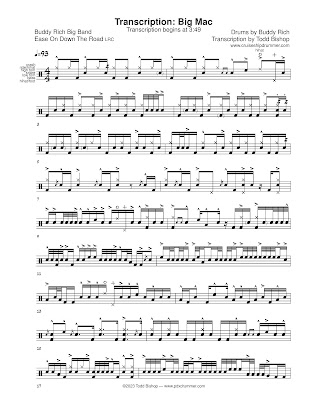
Tempo is 93, the solo begins at 3:49. 


It's Buddy, so lots of rim shots, he's extremely aggressive with his accents. We hear more unisons between the snare drum and bass drum than perhaps with other drummers. It's a powerful sound but kind of crude. His rock thing doesn't sound fully formed, but he's certainly bringing the energy. Who needs fully formed. 

I would expect him to be doing a lot of paradiddles, but here I believe the stickings on the denser stuff are mostly singles. He seems to be playing some very thin little hihats, and mostly hanging out on a very bright 70s 20" A. Zildjian. Tom toms sound good, classic rockin' late 60s/early 70s sound. Very little left foot activity that I can hear. 

Style note for you transcribers: when there's a lot of double time— 32nd notes and sixtuplets— it's best to create a little imaginary beat separation between the downbeat cluster of notes and the &-of-the-beat cluster of notes, connecting them with a single beam, as I've done here. 


Sunday, May 06, 2018

Hours

The true struggle comes in the practice room, facing those drums everyday for 10 hours.
— Famoudou Don Moye


When I was in college I decided that, at some point in their career, everyone who can play practiced 4-8 hours a day, for a period of years at least. I just got that impression from my teachers, from going to clinics, and from reading Modern Drummer magazine.  Today I finally decided to check; I got into my MD archives and pull as many actual quotes as I could about the number of hours people practiced.  
These quotes are all out of context, and spoken in the '70s and '80s— within the first decade of many of the players' professional careers— so don't draw too many ironclad conclusions about anyone's practice habits over their lifetime. David Garibaldi and Steve Smith, for example, were touring heavily at this time. John Guerin was probably doing recording dates 350 days a year. Most of them also talked about spending an equal amount of time listening to music, and playing with people— often practicing less when they were playing more. 


I know teachers who tell their students to practice four hours a day, eight hours a day. If you can't accomplish what you want in an hour, you're not gonna get it in four days.
— Buddy Rich


I practiced my ass off! I practiced eight hours a day. I would get up in the morning - grab a towel, put on a tee shirt and swimming trunks and go down in the basement and practice until everyone came home. I was sixteen years old[.] I would practice EVERYTHING! I practiced with records and without records. I practiced straight time, with a metronome and without a metronome. I practiced soloing with everything - sticks, brushes, mallets and fingers, and I practiced 4/4, 3/4 and 5/4 time, Latin beats... everything. I practiced everything I felt like - but I had to feel it.

There was a point when I was practicing 6 to 8 hours a day, 4 to 5 days per week. I just had all these things I wanted to work on.
— Butch Miles


Working on the road doesn't really give you that much of an opportunity to practice, but I still like to work out for at least three or four hours.
— David Garibaldi


I haven't practiced in ten or fifteen years. I'm just about to start again. When I was 19, I practiced six hours a day for about three months. I feel a need to do three months of practice; the next three months it does me good.
— John Guerin


You can play all day on the drum set if you want to, but you can accomplish more in ten minutes of good practice as opposed to two hours of wasteful practice. The amount of time isn't necessarily important.
— Peter Erskine


I used to practice seven and eight hours per day.
— Gene Krupa


A  minimum  of two hours a day, mostly on muffled drums. I normally practice an hour at home, and an hour or so at the studio.

I used to practice eight hours a day.
— Ed Shaughnessy


When I say practice I don't mean just for my hands either. I mean creative practicing, working on an idea. One idea for like two hours.

Some drummers have more natural ability than others. Some drummers need a half hour, others need four hours. It's an individual thing,

There's no such thing as you must practice 6 hours a day. You practice until it happens. Until whatever you want to happen, happens.
— Joe Cocuzzo


I would practice for four or five hours every day, and if I didn't practice that many hours in a day, at least I would practice something every day. I really noticed that, if I practiced every day, it made a difference.
— Steve Smith


[W]hen I was a kid, I'd come home from school and I would get on that practice pad for at least a couple of hours. Until I was about 17, that's all my life was. I didn't have girl friends or anything. That was it.
— Eddie Marshall


Sometimes an hour and a half, sometimes six or seven hours a day. It all depends. I go in cycles. Sometimes I can practice a whole lot every day; other times I'll be gigging a lot and won't practice at all.
— Casey Scheurell


Holy shit, I've been sitting here and practicing the Barimbau six hours a day.
— Mickey Hart


From 3:00 in the afternoon until 6:00. Three hours a day, seven days a week, forever!
— James Black


I don't think I could do anything for eight hours. I would get too bored doing one thing that long. Now, I could maybe play with a group for that period of time. But doing something like that for eight
hours in a room by myself—I don't have that kind of attention span. For two or three hours? Yes. But, eight hours? No. I know a lot of people who do that. If somebody practices for eight hours a day, they should be a monster.
— Terri Lyne Carrington


I practiced. I practiced timpani for five hours a day when I studied with Vic Firth, and I practiced five or six hours a day when I was getting mallets together with George Gaber. That's the only way you're going to get good at something. 

I was practicing six, seven, eight hours a day, learning to play like a rock'n'roll drummer.
— Kenny Aronoff


When I sit at the drums for four or six hours—whether I'm playing one rhythm for a long period of time, or playing with a rhythm machine or something like that—it creates a real trance-like quality. That's what I love best about drumming. That trance. It's the happiest place for me. It's the deepest place inside and it makes me understand "why" I play the drums.
— Michael Shrieve


 During the school term, I would practice several hours a day—all on drums.
— Kenny Washington


I would be practicing every day for like ten hours.
— Marvin “Smitty” Smith


For three months, I diligently did two or three hours a day of just Accents and Rebounds at a very slow tempo.
— Andy Newmark


Each student is an individual. One person may be able to handle a half hour tops. That individual might not be able to handle more. I had a student once who would practice eight to 11 hours a day. If
I were to practice half of that time, it would drive me crazy. The most I ever practiced myself was three hours a day for one year, and I almost ended up bananas. So you have to be realistic; you have to deal with your own particular situation.
— Chuck Flores


My most productive time was during my first year at college. I had the whole summer off, I didn't know anybody, and I was up at school alone. So I made up a practice schedule, and hit it ten to 15 hours a day for about three months. I went through two summers of that, and it never got under six or seven hours, even when school was in session.
— Dave Weckl


You've got to practice five to seven hours a day.
— Louis Hayes


There was nobody twisting my arm to practice six to eight hours a day.
— Terry Bozzio


Play at least ten minutes a day on the drum set.
— Paul Motian

Sunday, March 11, 2018

11 Buddy intros

This is pretty interesting: Buddy Rich playing a drum intro on eleven takes of the same tune: Leap Frog, released on The Complete Charlie Parker on Verve box set.  This is an actually an excerpt from from my much-promised, never-delivered Book of Intros, which has been languishing mere hours from completion for a couple of years now... I want to say three years... hey, you try saying something intelligent about ~100 drum intros by famous players and then commit it to print FOREVER, so all the other drummers and future generations and your mother can see it and pull your pants down and mock you for saying something stupid. Have you people ever heard of writer's block?

Please forgive that outburst. I'm hoping that posting this will encourage/force me to open the thing up and actually finish it this week. And listening to Buddy makes me a little tense.


So, yeah: 11 takes of one tune. He plays different stuff every time, and gets increasingly rambunctious— it's easy to imagine he's losing patience, but who knows, he may just be having fun with other people screwing up. Whatever's going on, he's playing very aggressively. The quarter note pulse is extreme. There may be some rudimental sticking or other happening on the rolls; that's what happens when you play extremely fast on a floppy old drum— nobody can tell what you're doing. If you learn to play these, use whatever sticking works for you to get the effect.

Get the pdf

Saturday, March 03, 2018

Very occasional quote of the day: Buddy's time

From the bassist Chuck Bergeron who was in Buddy Rich's band in the 80s:

“One afternoon, after a couple of nights of feeling that he wasn’t happy with where I was placing the beat, I asked Buddy if he wanted me to play a little more “on top.” 

He put a hand at the top of his head and the other at his waist and said “I don’t want it here and I don’t want it here – I want it RIGHT HERE, right down the middle” – pointing at his heart. 

What I learned from that statement is that everyone has a different opinion of where “on top” or “on the backside” of the beat is and the only definitive place to put the time is right down the middle and with conviction.”

Friday, March 31, 2017

Buddy meme

This Buddy Rich quote, embedded in a meme, has been kicking around the internet awhile:


“You only get better by playing.”

Uncontroversial to people who can play, but it has generated a small amount of discussion on a drumming forum. A lot of people are allergic to categorical statements, and take them as a challenge to poke holes in them, rather than figure out what this great player is trying to tell them.

Here's the context of the quote, from an interview in the first issue of Modern Drummer in 1977:

MD - Did you practice much? 
BR - Well, I never really practiced because I  never had the opportunity to practice.  I've been  working all my life ... I've been playing drums all my life, and now, I'm too lazy to bother with it. I have other things that I have to do - practice my martial arts ... take care of my cars. I don't put too much emphasis on practice anyhow. 
MD - Would you mind elaborating on that a bit. 
BR - I think  it's a fallacy that the harder you practice the better you get. You only get better by playing. You could sit around in a room, in a basement with a set of drums all day long and practice rudiments, and try to develop speed, but until you start playing with a band, you can't learn technique, you can't learn taste, you can't learn how to play with a band and for a band until you actually play. So, practice, particularly after you've attained a job, any kind of job, like playing with a four piece band, that's . . . on opportunity to develop. And practice, besides that, is boring. You know, I know teachers who tell their students to practice four hours a day, eight hours a day. If you can't accomplish what you want in an hour, you're not gonna get it in four days.

Important to point out that Buddy was a) exceptionally talented, b) onstage performing music since he was literally a toddler, c) coming up in a time and in a scene where people would be performing many hours every day. Today we do have to try to make up for having fewer playing opportunities by hitting the practice room harder. It's not an ideal situation.

The underlying assumption, anyhow, is that being a musician is the goal, that what you do when playing music is the only meaningful standard of your abilities as a drummer— and of the value of the things you practice. There are an array of skills needed to do that, which cannot be practiced in isolation: the ability to play appropriately for the music, unrehearsed, with a good sound and at the right volume for the setting, while generating some energy, making the other players feel and sound good, and maybe making a personal creative statement as well.

Sunday, June 30, 2013

Three Buddy Rich transcriptions

London-based drummer Caroline Scott has posted three Buddy Rich transcriptions— Big Swing Face, Mexicali Nose, and Love For Sale— sort of the big three of Buddy tunes for me, plus Ya Gotta Try. Very worth grabbing.


Visit her site to get the pages, plus some other things— a Brian Blade transcription, and more.

Audio of the tunes after the break:


Monday, May 14, 2012

DBMITW: Jazz at the Philharmonic

This is from a Jazz at the Philharmonic album from 1949 that I dug out of my father's record collection back in the early 80's, and I've been carrying it around ever since. It's got Lester Young, Charlie Parker, Roy Eldridge, Hank Jones, and Buddy Rich playing some pretty honking jam session style stuff. That trombone player is a guy named Tommy Turk.


That's what they used to call dropping bombs, what Buddy is doing there.

The record is labeled "New Volume 7 (formerly Vols. 12 and 13)"; you probably can't find the LP, but you can get it from Amazon. 

After the break is Lester Leaps In, from the same record, which I have to include because I love Lester Young's solo on it.


Monday, May 23, 2011

Out-of-print LP rips: some finds

Here are some exciting drummer-led things I found while paying a visit to the thriving community of record-collecting bloggers dedicated to ripping out-of-print LPs and making them available for download. Apparently no one wants to sell you this music any more, and this is the only way you can get it, short of dedicating your life to scouring the used bins and getting really lucky. This does raise some ethical questions, which I've addressed after the break.

Download links for the albums are usually located in the comments section; Mediafire links are quick and easy, Rapidshare links are a pain.

Bob Moses - Bittersuite in the Ozone
A famous record, and extremely rare- I've never seen it in close to 30 years of trolling the used bins. Features Billy Hart, Randy Brecker, Dave Liebman, Howard Johnson, Eddie Gomez, and more.

Roy Haynes Hip Ensemble
Haynes' "jazz-rock" band from the 70's. I've only seen one other record by this group, and I own the only copy of it I've ever seen in the wild. Recorded in Rome in 1975 for the Horo label. With Don Pate, Bill Saxton, John Mosley, and Mark Fiorillo.

Jack DeJohnette - Have You Heard?
I have not, in fact, ever heard of this great, very free Milestone release. Features Bennie Maupin, Gary Peacock, Hideo Ichikawa.

Elvin Jones - The Town Hall
Smoking John Coltrane memorial concert from 1971. One of the first Elvin LPs I bought, used, in '86 or so. With Frank Foster, Chick Corea, Joe Farrell.

Buddy Rich - A Different Drummer
Burning 70's big band.

Wednesday, January 26, 2011

1996 Paul Motian interview, part 1: Not-So-Correct

This is another old favorite of mine that's just been floating around the Internet- you kind of have to look for it to find it- a 1996 Paul Motian interview by Chuck Braman. Not a lot of what you call deep reflection- Motian seems to be a pretty direct cat- but that seems to be the lesson itself. I've excerpted my favorite parts, of which there are many. In the first part he talks about his influences and early career, up to the 1960's:

WHY HE LIKED MAX:
Chuck: What was it about Max Roach in particular that attracted you to his playing?

Paul: He was more into the Bebop. I was going to say jazz, but you can't say jazz because you'd have to put Buddy Rich and Gene Krupa in that too, you know? And of course I liked them too, but Max was the one that stood out to me. And also, I was never really a Buddy Rich fan, I must say.

Chuck: Why not?

Paul: Because to me that was more technical. I mean, I admired it and I respected it, he was a great technician and played great. Even today, you listen to some of that stuff he played with Art Tatum and Charlie Parker, some of that shit's great, man. It's really good. But somehow Max stood out more to me. Just from the sound and the rhythmical patterns and what came out from him was somehow more hip than the other shit.

Chuck: Some of your early recordings also remind me of Philly Joe Jones.

Paul: Sure. Philly, and Kenny Clarke, those were my people, but at this point Art Blakey is high up on that list, man. I listened to him too, you know, but my playing, listening to it now, came more from Max.