Showing posts with label Bob Moses. Show all posts

Wednesday, September 18, 2019

Very occasional quote of the day: spirit

“Now-a-days the technical information is available. A lot of people have it, which proves all the more that it's not the key to the music. The key is what's inside, the life you live, and that's what I really learned from those people. Where the music came from, how much dedication and how much love was in it. People who just study the music will never sound as real. There are piano players who analyze McCoy or Bill Evans or Chick Corea. They know analytically what it is, but they didn't live it and I hear that immediately. That's what I hear first, before the note. I hear the aura and spirit. I hear what's inside. But that's an ability I've always had. I see the inside before I see the outside.”

— Bob Moses, Modern Drummer interview, December, 1979


Thursday, August 09, 2018

New Joel Rothman title

In the mail I just received a new book by Joel Rothman: Drumming Outside The Box - for Rock & Jazz. It's basically a library of patterns focused around creating an unbroken rhythm on the drumset, a la Bob Moses's non-independent method— an ECM-type feel. Also good for taking a jazz feel into a triplety, Afro 6-like feel. Or a Mike Clark or David Garibaldi type funk feel. Anything modern and quasi-linear.

The patterns are for two voices— nominally cymbal and snare drum, though you can play them with whatever limbs (or combinations of limbs) you want, adding feet, adding ostinatos— it's designed to be used creatively. Half the book deals with triplets in 4, 3, and 5; the other half covers 8th notes in the same meters, plus a few pages on 16th notes (I usually play 8th note exercises in 2/2, which is functionally the same thing— a four-note subdivision). The patterns usually don't have more than two notes in a row with a limb, so they're designed to be played fast and with minimal technique— a system I heartily approve of. Basically if you can play the first page, you can play the whole book; the focus is on gaining fluency. You're supposed to smoke through a lot of patterns working on this book.

There are other ways of practicing the basic concept of this book— Reed-based methods, Stone-based methods, my Funk/Figure Control system, which is derived from both of them— but sometimes you want to change gears and look at something different. Different sets of patterns written different ways sometimes help you come up with different things. I'm in favor of having a lot of materials around, and doing the same thing different ways.

40 pages. I don't see a price for it yet, but it's bound to be reasonably inexpensive. No reason not to grab it if you're working on this type of thing.

Get Drumming Outside The Box from Joel Rothman Publications

Get other Rothman titles from Amazon via the links below:

Friday, December 14, 2012

DBMITW: trove o' Burton

I've been listening to a lot of Gary Burton lately— like the past five months or so— but haven't been sharing much because there's a shortage of his recorded stuff on YouTube, except for this series of bootleg live recordings. A series which I just noticed is ridiculously huge— there are dozens of videos, many of which include complete concerts dating from 1968-2011:

Vienna 1975 with Pat Metheny, Mick Goodrick, Steve Swallow, and Bob Moses:


There are several more after the break, including one with Roy Haynes— or you can visit the Burton bootlegs YouTube channel:

Wednesday, October 03, 2012

Transcription: Bob Moses — Mevlevia

Here's a quick take of a tune that will be part of my set on the Europe trip this year: Mevlevia, from the Gary Burton record Ring, with drumming by Bob Moses. This is one of those Real Book tunes that— along with those Michael Gibbs tunes— rarely gets played. At least when I was in college and actually used the Real Book. It's a great tune though, is in 5/4, and is pretty quintessentially “ECM”:


I've just given the drum performance during the head only; Moses plays fairly repetitively throughout the piece, and my hand is fatigued from using the mouse, so that's all we're doing. He uses that 3/16 lick at the end several times later on in the piece. There's more going on with the cymbals than I've indicated— he seems to be using both hand on some of those notes, and moves between what sounds like a couple of Paiste 602 flat rides— maybe an 18 and a 20 or 22— which I haven't bothered to try to sort out.

Audio of the track is not available on YouTube, so you'll either have to buy a used LP from your local used record store (or from Amazon), or from iTunes. If you're reading this blog, you should probably own it. If you don't own the Real Book, a lead sheet for the tune is viewable online.

For more in/on 5/4, hit the odd meters or 5/4 labels at the bottom of the post. My transcription of Jon Christensen's playing on Jan Garbarek's Dansere might be especially relevant here...

Get the pdf

Friday, July 06, 2012

What records I'm listening to

My original bleak assessment of the future of this feature has mostly played out-- I still just listen to the same batch of records over and over for days or weeks at a time. But a few more things have worked their way to the front of the pile this week, so here we are:

Gary Burton Quintet - Dreams So Real / Music of Carla Bley ECM
Side I: Dreams So Real - Ictus/Syndrome - Wrong Key Donkey - Jesus Maria
Drums by Bob Moses

Gary Burton - Turn of the Century (compilation) Atlantic
Side One: Vibrafinger - Moonchild/In Your Quiet Place - Fortune Smiles
Drums by Bernard Purdie and Bill Goodwin

Roy Haynes - Out of the Afternoon Impulse!
Side Two: Snap Crackle - If I Should Lose You - Long Wharf - Some Other Spring
Drums by Roy Haynes

Grachan Moncur III - Evolution Blue Note
Side One: Air Raid - Evolution
Drums by Tony Williams

A few YouTube selections from these records after the break:


Sunday, March 11, 2012

Bob Moses on "dependent" drumming

Or as he called it a little later in Drum Wisdom, "non-independent" drumming. This is relevant to some of the things I brought up both in the ECM feel post and the open-handed post:

"I have a philosophy of playing which involves not working too hard. It's not a technical thing as much as it is a conceptual thing. My playing gives the illusion of independence. But, I don't use much independence. My playing is what I call the dependent style of drumming. This means that I don't separate limbs and play "gangdig-a-dang-dig-a-dang" with my right hand and then my left hand will do whatever it can do against it. I would never play with just one hand. I'd never play a rhythm with just one hand or one foot. I use all four of my limbs constantly, in a melodic fashion. Consequently, I can play fast tempos easily without, but it's not because of any technical innovation. It's a conceptual thing. I play the flow, between my hands. If it's an eighth note flow I play eighth notes between two hands. Not just one hand. I get the same effect because what I'll do instead of putting both hands on the drum is put the right hand on the ride cymbal. So, I get the feeling of a ride beat. I play the flow whether it's eighth notes or triplets. I realize that the whole right side of your body wants to work together. So, I put the right foot exactly with the right hand, which also is a great sound. It gives the cymbal sound a bottom and it's also very easy. Your right hand and right foot want to hit together. Your body works that way. If I play it at a really fast tempo I don't catch every single beat with my right hand and right foot. I pick key ones that I want to bring out. My right foot and my left hand never stop when I play. I'm not one of those drummers who can swing a band with just their right hand. I need all four of my limbs, that's why I call myself a dependent drummer. But it makes it very easy to play. If you play very fast tempos using just that one limb, either you're going to tighten up or the tempo is going to go down."

From the Dec./Jan. 1979 issue of Modern Drummer. Get yourself their digital archive- it's quite an incredible resource.

Wednesday, February 22, 2012

A crash course in the ECM feel

Look for the photos with water
and the Helvetica font.
The "ECM feel", as it's now being called, is a style that evolved in the late 1960's and 70's, and has since become one of the major time feels of modern jazz. It's associated with the ECM record label because that's where you find most of its major early practitioners and first/best recorded examples. Before you do anything, I suggest hitting the read more link at the bottom of the page and listen to the audio examples.

Some of its features: Even 8th notes, non-repetitive, linear, broken-up (pick your adjective), possible suggestion of a backbeat, Brazilian influenced. Light, airy, ride cymbal based feel (get yourself a Paiste 602 Flat Ride to complete the period effect). Had it's beginnings in the 1960's work of Tony Williams, Roy Haynes, Paul Motian and Barry Altschul. The drummers it is most generally associated with include Jon Christensen, Jack Dejohnette, Bob Moses, and Airto.

There is no standard method that I'm aware of for developing this feel, but if you work through one or more of these suggestions and do a lot of listening and playing you should begin to find it

UPDATE: In the comments Clint lets us know that Berklee professor Skip Hadden has a method book and mini-series of videos at the Vic Firth site dealing more broadly with this style. Onward:


Practice methods:

Basic coordination using the 8th/2-16th cym pattern. You can also think of it in cut time:


Use regular jazz vocabulary with even 8th notes (converting them 8th note patterns to 16ths if you're thinking of it that way). Working out the same materials with two or three more complex cymbal patterns- and with plain 8th notes- would also be helpful; you could pick a pattern from Syncopation pp. 34-37 (new edition) and put it in double time, for example.

Stick Control- the first section, and maybe the flam section- and the same part of Syncopation as above, plus the long syncopation exercises. Play this (and all the following) with the right hand on the cymbal and the left on the snare. Also play the first section with the hands together on the cymbal and snare on the Rs, and the bass drum and/or hihat (w/foot) on the Ls.

Paradiddles and paradiddle-diddles and their inversions, plus plain old doubles- RRLL and RLLR RLLR- with/without a flam at the beginning of the R or L hand double:


And Swiss triplets in a 16th note rhythm. They make a 4:3 polyrhythm, so find a place to stop to fit them within one or two measures of 4/4:


Using the feet:

Again, with the right hand on the cymbal and the left on the snare, play all of the above over an ostinato with the feet; either samba or baiao, or double some/all of the right hand part with the bass drum. Also play an ostinato with one foot let the other play sporadically to fit with the hand part.

Note: It would seem to be an obvious choice for developing this style, but I don't like to recomend Dahlgren & Fine's Four Way Coordination to anyone seeking immediate results; as I've written before, I've seen it turn into a bit of a tar pit for more than one young drummer. But if you keep your eye on the practical result you want to achieve, and don't get bogged down with the need to learn it "completely", it should also be useful here. Vol. 2 of Dahlgren & Fine's Accent On Accents would be a good substitute/supplement for Stick Control for the exercises above, though.

Audio examples and discography after the break:


Tuesday, January 17, 2012

Paradiddle-diddle method for uptempo jazz

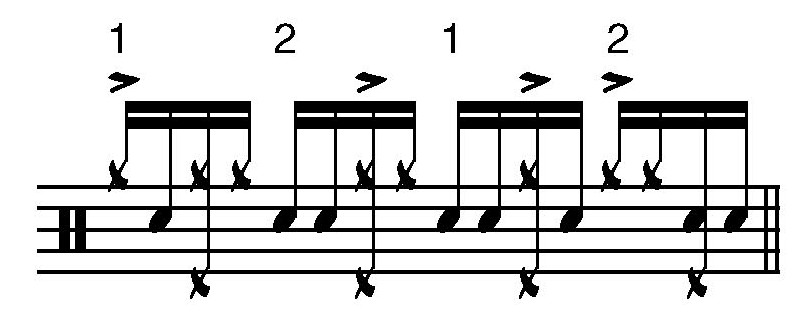
This is something I developed for both for getting some relief while playing fast tempos, and for doing a modern feel without getting your cymbal pattern lost in the weeds. The seed of the idea comes from Bob Moses (see "Non-independent method" in Drum Wisdom) and John Riley (see "Fast face-lift" in Jazz Drummer's Workshop). It's actually pretty straightforward, once you're able to read through this batch of syncopation exercises using the method outlined in the last post; first move your right hand to the ride cymbal, leaving the left on the snare, and add the hihat on the &s, with your foot:


We'll need to convert the 16th notes of the exercise to 8th notes, so one measure of 16ths becomes two measures of 8ths. If you can't do that instantly, start by counting 1-2-1-2 instead of 1-2-3-4:


Think of the 16th notes as 8th notes. Counting your fast tempos in a moderate 2 is actually preferable to counting a fast 4:


After the break I'll give a few options for the bass drum part.

Thursday, August 04, 2011

Quotable Bob Moses

A few stand-alone quotes from Drum Wisdom by Bob Moses:

[T]ake one idea and expand it., instead of playing a lot of ideas. The greatest musicians are those who can take one idea and make the most of it.

[O]ur goal is to groove. As far as I'm concerned, that's the only goal. Creativity is not a goal; creativity is. Everybody is creative, but not everybody grooves.

There should be a musical idea behind everything you practice, just as there should be a musical idea behind everything you play. [...] Music includes melody, harmony, and rhythm. Having just the drumistic things without having the rest of music is certainly incomplete.

What types of things do I hear internally in my mind? What I think about- the internal hearing- is always the simplest possible idea.

[W]hen it gets to the second chorus and one of the lead instruments starts playing an improvised solo, I am still internally hearing the original melody and almost ignoring what the soloist is playing. Many times a drummer will try to duplicate the ideas, abstractions or extensions of the soloist, but that is not your job. Your job is to be aligned with the structure and provide a cushion for the soloist to work off.

Trying to play with the soloist is like two people trying to get into the same end of a canoe- it's going to tip over.

Re: "independence": Instead of playing two rhythms- one on the ride and the other on the snare drum- think and play only one rhythm. When I play, even though I have one hand on the cymbal, I'm still playing only one rhythm- not two against each other.

I believe that you should be able to sing everything you play on the drums.

Monday, May 23, 2011

Out-of-print LP rips: some finds

Here are some exciting drummer-led things I found while paying a visit to the thriving community of record-collecting bloggers dedicated to ripping out-of-print LPs and making them available for download. Apparently no one wants to sell you this music any more, and this is the only way you can get it, short of dedicating your life to scouring the used bins and getting really lucky. This does raise some ethical questions, which I've addressed after the break.

Download links for the albums are usually located in the comments section; Mediafire links are quick and easy, Rapidshare links are a pain.

Bob Moses - Bittersuite in the Ozone
A famous record, and extremely rare- I've never seen it in close to 30 years of trolling the used bins. Features Billy Hart, Randy Brecker, Dave Liebman, Howard Johnson, Eddie Gomez, and more.

Roy Haynes Hip Ensemble
Haynes' "jazz-rock" band from the 70's. I've only seen one other record by this group, and I own the only copy of it I've ever seen in the wild. Recorded in Rome in 1975 for the Horo label. With Don Pate, Bill Saxton, John Mosley, and Mark Fiorillo.

Jack DeJohnette - Have You Heard?
I have not, in fact, ever heard of this great, very free Milestone release. Features Bennie Maupin, Gary Peacock, Hideo Ichikawa.

Elvin Jones - The Town Hall
Smoking John Coltrane memorial concert from 1971. One of the first Elvin LPs I bought, used, in '86 or so. With Frank Foster, Chick Corea, Joe Farrell.

Buddy Rich - A Different Drummer
Burning 70's big band.

Tuesday, February 22, 2011

Bob Moses interviews Rashied Ali

January 2003 interview of the late Rashied Ali by another great drummer, Bob Moses. This is only available through jpegs, so I can't quote it without typing it out, and you should read the whole thing anyway. They discuss music making and Ali's time with Coltrane, and how he missed getting on Ascension.


Purchase John Coltrane's Interstellar Space
Visit Rashied Ali's website.