Reprinting this from my Facebook page— I encourage you to head over there and add me as a friend. There's a thing going around where musicians list ten albums that were most important in their development. The idea of narrowing it down to just ten albums is absurd, so I'm not really trying. Mainly I was trying to do things other drummers had not already listed. These are all very, very important records to me, but there are 100+ more albums that are equally important. Here are numbers 1-5:
1. George Duke / Reach For It
My brother gave me a bootleg cassette of this that I listened to all through high school. It's got Ndugu Leon Chancler on drums. Great 70s LA Latin/fusion/funk, with a couple of soul ballads. High points are Omi, a high energy Afro 12/8, which began my very long engagement with that type of groove, and Watch Out Baby!, a sort of quasi-pornographic funk epic featuring Stanley Clarke— here's my transcription of Chancler's playing on that.
Here is Omi— I made a loop of the bulk of this tune, which is included in my massive zip of practice loops, which is still available to download free.
2. Bill Frisell / Before We Were Born
Got a cassette of this in a mall in Puerto Rico. I knew about Bill Frisell from the Marc Johnson Bass Desires record, but it was the first I heard of Joey Baron. Includes a pretty radical 13 minute John Zorn arrangement, and Arto Lindsay on one tune. I played these gigs in central Oregon, on the other side of the mountains, and would crank this driving home through the Cascades at 2am.
3. Thelonious Monk - Trio
Knowing individuals inform me that this is a weak, poorly performed album. The vibe is casual, but I don't know what's WRONG with it. Like, tell me what you want. We'll go to the British Museum and rate the Constable sketches. Settle some accounts.
To me it's a perfect record. This is what jazz is supposed to be. There are ten tracks and ~35 min of music total, so it's tight; the tunes are featured a little more than the soloing. Everybody sounds engaged, people are trying some things, and the total package is like walking in on a Leonardo sculpture— you already knew the whole thing before you even saw it.
4. McCoy Tyner / Blues For Coltrane
I posted about this one before: Blues for Coltrane. I think it's considered a McCoy album. With Roy Haynes, Cecil McBee, Pharoah Sanders, David Murray. At USC I used to listen to this on my way to combo rehearsal with Dwight Dickerson, and arrive ready to kick ass. Pretty sure I made a lifetime enemy out of a bass clarinetist. I never understood why everyone didn't want to play this level of energy all the time.
5. Miles Davis / Water Babies
I only just figured out that I liked this record a few years ago— like 10-12 years ago. It's outtakes from the Nefertiti and In A Silent Way sessions. Compared to Nefertiti and Filles de K they really sound like ensemble sketches. It sounds unfinished, the tunes are not really strong in a normal way, but that's what I like about it. It still sounds like a record. Especially love Wayne Shorter's playing all the way through this.

A drumming blog written by Todd Bishop.
Showing posts with label favorite albums. Show all posts
Showing posts with label favorite albums. Show all posts
Friday, May 29, 2020


Monday, May 18, 2020
Favorite albums: Trio Jeepy

So: Trio Jeepy by Branford Marsalis, released in 1989. With Milt Hinton (and Delbert Felix) on bass and Jeff Watts on drums. I bought a cassette of this because Wynton Marsalis's Standard Time and Live At Blues Alley records were very hot then, and I wanted to get more of Watts. Most of us who were students in the 80s were trying to find a voice somewhere between fusion and the neo-classic thing, and at this time neo-classic was where most of the energy was. Fusion was declining into fuzak, but its major artists were edging away from that, towards a more acoustic conception. See Michael Brecker's first solo record, Chick Corea's Akoustic Band, Scofield's Time On My Hands, Metheny's Question & Answer.
This is a nice, loose little recording with a lot of blowing and a lot of great featured drumming. They included some outtakes and talking in between tracks, which adds to the spontaneous vibe. Marsalis is doing his Dexteresque thing that is nice to listen to. The record introduced many of us jazz neophytes to some tunes we would play a lot in coming years: Doxy, Makin' Whoopee, UMMG, Three Little Words, The Nearness of You. Now I realize that it took some nerve to put Doxy on a record in 1989, and present it with an attitude of THIS. IS. THE. SHIT.
There's always an element of doctrinal pronouncement in recordings by any Marsalis; you come away feeling like you've been told how you're supposed to play. I don't know to what extent mainstream jazz was actually dead when the Marsalises came around— but they needed to declare it so, so they could bring it back. There was still jazz education, and a professional culture where people were still playing old tunes. But maybe all the big records were in the fusion arena, before they came along.
Jeff Watts is fantastic of course. He has a much deeper, more muscular sound here than we're accustomed to today. Similar to post-60s Tony Williams, but less outrageously aggressive. Listen to Watts if you want to find a sound different from the current twitchy, trebly thing. There's also a great example of “melodic” drumming, with his playing on Housed From Edward— hearing that was an unavoidable instruction to get a concept of playing blues.
On that track he does a big time displacement thing, which is a pretty audacious move. It doesn't add anything, and is kind of crass, showing off his fearlessness of blowing a take— and also Milt Hinton's unshakability. I wrote a page on how to do it. Good luck ever finding musicians you can do that with, or on having the courage to actually attempt it in a critical situation.
Here's Housed From Edward— listen to the video, but the proper way to do this is to buy the physical record, and play it many, many times.
Thursday, March 14, 2019
Daily best music in the world: Oval
You know what I'm tired of? Music that sounds like it was created with a free Android app. So here is one of my favorite albums in the late 90s: 94 Diskont by the German electronica group Oval. Created using some novel manipulations of digital media— marking up, damaging, and generally messing with CD surfaces, and remaking the resulting screwed up audio into music. A lot of electonica suffers from being made by people who never went through the discipline of learning to play an instrument, but these guys are real artists.
Wednesday, January 28, 2015
Listening: Coltrane — Crescent
This conversation between Bad Plus pianist Ethan Iverson, saxophonist Joshua Redman, and composer/bandleader Darcy James Argue, about the John Coltrane albums Crescent, and A Love Supreme, happened on Twitter:

Crescent was the first Coltrane album I ever bought, and actually listened to (the first actual one was Om— a very challenging record, if you've never heard it), but it has always been a little bit of a dark horse for me— compared to other Coltrane recordings, the visceral emotionality I was seeking is very restrained here. It's very deep music, and it was probably too grown-up for me, honestly. Redman summarizes it perfectly in the comment above, and those are all qualities it has taken me a long time to learn to appreciate.
It is one of the very greatest things in 20th century music, and if you haven't listened to Crescent all the way through in a while, or ever, here it is:
Crescent was the first Coltrane album I ever bought, and actually listened to (the first actual one was Om— a very challenging record, if you've never heard it), but it has always been a little bit of a dark horse for me— compared to other Coltrane recordings, the visceral emotionality I was seeking is very restrained here. It's very deep music, and it was probably too grown-up for me, honestly. Redman summarizes it perfectly in the comment above, and those are all qualities it has taken me a long time to learn to appreciate.
It is one of the very greatest things in 20th century music, and if you haven't listened to Crescent all the way through in a while, or ever, here it is:
Friday, May 25, 2012
Favorite albums: Impressions by John Coltrane
 |
| Cover from my version, the 80's reissue. |
1963 - Impulse!
John Coltrane - tenor and soprano saxophone
Eric Dolphy - alto saxophone, bass clarinet
McCoy Tyner - piano
Jimmy Garrison - bass
Reggie Workman - bass
Elvin Jones - drums
Roy Haynes - drums
This record has become kind of a dark horse in recent years, due I think to its pieced-together nature-- the two tracks that form the bulk of the album are from the famous 1961 Village Vanguard recordings, and are included in the box set that was released early in the 2000's, stealing a lot of its thunder. But this selection of tunes is very special, and there's something to be said for experiencing the music the way it was by the many, many players who have lived with this record in the nearly 50 years since it came out.
Up 'Gainst The Wall is an extremely important track for drummers-- right up there with Miles' Billy Boy, with Philly Joe, or Pat Metheny's Turnaround with Jack Dejohnette, or Miles' Seven Steps To Heaven with Tony Williams, or... anyway, transcribing it is pretty much a rite of passage; I did mine straight off the LP, which I don't recommend.
Impressions is of the style that Leonard Feather famously called "anti-jazz" at the time, referring to Chasin' The Trane from the Village Vanguard record; very open extended blowing basically on one chord, without piano accompaniment. Here they're playing over So What changes, with a bridge that goes up a half step, so it's not entirely formless, but the effect is the same. This used to be an extremely popular jam session tune, but doesn't seem to get played much any more. You also don't hear players going for this burnout type of thing much, do you?
India got hurt the most-- at least as far as my own listening was concerned-- by the release of the Vanguard box set, which included several competing versions. This one is still the best, and I've listened to it so many times it's like classical music to me. People need to make more music with too many cats blowing all at once.
After The Rain gets overshadowed by the blowing tracks, but is a tiny, impressionistic masterpiece in its own right.
Dear Old Stockholm is a bonus track on the newer reissues, but I've never heard it.
Some YouTube audio after the break:
Saturday, March 03, 2012
Favorite albums: Ballads by Paul Bley
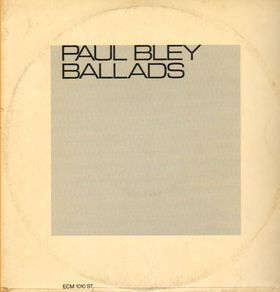
1967 - ECM 1010
Paul Bley - piano
Gary Peacock, Mark Levinson - bass
Barry Altschul - drums
Compositions by Annette Peacock
This is kind of a funny entry to this series. It has taken me a long time to come to fully appreciate this record. It's very open, very impressionistic, and offers few, ah, "conventional satisfactions"; each track is in broadly-paced free time, harmonically ambiguous (not to say atonal), with little in the way of tension and release, and no explosive performances. It's nobody's idea of a fist-pumping jazz record.
So, I've had it in my bins since the late 80's, and putting on every few years it's stayed kind of aloof, but it kept its hooks in, and eventually clicked. The record is more an environment than a conventional piece of music, and the perfect embodiment of pure improvised music, and of a certain player's space.
Barry Altschul is one of the most urgent-sounding drummers ever- pushing even beyond Roy Haynes or Alan Dawson for the amount of forward momentum in his playing- and he manages to keep that quality through this spacious, non-climax-seeking record. There's also a very different type of free playing at work here than the familiar dense style of drummers like Sunny Murray or Rashied Ali, or Paul Motian's naive/primitive thing- Altschul seems to be among the first very polished free players.
Annette Peacock also has become one of my favorite composers for her work recorded by Bley- her bio is rather interesting as well. The compositions here are perfect for this record, meaning they don't immediately jump out and grab you as needing to be played again.
YouTube audio of "So Hard It Hurts" after the break:
Monday, November 21, 2011
Favorite albums: Special Edition by Jack Dejohnette
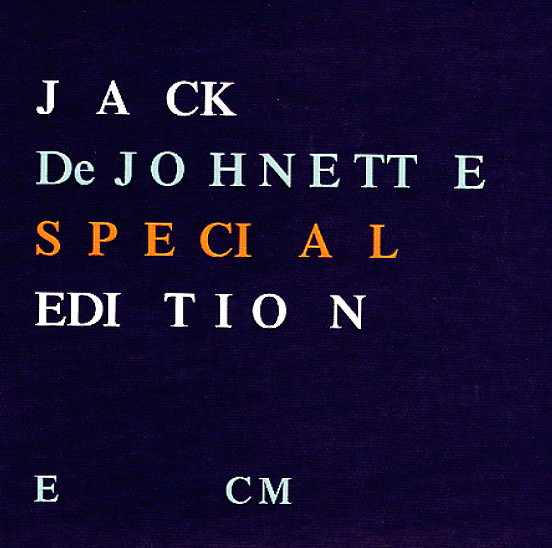
1980 - ECM 001161902
Arthur Blythe - alto saxophone
David Murray - tenor saxophone, bass clarinet
Peter Warren - bass, cello
Jack Dejohnette - drums, piano, melodica
It's been awhile since I've done one of these, which is bad because records are pretty much the most important thing in the world. Do not succumb to this current thing of buying individual mp3s. With jazz you need to buy complete albums and listen to them all the way through.
So, today we have the purple record. I've been hearing a lot of mannered, emptily virtuosic music lately, and listening to this record again blows it all out of my consciousness nicely. It feels very true. Includes two Coltrane tunes: India (my favorite track), and a drumless Central Park West. There's also the post-modern Zoot Suite, the spaced-out Journey to the Twin Planet (with a fun surprise a couple of minutes in), as well as the classic Dejohnette composition One for Eric (dedicated to Eric Dolphy). Blythe and Murray aren't Chicago guys, but there's a distinct Chicago vibe to their playing here which works very well for the ensemble- though I guess it's not the sort of playing that gets most sax players excited. I can't think of more classic examples of Dejohnette's playing than the blowing on Zoot Suite and India.
It appears that no part of this record is on YouTube, so you'll just have to buy an mp3 of India to get a taste of it, as long as you promise to purchase the whole thing.
Sunday, August 28, 2011
Favorite albums: Billy Higgins

Pat Metheny - Rejoicing

With Higgins and Charlie Haden. Word is that Metheny wasn't thrilled with this record- he thought the band played better on other occasions. We'll have to take his word for it. It's hard to pick a favorite track from the first side; I think the wash of brushes on Lonely Woman is the star of the show, though.
Don Cherry - Art Deco

Cherry and Higgins plus Charlie Haden and James Clay. One of the most relaxed and unpretentious drum performances ever- I wish more people would emulate that. Tunes include Cherry's Art Deco, Bemsha Swing, When Will The Blues Leave, Body & Soul, and The Blessing.
Joshua Redman - Wish

The Rejoicing band together again. I guess people don't dig Redman at this early stage of his career, but that doesn't matter- it's a great ensemble performance. Moose the Mooche is the standout, along with some nice originals I don't know the titles of.
Don Cherry - Brown Rice

This is an older record than the others, and very much from the 70's- quite clearly- I mean to tell you there is no ambiguity whatever on that question- none. Like doing macramé at a Bahai temple while tripping on LSD, I imagine.
Audio after the break:
Tuesday, April 12, 2011
The Ultimate
Here's The Ultimate Elvin Jones , one of the first Elvin records I ever got. I think it was out of print at the time, and I was really lucky to find an LP copy (a CD player affordable to me was a few years away) that had been sitting in the bins a long time, mealy cardboard, brittle, yellowing cellophane and all. That opening track "In The Truth" felt like a whole level of seriousness above anything I knew at the time. Incredible, pure, one of the greatest things ever.
Listen to the rest of the album after the break:
, one of the first Elvin records I ever got. I think it was out of print at the time, and I was really lucky to find an LP copy (a CD player affordable to me was a few years away) that had been sitting in the bins a long time, mealy cardboard, brittle, yellowing cellophane and all. That opening track "In The Truth" felt like a whole level of seriousness above anything I knew at the time. Incredible, pure, one of the greatest things ever.Listen to the rest of the album after the break:
Wednesday, February 23, 2011
It's hard to believe it has an age.

 . Like a lot of other people, the first jazz tune I learned was Stolen Moments
 (at least that I can put a title to- the first thing I ever played was a Sammy Nestico chart).
Unfortunately my favorite track, Hoe Down
 , isn't available on YouTube, but here's the opening from MySpace Music.
Audio after the break.
Monday, January 31, 2011
Favorite albums: Thelonious Monk Trio

Prestige 7027
Thelonious Monk - piano
Percy Heath, Gary Mapp - bass
Art Blakey, Max Roach - drums
This record doesn't seem to get talked about much, and I don't know why. It has a bunch of great tunes in their classic form, including Reflections, Trinkle Tinkle, Bye-Ya, and Little Rootie Tootie; it has a loose, breezy feel, with each track coming in at a very concise three minutes long; the drumming by both Blakey and Roach is creatively handled, with something special happening on each track. Extremely friendly and listenable record.
Friday, January 28, 2011
Favorite albums: Where In The World by Bill Frisell

1991 - Nonesuch B000002H9S
Bill Frisell - guitar
Hank Roberts - cello
Kermit Driscoll - bass
Joey Baron - drums
I and a lot of other drummers of my generation immediately took all of the muffling out of my bass drum after hearing the opening track, Unsung Heroes. Baron's incredible playing is a little more subdued and supportive of the mood than on some of his wilder blowing albums. Covers a lot of ground stylistically, but plays like episodes in a movie. One of the things that kept me sane in L.A. in the riot year.
Also from this record: Child At Heart practice loop and transcription
Tuesday, January 25, 2011
Favorite albums: Dance by Paul Motian

Our first entry:
Dance by Paul Motian
1977 - ECM 144384
Charles Brackeen - tenor and soprano sax
David Izenson - bass
Paul Motian - drums
This has been one of my all-time favorite records since I found the LP used (probably a promo) for two bucks at Portland's Crossroads Music in the late 90's. Features one of my favorite drum solos (on Dance), some of the friendliest Motian compositions recorded, the great David Izenson doing a lot of beautiful arco playing, and the interesting, elusive saxophonist Charles Brackeen. The blowing is raucous but also spacious. Rare overdubs nicely handled on Kalypso and Lullaby. Lush-sounding. Each piece and the entire album are beautifully balanced.
Purchase on Amazon.com.
Subscribe to:
Posts (Atom)