Friday, September 30, 2011

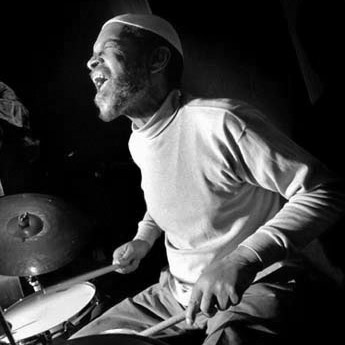
Very occasional quote of the day: Jeff Watts

Messing up is not really that bad; it's the recovery that's important.

- Jeff Watts

Billy Higgins' instrument

Here's a nice follow up on my recent Billy Higgins solo analysis. I was just surfing around and getting discouraged at how little of value I was coming across, when I stumbled across this 2000 Jazz Times interview with Higgins, by Chip Stern. The focus is on his instrument, but it's hardly a standard gear discussion:

“I switch up between a K. Constantinople and an old Paiste 602 Medium Ride,” says Higgins. “That old Paiste was given to me by Ed Blackwell, so it has a special thing going for it besides its sound. There’s a vibe to it, and I’ve made a lot of very good recordings using that particular cymbal.”

JazzTimes: Do you always favor rivets in a ride cymbal?

Well, yeah, because it gives everybody a cushion. I remember working with Milt Jackson, and sometime if a cat didn’t have a sizzle cymbal, he wouldn’t hire him [laughter]. Because you’re always playing it, it gives a lot to the player and the ensemble, too—it’s like the maĆ®tre d’ of the drums set. You might never touch a tom-tom, but that cymbal is a big part of your sound.

Higgins' 602 in action:


After the break, discussion of miking, and tuning and playing the bass drum:

Thursday, September 29, 2011

Something stupid

I hope you're ready for a descent several circles deeper than usual into pure drumming geekdom today, as I've been fooling with devising a sticking system for all limbs, and combinations of limbs. I don't know what the practical utility of this is yet, if any- we'll get into that later- it's just something I started working on.

The rules I gave myself were that the symbols should be keyboard characters found within Arial font, with normal available capitalization and formatting (bold, underline, italics, upper and lower case), that the logic of the character assignments should be not be completely arbitrary or obscure, and that they have to consist of one character only.

The system so far:

R - right hand
L - left hand
R - right foot
L - left foot

H - both hands
F - both feet

So far, so good. For other combinations of limbs the characters form a little diagram the logic of which should be clear:

X - all limbs
< - right hand and foot
> - left hand and foot
/ - right hand and left foot
\ - left hand and right foot

The combinations of three limbs are a challenge. Some possibilities:

L - left hand and both feet
7 - both hands and... left foot?
/ - (underlined slash) right hand and both feet
\ - (underlined backslash) left hand and both feet

Reversing and/or inverting an L (or 7- I think I would prefer that, actually) would cover all of those, but there does not seem to be a way of doing that within normal keyboard functions. There are some little jive web applications for doing that, but that's not an acceptable solution- the most involved I would want to get is some kind of special character (for example, you can enter alt-0169 to make a © symbol). I'd prefer to follow the same logic as for the other combinations of limbs, and to not use Greek/Cyrillic/other foreign characters. If anyone has any suggestions for something in Arial font, I'm all ears- get out your character maps or ascii table...


So, what's the point?


So, assuming we get that last thing ironed out, what's the point of this? What's it good for, if anything? We'll get into that after the break:

Wednesday, September 28, 2011

Transcription: Four - the classic intro

Here in chronological order are three very similar intros to the tune Four, recorded by Miles Davis. The one by Philly Joe is the classic beginning of this tune— I don't know if he was copping Blakey's earlier thing, or if it was rehearsed as part of the arrangement. Certainly by Tony's time it was, at least informally- though on his more famous version from Four & More he abandons the Philly Joe/Blakey thing altogether. In the intervening years there are some versions by Jimmy Cobb which follow it loosely. There's also a recording with Kenny Clarke where he just plays 8 bars of drums up front.


Get the pdf 


Tuesday, September 27, 2011

Very occasional quote of the day: Randy Brecker

It’s a reality these days that it is harder to tell guys apart trumpetistically, because we all study out of the same books, and there’s a certain trumpetistic artistry that’s prevalent these days. So it’s harder to pick people apart, but that’s overshadowed by the musicianship on all these records, which was really excellent. That’s always my answer to the problem these days, when guys say, “Ah, too many guys sound alike.” I say the musicianship is so high it doesn’t matter.

- Randy Brecker

Monday, September 26, 2011

Cruise ship pianist!

Here's something from Timothy McSweeney's Internet Tendency (usually dedicated to hyper-well-written humor): a straightforward interview with a cruise ship pianist. Good straight info for anyone considering that line of work.

Daily best music in the world: Gil Evans

We can debate the subtleties of the meaning of the word "daily" later- right now just play this loud:


That's Tony Williams on the drums, in one of my new favorite performances of his after the 1960's. This incredible album- There Comes a Time by Gil Evans- appears to be out of print. If you can't find anyone interested in selling you a copy, you can avail yourself of one of the OOP music blogs around the internet.

Sunday, September 25, 2011

Big band figure builder

Here's another installment of a thing I've been doing with several students, using Syncopation lesson 4 to get familiar with the basic moves and reading associated with setting up and kicking big band figures ("cutting" them, that is), or just interpreting a melody line on a lead sheet. The process is broken down to a number of logical, easy- darn near banal- interpretive steps. Read them carefully, and apply them to exercises 1-15:


These related posts should be very helpful: simple variations on lesson 4, kicks and set-ups using Syncopation, and basic big band set-ups.

Get the pdf.

Saturday, September 24, 2011

Very occasional quote of the day: Jack on Max

"...and he could play the fastest tempos!"
- Jack Dejohnette on Max Roach


I thought this one deserved its own post.