|
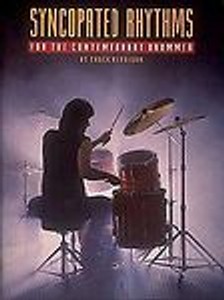
Ignore the model's bad posture, tucked-in
muscle shirt, and Bay City Rollers
hairdo, and buy the book. |
If you've worked with Ted Reed's Syncopation in any serious way you've probably sensed that it has a few limitations. It's also such a central text— you can and should do nearly everything with it— that you can get to the point where you feel you've worked its raw material to death, if not its possibilities. The style of notation can be a little formulaic, and there are a few subjects that aren't given the famous
page 37 treatment: 16th notes, triplets, and any meter other than 4/4, for starters.
A good supplement, then, is
Syncopated Rhythms for the Contemporary Drummer, by Chuck Kerrigan. It's 101 pages long, written in a similar style to the middle part
(about pp. 29-44)
of Syncopation, and has sections dealing with quarter notes, 8th notes, triplets, and 16th notes. It's mostly in 4/4, but there are also exercises in 3/4 and 5/4. Exercises are one, 12, 16, and 32 measures long. One-measure ideas are presented in four-measure phrases, with varied notation and accenting:
This varied way of writing the same basic rhythm is very helpful— it's not the same rhythm, actually, because the lengths of the notes are different; but the notes all begin in the same places from measure to measure— so the exercises read more like a real piece of music than do those in Reed, and gets you (or your students) thinking about how to handle variably long and short notes. A similar thing is done in
Louis Bellson's Reading Text in 4/4, another popular Reed alternative, but the notation in that book is so far out that it is, for me, impractical— you're not likely to see rhythms written the way they often are in Bellson, and if you did, they would be considered extremely poor practice on the part of the copyist. Kerrigan offers a nice, realistic middle ground.
You can see that he includes written accents, which are not present in Syncopation— I haven't incorporated them into any of my own methods, but they add another level of possibility to the exercises.
The triplet section will be welcome to a lot of people, as drummers seem to be getting serious about dealing with triplet partials in a systematic way. In Reed, the middle note of the triplet is purely incidental— it is only present with the rest of the triplet, or as an un-notated filler note. Which is actually the correct place for it; it's not normally used in jazz, except along with the rest of the triplet, or as part of a quarter note or half note triplet, or as a “late” note— an effect. But now drummers like Ari Hoenig* are making it a regular part of the language, and Kerrigan's exercises will help develop that. It's more a native thing to African and Afro-Cuban music, which is how I use them— along with the
Afro 6/8 bell pattern, for example.
Likewise, people working a lot with
The New Breed, or who are just more accustomed to thinking in terms of 16th notes, will appreciate the 16th note section.
In the Reed tradition, Kerrigan includes a simplified bass drum part, which will likely be ignored by everyone, the same as it is with Reed. He has also added a hihat part, with notes in parenthesis indicating optional notes, or silent notes “played” with the heel of the foot when playing the hihat with a stepped, heel-toe type of technique.
Self-teachers will also appreciate the included summary of interpretive methods— sixteen of them— for applying the rhythms to the drumset. I know the Internet is rife with people who bought Syncopation on the recommendation of, well, everyone in the world, but then didn't know what to do with it, because they didn't have a teacher, and the book doesn't really explain itself.
Now that I've sold you on the book, you'll be happy to know that it appears to be
out of print! Hence the goofy mid-late-80's cover art. But there are ample links to it on Google, and you should be able to pick up a used copy on
Amazon, Ebay, or somewhere else for about $10 or less.
* - It's not really fair to credit Hoenig with that, because drummers have obviously been
messing with it for quite some time now; but he's the main guy who's make a point of talking about it lately.