From Steve Houghton's book Studio and Big Band Drumming, here's an alternate sticking method for making triplets out of Syncopation. For most people the most familiar method is to play the melody notes— the written rhythm in Reed— with the right hand, and fill out the triplets with the left. I'll modify that to avoid playing more than two hits in a row with the left, using (as few as possible) alternating strokes. Houghton also puts all of the accents on the right hand, but takes the opposite approach with the inside notes: he plays as many alternating notes as possible, and as few doubles.
Examples after the break:
Showing posts with label Steve Houghton. Show all posts
Sunday, September 09, 2012
Wednesday, March 21, 2012
Several big band drumming books
A couple of new/old big band drumming books dropped into my lap recently, so what the heck, I thought I'd round them up for you:
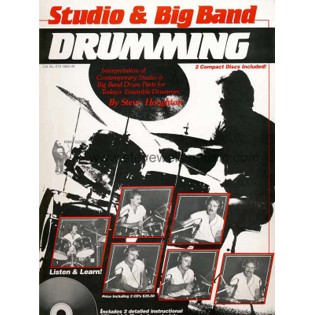
Studio & Big Band Drumming by Steve Houghton - 1985
This has been the definitive book on the subject for almost as long as I've been playing. Includes an essential, very concise but thorough explanation of terms and notation in professional charts. There are one or two page introductions to swing, rock, "Latin" and country styles. The swing section is good, the single page of Latin grooves is pretty dated; people have gotten much more serious about authenticity with those feels since the mid-80's. Probably most important for drummers are the pages on articulating a horn part, the "eighth note rule", and jazz phrasing. There are also many pages of sample ensemble figures, and authentic playalong charts.
College level. 68 pages, with 2 CDs of recorded figures, ensemble passages, and studio charts.
Studio & Big Band Drumming by Steve Houghton - 1985
This has been the definitive book on the subject for almost as long as I've been playing. Includes an essential, very concise but thorough explanation of terms and notation in professional charts. There are one or two page introductions to swing, rock, "Latin" and country styles. The swing section is good, the single page of Latin grooves is pretty dated; people have gotten much more serious about authenticity with those feels since the mid-80's. Probably most important for drummers are the pages on articulating a horn part, the "eighth note rule", and jazz phrasing. There are also many pages of sample ensemble figures, and authentic playalong charts.
College level. 68 pages, with 2 CDs of recorded figures, ensemble passages, and studio charts.
Labels:
best books,
big band,
books,
drums,
fills,
jazz,
Joel Rothman,
Mel Lewis,
reading,
Steve Houghton
Saturday, February 19, 2011
Best books: Like Syncopation
For many years Progressive Steps to Syncopation for the Modern Drummer (better known as just "Syncopation") by Ted Reed was virtually the only drum book I used. As I alluded to in the Joe Cusatis book post, I'm a big advocate of the interpreting-a-melody-line approach to practice, for which Syncopation is basically the Bible. Or Das Kapital, Origin of Species, whatever you like. It does have its limitations, which caused me to look into sources for similar materials. Here is a survey from my library:
Modern Reading Text in 4/4 by Louis Bellson. A classic in its own right. I find the majority of it a little too difficult for daily use- either Bellson is going way outside what is conventional in order to challenge the user, or maybe he is including things more likely to be encountered by horns. I use it primarily for its "10 Syncopated Exercises", which are long exercises similar to the ones in Reed. I haven't devised much in the way of practice methods adapted to the strengths of this book.
Odd Time Reading Text by Louis Bellson and Gil Breines. A thick book dealing with a wide variety of odd meters. There are several pages suitable for Syncopation-type applications, and quite a few more involving triplets and 16ths. Much of it is extremely difficult, in changing or */16 meters, which are frankly of limited value to me.
The Rhythm Book
by Martin Bradfield. Bradfield is a teacher in Pennsylvania who has self-published this book and two accompanying volumes of interpretive methods. Covers roughly the same territory as Syncopation, but with a number of rhythms Reed left out. Maybe the best companion volume of these, and a great value. Highly recommended.
Modern Reading Text in 4/4 by Louis Bellson. A classic in its own right. I find the majority of it a little too difficult for daily use- either Bellson is going way outside what is conventional in order to challenge the user, or maybe he is including things more likely to be encountered by horns. I use it primarily for its "10 Syncopated Exercises", which are long exercises similar to the ones in Reed. I haven't devised much in the way of practice methods adapted to the strengths of this book.
Odd Time Reading Text by Louis Bellson and Gil Breines. A thick book dealing with a wide variety of odd meters. There are several pages suitable for Syncopation-type applications, and quite a few more involving triplets and 16ths. Much of it is extremely difficult, in changing or */16 meters, which are frankly of limited value to me.
The Rhythm Book
by Martin Bradfield. Bradfield is a teacher in Pennsylvania who has self-published this book and two accompanying volumes of interpretive methods. Covers roughly the same territory as Syncopation, but with a number of rhythms Reed left out. Maybe the best companion volume of these, and a great value. Highly recommended.
Subscribe to:
Posts (Atom)