Showing posts with label library. Show all posts

Thursday, August 06, 2020

Syncopation rhythms in 5/4

Hey, who wants some practice rhythms in 5/4? Here are several pages of them. I'm working on a new book, Syncopation in 5/4— companion to my other book Syncopation in 3/4. There are some formatting decisions to be made, mainly to reflect a 2+3 phrasing or a 3+2 phrasing, which I'm working out here. I want the same exercises to be usable in either phrasing, and I think there may not be an ideal solution. Let me know in the comments if there's one version you like for that purpose.


Here's a fresh link to my practice methods for this type of thing. for See also John Ramsay's book The Complete Drummer's Vocabulary.

Get the pdf

Thursday, May 28, 2020

2/4 rhythms to triplets

Companion to the late three voice / four note patterns page, in case it wasn't challenging enough for you. This is to aid in playing those patterns as triplets in 4/4— as you play through, you can figure out how any particular part is supposed to lay in the triplet rhythm:


Get the pdf

Wednesday, September 02, 2015

Rhythms in 7/4

Here's a page of basic rhythms in 7/4 to go with yesterday's practice loop. The vamp on the loop is phrased in 3+2+2/4, so I've given a Ted Reed-style guide part on the bass drum line in that phrasing. 


If you've worked with Ted Reed's book Syncopation at all, or followed this blog, you should know some ways of using these rhythms on the drum set, but here are some ideas anyway. Using this rhythm as an example:


I haven't given a key here, but you probably know that Xs = cymbal, middle line = snare, bottom line = bass drum— if  not, this isn't what you should be working on. Anyway: you could revoice the rhythm between the snare drum and bass drum, in a rock-type phrasing, and play 8th notes (or another rhythm) on the cymbal:


You could play the rhythm on the cymbal, along with a basic rock-type groove on the snare drum and bass drum:


You could play the rhythm with the right hand on the cymbal, along with the bass drum, and fill in the gaps in the rhythm with the left hand on the snare drum (or moving around the drums):


You could play the rhythm with both hands together, on a cymbal and on the snare drum (or on any two drums), and fill in the gaps with the bass drum:


On that last one, where more than two bass drum hits in a row are called for, I'll often break up the multi-note runs by putting a rest in the middle of them. Of course there are many other Reed-style interpretations you can apply to these rhythms.

Get the pdf

Tuesday, July 14, 2015

7/8 rhythms

I got sort of lightly burned at a session recently, when a player pulled up a tune he had written which was in a fast 7/8. I've been working on my odd meters quite a bit in recent years— for the better part of my career I felt they were a relic of the 70s, and not very happening. I was more about finding a lot of freedom in 4/4, 3/4, and 6/8; with the odd meters I felt you were back in the stone age, playing a lot of downbeats. Now everyone's playing them again, and I needed to get them together for real. I thought I was pretty happening with it, until that fast 7/8, which took me a few minutes of fumbling around to find my vocabulary. I still feel the */8 odd meters are a leetle bit jive, as they put a little rhythmic straight jacket on you— you always have to catch the 2+2+3— it's almost a clave— or it falls apart. Maybe I just lack vision.

Or maybe I just need to work on it more. So here are a few basic rhythms in 7/8, in plain form (plus the beat written out, a la Ted Reed), and filled in. The right hand column has the rhythm played on the cymbal, filled out on the snare drum to make running 8th notes.


Get the pdf, and after the break I'll give some ways of using this.

Thursday, May 15, 2014

Partido Alto variations

The partido alto rhythm, in this case; it's also a Brazilian song style, a type of funk groove, and a tune (see below). It's one of the major rhythms in Brazilian music— several of the batucada instruments often play versions of it, as do drums, piano, and guitar in groups with a bossa nova/jazz instrumentation. The basic idea of the rhythm is that there is a series of notes played on the beat, and then several offbeats, usually crossing the bar line. It's become a very important rhythm for me, in all straight 8th note styles.

To illustrate the basic structure of the rhythm, the first set of exercises changes from downbeats to offbeats at the bar line; I can't recall hearing the rhythm played that way repetitively in actual Brazilian music. More often the change happens in the middle of the measure, as in the second and third sets of exercises.


Also play the patterns with the measures reversed. You can use these as the left hand part on a bossa nova, or with both hands in unison on a samba, for starters; you can also build a half time feel funk groove like this— later we'll have more on how to do that:


Get the pdf

Friday, May 02, 2014

Syncopation exercises in 3/4 — 01

This is a straight library piece: some syncopation exercises in 3/4, similar to the one-measure exercises in the middle section of Ted Reed's Syncopation, for doing all of the usual things you do with that book. We'll probably be seeing more of these, soon.


I've kept the format from Reed, with the quarter notes in the bass drum, even though I always ignore that part.

Get the pdf

Sunday, March 24, 2013

Gary Chaffee linear patterns

In the coming days we'll be doing a little extension of a thing found in vol. 3 of Gary Chaffee's Patterns series— an appendix, really— and since that's not an everyday title like Reed or Stone, I need to show you the core of the idea as presented in the book. Patterns is one of the major entries in the literature of drumming to come out of the 1980's. Chaffee was Vinnie Colaiuta's teacher for a time, and seems to have had a big influence on his playing; the books seem very Vinnie, handling a lot of heavy Zappa-esque rhythm. I've been working with them off and on since the later 80's, with periods of years when I'm not able to do much of anything with them.

We'll be working with the linear patterns, found on pp. 40-53; they are three to eight notes long, played with the hands on the drums, and ending in one or two bass drum notes:


The sticking and orchestration on the drums is indeterminate; usually I play them alternating, starting with the right hand, and improvise moving them around the drums. The book presents combinations of these patterns in 16th note and 8th note triplet rhythms in 4/4— for my own practice I've written out the combinations in 3/4 and 5/4, which is what I'll be posting this week.

There's much further exploration of this in the book than I will be doing here, and you will of course want to get these together in 4/4 as well, so it's highly recommended that you buy the book— it really belongs in every serious drummer's library.

Tuesday, March 05, 2013

Basic 16th note rhythms

Have I ever told you I like using the easy parts of Syncopation? Here's part 2 of that library piece from the other day, in this case converting the quarter note exercises to 16th notes in 2/4, presented for no other reason than to flesh out that book a little more fully. And I have a few students who can use it right now.


Get the pdf

Friday, March 01, 2013

Basic 8th note rhythms

This is a straight library piece— I've just transcribed the quarter note exercises from Reed into 8th notes in cut time, which will be more useful to me than the original. This same basic collection of rhythms certainly exists elsewhere, but I like connecting things to Syncopation, and following its format.


The bass drum part is included for the sake of tradition, I guess; I never use the written BD part when working with Reed. At the end I've included the Reed's 16 bar exercise, which is now an 8 bar exercise, but is still called “16 bar exercise”, which is certainly going to be confusing, and I should probably revise that.

Get the pdf

Wednesday, December 19, 2012

Syncopation, Lesson 4, in 5/4

This is really a library piece— I use pp. 10-11 from Syncopation (that's Lesson 4 in the new edition) so many different ways that I wanted to put it into 5/4. We'll be referring to this soon in some other posts, but right now it's just five pages of... potential?


Many of the interpretations we've done before will apply directly to these pages, and some will take some rejiggering. Coming soon...

Get the pdf

Thursday, June 28, 2012

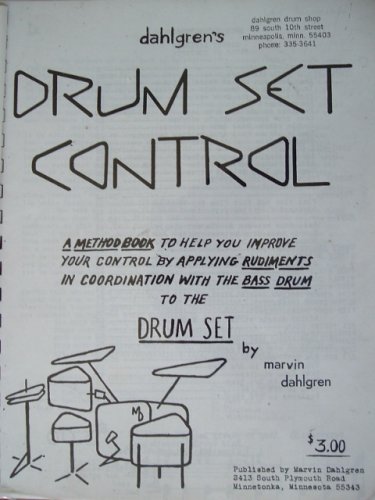
On Marv Dahlgren's prodigious output and the purpose of a library

Three bucks to purchase,
hundreds of hours to master.
As I was idly visiting the Really Good Music Publishing site-- the people, you'll recall, who have reissued several out of print Marvin Dahlgren books- an overwhelming amount of material-- checking to see if they had come out with volume 2 of his Variations on Three Camps book, I discovered that they have not released that book yet. Which is fine, because just the first couple of pages of variations have been dominating my pad practice time since I got the book.

No, that volume has not been released yet. Instead, there are a ten or so other new or reissued Dahlgren books: Drum Set Control in 3/4 Time, Drum Set Control in 5/4 Time, Hihat Control, 16th Note Stickings, Triplet Stickings, Setudes (drum set etudes), and on and on. The man is a machine.

Between all of that, his more famous Four Way Coordination, and his slightly-more-familiar Accent On Accents (Vol. 1 and 2)-- all together more than a lifetime's worth of practice materials; in fact very few drummers could claim to have exhausted the possibilities of any one of those books-- you begin to have to confront the question of the point of it all. Why have on hand piles of books if there is virtually no possibility of ever being able to master them? Why buy more books when you haven't completely learned the ones you have? What the hell are we doing?

A few thoughts on those questions after the break:

Saturday, January 14, 2012

Syncopation exercises with dotted quarter notes

This is one of many pages of original Syncopation variants I've written up, in this case restricted to combinations of dotted quarter notes, quarter notes, and single 8th notes. I've devised a few interpretive methods that work well within that limitation, which I'll be sharing, well, maybe real soon, since it looks like we're having  a few snow days here in Portland...


Get the pdf